


 |
市場調查報告書
商品編碼
2038455
內視鏡消毒市場:商業機會、成長要素、產業趨勢分析及 2026-2035 年預測。Endoscopy Sterilization Market Opportunity, Growth Drivers, Industry Trend Analysis, and Forecast 2026 - 2035 |
||||||

全球內視鏡消毒市場預計到 2025 年價值 15 億美元,預計到 2035 年將以 6.7% 的複合年成長率成長至 29 億美元。
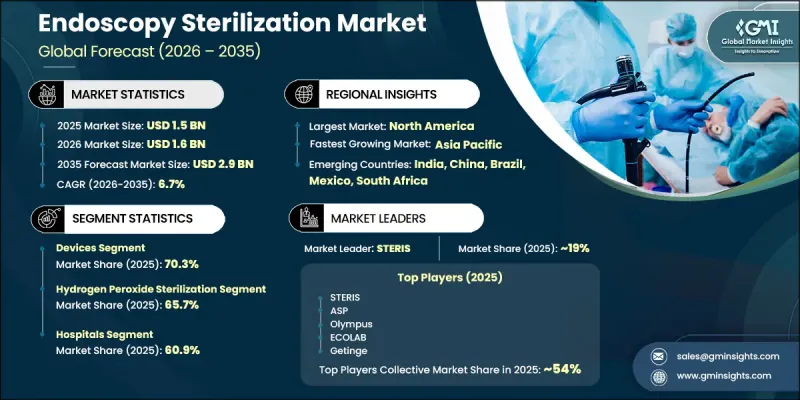
受醫療機構內視鏡檢查數量增加以及對感染預防和患者安全日益重視的推動,該市場正經歷穩步成長。醫院感染發生率的上升顯著增加了臨床環境中對可靠滅菌解決方案的需求。滅菌設備的科技進步以及自動化系統的廣泛應用,進一步加速了市場成長。醫療機構正在加速向先進的再處理解決方案轉型,以確保符合嚴格的衛生標準並提高營運效率。此外,微創手術的日益普及也促使人們對能夠確保醫療器材安全重複使用的有效滅菌系統的需求增加。一次性內視鏡的引進也影響市場動態,並推動滅菌方法的創新。總體而言,在醫療基礎設施的持續技術進步和發展的支持下,該市場正朝著效率、安全和合規性為重點而發展。
| 市場範圍 | |
|---|---|
| 開始年份 | 2025 |
| 預測期 | 2026-2035 |
| 上市時的市場規模 | 15億美元 |
| 預測金額 | 29億美元 |
| 複合年成長率 | 6.7% |
內視鏡滅菌是指在內視鏡器械再次用於醫療程序之前,對其進行嚴格控制,去除所有微生物污染,包括細菌、病毒、真菌和孢子。這個過程對於降低醫療環境中的感染風險、保障病人安全至關重要。它在預防內臟診斷和治療過程中的感染傳播方面也發揮著關鍵作用。隨著微創技術在胃腸病學、整形外科和泌尿系統等專科領域的日益普及,對高效能滅菌方法的需求也日益成長。現代滅菌技術不斷發展,旨在確保臨床工作流程的高效性和可靠性,同時滿足精密醫療設備的滅菌需求。
預計到2025年,設備細分市場將佔據70.3%的市場。這一主導地位主要得益於醫療機構對自動化內視鏡清洗消毒系統和先進滅菌系統的日益普及。對滅菌基礎設施投資的增加進一步推動了對技術先進設備的需求。對高效內視鏡乾燥和儲存系統的需求也促進了該細分市場的成長。醫療機構正在優先考慮滅菌流程的自動化和精準化,這推動了基於先進設備的解決方案的廣泛應用。
預計到2025年,過氧化氫滅菌市佔率將達到65.7%。其主導地位得益於其作為低溫滅菌方法的有效性,尤其適用於對熱敏感的醫療設備。許多內視鏡器械需要溫和而高效的滅菌技術來維持其功能和耐用性。過氧化氫滅菌系統因其快速的循環時間和穩定的滅菌性能,非常適合高需求的醫療環境。其縮短手術間週轉時間的能力使其成為醫院和門診機構的首選,有助於提高工作流程的效率。
美國內視鏡消毒市場預計到2025年將達到5.551億美元,並在2026年至2035年間以5.5%的複合年成長率成長。該國市場成長主要受嚴格的消毒和感染控制法規結構的影響。醫療機構必須遵守嚴格的內視鏡器械清潔和再處理指南,這推動了對先進消毒技術的持續投資。定期檢查和合規要求進一步促進了自動化系統和先進監控解決方案的應用。這些監管壓力,加上對病人安全的重視,持續支撐著該地區市場的穩定擴張。
目錄
第1章:調查方法
- 研究途徑
- 品質改進計劃
- GMI人工智慧政策和資料完整性計劃
- 資訊來源一致性協議
- GMI人工智慧政策和資料完整性計劃
- 調查過程和可靠性評分
- 調查過程的組成部分
- 評分組成部分
- 數據收集
- 主要來源部分列表
- 資料探勘資訊來源
- 付費資訊來源
- 區域資訊來源
- 付費資訊來源
- 基本估算和計算方法
- 每種方法中基準年的計算
- 預測模型
- 量化市場影響分析
- 生長參數對預測的數學影響
- 量化市場影響分析
- 關於調查透明度的補充信息
- 資訊來源歸屬框架
- 品質保證指標
- 對信任的承諾
第2章執行摘要
第3章業界考察
- 生態系分析
- 影響產業的因素
- 促進因素
- 院內感染(HAI)發生率增加
- 滅菌技術的技術進步
- 內視鏡診斷和治療程序數量增加。
- 增加對醫療基礎設施和醫院消毒部門的投資
- 產業潛在風險與挑戰
- 先進滅菌系統高成本
- 再處理程序的複雜性和嚴格的規程要求
- 市場機遇
- 開發先進的自動化滅菌和再處理技術
- 隨著醫療基礎設施的擴建,新興市場的需求正在增加。
- 促進因素
- 成長潛力分析
- 監理情勢(基於初步調查)
- 北美洲
- 歐洲
- 亞太地區
- 科技趨勢
- 當前技術趨勢
- 新興技術
- 未來市場趨勢
- 波特五力分析
- PESTEL 分析
- 客戶洞察(基於初步研究)
- 創業情境(基於初步研究)
- 投資環境(基於初步調查)
- 人工智慧的影響及其未來前景
第4章 競爭情勢
- 介紹
- 企業矩陣分析
- 企業市佔率分析(基於初步研究)
- 世界
- 北美洲
- 歐洲
- 亞太地區
- 競爭定位矩陣
- 主要市場公司的競爭分析
- 主要進展
- 併購
- 夥伴關係與合作
- 新產品發布
- 業務拓展計劃
第5章 市場估價與預測:依產品分類,2022-2035年
- 裝置
- 內視鏡消毒系統
- 內視鏡乾燥、儲存及運送系統
- 其他設備
- 耗材和配件
第6章 市場估算與預測:依滅菌方法分類,2022-2035年
- 過氧化氫滅菌
- 環氧乙烷(EtO)滅菌
- 液體化學滅菌
- 其他滅菌方法
第7章 市場估計與預測:依最終用途分類,2022-2035年
- 醫院
- 門診手術中心
- 其他最終用戶
第8章 市場估計與預測:依地區分類,2022-2035年
- 北美洲
- 美國
- 加拿大
- 歐洲
- 德國
- 英國
- 法國
- 西班牙
- 義大利
- 荷蘭
- 亞太地區
- 中國
- 日本
- 印度
- 澳洲
- 韓國
- 拉丁美洲
- 巴西
- 墨西哥
- 阿根廷
- 中東和非洲
- 南非
- 沙烏地阿拉伯
- 阿拉伯聯合大公國
第9章:公司簡介
- ARC Healthcare Solutions
- ASP
- AURORA
- ECOLAB
- Getinge
- HWAndersen Products
- HUMAN MEDITEK
- Matachana
- MMM Group
- Olympus
- Richard Wolf
- Steelco
- STERIS
- Stryker
- Tuttnauer
The Global Endoscopy Sterilization Market was valued at USD 1.5 billion in 2025 and is estimated to grow at a CAGR of 6.7% to reach USD 2.9 billion by 2035.
The market is experiencing consistent growth driven by the rising volume of endoscopic procedures across healthcare facilities and the increasing emphasis on infection prevention and patient safety. The growing incidence of hospital-acquired infections has significantly strengthened the need for reliable sterilization solutions in clinical environments. Technological advancements in sterilization equipment, coupled with increasing adoption of automated systems, are further accelerating market expansion. Healthcare providers are increasingly shifting toward advanced reprocessing solutions to ensure compliance with strict hygiene standards and improve operational efficiency. Additionally, the rising preference for minimally invasive procedures is contributing to higher demand for effective sterilization systems that ensure safe reuse of medical instruments. The introduction of single-use and disposable endoscopes is also influencing market dynamics, encouraging innovation in sterilization practices. Overall, the market is evolving with a strong focus on efficiency, safety, and regulatory compliance, supported by continuous technological progress and healthcare infrastructure development.
| Market Scope | |
|---|---|
| Start Year | 2025 |
| Forecast Year | 2026-2035 |
| Start Value | $1.5 Billion |
| Forecast Value | $2.9 Billion |
| CAGR | 6.7% |
Endoscopy sterilization refers to the controlled process of eliminating all microbial contamination, including bacteria, viruses, fungi, and spores, from endoscopic instruments prior to reuse in medical procedures. This process is essential in reducing infection risks and maintaining high standards of patient safety in healthcare environments. It plays a critical role in preventing the transmission of infections during diagnostic and therapeutic procedures involving internal organs. The increasing use of minimally invasive techniques across specialties such as gastrointestinal, orthopedic, and urological procedures has further intensified the need for effective sterilization practices. Modern sterilization approaches are evolving to meet the demands of delicate medical instruments while ensuring efficiency and reliability in clinical workflows.
The devices segment held a 70.3% share in 2025. This leadership is primarily supported by the growing adoption of automated endoscope reprocessors and advanced sterilization systems across healthcare facilities. Increasing investment in sterile processing infrastructure has further strengthened demand for technologically advanced devices. The need for efficient drying and storage systems for endoscopes has also contributed to segment growth. Healthcare institutions are prioritizing automation and precision in sterilization workflows, which is reinforcing the widespread adoption of advanced device-based solutions.
The hydrogen peroxide sterilization segment held a 65.7% share in 2025. Its dominance is driven by its effectiveness as a low-temperature sterilization method suitable for heat-sensitive medical instruments. Many endoscopic devices require gentle yet highly efficient sterilization techniques to preserve their functionality and durability. Hydrogen peroxide-based systems offer rapid cycle times and consistent sterilization performance, making them highly suitable for high-demand healthcare settings. Their ability to reduce turnaround time between procedures has made them a preferred choice in hospitals and outpatient facilities, supporting continuous workflow efficiency.
U.S. Endoscopy Sterilization Market reached USD 555.1 million in 2025 and is projected to grow at a CAGR of 5.5% from 2026 to 2035. Market growth in the country is strongly influenced by stringent regulatory frameworks governing sterilization and infection control practices. Healthcare facilities are required to adhere to strict guidelines for cleaning and reprocessing endoscopic instruments, which drives continuous investment in advanced sterilization technologies. Regular inspections and compliance requirements further encourage the adoption of automated systems and advanced monitoring solutions. These regulatory pressures, combined with a strong focus on patient safety, continue to support steady market expansion in the region.
Key companies operating in the Global Endoscopy Sterilization Market include STERIS, Getinge, Olympus, ECOLAB, Stryker, ASP, Steelco, Matachana, Richard Wolf, Tuttnauer, ARC Healthcare Solutions, AURORA, H.W. Andersen Products, HUMAN MEDITEK, and MMM Group. Companies in the Global Endoscopy Sterilization Market are focusing on technological innovation, automation, and product efficiency to strengthen their competitive position. Manufacturers are investing in advanced sterilization technologies that offer faster cycle times and improved safety standards. Expansion of product portfolios with integrated automated reprocessing systems is helping companies address increasing demand from healthcare facilities. Strategic collaborations with hospitals and surgical centers are supporting wider adoption of advanced solutions. Firms are also emphasizing regulatory compliance and certification standards to build trust and ensure market acceptance. Increased focus on research and development is enabling the introduction of more efficient and cost-effective sterilization technologies. Additionally, companies are expanding their global distribution networks and strengthening service capabilities to improve customer support and enhance long-term market presence.
Table of Contents
Chapter 1 Research Methodology
- 1.1 Research approach
- 1.2 Quality commitments
- 1.2.1 GMI AI policy & data integrity commitment
- 1.2.1.1 Source consistency protocol
- 1.2.1 GMI AI policy & data integrity commitment
- 1.3 Research trail & confidence scoring
- 1.3.1 Research trail components
- 1.3.2 Scoring components
- 1.4 Data collection
- 1.4.1 Partial list of primary sources
- 1.5 Data mining sources
- 1.5.1 Paid sources
- 1.5.1.1 Sources, by region
- 1.5.1 Paid sources
- 1.6 Base estimates and calculations
- 1.6.1 Base year calculation for any one approach
- 1.7 Forecast model
- 1.7.1 Quantified market impact analysis
- 1.7.1.1 Mathematical impact of growth parameters on forecast
- 1.7.1 Quantified market impact analysis
- 1.8 Research transparency addendum
- 1.8.1 Source attribution framework
- 1.8.2 Quality assurance metrics
- 1.8.3 Our commitment to trust
Chapter 2 Executive Summary
- 2.1 Industry 360° synopsis
- 2.2 Key market trends
- 2.2.1 Regional trends
- 2.2.2 Product trends
- 2.2.3 Sterilization method trends
- 2.2.4 End use trends
- 2.3 CXO perspectives: Strategic imperatives
Chapter 3 Industry Insights
- 3.1 Industry ecosystem analysis
- 3.2 Industry impact forces
- 3.2.1 Growth drivers
- 3.2.1.1 Rising incidence of hospital-acquired infections (HAIs)
- 3.2.1.2 Technological advancements in sterilization technologies
- 3.2.1.3 Increasing volume of endoscopic diagnostic and therapeutic procedures
- 3.2.1.4 Growing investments in healthcare infrastructure and hospital sterilization departments
- 3.2.2 Industry pitfalls and challenges
- 3.2.2.1 High costs of advanced sterilization systems
- 3.2.2.2 Complexity of reprocessing procedures and strict protocol requirements
- 3.2.3 Market opportunities
- 3.2.3.1 Development of advanced automated sterilization and reprocessing technologies
- 3.2.3.2 Growing demand from emerging markets with expanding healthcare infrastructure
- 3.2.1 Growth drivers
- 3.3 Growth potential analysis
- 3.4 Regulatory landscape (Driven by primary research)
- 3.4.1 North America
- 3.4.2 Europe
- 3.4.3 Asia Pacific
- 3.5 Technology landscape
- 3.5.1 Current technological trends
- 3.5.2 Emerging technologies
- 3.6 Future market trends
- 3.7 Porter's analysis
- 3.8 PESTEL analysis
- 3.9 Customer insights (Driven by primary research)
- 3.10 Start-up scenarios (Driven by primary research)
- 3.11 Investment landscape (Driven by primary research)
- 3.12 Impact of AI and its future assessment
Chapter 4 Competitive Landscape, 2025
- 4.1 Introduction
- 4.2 Company matrix analysis
- 4.3 Company market share analysis (Driven by primary research)
- 4.3.1 Global
- 4.3.2 North America
- 4.3.3 Europe
- 4.3.4 Asia Pacific
- 4.4 Competitive positioning matrix
- 4.5 Competitive analysis of major market players
- 4.6 Key developments
- 4.6.1 Mergers & acquisitions
- 4.6.2 Partnerships & collaborations
- 4.6.3 New product launches
- 4.6.4 Expansion plans
Chapter 5 Market Estimates and Forecast, By Product, 2022 - 2035 ($ Mn)
- 5.1 Key trends
- 5.2 Devices
- 5.2.1 Endoscope sterilization systems
- 5.2.2 Endoscope drying, storage, and transport systems
- 5.2.3 Other devices
- 5.3 Consumables & accessories
Chapter 6 Market Estimates and Forecast, By Sterilization Method, 2022 - 2035 ($ Mn)
- 6.1 Key trends
- 6.2 Hydrogen peroxide sterilization
- 6.3 Ethylene oxide (EtO) sterilization
- 6.4 Liquid chemical sterilization
- 6.5 Other sterilization methods
Chapter 7 Market Estimates and Forecast, By End Use, 2022 - 2035 ($ Mn)
- 7.1 Key trends
- 7.2 Hospitals
- 7.3 Ambulatory surgical centers
- 7.4 Other end users
Chapter 8 Market Estimates and Forecast, By Region, 2022 - 2035 ($ Mn)
- 8.1 Key trends
- 8.2 North America
- 8.2.1 U.S.
- 8.2.2 Canada
- 8.3 Europe
- 8.3.1 Germany
- 8.3.2 UK
- 8.3.3 France
- 8.3.4 Spain
- 8.3.5 Italy
- 8.3.6 Netherlands
- 8.4 Asia Pacific
- 8.4.1 China
- 8.4.2 Japan
- 8.4.3 India
- 8.4.4 Australia
- 8.4.5 South Korea
- 8.5 Latin America
- 8.5.1 Brazil
- 8.5.2 Mexico
- 8.5.3 Argentina
- 8.6 Middle East and Africa
- 8.6.1 South Africa
- 8.6.2 Saudi Arabia
- 8.6.3 UAE
Chapter 9 Company Profiles
- 9.1 ARC Healthcare Solutions
- 9.2 ASP
- 9.3 AURORA
- 9.4 ECOLAB
- 9.5 Getinge
- 9.6 H.W.Andersen Products
- 9.7 HUMAN MEDITEK
- 9.8 Matachana
- 9.9 MMM Group
- 9.10 Olympus
- 9.11 Richard Wolf
- 9.12 Steelco
- 9.13 STERIS
- 9.14 Stryker
- 9.15 Tuttnauer

 內視鏡再處理市場-全球市場預測(2026-2032年)
 內視鏡自動清洗消毒設備市場:依產品類型、模式、最終用戶和地區分類
 2026年全球醫療清潔消毒設備市場報告內視鏡自動消毒設備市場:依產品類型、模式、最終用戶和地區分類
 內視鏡再處理市場報告:按產品、製程、最終用戶和地區分類(2026-2034 年)自動化內視鏡再處理設備市場:2026-2032年全球市場預測(依產品類型、技術、內視鏡類型、最終用戶和通路分類)
 全球內視鏡再處理市場規模、佔有率、趨勢和成長分析報告(2026-2034年)2026年全球內視鏡消毒市場報告
 自動化醫療清潔消毒設備市場分析及預測(至2035年):按類型、產品、技術、應用、最終用戶、流程、組件、功能和安裝類型分類2026-2034年全球自動化內視鏡清洗消毒系統市場規模、佔有率、趨勢及成長分析報告