


 |
市場調查報告書
商品編碼
2038445
2026 年至 2035 年醫療設備分銷服務的市場機會、成長要素、產業趨勢與預測。Medical Device Distribution Services Market Opportunity, Growth Drivers, Industry Trend Analysis, and Forecast 2026 - 2035 |
||||||

2025年全球醫療設備分銷和服務市場價值為517億美元,預計到2035年將以8.3%的複合年成長率成長至1126億美元。
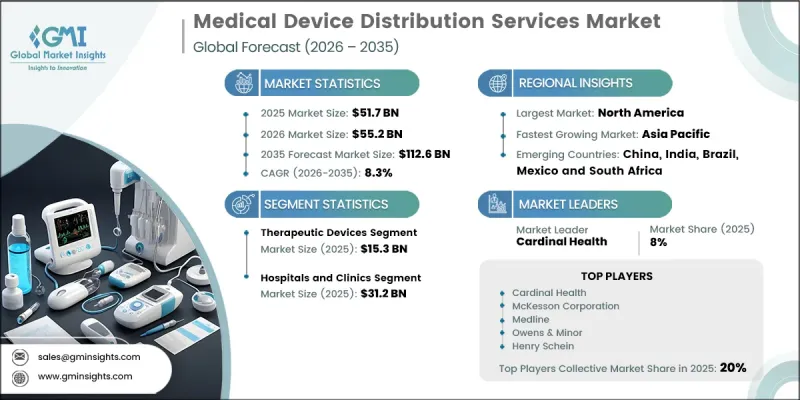
市場擴張的促進因素包括慢性病負擔加重、醫療創新投資增加以及進入醫療生態系統的醫療設備核准數量上升。對包括遠端監測和居家照護在內的先進醫療解決方案的需求,進一步加速了高效分銷網路的建設。醫療技術的不斷進步推動了醫療設備的數量和複雜性成長,導致人們對專業服務供應商的依賴性增強。公共和私營部門資金的增加正在加速診斷、治療和監測解決方案的研發,從而形成穩定的新產品線。隨著供應鏈日益複雜,分銷合作夥伴在管理合規要求、物流營運和庫存管理系統方面發揮著至關重要的作用。他們在連結製造商和醫療服務提供者方面的角色日益重要,有助於保障產品供應穩定,並推動全球市場的永續成長。
| 市場範圍 | |
|---|---|
| 開始年份 | 2025 |
| 預測期 | 2026-2035 |
| 上市時的市場規模 | 517億美元 |
| 預計金額 | 1126億美元 |
| 複合年成長率 | 8.3% |
預計到2025年,治療性醫療設備市場規模將達到153億美元。該領域涵蓋了旨在為整個醫療保健系統提供治療、長期護理和功能支援的廣泛技術。這些器械廣泛應用於各種醫療機構,並在從緊急干預到持續疾病管理的各個環節中發揮至關重要的作用。由於嚴格的處理要求和監管,這些產品的分銷需要高度結構化的供應鏈流程。大多數此類醫療設備屬於較高監管級別,需要符合嚴格的合規標準。因此,分銷服務供應商在確保妥善儲存、運輸和交付的同時,遵守品質和安全規程方面發揮著至關重要的作用。
預計到2025年,醫院和診所領域的市場規模將達到312億美元。醫療機構高度依賴配送服務,以確保基本醫療設備的持續供應,並實現高效的醫療服務和及時的臨床決策。不斷成長的患者群體以及以結果為導向的醫療模式的轉變,推動了對可靠供應鏈支援的需求。配送服務商透過確保醫療環境中產品的穩定供應和最佳化物流運營,為維持患者照護服務的效率和連續性做出了重要貢獻。
預計到2025年,美國醫療設備分銷服務市場規模將達到186億美元,這主要得益於強勁的醫療費用支出和先進醫療技術的廣泛應用。慢性病盛行率的上升進一步推動了對高效分銷網路的需求。此外,日益嚴格的監管要求和醫療保健系統日益複雜化,也使得能夠管理合規性、庫存和及時交付的專業服務供應商的需求不斷成長,從而確保營運效率和患者照護的連續性。
目錄
第1章:調查方法
- 研究途徑
- 品質改進計劃
- GMI人工智慧政策和資料完整性計劃
- 資訊來源一致性協議
- GMI人工智慧政策和資料完整性計劃
- 調查過程和可靠性評分
- 調查過程的組成部分
- 評分組成部分
- 數據收集
- 主要來源部分列表
- 資料探勘資訊來源
- 付費資訊來源
- 區域資訊來源
- 付費資訊來源
- 基本估算和計算方法
- 每種方法中基準年的計算
- 預測模型
- 量化市場影響分析
- 生長參數對預測的數學影響
- 量化市場影響分析
- 關於調查透明度的補充信息
- 資訊來源歸屬框架
- 品質保證指標
- 對信任的承諾
第2章執行摘要
第3章業界考察
- 生態系分析
- 影響產業的因素
- 促進因素
- 慢性病增多
- 研發投入激增,醫療設備認證數量增加
- 對居家醫療和遠端監測的需求日益成長
- 醫療設備技術的進步
- 產業潛在風險與挑戰
- 需要大量的初始資金投入。
- 嚴格的監理合規要求
- 市場機遇
- 線上分銷服務和數位訂購系統的成長
- 擴大公私合營以加強供應鏈
- 促進因素
- 成長潛力分析
- 監理情勢(基於初步調查)
- 北美洲
- 歐洲
- 亞太地區
- 技術趨勢(基於初步調查)
- 目前技術
- 人工智慧(AI)和供應鏈自動化
- 物聯網 (IoT) 用於即時追蹤
- 用於供應鏈模擬的數位雙胞胎
- 新興技術
- 利用5G進行物流和遠端監控
- 自主配送系統
- 目前技術
- 未來市場趨勢(基於初步研究)
- 價格分析(2025 年)(基於初步調查)
- 專利分析(基於初步研究)
- 人工智慧和生成式人工智慧對市場的影響(基於初步研究)
- 波特五力分析
- PESTEL 分析
第4章 競爭情勢
- 介紹
- 企業市佔率分析
- 企業矩陣分析
- 主要市場公司的競爭分析
- 競爭定位矩陣
- 主要進展
- 併購
- 夥伴關係與合作
- 新產品發布
- 業務拓展計劃
第5章 市場估價與預測:依產品分類,2022-2035年
- 診斷設備
- 治療設備
- 病患監測設備
- 居家醫療設備
- 其他醫療設備分銷服務
第6章 市場估算與預測:依最終用途分類,2022-2035年
- 醫院和診所
- 診斷中心
- 門診手術中心(ASC)
- 長期照護機構
- 居家醫療環境
第7章 市場估計與預測:依地區分類,2022-2035年
- 北美洲
- 美國
- 加拿大
- 歐洲
- 德國
- 英國
- 法國
- 西班牙
- 義大利
- 荷蘭
- 亞太地區
- 中國
- 日本
- 印度
- 澳洲
- 韓國
- 拉丁美洲
- 巴西
- 墨西哥
- 阿根廷
- 中東和非洲
- 南非
- 沙烏地阿拉伯
- 阿拉伯聯合大公國
第8章:公司簡介
- Alfresa Holdings Corporation
- Avantor
- Bunzl
- CAN-med Healthcare
- Cardinal Health
- Henry Schein
- KEBOMED Europe
- McKesson Corporation
- Meditek Systems
- Medline
- Owens & Minor
- 帕特森公司
- Soquelec
- Southmedic
- The Stevens Company Limited
The Global Medical Device Distribution Services Market was valued at USD 51.7 billion in 2025 and is estimated to grow at a CAGR of 8.3% to reach USD 112.6 billion by 2035.
Market expansion is driven by the rising burden of chronic conditions, increasing investments in medical innovation, and a growing number of device approvals entering the healthcare ecosystem. Demand for advanced healthcare solutions, including remote monitoring and home-based care, is further accelerating the need for efficient distribution networks. Continuous progress in medical technology is increasing the volume and sophistication of devices, which in turn is intensifying reliance on specialized service providers. Growing financial support from public and private sectors is enabling faster development of diagnostic, therapeutic, and monitoring solutions, leading to a steady pipeline of new products. As the complexity of supply chains increases, distribution partners are becoming essential in managing compliance requirements, logistics operations, and inventory systems. Their role in bridging manufacturers and healthcare providers continues to strengthen, supporting consistent product availability and driving sustained global market growth.
| Market Scope | |
|---|---|
| Start Year | 2025 |
| Forecast Year | 2026-2035 |
| Start Value | $51.7 Billion |
| Forecast Value | $112.6 Billion |
| CAGR | 8.3% |
The therapeutic devices segment generated USD 15.3 billion in 2025. This segment encompasses a wide range of technologies designed for treatment, long-term care, and functional support across healthcare systems. These devices are extensively utilized in various care settings and are critical for both immediate interventions and ongoing disease management. The distribution of such products involves highly structured supply chain processes due to strict handling requirements and regulatory oversight. A large proportion of these devices falls under higher regulatory classifications, which demand rigorous compliance standards. As a result, distribution service providers play a vital role in ensuring proper storage, transportation, and delivery while maintaining adherence to quality and safety protocols.
The hospitals and clinics segment accounted for USD 31.2 billion in 2025. Healthcare facilities rely heavily on distribution services to maintain uninterrupted access to essential medical equipment, enabling efficient care delivery and timely clinical decisions. Increasing patient volumes and the transition toward outcome-focused care models are amplifying the need for reliable supply chain support. Distribution providers contribute significantly by ensuring consistent product availability and optimizing logistics operations within healthcare environments, which is critical for maintaining efficiency and continuity in patient care services.
U.S. Medical Device Distribution Services Market reached USD 18.6 billion in 2025 supported by strong healthcare expenditure and widespread adoption of advanced medical technologies. The growing prevalence of chronic health conditions is further driving demand for efficient distribution networks. Additionally, stringent regulatory requirements and the complexity of healthcare systems are increasing the need for specialized service providers that can manage compliance, inventory, and timely delivery, ensuring operational efficiency and uninterrupted patient care.
Key players operating in the Global Medical Device Distribution Services Market include McKesson Corporation, Cardinal Health, Owens & Minor, Medline, Henry Schein, Patterson Companies, Bunzl, Avantor, Alfresa Holdings Corporation, KEBOMED Europe, CAN-med Healthcare, Meditek Systems, Soquelec, Southmedic, and The Stevens Company Limited. Companies in the Medical Device Distribution Services Market are strengthening their market position through strategic investments in technology, infrastructure, and partnerships. Businesses are focusing on enhancing supply chain efficiency by adopting digital tools, automation, and advanced inventory management systems. Collaborations with manufacturers and healthcare providers are helping expand distribution networks and improve service capabilities. Firms are also investing in compliance frameworks to meet stringent regulatory standards and ensure safe handling of medical devices. Geographic expansion into emerging markets is another key strategy to capture new growth opportunities.
Table of Contents
Chapter 1 Research Methodology
- 1.1 Research approach
- 1.2 Quality commitments
- 1.2.1 GMI AI policy & data integrity commitment
- 1.2.1.1 Source consistency protocol
- 1.2.1 GMI AI policy & data integrity commitment
- 1.3 Research trail & confidence scoring
- 1.3.1 Research trail components
- 1.3.2 Scoring components
- 1.4 Data collection
- 1.4.1 Partial list of primary sources
- 1.5 Data mining sources
- 1.5.1 Paid sources
- 1.5.1.1 Sources, by region
- 1.5.1 Paid sources
- 1.6 Base estimates and calculations
- 1.6.1 Base year calculation for any one approach
- 1.7 Forecast model
- 1.7.1 Quantified market impact analysis
- 1.7.1.1 Mathematical impact of growth parameters on forecast
- 1.7.1 Quantified market impact analysis
- 1.8 Research transparency addendum
- 1.8.1 Source attribution framework
- 1.8.2 Quality assurance metrics
- 1.8.3 Our commitment to trust
Chapter 2 Executive Summary
- 2.1 Industry 360° synopsis
- 2.1.1 Key market trends
- 2.1.2 Product trends
- 2.1.3 End use trends
- 2.1.4 Regional trends
- 2.2 CXO perspectives: Strategic imperatives
Chapter 3 Industry Insights
- 3.1 Industry ecosystem analysis
- 3.2 Industry impact forces
- 3.2.1 Growth drivers
- 3.2.1.1 Growing prevalence of chronic diseases
- 3.2.1.2 Surge in investments for research and growth in medical device approvals
- 3.2.1.3 Rising demand for home healthcare and remote monitoring
- 3.2.1.4 Advancements in medical device technology
- 3.2.2 Industry pitfalls and challenges
- 3.2.2.1 Requirement for high initial capital expenditure
- 3.2.2.2 Presence of stringent regulatory compliance
- 3.2.3 Market opportunity
- 3.2.3.1 Growth in online distribution services and digital ordering system
- 3.2.3.2 Increasing public private partnership to strengthen supply chain
- 3.2.1 Growth drivers
- 3.3 Growth potential analysis
- 3.4 Regulatory landscape (Driven by Primary Research)
- 3.4.1 North America
- 3.4.2 Europe
- 3.4.3 Asia Pacific
- 3.5 Technological landscape (Driven by Primary Research)
- 3.5.1 Current technologies
- 3.5.1.1 Artificial intelligence (AI) and automation in supply chain
- 3.5.1.2 Internet of things (IoT) for real-time tracking
- 3.5.1.3 Digital twins for supply chain simulation
- 3.5.2 Emerging technologies
- 3.5.2.1 5G-enabled logistics and remote monitoring
- 3.5.2.2 Autonomous delivery systems
- 3.5.1 Current technologies
- 3.6 Future market trends (Driven by Primary Research)
- 3.7 Pricing analysis, 2025 (Driven by Primary Research)
- 3.8 Patent analysis (Driven by Primary Research)
- 3.9 Impact of AI and Generative AI on the market (Driven by Primary Research)
- 3.10 Porter's analysis
- 3.11 PESTEL analysis
Chapter 4 Competitive Landscape, 2025
- 4.1 Introduction
- 4.2 Company market share analysis
- 4.3 Company matrix analysis
- 4.4 Competitive analysis of major market players
- 4.5 Competitive positioning matrix
- 4.6 Key developments
- 4.6.1 Merger and acquisition
- 4.6.2 Partnership and collaboration
- 4.6.3 New product launches
- 4.6.4 Expansion plans
Chapter 5 Market Estimates and Forecast, By Product, 2022 - 2035 ($ Mn)
- 5.1 Key trends
- 5.2 Diagnostic devices
- 5.3 Therapeutic devices
- 5.4 Patient monitoring devices
- 5.5 Home healthcare devices
- 5.6 Other device distribution services
Chapter 6 Market Estimates and Forecast, By End Use, 2022 - 2035 ($ Mn)
- 6.1 Key trends
- 6.2 Hospitals and clinics
- 6.3 Diagnostic centers
- 6.4 Ambulatory surgical centers (ASCs)
- 6.5 Long-term care facilities
- 6.6 Homecare settings
Chapter 7 Market Estimates and Forecast, By Region, 2022 - 2035 ($ Mn)
- 7.1 Key trends
- 7.2 North America
- 7.2.1 U.S.
- 7.2.2 Canada
- 7.3 Europe
- 7.3.1 Germany
- 7.3.2 UK
- 7.3.3 France
- 7.3.4 Spain
- 7.3.5 Italy
- 7.3.6 Netherlands
- 7.4 Asia Pacific
- 7.4.1 China
- 7.4.2 Japan
- 7.4.3 India
- 7.4.4 Australia
- 7.4.5 South Korea
- 7.5 Latin America
- 7.5.1 Brazil
- 7.5.2 Mexico
- 7.5.3 Argentina
- 7.6 Middle East and Africa
- 7.6.1 South Africa
- 7.6.2 Saudi Arabia
- 7.6.3 UAE
Chapter 8 Company Profiles
- 8.1 Alfresa Holdings Corporation
- 8.2 Avantor
- 8.3 Bunzl
- 8.4 CAN-med Healthcare
- 8.5 Cardinal Health
- 8.6 Henry Schein
- 8.7 KEBOMED Europe
- 8.8 McKesson Corporation
- 8.9 Meditek Systems
- 8.10 Medline
- 8.11 Owens & Minor
- 8.12 Patterson Companies
- 8.13 Soquelec
- 8.14 Southmedic
- 8.15 The Stevens Company Limited


