

 |
市場調查報告書
商品編碼
2038441
鋁市場機會、成長要素、產業趨勢分析及2026-2035年預測Aluminum Market Opportunity, Growth Drivers, Industry Trend Analysis, and Forecast 2026 - 2035 |
||||||

預計到 2025 年,全球鋁市場價值將達到 1,888 億美元,並預計以 5.9% 的複合年成長率成長,到 2035 年達到 3,338 億美元。
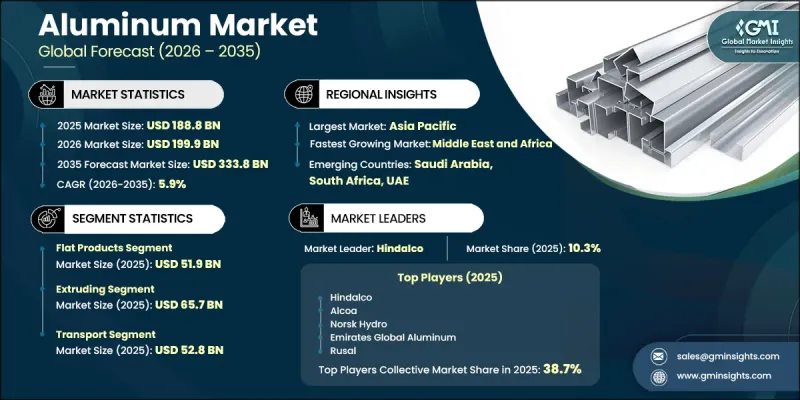
該行業涵蓋了鋁產品的整個價值鏈,包括開採、提煉、加工和分銷,這些產品應用於各種終端行業。由於鋁具有輕質、耐腐蝕、高導電性和優異的成形性等特性,使其適用於廣泛的工業應用,因此其重要性日益凸顯。鋁廣泛應用於建築、交通、包裝、電氣系統和重工業等領域,滿足結構和功能的雙重需求。市場區隔將鋁分為礬土(源自鋁土礦)和再生原生鋁(透過回收製程生產),兩者都對供應穩定性做出了重要貢獻。鋁的生命週期長且可回收利用,強化了其在現代製造業生態系統中的作用,而效率和永續性在現代製造業生態系統中至關重要。在保持強度的前提下追求更輕的材料,這一趨勢正在進一步加速鋁在整個行業中的應用。鋁生產領域的持續技術創新主要旨在提高能源效率、最佳化生產流程並提升材料在所有應用中的整體性能。
| 市場範圍 | |
|---|---|
| 開始年份 | 2025 |
| 預測期 | 2026-2035 |
| 上市時的市場規模 | 1888億美元 |
| 預計金額 | 3338億美元 |
| 複合年成長率 | 5.9% |
預計到2025年,平板產品市場規模將達到519億美元。這主要得益於平板產品在包裝、建築和運輸等行業的廣泛應用,在這些行業中,表面光潔度和成型性是至關重要的因素。此外,由於平板產品能夠很好地適應各種工業流程,因此市場對其需求仍然強勁。
預計到2025年,擠壓鋁材市場規模將達到657億美元,主要得益於其能夠為汽車、建築和電氣設備等應用領域生產客製化的結構型材。軋延工藝廣泛用於製造板材,而擠壓製程則用於生產工程和工業設計中常用的複雜形狀。鑄造工藝對於生產機械和汽車系統中使用的耐用鋁製部件至關重要,而拉拔工藝則用於生產精密管材及相關零件。此外,鍛造鋁製品廣泛應用於交通運輸領域和嚴苛的工業環境中,滿足這些領域對強度和可靠性的要求。
預計到2035年,北美鋁市場規模將從2025年的326億美元成長至601億美元,主要得益於運輸、建築、包裝、回收和電力基礎建設等領域的穩定需求。該地區持續重視永續材料和高效製造程序,從而維持了鋁消費的穩定。在美國,汽車輕量化、飲料包裝需求、基礎設施現代化、可再生能源的普及以及回收系統的擴展等因素都對鋁需求產生了顯著影響,所有這些因素都提升了鋁在工業、商業和消費領域的重要性。
目錄
第1章:調查方法和範圍
第2章執行摘要
第3章業界考察
- 生態系分析
- 供應商情況
- 利潤率
- 每個階段增加的價值
- 影響價值鏈的因素
- 中斷
- 影響產業的因素
- 促進因素
- 交通運輸領域對輕質材料的需求
- 基礎建設和城市建設活動
- 人們越來越關注可回收包裝材料
- 陷阱與挑戰
- 初級生產中高耗能
- 原物料和電力價格波動
- 機會
- 擴大再生鋁生產與回收利用
- 推廣在電動車製造中使用鋁
- 促進因素
- 成長潛力分析
- 監理情勢
- 波特五力分析
- PESTEL 分析
- 科技與創新趨勢
- 當前技術趨勢
- 新興技術
- 價格趨勢
- 按地區
- 依產品
- 未來市場趨勢
- 科技與創新趨勢
- 當前技術趨勢
- 新興技術
- 專利趨勢
- 貿易統計(HS編碼)
- 主要進口國
- 主要出口國
- 永續性和環境方面
- 永續計劃
- 減少廢棄物策略
- 生產中的能源效率
- 環保意識的舉措
- 考慮碳足跡
第4章 競爭情勢
- 介紹
- 企業市佔率分析
- 按地區
- 北美洲
- 歐洲
- 亞太地區
- 拉丁美洲
- 中東和非洲(MEA)
- 按地區
- 企業矩陣分析
- 主要市場公司的競爭分析
- 競爭定位矩陣
- 主要進展
- 併購
- 夥伴關係和聯盟
- 新產品發布
- 業務拓展計劃
第5章 市場估價與預測:依產品分類,2022-2035年
- 平板產品
- 壓製產品
- 鍛造產品
- 長條類產品
- 鑄件
- 其他
第6章 市場估算與預測:依加工方式分類,2022-2035年
- 軋延
- 擠出成型
- 退出
- 鑄件
- 鍛造
第7章 市場估計與預測:依應用領域分類,2022-2035年
- 運輸
- 建造
- 電氣和電子
- 包裝
- 設備和機械
- 耐久性消費品
- 箔材
- 其他
第8章 市場估計與預測:依地區分類,2022-2035年
- 北美洲
- 美國
- 加拿大
- 歐洲
- 德國
- 英國
- 法國
- 西班牙
- 義大利
- 其他歐洲地區
- 亞太地區
- 中國
- 印度
- 日本
- 澳洲
- 韓國
- 亞太其他地區
- 拉丁美洲
- 巴西
- 墨西哥
- 阿根廷
- 其他拉丁美洲地區
- 中東和非洲
- 沙烏地阿拉伯
- 南非
- 阿拉伯聯合大公國
- 其他中東和非洲地區
第9章:公司簡介
- Alcoa
- Zhongxiang Steel Group CO., LTD
- Arconic
- Emirates Global Aluminum
- Hangzhou Century Aluminium
- Hindalco Industries Ltd.
- Hongqiao Group
- JW Aluminium
- Logan Aluminium
- Norsk Hydro
- Rusal
- INALCO Private Limited
The Global Aluminum Market was valued at USD 188.8 billion in 2025 and is estimated to grow at a CAGR of 5.9% to reach USD 333.8 billion by 2035.
The industry covers the full value chain, including extraction, refining, processing, and distribution of aluminum products used across diverse end-use sectors. Aluminum continues to gain strong relevance due to its lightweight nature, corrosion resistance, high electrical conductivity, and excellent formability, making it suitable for a wide range of industrial applications. It is widely used in construction, transportation, packaging, electrical systems, and heavy industrial operations, supporting both structural and functional requirements. The market is segmented into primary aluminum derived from bauxite and secondary aluminum produced through recycling streams, both contributing significantly to supply stability. Its long lifecycle and recyclability strengthen its role in modern manufacturing ecosystems where efficiency and sustainability are key priorities. Growing focus on reducing material weight while maintaining strength has further accelerated its adoption across industries. Ongoing technological advancements in aluminum production are primarily aimed at improving energy efficiency, optimizing manufacturing processes, and enhancing overall material performance across applications.
| Market Scope | |
|---|---|
| Start Year | 2025 |
| Forecast Year | 2026-2035 |
| Start Value | $188.8 Billion |
| Forecast Value | $333.8 Billion |
| CAGR | 5.9% |
The flat products segment accounted for USD 51.9 billion in 2025, supported by their extensive use across packaging, construction, and transportation applications where surface finish quality and formability are critical. Demand for these products remains strong due to their adaptability in multiple industrial processes.
The extruded aluminum segment reached USD 65.7 billion in 2025, driven by its ability to produce customized structural profiles used across automotive, construction, and electrical applications. Rolling processes are widely utilized to manufacture sheets and plates, while extrusion supports complex shapes used in engineering and industrial designs. Casting processes are essential for producing durable aluminum components used in machinery and automotive systems, whereas drawing processes support the production of precision tubing and related components. Forged aluminum products are also widely used in applications requiring high strength and reliability across transportation and heavy-duty industrial environments.
North America Aluminum Market is projected to grow from USD 32.6 billion in 2025 to USD 60.1 billion by 2035, supported by steady demand across transportation, construction, packaging, recycling, and power infrastructure development. The region continues to prioritize sustainable materials and efficient manufacturing practices, contributing to stable aluminum consumption patterns. In the United States, demand is strongly influenced by vehicle lightweighting initiatives, beverage packaging requirements, infrastructure modernization, renewable energy integration, and expanding recycling systems, all of which reinforce aluminum's importance across industrial, commercial, and consumer sectors.
Major players operating in the Global Aluminum Industry are Alcoa, Norsk Hydro, Hindalco Industries Ltd., Emirates Global Aluminum, Rusal, Arconic, JW Aluminium, Logan Aluminium, INALCO Private Limited, Hongqiao Group, Hangzhou Century Aluminium, Zhongxiang Steel Group CO.,LTD. Companies in the Aluminum Market are increasingly focusing on strengthening their production efficiency through advanced smelting technologies and energy-optimized manufacturing systems. Strategic investments in recycling infrastructure are being prioritized to enhance secondary aluminum output and support circular economy goals. Many players are expanding downstream capabilities by developing value-added products tailored for automotive, construction, and packaging industries. Partnerships and long-term supply agreements are being used to stabilize raw material sourcing and ensure consistent demand fulfillment. Digitalization of operations, including smart monitoring and process automation, is improving yield efficiency and reducing operational costs. Firms are also expanding geographically through capacity additions and joint ventures in high-demand regions. Sustainability initiatives, including carbon reduction programs and renewable energy integration in production facilities, are becoming central to competitive positioning.
Table of Contents
Chapter 1 Methodology & Scope
- 1.1 Market scope and definition
- 1.2 Research design
- 1.2.1 Research approach
- 1.2.2 Data collection methods
- 1.3 Data mining sources
- 1.3.1 Global
- 1.3.2 Regional/Country
- 1.4 Base estimates and calculations
- 1.4.1 Base year calculation
- 1.4.2 Key trends for market estimation
- 1.5 Primary research and validation
- 1.5.1 Primary sources
- 1.6 Forecast model
- 1.7 Research assumptions and limitations
Chapter 2 Executive Summary
- 2.1 Industry 360° synopsis
- 2.2 Key market trends
- 2.2.1 Product
- 2.2.2 Processing Method
- 2.2.3 Application
- 2.2.4 Regional
- 2.3 TAM Analysis, 2026-2035
- 2.4 CXO perspectives: Strategic imperatives
- 2.5 Future outlook and strategic recommendations
Chapter 3 Industry Insights
- 3.1 Industry ecosystem analysis
- 3.1.1 Supplier landscape
- 3.1.2 Profit margin
- 3.1.3 Value addition at each stage
- 3.1.4 Factor affecting the value chain
- 3.1.5 Disruptions
- 3.2 Industry impact forces
- 3.2.1 Growth drivers
- 3.2.1.1 Lightweight material demand across transportation sectors
- 3.2.1.2 Infrastructure expansion and urban construction activity
- 3.2.1.3 Increased focus on recyclable packaging materials
- 3.2.2 Pitfalls/challenge
- 3.2.2.1 High energy consumption in primary production
- 3.2.2.2 Volatile raw material and electricity prices
- 3.2.3 Opportunities
- 3.2.3.1 Growing secondary aluminum production and recycling
- 3.2.3.2 Electric vehicle manufacturing supporting aluminum usage
- 3.2.1 Growth drivers
- 3.3 Growth potential analysis
- 3.4 Regulatory landscape
- 3.4.1 North America
- 3.4.2 Europe
- 3.4.3 Asia Pacific
- 3.4.4 Latin America
- 3.4.5 Middle East & Africa
- 3.5 Porter's analysis
- 3.6 PESTEL analysis
- 3.7 Technology and innovation landscape
- 3.7.1 Current technological trends
- 3.7.2 Emerging technologies
- 3.8 Price trends
- 3.8.1 By region
- 3.8.2 By product
- 3.9 Future market trends
- 3.10 Technology and innovation landscape
- 3.10.1 Current technological trends
- 3.10.2 Emerging technologies
- 3.11 Patent landscape
- 3.12 Trade statistics (HS code)
- 3.12.1 Major importing countries
- 3.12.2 Major exporting countries
- 3.13 Sustainability and environmental aspects
- 3.13.1 Sustainable practices
- 3.13.2 Waste reduction strategies
- 3.13.3 Energy efficiency in production
- 3.13.4 Eco-friendly initiatives
- 3.14 Carbon footprint consideration
Chapter 4 Competitive Landscape, 2025
- 4.1 Introduction
- 4.2 Company market share analysis
- 4.2.1 By region
- 4.2.1.1 North America
- 4.2.1.2 Europe
- 4.2.1.3 Asia Pacific
- 4.2.1.4 LATAM
- 4.2.1.5 MEA
- 4.2.1 By region
- 4.3 Company matrix analysis
- 4.4 Competitive analysis of major market players
- 4.5 Competitive positioning matrix
- 4.6 Key developments
- 4.6.1 Mergers & acquisitions
- 4.6.2 Partnerships & collaborations
- 4.6.3 New product launches
- 4.6.4 Expansion plans
Chapter 5 Market Estimates and Forecast, By Product, 2022-2035 (USD Billion) (Kilo Tons)
- 5.1 Key trends
- 5.2 Flat products
- 5.3 Extruded products
- 5.4 Forged products
- 5.5 Long products
- 5.6 Cast products
- 5.7 Others
Chapter 6 Market Estimates and Forecast, By Processing Method, 2022-2035 (USD Billion) (Kilo Tons)
- 6.1 Key trends
- 6.2 Rolling
- 6.3 Extruding
- 6.4 Drawn
- 6.5 Casting
- 6.6 Forging
Chapter 7 Market Estimates and Forecast, By Application, 2022-2035 (USD Billion) (Kilo Tons)
- 7.1 Key trends
- 7.2 Transport
- 7.3 Construction
- 7.4 Electrical & electronics
- 7.5 Packaging
- 7.6 Equipment & machinery
- 7.7 Consumer durables
- 7.8 Foil stock
- 7.9 Others
Chapter 8 Market Estimates and Forecast, By Region, 2022-2035 (USD Billion) (Kilo Tons)
- 8.1 Key trends
- 8.2 North America
- 8.2.1 U.S.
- 8.2.2 Canada
- 8.3 Europe
- 8.3.1 Germany
- 8.3.2 UK
- 8.3.3 France
- 8.3.4 Spain
- 8.3.5 Italy
- 8.3.6 Rest of Europe
- 8.4 Asia Pacific
- 8.4.1 China
- 8.4.2 India
- 8.4.3 Japan
- 8.4.4 Australia
- 8.4.5 South Korea
- 8.4.6 Rest of Asia Pacific
- 8.5 Latin America
- 8.5.1 Brazil
- 8.5.2 Mexico
- 8.5.3 Argentina
- 8.5.4 Rest of Latin America
- 8.6 Middle East and Africa
- 8.6.1 Saudi Arabia
- 8.6.2 South Africa
- 8.6.3 UAE
- 8.6.4 Rest of Middle East and Africa
Chapter 9 Company Profiles
- 9.1 Alcoa
- 9.2 Zhongxiang Steel Group CO., LTD
- 9.3 Arconic
- 9.4 Emirates Global Aluminum
- 9.5 Hangzhou Century Aluminium
- 9.6 Hindalco Industries Ltd.
- 9.7 Hongqiao Group
- 9.8 JW Aluminium
- 9.9 Logan Aluminium
- 9.10 Norsk Hydro
- 9.11 Rusal
- 9.12 INALCO Private Limited

 鋁市場規模、佔有率和成長分析:按產品類型、合金類型、最終用途產業、加工方法、鋁品種和地區分類-2026-2033年產業預測
 2026-2030年全球鋁型材市場
 2026-2030年全球鋁市場
 2026-2030年全球鋁粉、鋁膏及鋁片市場
 鋁系統市場:依製造流程、形狀、產品類型和應用分類-2026-2032年全球市場預測鋁市場:按類型、形狀、原料、等級、加工方法和應用分類-2026-2032年全球市場預測鋁導體市場:依導體類型、絕緣方式、額定電壓和應用分類-2026-2032年全球市場預測
 鋁市場規模、佔有率、成長及全球產業分析:按類型、應用和地區分類的洞察與預測(2026-2034 年)磷酸鋁市場:依形態、等級、應用和分銷管道分類-2026-2032年全球市場預測乙醯丙酮鋁市場:依等級、形態、應用、終端用戶產業和分銷管道分類-2026-2032年全球預測