

 |
市場調查報告書
商品編碼
2038419
私密部位美白產品的市場機會、成長要素、產業趨勢及 2026-2035 年預測。Intimate Lightening Products Market Opportunity, Growth Drivers, Industry Trend Analysis, and Forecast 2026 - 2035 |
||||||

2025年全球私密部位美白產品市值為1.483億美元,預計2035年將以3.1%的複合年成長率成長至2.066億美元。
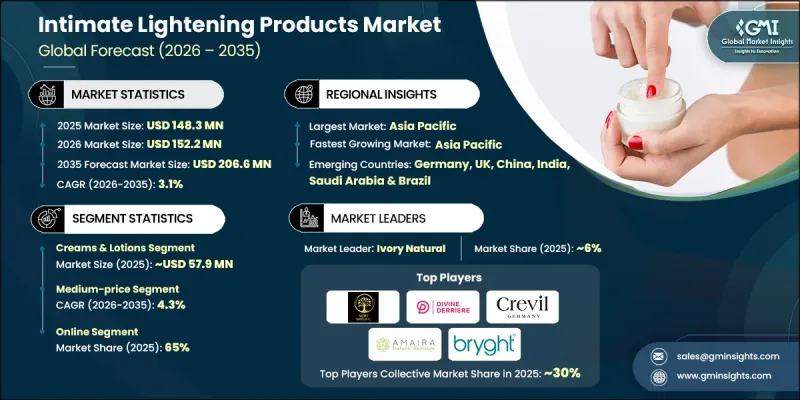
隨著私密護理產品日益融入個人護理流程,成為護膚和提升自信等日常活動的一部分,私人護理行業正經歷著穩定成長。消費者的觀念正在發生顯著轉變,私密美白產品也從小眾品類發展成為高階個人護理領域中廣受歡迎的市場區隔。這項轉變的促進因素包括:數位平台的普及、皮膚科醫生認可度的提高,以及人們對私密部位健康和自我護理意識的增強。因此,這些產品如今已與主流護膚產品並駕齊驅,體現了它們融入現代美學標準。
| 市場範圍 | |
|---|---|
| 開始年份 | 2025 |
| 預測期 | 2026-2035 |
| 上市時的市場規模 | 1.483億美元 |
| 預計金額 | 2.066億美元 |
| 複合年成長率 | 3.1% |
持續的產品創新和針對敏感肌膚需求的專用配方的推出進一步推動了市場成長。製造商致力於研發更安全的成分、提升產品功效,並提供經皮膚科測試的解決方案,以建立消費者信任並促進重複購買。都市化加快、可支配收入增加以及人們對美的觀念轉變也在加速市場擴大,尤其是在新興市場,這些市場更容易受到全球護膚趨勢的影響。有組織的零售和電子商務平台的擴張顯著提高了產品的可及性,使消費者能夠更私密、更便捷地探索更廣泛的產品。此外,消費者對成分透明度和安全認證的日益關注正在改變他們的購買行為,促使他們做出更明智的選擇。這些因素共同創造了一個更結構化和競爭激烈的市場環境,產品品質、安全檢驗和消費者教育在需求形成中發揮核心作用。
預計到2025年,乳霜和乳液市場規模將達到5,790萬美元,並在2026年至2035年間以3.4%的複合年成長率成長。由於消費者越來越偏好溫和有效的配方,以解決敏感部位的膚色和色素沉澱問題,該品類將繼續保持主導地位。消費者對經皮膚科醫生測試、注重皮膚安全性和舒適度、富含天然成分且備受推崇的產品需求日益成長。配方科學的進步,包括改進的輸送機制和穩定技術,正在提升產品的性能和吸收效率。同時,消費者越來越重視永續性,促使品牌採用環保包裝和更透明的原料採購慣例,進一步提升了乳霜和乳液在市場上的吸引力。
預計2026年至2035年,中端價位產品市場將以4.3%的複合年成長率成長。隨著消費者越來越傾向於選擇價格適中且品質優良的產品,該細分市場正蓬勃發展。中產階級的壯大,尤其是在發展中地區,推動了消費者對價格適中但效果顯著的產品的需求。線上零售通路頻繁的促銷活動進一步加速了中端價位產品的滲透,同時各大品牌也積極改進產品配方,以滿足不斷變化的消費者期望。中階價位產品介於低價位和高階產品之間,作為實用的升級選擇,其吸引力日益增強,並推動了不同消費群體的穩定成長。
美國私密部位美白產品市場預計到2025年將達到2,490萬美元,並在2026年至2035年間以2.9%的複合年成長率成長。市場成長的主要驅動力是消費者購買力的增強以及對注重舒適性、安全性和美觀性的高階個人保健產品的強烈偏好。私密部位美白產品正日益被視為更廣泛的健康和自我護理習慣的一部分,這有助於提高產品的接受度。天然成分、環保包裝和潔淨標示產品的受歡迎程度也支撐了市場需求。線上零售通路的擴張進一步提升了產品的可近性,使注重健康的消費者能夠更便捷地購買產品,並擴大產品的經銷範圍。
目錄
第1章:調查方法
- 研究途徑
- 品質改進計劃
- GMI人工智慧政策及對資料完整性的承諾
- 資訊來源一致性協議
- 調查軌跡和置信度評分
- 調查和路線的組成部分
- 評分組成部分
- 數據收集
- 主要來源部分列表
- 資料探勘資訊來源
- 付費資訊來源
- 區域資訊來源
- 付費資訊來源
- 基本估算和計算方法
- 每種方法中基準年的計算
- 預測模型
- 量化市場影響分析
- 生長參數對預測的數學影響
- 關於調查透明度的補充信息
- 資訊來源歸屬框架
- 品質保證指標
- 對信任的承諾
第2章執行摘要
第3章業界考察
- 生態系分析
- 影響價值鏈的因素
- 利潤率分析
- 中斷
- 前景
- 製造商
- 銷售代理
- 零售商
- 影響產業的因素
- 促進因素
- 人們對美容和自我護理的興趣日益濃厚
- 電子商務和私人採購的成長
- 「清潔美容」與向天然成分的轉變
- 產業潛在風險與挑戰
- 嚴格的監管和安全標準
- 增加皮膚刺激和發炎的風險
- 機會
- 私密護理和衛生用品市場的擴張
- 皮膚科和臨床建議
- 促進因素
- 成長潛力分析
- 監理情勢
- 價格分析(基於初步調查)
- 過去價格趨勢分析(基於初步調查)(2022-2025 年)
- 根據業務類型分類的定價策略(高階/價值/成本加成)(基於初步調查)
- 按消費者群體分類的價格彈性分析
- 關鍵市場趨勢與轉型
- 科技與創新趨勢
- 專利趨勢(基於初步調查)
- 專利申請趨勢(2022-2025)
- 按智慧財產權 (IP) 排名的主要專利擁有者
- 創新領域的閒置頻段分析
- 波特五力分析
- PESTEL 分析
- 交易資料分析(基於付費資訊來源)
- 進出口數量和價值趨勢(基於初步調查)
- 主要貿易走廊及關稅影響(基於初步調查)
- 跨境電商分銷趨勢
- 人工智慧和生成式人工智慧對市場的影響
- 人工智慧驅動的產品開發與個人化轉型
- GenAI 應用案例(虛擬膚色配對、處方最佳化、客戶參與)
- 風險、限制和監管考量
- 分銷基礎設施和通路滲透狀況[解決方案核心](基於初步調查)
- 按地區和業態(現代零售與傳統零售)分類的通路覆蓋率[解決方案核心](基於初步調查)
- 最後一公里基礎設施的不足和新的管道轉變(D2C、訂閱模式)(基於初步研究)
第4章 競爭情勢
- 介紹
- 企業市佔率分析
- 按地區
- 企業矩陣分析
- 主要市場公司的競爭分析
- 競爭定位矩陣
- 主要進展
- 併購
- 夥伴關係與合作
- 新產品發布
- 業務拓展計劃
第5章 市場估算與預測:依產品類型分類,2022-2035年
- 乳霜和乳液
- 美容精華液
- 凝膠
- 其他(肥皂等)
第6章 市場估計與預測:依成分分類,2022-2035年
- 天然/有機
- 化學
第7章 市場估計與預測:依價格分類,2022-2035年
- 低的
- 中等的
- 高的
第8章 市場估計與預測:依年齡層別分類,2022-2035年
- 20歲以下
- 20-35歲
- 35-50歲
- 超過50歲
第9章 市場估計與預測:依消費者區隔市場分類,2022-2035年
- 男性
- 女士
第10章 市場估價與預測:依銷售管道分類,2022-2035年
- 線上
- 電子商務
- 企業網站
- 離線
- 大型零售商店
- 專賣店
- 藥局
- 其他(個體商店、傳統商店等)
第11章 市場估價與預測:按地區分類,2022-2035年
- 北美洲
- 美國
- 加拿大
- 歐洲
- 德國
- 英國
- 法國
- 義大利
- 西班牙
- 亞太地區
- 中國
- 印度
- 日本
- 韓國
- 澳洲
- 拉丁美洲
- 巴西
- 墨西哥
- 阿根廷
- 中東和非洲(MEA)
- 沙烏地阿拉伯
- 阿拉伯聯合大公國
- 南非
第12章:公司簡介
- Amaira Natural Skincare
- Bryght
- Buddha Natural
- Bushbalm
- Crevil Cosmetics
- DermalMD
- Divine Derriere
- Gleamin
- Ivory Natural
- Musely
- Pink Privates
- Prana SpaCeuticals(Dermastart)
- Sesderma
- SlimSpaOnline
- WOO WOO
The Global Intimate Lightening Products Market was valued at USD 148.3 million in 2025 and is estimated to grow at a CAGR of 3.1% to reach USD 206.6 million by 2035.
The industry is witnessing steady expansion as personal care routines increasingly incorporate intimate grooming as part of overall skincare and confidence-focused regimens. Consumer perception has shifted notably, with intimate lighting solutions transitioning from a niche category to a widely accepted segment within premium personal care. This change has been reinforced by greater visibility on digital platforms, increasing dermatological acceptance, and a stronger emphasis on intimate wellness and self-care awareness. As a result, these products are now positioned alongside mainstream skincare offerings, reflecting their integration into modern beauty standards.
| Market Scope | |
|---|---|
| Start Year | 2025 |
| Forecast Year | 2026-2035 |
| Start Value | $148.3 Million |
| Forecast Value | $206.6 Million |
| CAGR | 3.1% |
Market growth is further supported by continuous product innovation and the introduction of specialized formulations catering to sensitive skin requirements. Manufacturers are focusing on safer ingredients, improved efficacy, and dermatologically tested solutions to build trust and encourage repeat purchases. Rising urbanization, higher disposable incomes, and evolving beauty perceptions are also accelerating adoption, particularly in emerging economies where exposure to global skincare trends is increasing. The expansion of organized retail and e-commerce platforms has significantly improved accessibility, enabling consumers to explore a wider range of products with enhanced privacy and convenience. Additionally, growing emphasis on ingredient transparency and safety certifications is reshaping purchasing behavior, encouraging more informed decision-making. Together, these factors are creating a more structured and competitive market environment, where product quality, safety validation, and consumer education play a central role in shaping demand.
The creams and lotions segment generated USD 57.9 million in 2025 and is expected to grow at a CAGR of 3.4% from 2026 to 2035. This category continues to lead due to rising consumer preference for mild and effective formulations designed to address uneven skin tone and pigmentation concerns in sensitive areas. Demand is increasing for dermatologist-tested solutions enriched with naturally derived components that prioritize skin safety and comfort. Advances in formulation science, including improved delivery mechanisms and stabilization technologies, are enhancing product performance and absorption efficiency. In parallel, consumers are placing stronger emphasis on sustainability, prompting brands to adopt environmentally responsible packaging and more transparent ingredient sourcing practices, further strengthening the appeal of creams and lotions in this market.
The medium-price segment is projected to expand at a CAGR of 4.3% from 2026 to 2035. This segment is gaining momentum as consumers increasingly prefer products that offer a balance between affordability and higher-quality formulations. A growing middle-income population, particularly in developing regions, is fueling demand for mid-range solutions that deliver reliable performance without premium pricing. Frequent promotional activities across online retail channels are further stimulating adoption, while brands are actively enhancing formulation quality to align with evolving consumer expectations. This positioning between budget and luxury offerings has strengthened its appeal as a practical upgrade option, driving consistent growth across diverse consumer groups.
United States Intimate Lightening Products Market reached USD 24.9 million in 2025 and is expected to grow at a CAGR of 2.9% from 2026 to 2035. Market growth is supported by high consumer spending capacity and a strong preference for advanced personal care solutions that emphasize comfort, safety, and aesthetic enhancement. Intimate lightening products are increasingly viewed as part of broader wellness and self-care routines, contributing to their rising acceptance. Demand is also supported by the growing popularity of natural formulations, eco-conscious packaging, and clean-label product development. The expansion of online retail channels further strengthens accessibility, enabling discreet purchasing and wider product reach among health-conscious consumers.
Major players operating in the Global Intimate Lightening Products Market include Sesderma, Bushbalm, Musely, Crevil Cosmetics, Bryght, Pink Privates, DermalMD, Buddha Natural, WOO WOO, Amaira Natural Skincare, Gleamin, Ivory Natural, SlimSpaOnline, Divine Derriere, and Prana SpaCeuticals (Dermastart). Companies in the Intimate Lightening Products Market are focusing on strengthening their presence through advanced formulation innovation, clinical testing, and dermatological validation to build consumer trust. Strong emphasis is placed on ingredient transparency, safety certifications, and the use of gentle bioactive compounds suitable for sensitive skin. Brands are increasingly investing in research and development to create multifunctional products that combine lightening benefits with hydration and skin repair properties. Digital-first marketing strategies, influencer collaborations, and social media education campaigns are helping expand consumer awareness and normalize product usage. E-commerce optimization, discreet packaging, and subscription-based models are improving customer retention and repeat purchases. Additionally, companies are expanding their product portfolios to include diverse price points, enabling broader market penetration.
Table of Contents
Chapter 1 Research Methodology
- 1.1 Research approach
- 1.2 Quality Commitments
- 1.2.1 GMI AI policy & data integrity commitment
- 1.2.2 Source consistency protocol
- 1.3 Research Trail & Confidence Scoring
- 1.3.1 Research Trail Components
- 1.3.2 Scoring Components
- 1.4 Data Collection
- 1.4.1 Partial list of primary sources
- 1.5 Data mining sources
- 1.5.1 Paid sources
- 1.5.1.1 Sources, by region
- 1.5.1 Paid sources
- 1.6 Base estimates and calculations
- 1.6.1 Base year calculation for any one approach
- 1.7 Forecast model
- 1.7.1 Quantified market impact analysis
- 1.7.2 Mathematical impact of growth parameters on forecast
- 1.8 Research transparency addendum
- 1.8.1 Source attribution framework
- 1.8.2 Quality assurance metrics
- 1.8.3 Our commitment to trust
Chapter 2 Executive Summary
- 2.1 Industry 360° synopsis, 2022 - 2035
- 2.2 Key market trends
- 2.2.1 Regional
- 2.2.2 Product Type
- 2.2.3 Ingredients
- 2.2.4 Price
- 2.2.5 Age Group
- 2.2.6 Consumer Group
- 2.2.7 Distribution Channel
Chapter 3 Industry Insights
- 3.1 Industry ecosystem analysis
- 3.1.1 Factors affecting the value chain
- 3.1.2 Profit margin analysis
- 3.1.3 Disruptions
- 3.1.4 Future outlook
- 3.1.5 Manufacturers
- 3.1.6 Distributors
- 3.1.7 Retailers
- 3.2 Industry Impact forces
- 3.2.1 Growth drivers
- 3.2.1.1 Rising focus on aesthetic grooming & self-care
- 3.2.1.2 Growth of E-commerce & private purchasing
- 3.2.1.3 Shift toward "clean beauty" & natural ingredients
- 3.2.2 Industry pitfalls & challenges
- 3.2.2.1 Strict regulatory scrutiny & safety standards
- 3.2.2.2 High potential for skin sensitivity & irritation
- 3.2.3 Opportunities
- 3.2.3.1 Expanding intimate care hygiene
- 3.2.3.2 Dermatological & clinical endorsements
- 3.2.1 Growth drivers
- 3.3 Growth potential analysis
- 3.4 Regulatory landscape
- 3.5 Pricing analysis (Driven by Primary Research)
- 3.5.1 Historical Price Trend Analysis (Driven by Primary Research) (2022-2025)
- 3.5.2 Pricing Strategy by Player Type (Premium / Value / Cost-Plus) (Driven by Primary Research)
- 3.5.3 Price Elasticity Analysis by Consumer Segment
- 3.6 Major market trends and disruptions
- 3.7 Technological and innovation landscape
- 3.8 Patent Landscape (Driven by Primary Research)
- 3.8.1 Patent Filing Trends (2022-2025)
- 3.8.2 Key Patent Holders by IP Positioning
- 3.8.3 White Space Analysis for Innovation
- 3.9 Porter's analysis
- 3.10 PESTEL analysis
- 3.11 Trade Data Analysis (Driven by Paid Sources)
- 3.11.1 Import/Export Volume & Value Trend (Driven by Primary Research)
- 3.11.2 Key Trade Corridors & Tariff Impact (Driven by Primary Research)
- 3.11.3 Cross-Border E-Commerce Flows
- 3.12 Impact of AI & Generative AI on the Market
- 3.12.1 AI-Driven Disruption of Product Development & Personalization
- 3.12.2 GenAI Use Cases (Virtual Skin Tone Matching, Formulation Optimization, Customer Engagement)
- 3.12.3 Risks, Limitations & Regulatory Considerations
- 3.13 Distribution Infrastructure & Channel Penetration Landscape [SOLUTION CORE] (Driven by Primary Research)
- 3.13.1 Channel Coverage by Region & Format (Modern vs. Traditional Trade) [SOLUTION CORE] (Driven by Primary Research)
- 3.13.2 Last-Mile Infrastructure Gaps & Emerging Channel Shifts (D2C, Subscription Models) (Driven by Primary Research)
Chapter 4 Competitive Landscape, 2025
- 4.1 Introduction
- 4.2 Company market share analysis
- 4.2.1 By region
- 4.2.1.1 North America
- 4.2.1.2 Europe
- 4.2.1.3 Asia Pacific
- 4.2.1.4 Latin America
- 4.2.1.5 Middle East and Africa
- 4.2.1 By region
- 4.3 Company matrix analysis
- 4.4 Competitive analysis of major market players
- 4.5 Competitive positioning matrix
- 4.6 Key developments
- 4.6.1 Mergers & acquisitions
- 4.6.2 Partnerships & collaborations
- 4.6.3 New Product Launches
- 4.6.4 Expansion Plans
Chapter 5 Market Estimates & Forecast, By Product Type, 2022 - 2035, (USD Million) (Thousand Unit)
- 5.1 Key trends
- 5.2 Creams & lotions
- 5.3 Serums
- 5.4 Gels
- 5.5 Others (soaps, etc.)
Chapter 6 Market Estimates & Forecast, By Ingredients, 2022 - 2035, (USD Million) (Thousand Unit)
- 6.1 Key trends
- 6.2 Natural/organic
- 6.3 Chemical
Chapter 7 Market Estimates & Forecast, By Price, 2022 - 2035, (USD Million) (Thousand Unit)
- 7.1 Key trends
- 7.2 Low
- 7.3 Medium
- 7.4 High
Chapter 8 Market Estimates & Forecast, By Age Group, 2022 - 2035, (USD Million) (Thousand Unit)
- 8.1 Key trends
- 8.2 Below 20 Yrs
- 8.3 20-35 Yrs
- 8.4 35-50 Yrs
- 8.5 Above 50 Yrs
Chapter 9 Market Estimates & Forecast, By Consumer Group, 2022 - 2035, (USD Million) (Thousand Unit)
- 9.1 Key trends
- 9.2 Male
- 9.3 Female
Chapter 10 Market Estimates & Forecast, By Distribution Channel, 2022 - 2035, (USD Million) (Thousand Unit)
- 10.1 Key trends
- 10.2 Online
- 10.2.1 E-commerce
- 10.2.2 Company websites
- 10.3 Offline
- 10.3.1 Mega retail stores
- 10.3.2 Specialty stores
- 10.3.3 Pharmacies
- 10.3.4 Others (Individual stores, conventional stores, etc.)
Chapter 11 Market Estimates & Forecast, By Region, 2022 - 2035, (USD Million) (Million Units)
- 11.1 Key trends
- 11.2 North America
- 11.2.1 U.S.
- 11.2.2 Canada
- 11.3 Europe
- 11.3.1 Germany
- 11.3.2 UK
- 11.3.3 France
- 11.3.4 Italy
- 11.3.5 Spain
- 11.4 Asia Pacific
- 11.4.1 China
- 11.4.2 India
- 11.4.3 Japan
- 11.4.4 South Korea
- 11.4.5 Australia
- 11.5 Latin America
- 11.5.1 Brazil
- 11.5.2 Mexico
- 11.5.3 Argentina
- 11.6 MEA
- 11.6.1 Saudi Arabia
- 11.6.2 UAE
- 11.6.3 South Africa
Chapter 12 Company Profiles
- 12.1 Amaira Natural Skincare
- 12.2 Bryght
- 12.3 Buddha Natural
- 12.4 Bushbalm
- 12.5 Crevil Cosmetics
- 12.6 DermalMD
- 12.7 Divine Derriere
- 12.8 Gleamin
- 12.9 Ivory Natural
- 12.10 Musely
- 12.11 Pink Privates
- 12.12 Prana SpaCeuticals (Dermastart)
- 12.13 Sesderma
- 12.14 SlimSpaOnline
- 12.15 WOO WOO

 美白產品市場-2026-2032年全球市場預測
 美白產品市場報告:按產品、性質、性別、分銷管道和地區分類(2026-2034 年)
 美白產品市場規模、佔有率、成長及全球產業分析:按類型、應用和地區分類-2026-2034年洞察與預測全球美白產品市場規模、佔有率、趨勢及成長分析報告(2026-2034)
 全球美白產品市場-產業規模、佔有率、趨勢、機會及預測:依產品類型、天然成分、最終用途、通路、地區及競爭格局分類,2021-2031年
 美白產品市場機會、成長要素、產業趨勢分析及2026年至2035年預測
 美白產品市場規模、佔有率及成長分析(依性質、產品類型、銷售管道、最終用戶及地區分類)-2026-2033年產業預測
 全球私人美白產品市場
 私密美白產品市場,按產品類型、成分、價格、消費者群體、配銷通路、國家和地區分類 - 2025 年至 2032 年全球產業分析、市場規模、市場佔有率及預測