


 |
市場調查報告書
商品編碼
2038385
機器人泳池清潔器市場機會、成長要素、產業趨勢分析及2026-2035年預測Robotic Pool Cleaner Market Opportunity, Growth Drivers, Industry Trend Analysis, and Forecast 2026 - 2035 |
||||||

全球泳池清潔機器人市場預計到 2025 年將價值 11.8 億美元,預計到 2035 年將達到 91.1 億美元,年複合成長率為 23.7%。
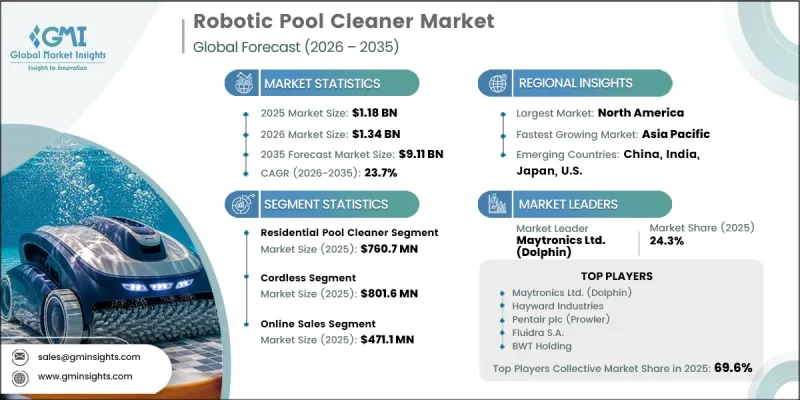
市場擴張的驅動力來自住宅和商業設施中游泳池數量的增加,以及對自動化、低維護成本清潔解決方案日益成長的需求。機器人技術的不斷進步,尤其是在人工智慧和感測器技術方面,顯著提高了產品的效率和操作精度。對節能型泳池維護系統的日益關注,進一步加速了終端用戶領域的應用。隨著智慧技術的日益融合,泳池清潔正轉變為高度自動化且使用者友好的流程。現代機器人清潔器配備智慧導航系統,能夠繪製泳池佈局圖、適應結構變化並偵測障礙物,因此無需人工干預即可徹底清潔。先進的型號利用人工智慧學習功能,隨著時間的推移最佳化清潔路線,在提高性能的同時減少設備磨損。日益增強的環保意識也推動了對節水和化學品用量最小化系統的需求,進一步增強了市場的成長前景。
| 市場範圍 | |
|---|---|
| 開始年份 | 2025 |
| 預測期 | 2026-2035 |
| 上市時的市場規模 | 11.8億美元 |
| 預測金額 | 91.1億美元 |
| 複合年成長率 | 23.7% |
預計2025年,住宅泳池清潔器市場規模將達到7.607億美元。這些系統是專為私人住宅泳池設計的自動化清潔設備。它們融合了智慧導航、吸力系統和壓力驅動機制等先進的機器人技術,能夠有效清除泳池底部、池壁和水面附近的污垢、碎屑和藻類。隨著消費者對便利性、節能性和減少人力勞動的需求日益成長,這些解決方案對尋求智慧泳池維護方案的住宅來說極具吸引力。
預計2025年至2036年,有線吸塵器市場將以19.1%的複合年成長率成長。其高性能、連續運作和具成本效益是推動市場需求的主要因素。這些系統廣泛應用於需要穩定吸力和不間斷清潔循環的大規模場所,尤其適用於高強度清潔環境。
預計到2025年,北美泳池機器人清潔器市佔率將達到39.1%。該地區的成長主要得益於住宅和商業泳池中機器人清潔器的大規模應用,以及消費者對自動化維護解決方案日益成長的興趣。此外,具備節能功能和智慧家庭相容性的AI驅動型機器人清潔器的普及也進一步推動了市場需求。包括線上零售平台、專業泳池商店和銷售管道中心在內的分銷管道的拓展,也促進了市場成長,提高了產品供應量和消費者覆蓋率。
目錄
第1章:調查方法和範圍
第2章執行摘要
第3章業界考察
- 生態系分析
- 供應商情況
- 利潤率
- 成本結構
- 每個階段增加的價值
- 影響價值鏈的因素
- 中斷
- 影響產業的因素
- 促進因素
- 與先進技術、人工智慧和感測器的整合發展。
- 節能環保的泳池清潔方案
- 消費者對智慧家庭解決方案的需求日益成長
- 提高能源效率和環境永續性
- 住宅和商業游泳池安裝數量增加
- 產業潛在風險與挑戰
- 先進機器人泳池清潔器的初始成本很高
- 泳池形狀不規則,對錶面適應性差
- 市場機遇
- 拓展面向住宅游泳池的智慧機器人解決方案
- 商業設施和飯店泳池自動化發展
- 促進因素
- 成長潛力分析
- 監理情勢
- 波特五力分析
- PESTEL 分析
- 科技與創新趨勢
- 當前技術趨勢
- 新興技術
- 價格趨勢
- 按地區
- 依產品
- 定價策略
- 新興經營模式
- 合規要求
- 專利和智慧財產權分析
第4章 競爭情勢
- 介紹
- 企業市佔率分析
- 按地區
- 市場集中度分析
- 主要公司的競爭標竿分析
- 財務績效比較
- 銷售量
- 利潤率
- 研究與發展(R&D)
- 產品系列比較
- 產品線寬度
- 科技
- 創新
- 區域擴張比較
- 全球擴張分析
- 服務網路覆蓋
- 按地區分類的市場滲透率
- 競爭定位矩陣
- 領導者
- 挑戰者
- 追蹤者
- 小眾玩家
- 財務績效比較
- 主要進展
- 併購
- 夥伴關係和聯盟
- 技術進步
- 業務拓展與投資策略
- 數位轉型計劃
- 新興/新創競爭對手的發展趨勢
第5章 市場估計與預測:依連結方式分類,2022-2035年
- 有線機器人
- 無線機器人
第6章 市場估價與預測:依泳池規模分類,2022-2035年
- 小型游泳池(30平方公尺或以下)
- 中型游泳池(30-60平方公尺)
- 大型游泳池(超過60平方公尺)
- 奧林匹克標準泳池
- 其他
第7章 市場估價與預測:依通路分類,2022-2035年
- 線上銷售
- 直接面對消費者 (D2C) 的品牌網站
- 電子商務市場
- 專業線上零售商
- 家居建材商店
- 游泳池用品專賣店
- 直銷
第8章 市場估算與預測:依最終使用者分類,2022-2035年
- 住宅泳池
- 小規模
- 中等的
- 大規模
- 商業游泳池
- 飯店和度假村
- 公共游泳池
- 社區中心
- 教育機構
- 醫療設施
- 其他
- 其他
第9章 市場估計與預測:依地區分類,2022-2035年
- 北美洲
- 美國
- 加拿大
- 歐洲
- 德國
- 英國
- 法國
- 西班牙
- 義大利
- 荷蘭
- 亞太地區
- 中國
- 印度
- 日本
- 澳洲
- 韓國
- 拉丁美洲
- 巴西
- 墨西哥
- 阿根廷
- 中東和非洲
- 南非
- 沙烏地阿拉伯
- 阿拉伯聯合大公國
第10章:公司簡介
- 全球主要公司
- Fluidra SA(Zodiac, Polaris)
- Hayward Industries(TigerShark, AquaVac)
- Maytronics Ltd.(Dolphin)
- Pentair plc(Prowler)
- Fairland Group
- 按地區分類的主要公司
- BWT Holding
- Beatbot
- Water Tech Corp
- Waterco Limited
- 特殊玩家/干擾者
- WEDA Dammann & Westerkamp
- Mariner 3S
- Zucchetti Centro Sistemi
- Milagrow HumanTech
- Paxcess
- Hangzhou Gaoyue Technology
- Wybotics
The Global Robotic Pool Cleaner Market was valued at USD 1.18 billion in 2025 and is estimated to grow at a CAGR of 23.7% to reach USD 9.11 billion by 2035.
Market expansion is driven by the rising number of swimming pools across residential and commercial properties, alongside increasing demand for automated and low-maintenance cleaning solutions. Continuous advancements in robotics, particularly in artificial intelligence and sensor-based technologies, are significantly enhancing product efficiency and operational precision. The growing focus on energy-efficient pool maintenance systems is further accelerating adoption across end-use sectors. Increasing integration of smart technologies is transforming pool cleaning into a highly automated and user-friendly process. Modern robotic cleaners are designed with intelligent navigation systems that map pool layouts, adjust to structural variations, and detect obstacles to ensure complete cleaning coverage without human intervention. Advanced models also leverage AI-based learning capabilities to refine cleaning routes over time, improving performance while reducing equipment wear. Rising environmental awareness is also supporting demand for systems that minimize water and chemical usage, further strengthening market growth prospects.
| Market Scope | |
|---|---|
| Start Year | 2025 |
| Forecast Year | 2026-2035 |
| Start Value | $1.18 Billion |
| Forecast Value | $9.11 Billion |
| CAGR | 23.7% |
The residential pool cleaner segment generated USD 760.7 million in 2025. These systems are automated cleaning devices designed specifically for private residential swimming pools. They incorporate advanced robotic technologies, including intelligent navigation, suction-based systems, and pressure-driven mechanisms to effectively eliminate dirt, debris, and algae from pool floors, walls, and waterlines. Increasing consumer preference for convenience, energy efficiency, and reduced manual effort is making these solutions highly attractive for homeowners seeking smart pool maintenance options.
The corded segment is projected to register growth at a CAGR of 19.1% during 2025 to 2036. Demand is driven by their strong performance capabilities, continuous operation, and cost efficiency. These systems are widely preferred for large-scale installations where consistent suction power and uninterrupted cleaning cycles are required, making them suitable for intensive cleaning environments.
North America Robotic Pool Cleaner Market accounted for 39.1% share in 2025. The region's growth is supported by a large installed base of residential and commercial swimming pools, along with rising consumer inclination toward automated maintenance solutions. Strong adoption of AI-powered robotic cleaners with energy-efficient features and smart home compatibility is further boosting demand. Market expansion is also supported by increasing distribution through online retail platforms, pool specialty stores, and home improvement channels, strengthening accessibility and consumer reach.
Key players in the Global Robotic Pool Cleaner Industry include Hayward Industries (AquaVac, TigerShark), Fluidra S.A. (Polaris, Zodiac), Maytronics Ltd. (Dolphin), Pentair plc (Prowler), Fairland Group, BWT Holding, Beatbot, Waterco Limited, Water Tech Corp, Mariner 3S, WEDA Dammann & Westerkamp, Zucchetti Centro Sistemi, Milagrow HumanTech, Paxcess, Hangzhou Gaoyue Technology, and Wybotics. Companies in the Robotic Pool Cleaner Market are focusing on enhancing product intelligence through advanced AI and sensor integration to improve cleaning accuracy and automation levels. Continuous investment in R&D is enabling the development of energy-efficient and high-performance robotic systems. Manufacturers are expanding product portfolios with smart connectivity features, including app-based control and real-time monitoring capabilities. Strategic partnerships with distributors, e-commerce platforms, and retail networks are strengthening global market penetration. Firms are also prioritizing product durability, improved battery performance, and reduced maintenance requirements to enhance customer satisfaction.
Table of Contents
Chapter 1 Methodology and Scope
- 1.1 Market scope and definition
- 1.2 Research design
- 1.2.1 Research approach
- 1.2.2 Data collection methods
- 1.3 Data mining sources
- 1.3.1 Global
- 1.3.2 Regional/Country
- 1.4 Base estimates and calculations
- 1.4.1 Base year calculation
- 1.4.2 Key trends for market estimation
- 1.5 Primary research and validation
- 1.5.1 Primary sources
- 1.6 Forecast model
- 1.7 Research assumptions and limitations
Chapter 2 Executive Summary
- 2.1 Industry 360° synopsis, 2022 - 2035
- 2.2 Key market trends
- 2.2.1 Connectivity trends
- 2.2.2 Pool Size trends
- 2.2.3 Distribution Channel trends
- 2.2.4 End-user trends
- 2.2.5 Regional trends
- 2.3 CXO perspectives: Strategic imperatives
Chapter 3 Industry Insights
- 3.1 Industry ecosystem analysis
- 3.1.1 Supplier Landscape
- 3.1.2 Profit Margin
- 3.1.3 Cost structure
- 3.1.4 Value addition at each stage
- 3.1.5 Factor affecting the value chain
- 3.1.6 Disruptions
- 3.2 Industry impact forces
- 3.2.1 Growth drivers
- 3.2.1.1 Increasing integration in advanced technology, AI and sensors
- 3.2.1.2 Energy-efficient and eco-friendly pool cleaning solutions
- 3.2.1.3 Increasing consumer demand for smart home solutions
- 3.2.1.4 Enhanced energy efficiency and environmental sustainability
- 3.2.1.5 Rising residential and commercial swimming pool installations
- 3.2.2 Industry pitfalls and challenges
- 3.2.2.1 High initial cost of advanced robotic pool cleaners
- 3.2.2.2 Limited adaptability to irregular pool shapes and surfaces
- 3.2.3 Market opportunities
- 3.2.3.1 Expansion of smart robotic solutions for residential pools
- 3.2.3.2 Growth of commercial and hotel pool automation
- 3.2.1 Growth drivers
- 3.3 Growth potential analysis
- 3.4 Regulatory landscape
- 3.4.1 North America
- 3.4.2 Europe
- 3.4.3 Asia Pacific
- 3.4.4 Latin America
- 3.4.5 Middle East & Africa
- 3.5 Porter's analysis
- 3.6 PESTEL analysis
- 3.7 Technology and Innovation landscape
- 3.7.1 Current technological trends
- 3.7.2 Emerging technologies
- 3.8 Price trends
- 3.8.1 By region
- 3.8.2 By product
- 3.9 Pricing Strategies
- 3.10 Emerging Business Models
- 3.11 Compliance Requirements
- 3.12 Patent and IP analysis
Chapter 4 Competitive Landscape, 2025
- 4.1 Introduction
- 4.2 Company market share analysis
- 4.2.1 By region
- 4.2.1.1 North America
- 4.2.1.2 Europe
- 4.2.1.3 Asia Pacific
- 4.2.1.4 Latin America
- 4.2.1.5 Middle East & Africa
- 4.2.2 Market concentration analysis
- 4.2.1 By region
- 4.3 Competitive benchmarking of key players
- 4.3.1 Financial performance comparison
- 4.3.1.1 Revenue
- 4.3.1.2 Profit margin
- 4.3.1.3 R&D
- 4.3.2 Product portfolio comparison
- 4.3.2.1 Product range breadth
- 4.3.2.2 Technology
- 4.3.2.3 Innovation
- 4.3.3 Geographic presence comparison
- 4.3.3.1 Global footprint analysis
- 4.3.3.2 Service network coverage
- 4.3.3.3 Market penetration by region
- 4.3.4 Competitive positioning matrix
- 4.3.4.1 Leaders
- 4.3.4.2 Challengers
- 4.3.4.3 Followers
- 4.3.4.4 Niche players
- 4.3.1 Financial performance comparison
- 4.4 Key developments
- 4.4.1 Mergers and acquisitions
- 4.4.2 Partnerships and collaborations
- 4.4.3 Technological advancements
- 4.4.4 Expansion and investment strategies
- 4.4.5 Digital transformation initiatives
- 4.5 Emerging/ startup competitors landscape
Chapter 5 Market Estimates and Forecast, By Connectivity, 2022 - 2035 (USD Million)
- 5.1 Key trends
- 5.2 Corded Robotic
- 5.3 Cordless Robotic
Chapter 6 Market Estimates and Forecast, By Pool Size, 2022 - 2035 (USD Million)
- 6.1 Key trends
- 6.2 Small Pools (up to 30m2)
- 6.3 Medium Pools (30-60m2)
- 6.4 Large Pools (above 60m2)
- 6.5 Olympic-size Pools
- 6.6 Others
Chapter 7 Market Estimates and Forecast, By Distribution Channel, 2022 - 2035 (USD Million)
- 7.1 Key trends
- 7.2 Online Sales
- 7.2.1 Brand D2C Websites
- 7.2.2 E-commerce Marketplaces
- 7.2.3 Specialty Online Retailers
- 7.3 Home Improvement Stores
- 7.4 Pool Supply Stores
- 7.5 Direct Sales
Chapter 8 Market Estimates and Forecast, By End User, 2022 - 2035 (USD Million)
- 8.1 Key trends
- 8.2 Residential pool
- 8.2.1 Small
- 8.2.2 Medium
- 8.2.3 Large
- 8.3 Commercial pool
- 8.3.1 Hotels and resorts
- 8.3.2 Public swimming
- 8.3.3 Community centers
- 8.3.4 Educational institutions
- 8.3.5 Healthcare facilities
- 8.3.6 Others
- 8.4 Others
Chapter 9 Market Estimates and Forecast, By Region, 2022 - 2035 (USD Million)
- 9.1 Key trends
- 9.2 North America
- 9.2.1 U.S.
- 9.2.2 Canada
- 9.3 Europe
- 9.3.1 Germany
- 9.3.2 UK
- 9.3.3 France
- 9.3.4 Spain
- 9.3.5 Italy
- 9.3.6 Netherlands
- 9.4 Asia Pacific
- 9.4.1 China
- 9.4.2 India
- 9.4.3 Japan
- 9.4.4 Australia
- 9.4.5 South Korea
- 9.5 Latin America
- 9.5.1 Brazil
- 9.5.2 Mexico
- 9.5.3 Argentina
- 9.6 Middle East and Africa
- 9.6.1 South Africa
- 9.6.2 Saudi Arabia
- 9.6.3 UAE
Chapter 10 Company Profiles
- 10.1 Global Key Players
- 10.1.1 Fluidra S.A. (Zodiac, Polaris)
- 10.1.2 Hayward Industries (TigerShark, AquaVac)
- 10.1.3 Maytronics Ltd. (Dolphin)
- 10.1.4 Pentair plc (Prowler)
- 10.1.5 Fairland Group
- 10.2 Regional key players
- 10.2.1 BWT Holding
- 10.2.2 Beatbot
- 10.2.3 Water Tech Corp
- 10.2.4 Waterco Limited
- 10.3 Niche Players/Disruptors
- 10.3.1 WEDA Dammann & Westerkamp
- 10.3.2 Mariner 3S
- 10.3.3 Zucchetti Centro Sistemi
- 10.3.4 Milagrow HumanTech
- 10.3.5 Paxcess
- 10.3.6 Hangzhou Gaoyue Technology
- 10.3.7 Wybotics

 全球泳池清潔機器人市場規模、佔有率、趨勢和成長分析報告(2026-2034年)
 機器人泳池清潔器市場 - 全球產業規模、佔有率、趨勢、機會、預測:按類型、分銷管道、最終用戶、地區和競爭格局分類,2021-2031年
 自動泳池清潔器市場:依清潔技術、泳池類型、價格範圍、銷售管道和最終用戶分類-2026-2032年全球市場預測全球機器人泳池清潔器市場按產品類型、泳池類型、最終用戶和分銷管道分類,2026-2032年預測智慧泳池清潔設備市場按產品類型、泳池類型、技術、最終用戶和分銷管道分類,全球預測(2026-2032年)機器人泳池清潔器市場規模、佔有率、成長率及全球產業分析:按類型、應用和地區分類,並提供 2026-2034 年的洞察和預測全球泳池清潔機器人市場按分銷管道、最終用戶、泳池類型、電源、清潔技術和過濾類型分類,預測時間:2026-2032年全球自動泳池清潔機器人市場(按泳池類型、最終用途、分銷管道、應用和產品類型分類)預測(2026-2032年)按最終用戶、電源、連接方式、分銷管道和產品類型分類的全球自動泳池吸塵器市場預測(2026-2032年)按產品類型、最終用戶和泳池類型分類的全球自動泳池清潔機器人市場預測(2026-2032)