


 |
市場調查報告書
商品編碼
2038381
製程刀具市場機會、成長要素、產業趨勢分析及2026-2035年預測。Craft Knife Market Opportunity, Growth Drivers, Industry Trend Analysis, and Forecast 2026 - 2035 |
||||||

預計到 2025 年,全球工藝刀具市場價值將達到 4.633 億美元,年複合成長率為 7.2%,到 2035 年將達到 9.215 億美元。
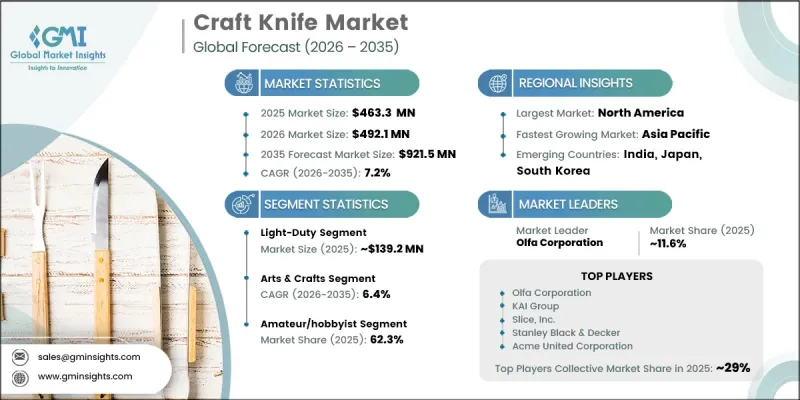
全球對DIY活動、藝術和創新項目的興趣日益濃厚,而精密切割工具在這些活動中扮演著至關重要的角色,這推動了市場成長。隨著手工活動在愛好者和專業人士中持續流行,人們對可靠且用途廣泛的工藝刀的需求也日益成長,這些工藝刀可用於處理紙張、布料、紙板和輕質複合複合材料等各種材料。數位平台的廣泛應用正在加速人們對創新活動的認知和參與,鼓勵人們嘗試各種動手實踐的項目。教育機構和社區計畫也開始採用創造性學習方法,進一步提升了對安全高效切割工具的需求。製造商們積極回應,推出符合人體工學設計、安全性和功能性更強的產品,以滿足不同使用者群體的需求。此外,零售和電子商務分銷通路的拓展也提高了產品的可及性,提供了各種設計和價位的產品,以滿足不同消費者的偏好。
| 市場範圍 | |
|---|---|
| 開始年份 | 2025 |
| 預測期 | 2026-2035 |
| 初始市場規模 | 4.633億美元 |
| 預計金額 | 9.215億美元 |
| 複合年成長率 | 7.2% |
預計到2025年,輕型切割設備市場規模將達到1.392億美元,並在2035年之前以6.1%的複合年成長率成長。此細分市場的成長動力源自於其能夠有效率地使用輕質材料進行精密切割。其易用性、經濟性和多功能性使其適用於從創新項目到一般用途的各種應用。家庭手工和設計活動的日益普及進一步鞏固了該細分市場的領先地位。
預計到2025年,業餘愛好者和興趣愛好者類別將佔據62.3%的市場佔有率,並在2026年至2035年間以6.4%的複合年成長率成長。隨著非專業用戶擴大使用工藝工具進行個人專案和創意活動,該細分市場保持主導地位。對兼具易用性、安全性和精確性的工具的需求,支撐著該類別市場的持續成長,尤其是在人們對創新愛好興趣不斷成長的情況下。
美國工藝刀具市場預計到2025年將達到9,230萬美元,並在2026年至2035年間以6.4%的複合年成長率成長。該國市場成長的主要驅動力來自創新活動、手工愛好以及專業應用領域的強勁需求。消費者傾向於選擇精度高、零件可更換、符合人體工學設計且安全性能卓越的產品。居家創新企業的持續成長以及客製化產品的普及進一步推動了市場需求的穩定。完善的分銷管道,零售商店和數位平台均有銷售,確保了產品的廣泛普及。
目錄
第1章:調查方法和範圍
第2章執行摘要
第3章業界考察
- 生態系分析
- 供應商情況
- 利潤率
- 每個階段增加的價值
- 影響價值鏈的因素
- 影響產業的因素
- 促進因素
- DIY、藝術和手工藝項目在全球範圍內越來越受歡迎。
- 拓展教育與創造性學習領域
- 人體工學和刀片安全性方面的技術進步
- 陷阱與挑戰
- 與鋒利刀片相關的安全隱患
- 透過替代切削工具和數位化製造技術競爭
- 機會
- 對環保和永續刀片材料的需求日益成長
- 開發一套多用途且可自訂的工藝刀具套裝
- 促進因素
- 成長潛力分析
- 未來市場趨勢
- 科技與創新趨勢
- 當前技術趨勢
- 新興技術
- 監理情勢
- 標準和合規要求
- 區域法規結構
- 認證標準
- 波特五力分析
- PESTEL 分析
- 價格分析(基於初步調查)
- 過去價格趨勢分析(基於初步調查)(2019-2024 年)
- 根據業務類型分類的定價策略(高階/價值/成本加成)(基於初步調查)
- 按最終使用者群體進行價格敏感度分析
- 影響價格波動的區域因素
- 貿易資料分析 - HS編碼:8211.93(非固定刀片刀具)(基於付費資料庫)
- 按地區分類的進出口數量和價值趨勢
- 主要貿易走廊和關稅的影響分析
- 貿易政策對定價和市場進入的影響
- 國內生產與進口依賴度的比較
- 生產能力和生產狀況(基於初步調查)
- 按地區和主要生產商分類的製造能力(基於初步調查)
- 運轉率和擴張計劃(基於初步調查)
- 生產技術配置(自動化與人工操作)
- 生產能力限制和瓶頸分析
第4章 競爭情勢
- 介紹
- 企業市佔率分析
- 按地區
- 北美洲
- 歐洲
- 亞太地區
- 拉丁美洲
- 中東和非洲
- 按地區
- 企業矩陣分析
- 主要市場公司的競爭分析
- 競爭定位矩陣
- 主要進展
- 併購
- 夥伴關係與合作
- 新產品發布
- 業務拓展計劃
第5章 市場估算與預測:依產品類型分類,2022-2035年
- 小型汽車
- 中號
- 大的
- 旋轉
- Fingertip
- 其他
第6章 市場估計與預測:依價格分類,2022-2035年
- 低價位
- 中等的
- 高價位範圍
第7章 市場估計與預測:依應用領域分類,2022-2035年
- 藝術與工藝
- 專業設計
- DIY家居
- 教育
- 工業的
- 其他
第8章 市場估算與預測:依最終使用者分類,2022-2035年
- 業餘愛好者/發燒友
- 專業的
第9章 市場估價與預測:依通路分類,2022-2035年
- 線上
- 離線
第10章 市場估價與預測:依地區分類,2022-2035年
- 北美洲
- 美國
- 加拿大
- 歐洲
- 德國
- 英國
- 法國
- 義大利
- 西班牙
- 亞太地區
- 中國
- 印度
- 日本
- 韓國
- 澳洲
- 拉丁美洲
- 巴西
- 墨西哥
- 阿根廷
- 中東和非洲(MEA)
- 沙烏地阿拉伯
- 阿拉伯聯合大公國
- 南非
第11章:公司簡介
- Acme United Corporation
- Dahl北美公司
- Excel Blades
- Fiskars Corporation
- General Tools &Instruments LLC
- Gerber Gear
- KAI Group
- Klein Tools, Inc.
- MARTOR KG
- Milwaukee Tool
- NT Cutter
- Olfa Corporation
- Slice, Inc.
- Stanley Black &Decker
- Tajima Tool
The Global Craft Knife Market was valued at USD 463.3 million in 2025 and is estimated to grow at a CAGR of 7.2% to reach USD 921.5 million by 2035.
Market growth is driven by the rising global interest in do-it-yourself activities, arts, and creative projects, where precision cutting tools play a critical role. As crafting continues to gain popularity among both hobbyists and professionals, demand for reliable and versatile craft knives is increasing across various applications involving materials such as paper, fabric, cardboard, and lightweight composites. The widespread influence of digital platforms has accelerated awareness and participation in creative activities, encouraging individuals to explore hands-on projects. Educational institutions and community programs are also incorporating creative learning approaches, further supporting demand for safe and efficient cutting tools. Manufacturers are responding by introducing ergonomically designed products with enhanced safety and functionality to cater to a diverse user base. Additionally, the expansion of retail and e-commerce distribution channels has improved product accessibility, offering a wide range of designs and price points to meet diverse consumer preferences.
| Market Scope | |
|---|---|
| Start Year | 2025 |
| Forecast Year | 2026-2035 |
| Start Value | $463.3 Million |
| Forecast Value | $921.5 Million |
| CAGR | 7.2% |
The light-duty segment generated USD 139.2 million in 2025 and is expected to grow at a CAGR of 6.1% through 2035. This segment leads the market due to its effectiveness in handling precision-cutting tasks involving lightweight materials. Its user-friendly design, affordability, and versatility make it suitable for a broad range of applications, including creative projects and general-purpose use. The growing participation in home-based crafting and design activities continues to reinforce the dominance of this segment.
The amateur and hobbyist category accounted for 62.3% share in 2025 and is projected to grow at a CAGR of 6.4% during 2026-2035. This segment maintains a leading position as non-professional users increasingly adopt crafting tools for personal projects and creative pursuits. The preference for tools that offer ease of handling, safety, and precision supports sustained demand within this category, particularly as interest in creative hobbies continues to rise.
United States Craft Knife Market reached USD 92.3 million in 2025 and is expected to grow at a CAGR of 6.4% from 2026 to 2035. Market growth in the country is supported by strong demand from creative activities, hobby-based crafting, and professional applications. Consumers show a preference for products that offer precision, replaceable components, ergonomic design, and enhanced safety features. The continued rise of home-based creative businesses and customized product offerings is further contributing to steady demand. Distribution channels remain well-developed, with availability across retail outlets and digital platforms supporting widespread product access.
Key companies operating in the Global Craft Knife Market include Fiskars Corporation, Stanley Black & Decker, Olfa Corporation, NT Cutter, Acme United Corporation, Dahle North America, Excel Blades, Slice Inc., Milwaukee Tool, Tajima Tool, KAI Group, Gerber Gear, Klein Tools Inc., General Tools & Instruments LLC, and MARTOR KG. Companies in the Craft Knife Market are focusing on innovation, product differentiation, and distribution expansion to strengthen their market position. Manufacturers are investing in advanced designs that enhance precision, safety, and user comfort, including ergonomic handles and improved blade mechanisms. Expanding product portfolios to cater to both professional users and hobbyists remains a key strategy. Firms are also leveraging e-commerce platforms and strengthening retail partnerships to increase market reach and accessibility.
Table of Contents
Chapter 1 Methodology & Scope
- 1.1 Market scope and definition
- 1.2 Research design
- 1.2.1 Research approach
- 1.2.2 Data collection methods
- 1.3 Data mining sources
- 1.3.1 Global
- 1.3.2 Regional/Country
- 1.4 Base estimates and calculations
- 1.4.1 Base year calculation
- 1.4.2 Key trends for market estimation
- 1.5 Primary research and validation
- 1.5.1 Primary sources
- 1.6 Forecast model
- 1.7 Research assumptions and limitations
Chapter 2 Executive Summary
- 2.1 Industry 360° synopsis
- 2.2 Key market trends
- 2.2.1 Regional
- 2.2.2 Product type
- 2.2.3 Price
- 2.2.4 Application
- 2.2.5 End user
- 2.2.6 Distribution channel
Chapter 3 Industry Insights
- 3.1 Industry ecosystem analysis
- 3.1.1 Supplier landscape
- 3.1.2 Profit margin
- 3.1.3 Value addition at each stage
- 3.1.4 Factor affecting the value chain
- 3.2 Industry impact forces
- 3.2.1 Growth drivers
- 3.2.1.1 Rising popularity of DIY, arts, and craft projects globally
- 3.2.1.2 Expansion of the educational and creative learning sectors
- 3.2.1.3 Technological advancements in ergonomics and blade safety
- 3.2.2 Pitfalls & Challenges
- 3.2.2.1 Safety concerns associated with sharp blades
- 3.2.2.2 Competition from alternative cutting tools and digital fabrication technologies
- 3.2.3 Opportunities
- 3.2.3.1 Rising demand for eco-friendly and sustainable blade materials
- 3.2.3.2 Development of multipurpose and customizable craft knife sets
- 3.2.1 Growth drivers
- 3.3 Growth potential analysis
- 3.4 Future market trends
- 3.5 Technology and innovation landscape
- 3.5.1 Current technological trends
- 3.5.2 Emerging technologies
- 3.6 Regulatory landscape
- 3.6.1 Standards and compliance requirements
- 3.6.2 Regional regulatory frameworks
- 3.6.3 Certification standards
- 3.7 Porter's analysis
- 3.8 PESTEL analysis
- 3.9 Pricing analysis (driven by primary research)
- 3.9.1 Historical price trend analysis (driven by primary research) (2019-2024)
- 3.9.2 Pricing strategy by player type (premium/value/cost-plus) (driven by primary research)
- 3.9.3 Price sensitivity analysis by end-user segment
- 3.10 Regional price variation factors
- 3.11 Trade data analysis - HS Code: 8211.93 (knives having other than fixed blades)(driven by paid database)
- 3.11.1 Import/export volume & value trends by region
- 3.11.2 Key trade corridors & tariff impact analysis
- 3.11.3 Trade policy impact on pricing & market access
- 3.12 Domestic production vs. import dependency
- 3.13 Capacity & production landscape (driven by primary research)
- 3.13.1 Installed manufacturing capacity by region & key producer (driven by primary research)
- 3.13.2 Capacity utilization rates & expansion pipelines (driven by primary research)
- 3.13.3 Production technology mix (automated vs. manual)
- 3.13.4 Capacity constraints & bottleneck analysis
Chapter 4 Competitive Landscape, 2025
- 4.1 Introduction
- 4.2 Company market share analysis
- 4.2.1 By Region
- 4.2.1.1 North America
- 4.2.1.2 Europe
- 4.2.1.3 Asia Pacific
- 4.2.1.4 Latin America
- 4.2.1.5 Middle East & Africa
- 4.2.1 By Region
- 4.3 Company matrix analysis
- 4.4 Competitive analysis of major market players
- 4.5 Competitive positioning matrix
- 4.6 Key developments
- 4.6.1 Mergers & acquisitions
- 4.6.2 Partnerships & collaborations
- 4.6.3 New product launches
- 4.6.4 Expansion plans
Chapter 5 Market Estimates & Forecast, By Product Type, 2022 - 2035, (USD Million) (Thousand Units)
- 5.1 Key trends
- 5.2 Light-duty
- 5.3 Medium-duty
- 5.4 Heavy-duty
- 5.5 Swivel
- 5.6 Fingertip
- 5.7 Others
Chapter 6 Market Estimates & Forecast, By Price, 2022 - 2035, (USD Million) (Thousand Units)
- 6.1 Key trends
- 6.2 Low
- 6.3 Medium
- 6.4 High
Chapter 7 Market Estimates & Forecast, By Application, 2022 - 2035, (USD Million) (Thousand Units)
- 7.1 Key trends
- 7.2 Arts & Crafts
- 7.3 Professional Design
- 7.4 DIY & Home
- 7.5 Educational
- 7.6 Industrial
- 7.7 Others
Chapter 8 Market Estimates & Forecast, By End User, 2022 - 2035, (USD Million) (Thousand Units)
- 8.1 Key trends
- 8.2 Amateur/Hobbyist
- 8.3 Professional
Chapter 9 Market Estimates & Forecast, By Distribution Channel, 2022 - 2035, (USD Million) (Thousand Units)
- 9.1 Key trends
- 9.2 Online
- 9.3 Offline
Chapter 10 Market Estimates & Forecast, By Region, 2022 - 2035, (USD Million) (Thousand Units)
- 10.1 Key trends
- 10.2 North America
- 10.2.1 U.S.
- 10.2.2 Canada
- 10.3 Europe
- 10.3.1 Germany
- 10.3.2 UK
- 10.3.3 France
- 10.3.4 Italy
- 10.3.5 Spain
- 10.4 Asia Pacific
- 10.4.1 China
- 10.4.2 India
- 10.4.3 Japan
- 10.4.4 South Korea
- 10.4.5 Australia
- 10.5 Latin America
- 10.5.1 Brazil
- 10.5.2 Mexico
- 10.5.3 Argentina
- 10.6 MEA
- 10.6.1 Saudi Arabia
- 10.6.2 UAE
- 10.6.3 South Africa
Chapter 11 Company Profiles
- 11.1 Acme United Corporation
- 11.2 Dahle North America, Inc.
- 11.3 Excel Blades
- 11.4 Fiskars Corporation
- 11.5 General Tools & Instruments LLC
- 11.6 Gerber Gear
- 11.7 KAI Group
- 11.8 Klein Tools, Inc.
- 11.9 MARTOR KG
- 11.10 Milwaukee Tool
- 11.11 NT Cutter
- 11.12 Olfa Corporation
- 11.13 Slice, Inc.
- 11.14 Stanley Black & Decker
- 11.15 Tajima Tool

 飛機電動動器市場:市場機會、成長要素、產業趨勢分析及2026-2035年預測
 全球貸款合規監控市場規模、佔有率、趨勢和成長分析報告(2026-2034年)
 窄體飛機市場規模、佔有率和成長分析:按飛機類型、推進系統、航程、最終用戶、所有權類型、座位容量和地區分類-2026-2033年產業預測
 飛機機隊管理市場預測至2034年-按組件、部署類型、機隊類型、應用、最終用戶和地區分類的全球分析飛機維護分析市場預測至2034年-按組件、分析類型、資料來源、應用、最終用戶和地區分類的全球分析飛機調度管理市場預測至2034年-按組件、部署模式、調度類型、應用、最終用戶和地區分類的全球分析
 通用飛機市場 - 全球產業規模、佔有率、趨勢、機會、預測:旋翼機、固定翼飛機,按應用、地區和競爭格局分類,2021-2031年
 2026年全球窄體飛機市場報告
 貸款合規監控市場規模、佔有率和趨勢分析報告:按組件、部署模式、合規範圍、貸款類型、機構規模、最終用途、地區和細分市場預測(2026-2033 年)
 全球國防抬頭顯示器(HUD)市場