

 |
市場調查報告書
商品編碼
2038374
穿戴式材料市場:商業機會、成長要素、產業趨勢分析及2026-2035年預測Wearable Materials Market Opportunity, Growth Drivers, Industry Trend Analysis, and Forecast 2026 - 2035 |
||||||

2025 年全球穿戴式材料市場價值為 38 億美元,預計到 2035 年將達到 145 億美元,年複合成長率為 14.2%。
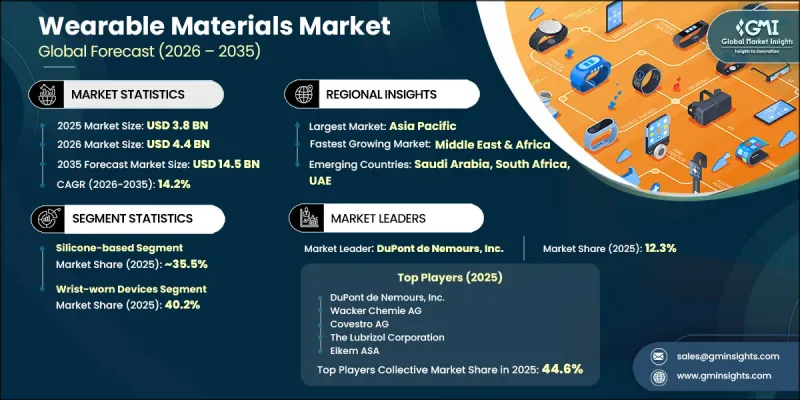
由於先進材料擴大整合到穿戴式技術產品中,並應用於多個終端領域,該行業展現出強勁的發展勢頭。這些材料包括軟性聚合物、導電金屬以及含有導電纖維的紡織品,從而實現了智慧設備的無縫功能。隨著穿戴式科技日益融入日常生活,其在消費性電子、醫療保健、運動和時尚等領域的需求不斷成長。設備功能的持續創新也在塑造市場,使用戶能夠監測身體活動、追蹤健康指標、與虛擬環境互動並個性化數位體驗。日益增強的健康意識和消費者對預防醫學的關注是推動穿戴式解決方案普及的主要成長要素。技術進步使得輕盈、柔軟性和耐用的材料得以開發,這些材料在提升舒適度的同時,也保持了高性能。對個人化、互聯生活方式解決方案日益成長的需求進一步加速了產品開發和市場擴張,為材料創新和應用多元化創造了新的機會。
| 市場範圍 | |
|---|---|
| 開始年份 | 2025 |
| 預測期 | 2026-2035 |
| 上市時的市場規模 | 38億美元 |
| 預計金額 | 145億美元 |
| 複合年成長率 | 14.2% |
預計到2025年,矽膠市佔率將達到35.5%,並在2035年之前以14.4%的複合年成長率成長。該細分市場持續保持主導地位,主要得益於矽膠卓越的柔軟性、耐用性和生物相容性。這些特性使矽膠成為需要與皮膚直接接觸的應用的理想選擇,例如智慧服裝、穿戴式感測器和軟性腕帶配件。矽膠兼具舒適性和機械強度,廣泛應用於先進穿戴式裝置的製造。
預計到2025年,腕戴式設備市佔率將達到40.2%。此類別產品,包括智慧型手錶和健身追蹤設備,因其能夠提供即時健康監測、活動追蹤和通訊功能而備受歡迎。消費者對整合健康洞察和互聯數位體驗日益成長的需求正在推動其普及。這些設備採用輕盈、親膚且耐用的材料,即使長時間佩戴也能確保舒適性。持續的創新和對個人化健康解決方案日益成長的興趣預計將使該細分市場在整個預測期內保持領先地位。
北美穿戴式材料市場價值達9.233億美元,預計2026年至2035年將以13.5%的複合年成長率成長。該地區穿戴式材料市場的成長主要主導消費者對先進穿戴技術的高度接受,以及材料科學和裝置工程的持續創新。專注於健康監測、健身追蹤和生活方式提升解決方案的領先技術開發商的需求不斷成長,也推動了市場的發展。此外,人們對數位健康生態系統的認知不斷提高,以及智慧技術在醫療保健應用中的融合,也進一步促進了全部區域市場的擴張。
目錄
第1章:調查方法和範圍
第2章執行摘要
第3章業界考察
- 生態系分析
- 供應商情況
- 利潤率
- 每個階段增加的價值
- 影響價值鏈的因素
- 中斷
- 影響產業的因素
- 促進因素
- 材料科學與技術的不斷創新正在推動更輕、更柔軟性、更耐用的穿戴式材料的發展。
- 穿戴式裝置在醫療保健、健身、時尚和娛樂等各個領域日益普及和廣泛使用。
- 人們對健康監測、健身追蹤和整體健康的興趣日益濃厚,推動了穿戴式材料的開發和應用。
- 產業潛在風險與挑戰
- 由於技術限制,開發具有柔軟性、耐用性和導電性等理想特性的穿戴式材料可能具有挑戰性。
- 生產先進的穿戴式材料可能涉及高昂的製造成本。
- 市場機遇
- 新興的生物基和永續材料
- 將智慧紡織品融入時尚和生活風格領域
- 促進因素
- 成長潛力分析
- 監理情勢
- 北美洲
- 歐洲
- 亞太地區
- 拉丁美洲
- 中東和非洲
- 波特五力分析
- PESTEL 分析
- 價格趨勢
- 按地區
- 按類型
- 未來市場趨勢
- 科技與創新趨勢
- 當前技術趨勢
- 新興技術
- 專利趨勢
- 貿易統計(HS編碼)
- 主要進口國
- 主要出口國
- 永續性和環境方面
- 永續計劃
- 減少廢棄物策略
- 生產中的能源效率
- 環保意識的舉措
- 考慮碳足跡
第4章 競爭情勢
- 介紹
- 企業市佔率分析
- 按地區
- 北美洲
- 歐洲
- 亞太地區
- 拉丁美洲
- 中東和非洲(MEA)
- 按地區
- 主要市場公司的競爭分析
- 競爭定位矩陣
- 主要進展
- 併購
- 夥伴關係和聯盟
- 新產品發布
- 業務拓展計劃
第5章 市場估計與預測:依類型分類,2022-2035年
- 矽基
- 氟橡膠體系
- 聚氨酯基
- 紡織品
- 金屬
第6章 市場估算與預測:依設備類型分類,2022-2035年
- 腕戴式裝置
- 可聽見的
- 智慧眼鏡產品
- 智慧服飾和服飾
- 人體感測器及貼片
- 智慧珠寶
- 其他
第7章 市場估計與預測:依最終用途產業分類,2022-2035年
- 家用電子電器
- 衛生保健
- 運動與健身
- 工業和軍事
- 娛樂遊戲
- 時尚與生活風格
- 其他
第8章 市場估計與預測:依地區分類,2022-2035年
- 北美洲
- 美國
- 加拿大
- 歐洲
- 德國
- 英國
- 法國
- 西班牙
- 義大利
- 其他歐洲地區
- 亞太地區
- 中國
- 印度
- 日本
- 澳洲
- 韓國
- 亞太其他地區
- 拉丁美洲
- 巴西
- 墨西哥
- 阿根廷
- 其他拉丁美洲地區
- 中東和非洲
- 沙烏地阿拉伯
- 南非
- 阿拉伯聯合大公國
- 其他中東和非洲地區
第9章:公司簡介
- BASF SE
- Arkema SA
- Covestro AG
- DuPont de Nemours, Inc.
- Eastman Chemical Company
- Elkem ASA
- Momentive Performance Materials
- Shin-Etsu Chemical Co., Ltd.
- Solvay SA
- The Lubrizol Corporation
- Wacker Chemie AG
The Global Wearable Materials Market was valued at USD 3.8 billion in 2025 and is estimated to grow at a CAGR of 14.2% to reach USD 14.5 billion by 2035.
The industry is experiencing strong momentum due to the growing integration of advanced materials into wearable technology products used across multiple end-use sectors. These materials include flexible polymers, conductive metals, and textiles embedded with conductive fibers, enabling seamless functionality in smart devices. Demand is expanding across consumer electronics, healthcare, sports, and fashion applications as wearable technology becomes increasingly embedded in everyday life. The market is also being shaped by continuous innovation in device functionality, allowing users to monitor physical activity, track health metrics, interact with virtual environments, and personalize digital experiences. Rising health awareness and increasing consumer interest in preventive healthcare are major growth drivers, encouraging widespread adoption of wearable solutions. Technological progress is enabling the development of lightweight, flexible, and durable materials that enhance comfort while maintaining high performance. Growing demand for personalized and connected lifestyle solutions is further accelerating product development and market expansion, creating new opportunities for material innovation and application diversification.
| Market Scope | |
|---|---|
| Start Year | 2025 |
| Forecast Year | 2026-2035 |
| Start Value | $3.8 Billion |
| Forecast Value | $14.5 Billion |
| CAGR | 14.2% |
The silicone-based segment accounted for a share of 35.5% in 2025 and is projected to grow at a CAGR of 14.4% through 2035. This segment continues to lead due to the material's superior flexibility, durability, and biocompatibility. These properties make silicone highly suitable for applications requiring direct skin contact, including smart garments, wearable sensors, and flexible wrist accessories. Its ability to combine comfort with mechanical strength supports its widespread use in advanced wearable device manufacturing.
The wrist-worn devices segment held a share of 40.2% in 2025. Products in this category, including smartwatches and fitness tracking devices, remain highly popular due to their ability to deliver real-time health monitoring, activity tracking, and communication features. Increasing consumer demand for integrated health insights and connected digital experiences is strengthening adoption. These devices rely on lightweight, skin-friendly, and durable materials that ensure comfort during continuous use. Ongoing innovation and rising interest in personalized wellness solutions are expected to sustain the dominance of this segment over the forecast period.
North America Wearable Materials Market was valued at USD 923.3 million and is projected to grow at a CAGR of 13.5% from 2026 to 2035. The region continues to lead adoption due to strong consumer acceptance of advanced wearable technologies and continuous innovation in material science and device engineering. High demand is driven by leading technology developers focused on health monitoring, fitness tracking, and lifestyle enhancement solutions. Increasing awareness of digital health ecosystems and the integration of smart technologies into healthcare applications are further contributing to market expansion across the region.
Key companies operating in the Global Wearable Materials Industry include BASF SE, Arkema S.A., Covestro AG, DuPont de Nemours, Inc., Eastman Chemical Company, Elkem ASA, Momentive Performance Materials, Shin-Etsu Chemical Co., Ltd., Solvay S.A., The Lubrizol Corporation, and Wacker Chemie AG. Companies in the wearable materials market are strengthening their market position by investing heavily in advanced material innovation focused on flexibility, conductivity, and durability for next-generation wearable devices. Many players are expanding silicone-based and smart textile portfolios to meet rising demand for skin-compatible and lightweight solutions. Strategic collaborations with electronics manufacturers and wearable device brands are being used to accelerate product integration and commercialization. Firms are also prioritizing R&D in conductive polymers and hybrid materials to enhance device performance and energy efficiency. Sustainability-focused initiatives, including recyclable and low-impact material development, are gaining traction.
Table of Contents
Chapter 1 Methodology & Scope
- 1.1 Market scope and definition
- 1.2 Research design
- 1.2.1 Research approach
- 1.2.2 Data collection methods
- 1.3 Data mining sources
- 1.3.1 Global
- 1.3.2 Regional/Country
- 1.4 Base estimates and calculations
- 1.4.1 Base year calculation
- 1.4.2 Key trends for market estimation
- 1.5 Primary research and validation
- 1.5.1 Primary sources
- 1.6 Forecast model
- 1.7 Research assumptions and limitations
Chapter 2 Executive Summary
- 2.1 Industry 360° synopsis
- 2.2 Key market trends
- 2.2.1 Regional
- 2.2.2 Type
- 2.2.3 Device Type
- 2.2.4 End-use industry
- 2.3 TAM Analysis, 2026-2035
- 2.4 CXO perspectives: Strategic imperatives
Chapter 3 Industry Insights
- 3.1 Industry ecosystem analysis
- 3.1.1 Supplier landscape
- 3.1.2 Profit margin
- 3.1.3 Value addition at each stage
- 3.1.4 Factor affecting the value chain
- 3.1.5 Disruptions
- 3.2 Industry impact forces
- 3.2.1 Growth drivers
- 3.2.1.1 Continuous innovations in materials science and technology lead to the development of lighter, more flexible, and durable wearable materials
- 3.2.1.2 Growing popularity and adoption of wearable devices across various sectors such as healthcare, fitness, fashion, and entertainment
- 3.2.1.3 Increasing focus on health monitoring, fitness tracking, and overall wellness encourages the development and utilization of wearable materials
- 3.2.2 Industry pitfalls and challenges
- 3.2.2.1 Developing wearable materials with the desired properties such as flexibility, durability, and conductivity can be challenging due to technological constraints.
- 3.2.2.2 The production of advanced wearable materials may involve high manufacturing costs
- 3.2.3 Market opportunities
- 3.2.3.1 Emerging bio-based & sustainable materials
- 3.2.3.2 Smart textile integration in fashion & lifestyle
- 3.2.1 Growth drivers
- 3.3 Growth potential analysis
- 3.4 Regulatory landscape
- 3.4.1 North America
- 3.4.2 Europe
- 3.4.3 Asia Pacific
- 3.4.4 Latin America
- 3.4.5 Middle East & Africa
- 3.5 Porter's analysis
- 3.6 PESTEL analysis
- 3.7 Price trends
- 3.7.1 By region
- 3.7.2 By type
- 3.8 Future market trends
- 3.9 Technology and innovation landscape
- 3.9.1 Current technological trends
- 3.9.2 Emerging technologies
- 3.10 Patent Landscape
- 3.11 Trade statistics (HS code)
- 3.11.1 Major importing countries
- 3.11.2 Major exporting countries
- 3.12 Sustainability and environmental aspects
- 3.12.1 Sustainable practices
- 3.12.2 Waste reduction strategies
- 3.12.3 Energy efficiency in production
- 3.12.4 Eco-friendly initiatives
- 3.13 Carbon footprint consideration
Chapter 4 Competitive Landscape, 2025
- 4.1 Introduction
- 4.2 Company market share analysis
- 4.2.1 By region
- 4.2.1.1 North America
- 4.2.1.2 Europe
- 4.2.1.3 Asia Pacific
- 4.2.1.4 LATAM
- 4.2.1.5 MEA
- 4.2.1 By region
- 4.3 Competitive analysis of major market players
- 4.4 Competitive positioning matrix
- 4.5 Key developments
- 4.5.1 Mergers & acquisitions
- 4.5.2 Partnerships & collaborations
- 4.5.3 New Product Launches
- 4.5.4 Expansion Plans
Chapter 5 Market Estimates and Forecast, By Type, 2022-2035 (USD Billion) (Kilo Tons)
- 5.1 Key trends
- 5.2 Silicone-based
- 5.3 Fluoroelastomer-based
- 5.4 Polyurethane-based
- 5.5 Textile-based
- 5.6 Metal-based
Chapter 6 Market Estimates and Forecast, By Device Type, 2022-2035 (USD Billion) (Kilo Tons)
- 6.1 Key trends
- 6.2 Wrist-worn devices
- 6.3 Hearables
- 6.4 Smart eyewear
- 6.5 Smart clothing & apparel
- 6.6 Body sensors & patches
- 6.7 Smart jewelry
- 6.8 Others
Chapter 7 Market Estimates and Forecast, By End Use Industry, 2022-2035 (USD Billion) (Kilo Tons)
- 7.1 Key trends
- 7.2 Consumer electronics
- 7.3 Healthcare
- 7.4 Sports and fitness
- 7.5 Industrial and military
- 7.6 Entertainment and gaming
- 7.7 Fashion and lifestyle
- 7.8 Others
Chapter 8 Market Estimates and Forecast, By Region, 2022-2035 (USD Billion) (Kilo Tons)
- 8.1 Key trends
- 8.2 North America
- 8.2.1 U.S.
- 8.2.2 Canada
- 8.3 Europe
- 8.3.1 Germany
- 8.3.2 UK
- 8.3.3 France
- 8.3.4 Spain
- 8.3.5 Italy
- 8.3.6 Rest of Europe
- 8.4 Asia Pacific
- 8.4.1 China
- 8.4.2 India
- 8.4.3 Japan
- 8.4.4 Australia
- 8.4.5 South Korea
- 8.4.6 Rest of Asia Pacific
- 8.5 Latin America
- 8.5.1 Brazil
- 8.5.2 Mexico
- 8.5.3 Argentina
- 8.5.4 Rest of Latin America
- 8.6 Middle East and Africa
- 8.6.1 Saudi Arabia
- 8.6.2 South Africa
- 8.6.3 UAE
- 8.6.4 Rest of Middle East and Africa
Chapter 9 Company Profiles
- 9.1 BASF SE
- 9.2 Arkema S.A.
- 9.3 Covestro AG
- 9.4 DuPont de Nemours, Inc.
- 9.5 Eastman Chemical Company
- 9.6 Elkem ASA
- 9.7 Momentive Performance Materials
- 9.8 Shin-Etsu Chemical Co., Ltd.
- 9.9 Solvay S.A.
- 9.10 The Lubrizol Corporation
- 9.11 Wacker Chemie AG

 穿戴式裝置市場:商業機會、成長要素、產業趨勢分析及2026-2035年預測
 2034年穿戴式裝置人工智慧市場預測:按產品、組件、部署模式、應用和區域分類的全球分析
 2026年全球運動心理服務市場報告
 穿戴式材料市場規模、佔有率和成長分析:按材料類型、技術、應用、最終用戶和地區分類-2026-2033年產業預測
 全球穿戴式材料市場規模、佔有率、趨勢和成長分析報告(2026-2034年)
 人工智慧穿戴裝置市場按產品類型、應用和消費者分類-2026-2032年全球預測AI眼鏡市場:2025-2030年全球預測(按用戶互動模式、電源、連接性、應用和分銷管道)智慧眼鏡市場按類型、組件、連接性、設計、輸入介面和分銷管道分類—全球預測,2025-2030 年
 2025-2029年全球智慧穿戴健身及運動設備及服務市場
 2025-2029年穿戴式裝置全球市場