


 |
市場調查報告書
商品編碼
2038361
拖車預浸料市場業務機會、成長要素、產業趨勢分析及 2026-2035 年預測。Tow Prepreg Market Opportunity, Growth Drivers, Industry Trend Analysis, and Forecast 2026 - 2035 |
||||||

2025 年全球拖曳預浸料市場規模預計為 4.167 億美元,預計到 2035 年將達到 13 億美元,年複合成長率為 12.3%。
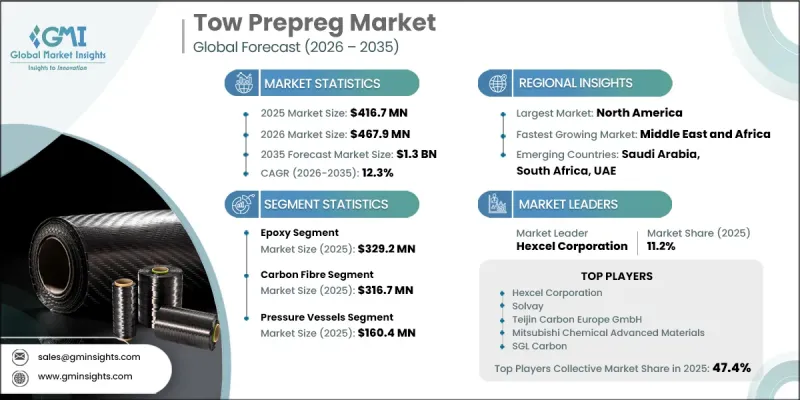
該行業的核心在於工程材料的製造,其原理是將連續纖維束浸漬在可控樹脂含量的樹脂中,使製造商能夠高精度地生產複合材料。這些材料旨在確保纖維取向一致、樹脂分佈均勻,並在整個製造過程中保持可靠的機械性能。纖維束預浸料廣泛用於碳纖維、玻璃纖維和醯胺纖維與熱固性或熱塑性樹脂體系的結合,為先進工程應用提供了廣泛的靈活性。隨著樹脂化學的不斷創新以及與自動化製造的兼容性,市場正在不斷發展,並能夠與現代生產系統無縫整合。這些進步提高了效率,減少了材料浪費,並確保了品質的可重複性。隨著輕量化結構、最佳化材料利用和可擴展的生產流程成為各行業的優先事項,市場需求持續成長。纖維束預浸料透過精確放置和最大限度地減少人工干預,為複雜複合材料的生產提供了支持。對高性能材料的日益關注,以及對製程一致性和提高營運效率的需求,正在推動纖維束預浸料市場整體的持續擴張。
| 市場範圍 | |
|---|---|
| 開始年份 | 2025 |
| 預測期 | 2026-2035 |
| 上市時的市場規模 | 4.167億美元 |
| 預測市場規模 | 13億美元 |
| 複合年成長率 | 12.3% |
預計到2025年,環氧樹脂市場規模將達到3.292億美元,主要得益於其卓越的性能和在複合材料製造中的廣泛應用。環氧樹脂絲束預浸料因其結構強度高、固化性能可控以及與自動化系統的兼容性而備受青睞。環氧樹脂配方的不斷改進提升了其儲存穩定性、黏合性能和加工柔軟性,使其適用於各種工業應用。這些改進使製造商能夠在維持高品質生產標準的同時,提高複合材料生產的一致性和效率。
預計到2025年,壓力容器市場規模將達到1.604億美元,反映出絲束預浸料的廣泛應用。這些材料因其能夠實現精確的纏繞成型製程並控制結構完整性而被廣泛採用。該領域受益於纖維取向的一致性、樹脂分佈的最佳化以及可靠的加工技術,這些優勢有助於提高材料在嚴苛條件下的耐久性和性能。絲束預浸料能夠在提供均勻機械性能的同時支援高效的生產流程,這持續推動其在該領域的應用。
預計北美絲束預浸料市場規模將從2025年的1.396億美元成長至2035年的4.168億美元。在先進製造能力和對高性能複合材料日益成長的需求的推動下,該地區絲束預浸料市場正穩步發展。完善的工業基礎設施和對自動化的重視支撐著穩定的需求。製造商致力於維持生產效率、遵守認證標準並確保可靠的供應鏈,以支援長期業務營運。對高精度材料和擴充性生產流程日益成長的需求進一步增強了該地區的市場前景。
目錄
第1章:調查方法和範圍
第2章執行摘要
第3章業界考察
- 生態系分析
- 供應商情況
- 利潤率
- 每個階段增加的價值
- 影響價值鏈的因素
- 中斷
- 影響產業的因素
- 促進因素
- 自動化製造的擴張
- 複合材料品質穩定性的必要性
- 各行業對輕質材料的需求
- 陷阱與挑戰
- 高昂的材料運輸和倉儲成本
- 傳統製造業意識薄弱
- 機會
- 擴大自動光纖鋪放(AFP)技術的應用
- 可回收預浸料的開發
- 促進因素
- 成長潛力分析
- 監理情勢
- 北美洲
- 歐洲
- 亞太地區
- 拉丁美洲
- 中東和非洲
- 波特五力分析
- PESTEL 分析
- 科技與創新趨勢
- 當前技術趨勢
- 新興技術
- 價格趨勢
- 按地區
- 依樹脂類型
- 未來市場趨勢
- 專利趨勢
- 貿易統計(HS編碼)
- 主要進口國
- 主要出口國
- 永續性和環境方面
- 永續計劃
- 減少廢棄物策略
- 生產中的能源效率
- 環保意識的舉措
- 考慮碳足跡
第4章 競爭情勢
- 介紹
- 企業市佔率分析
- 按地區
- 北美洲
- 歐洲
- 亞太地區
- 拉丁美洲
- 中東和非洲(MEA)
- 按地區
- 企業矩陣分析
- 主要市場公司的競爭分析
- 競爭定位矩陣
- 主要進展
- 併購
- 夥伴關係和聯盟
- 新產品發布
- 業務拓展計劃
第5章 市場估算與預測:依樹脂類型分類,2022-2035年
- 環氧樹脂
- 酚醛樹脂
第6章 市場估算與預測:依紡織品類型分類,2022-2035年
- 碳纖維
- 玻璃纖維
第7章 市場估計與預測:依應用領域分類,2022-2035年
- 壓力容器
- 氧氣罐
- 潛水氣瓶
- 其他
第8章 市場估計與預測:依地區分類,2022-2035年
- 北美洲
- 美國
- 加拿大
- 歐洲
- 德國
- 英國
- 法國
- 西班牙
- 義大利
- 其他歐洲地區
- 亞太地區
- 中國
- 印度
- 日本
- 澳洲
- 韓國
- 亞太其他地區
- 拉丁美洲
- 巴西
- 墨西哥
- 阿根廷
- 其他拉丁美洲地區
- 中東和非洲
- 沙烏地阿拉伯
- 南非
- 阿拉伯聯合大公國
- 其他中東和非洲地區
第9章:公司簡介
- Axiom Materials
- Solvay
- ENEOS Techno Material Corporation
- Hexcel Corporation
- Mitsubishi Chemical Advanced Materials
- Gurit Services AG, Zurich
- Renegade Materials Corporation
- SGL Carbon
- 帝人碳素歐洲有限公司
- Park Aerospace Corp
The Global Tow Prepreg Market was valued at USD 416.7 million in 2025 and is estimated to grow at a CAGR of 12.3% to reach USD 1.3 billion by 2035.
The industry revolves around engineered materials produced by impregnating continuous fiber tows with controlled resin content, enabling manufacturers to achieve precision in composite fabrication. These materials are designed to support consistent fiber orientation, uniform resin distribution, and reliable mechanical properties during production. Tow prepregs are widely developed using carbon, glass, and aramid fibers combined with thermoset or thermoplastic resin systems, offering versatility across advanced engineering applications. The market is evolving with continuous innovation in resin chemistry and automated manufacturing compatibility, allowing seamless integration with modern production systems. These advancements are improving efficiency, reducing material waste, and ensuring repeatable quality outcomes. Demand continues to rise as industries prioritize lightweight structures, optimized material usage, and scalable production processes. Tow prepregs support complex composite manufacturing by enabling accurate placement and minimizing manual intervention. The increasing emphasis on high-performance materials, combined with the need for process consistency and improved operational productivity, is driving sustained expansion across the tow prepreg market.
| Market Scope | |
|---|---|
| Start Year | 2025 |
| Forecast Year | 2026-2035 |
| Start Value | $416.7 Million |
| Forecast Value | $1.3 Billion |
| CAGR | 12.3% |
The epoxy segment accounted for USD 329.2 million in 2025, supported by its strong performance characteristics and adaptability in composite manufacturing. Epoxy-based tow prepregs are widely preferred due to their ability to deliver structural strength, controlled curing behavior, and compatibility with automated systems. Continuous advancements in epoxy formulations are enhancing storage stability, bonding performance, and processing flexibility, making them suitable for a wide range of industrial applications. These improvements are helping manufacturers achieve better consistency and efficiency in composite production while maintaining high-quality output standards.
The pressure vessels segment generated USD 160.4 million in 2025, reflecting its strong adoption of tow prepreg materials. These materials are utilized for their ability to enable precise filament winding processes and controlled structural integrity. The segment benefits from consistent fiber alignment, optimized resin distribution, and reliable processing techniques, which contribute to improved durability and performance under demanding conditions. The ability to deliver uniform mechanical properties while supporting efficient production workflows continues to drive the use of tow prepregs in this segment.
North America Tow Prepreg Market is projected to grow from USD 139.6 million in 2025 to USD 416.8 million by 2035. The region demonstrates steady adoption driven by advanced manufacturing capabilities and increasing reliance on high-performance composite materials. The presence of well-established industrial infrastructure and emphasis on automation are supporting consistent demand. Manufacturers focus on maintaining production efficiency, meeting certification standards, and ensuring reliable supply chains to support long-term operations. The need for precision-driven materials and scalable production processes continues to strengthen the regional market outlook.
Major players operating in the Global Tow Prepreg Industry include Axiom Materials, Solvay, ENEOS Techno Material Corporation, Hexcel Corporation, Mitsubishi Chemical Advanced Materials, Gurit Services AG, Zurich, Renegade Materials Corporation, SGL Carbon, Teijin Carbon Europe GmbH, and Park Aerospace Corp. Companies operating in the Global Tow Prepreg Market are implementing strategic initiatives to enhance their competitive positioning and expand market reach. They are investing in research and development to create advanced resin systems and improve material performance, enabling compatibility with automated manufacturing technologies. Expanding production capacity and optimizing supply chains are key priorities to meet rising global demand. Organizations are also forming partnerships and collaborations to strengthen technological capabilities and access new markets. Product diversification and customization allow companies to address specific application requirements across industries. In addition, firms are focusing on quality certifications and process standardization to build customer trust. Continuous innovation, operational efficiency, and geographic expansion remain central to strengthening market presence and long-term growth.
Table of Contents
Chapter 1 Methodology & Scope
- 1.1 Market scope and definition
- 1.2 Research design
- 1.2.1 Research approach
- 1.2.2 Data collection methods
- 1.3 Data mining sources
- 1.3.1 Global
- 1.3.2 Regional/Country
- 1.4 Base estimates and calculations
- 1.4.1 Base year calculation
- 1.4.2 Key trends for market estimation
- 1.5 Primary research and validation
- 1.5.1 Primary sources
- 1.6 Forecast model
- 1.7 Research assumptions and limitations
Chapter 2 Executive Summary
- 2.1 Industry 360° synopsis
- 2.2 Key market trends
- 2.2.1 Resin Type
- 2.2.2 Fiber Type
- 2.2.3 Application
- 2.2.4 Regional
- 2.3 TAM Analysis, 2026-2035
- 2.4 CXO perspectives: Strategic imperatives
- 2.5 Future outlook and strategic recommendations
Chapter 3 Industry Insights
- 3.1 Industry ecosystem analysis
- 3.1.1 Supplier landscape
- 3.1.2 Profit margin
- 3.1.3 Value addition at each stage
- 3.1.4 Factor affecting the value chain
- 3.1.5 Disruptions
- 3.2 Industry impact forces
- 3.2.1 Growth drivers
- 3.2.1.1 Increasing adoption of automated manufacturing
- 3.2.1.2 Need for consistent composite material quality
- 3.2.1.3 Lightweight material demand across industries
- 3.2.2 Pitfalls/challenge
- 3.2.2.1 High material handling and storage costs
- 3.2.2.2 Limited awareness in traditional manufacturing
- 3.2.3 Opportunities
- 3.2.3.1 Expansion of automated fiber placement usage
- 3.2.3.2 Development of recyclable prepreg materials
- 3.2.1 Growth drivers
- 3.3 Growth potential analysis
- 3.4 Regulatory landscape
- 3.4.1 North America
- 3.4.2 Europe
- 3.4.3 Asia Pacific
- 3.4.4 Latin America
- 3.4.5 Middle East & Africa
- 3.5 Porter's analysis
- 3.6 PESTEL analysis
- 3.7 Technology and innovation landscape
- 3.7.1 Current technological trends
- 3.7.2 Emerging technologies
- 3.8 Price trends
- 3.8.1 By region
- 3.8.2 By resin type
- 3.9 Future market trends
- 3.10 Patent landscape
- 3.11 Trade statistics (HS code)
- 3.11.1 Major importing countries
- 3.11.2 Major exporting countries
- 3.12 Sustainability and environmental aspects
- 3.12.1 Sustainable practices
- 3.12.2 Waste reduction strategies
- 3.12.3 Energy efficiency in production
- 3.12.4 Eco-friendly initiatives
- 3.13 Carbon footprint consideration
Chapter 4 Competitive Landscape, 2025
- 4.1 Introduction
- 4.2 Company market share analysis
- 4.2.1 By region
- 4.2.1.1 North America
- 4.2.1.2 Europe
- 4.2.1.3 Asia Pacific
- 4.2.1.4 LATAM
- 4.2.1.5 MEA
- 4.2.1 By region
- 4.3 Company matrix analysis
- 4.4 Competitive analysis of major market players
- 4.5 Competitive positioning matrix
- 4.6 Key developments
- 4.6.1 Mergers & acquisitions
- 4.6.2 Partnerships & collaborations
- 4.6.3 New product launches
- 4.6.4 Expansion plans
Chapter 5 Market Estimates and Forecast, By Resin Type, 2022-2035 (USD Million) (Kilo Tons)
- 5.1 Key trends
- 5.2 Epoxy
- 5.3 Phenolic
Chapter 6 Market Estimates and Forecast, By Fiber Type, 2022-2035 (USD Million) (Kilo Tons)
- 6.1 Key trends
- 6.2 Carbon fibre
- 6.3 Glass fibre
Chapter 7 Market Estimates and Forecast, By Application, 2022-2035 (USD Million) (Kilo Tons)
- 7.1 Key trends
- 7.2 Pressure vessels
- 7.3 Oxygen cylinders
- 7.4 Scuba tanks
- 7.5 Others
Chapter 8 Market Estimates and Forecast, By Region, 2022-2035 (USD Million) (Kilo Tons)
- 8.1 Key trends
- 8.2 North America
- 8.2.1 U.S.
- 8.2.2 Canada
- 8.3 Europe
- 8.3.1 Germany
- 8.3.2 UK
- 8.3.3 France
- 8.3.4 Spain
- 8.3.5 Italy
- 8.3.6 Rest of Europe
- 8.4 Asia Pacific
- 8.4.1 China
- 8.4.2 India
- 8.4.3 Japan
- 8.4.4 Australia
- 8.4.5 South Korea
- 8.4.6 Rest of Asia Pacific
- 8.5 Latin America
- 8.5.1 Brazil
- 8.5.2 Mexico
- 8.5.3 Argentina
- 8.5.4 Rest of Latin America
- 8.6 Middle East and Africa
- 8.6.1 Saudi Arabia
- 8.6.2 South Africa
- 8.6.3 UAE
- 8.6.4 Rest of Middle East and Africa
Chapter 9 Company Profiles
- 9.1 Axiom Materials
- 9.2 Solvay
- 9.3 ENEOS Techno Material Corporation
- 9.4 Hexcel Corporation
- 9.5 Mitsubishi Chemical Advanced Materials
- 9.6 Gurit Services AG, Zurich
- 9.7 Renegade Materials Corporation
- 9.8 SGL Carbon
- 9.9 Teijin Carbon Europe GmbH
- 9.10 Park Aerospace Corp


