


 |
市場調查報告書
商品編碼
2038360
陶瓷球市場機會、成長要素、產業趨勢分析及2026-2035年預測Ceramic Balls Market Opportunity, Growth Drivers, Industry Trend Analysis, and Forecast 2026 - 2035 |
||||||

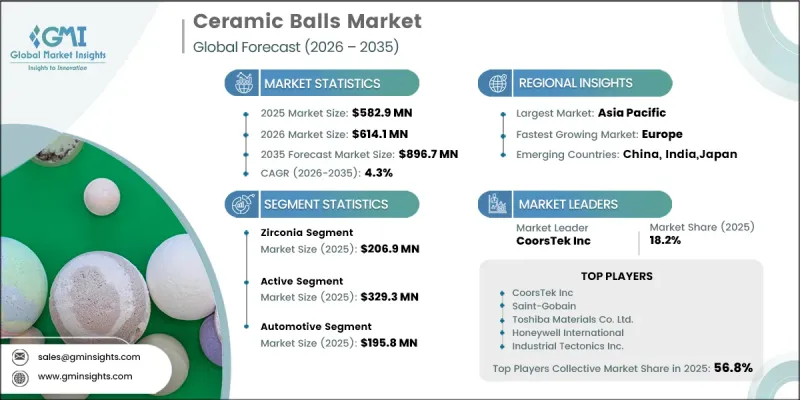
2025 年全球陶瓷球市場價值為 5.829 億美元,預計到 2035 年將達到 8.967 億美元,年複合成長率為 4.3%。
陶瓷球是由優質陶瓷材料製成的先進球形工程零件。其生產製程為:先將陶瓷粉末高溫燒結,再經精密模壓成型,最終形成緻密均勻的結構。陶瓷球以其高硬度、輕質和優異的耐腐蝕性而著稱,尤其適用於嚴苛的工業環境。其卓越的性能優勢使其在汽車、航太、化學、石油天然氣等領域廣泛應用,這些領域對極端工況下的耐久性要求極高。此外,陶瓷球還具有優異的耐磨性、抗熱衝擊性和抗化學劣化,能夠為從常規系統到高負荷系統提供穩定的性能。在許多應用中,陶瓷球無需潤滑即可運行,這進一步提升了其在先進機械系統中的需求。隨著對高精度工程解決方案的需求不斷成長,陶瓷球的應用範圍也在不斷擴大,尤其是在那些注重效率和長使用壽命的行業中。材料科學和生產技術的持續進步,包括先進的燒結製程和精密研磨技術,不斷提高陶瓷球的尺寸精度、表面光潔度和球形度控制,進一步拓展了其在工業領域的實際應用。
| 市場範圍 | |
|---|---|
| 開始年份 | 2025 |
| 預測期 | 2026-2035 |
| 初始市場規模 | 5.829億美元 |
| 預計金額 | 8.967億美元 |
| 複合年成長率 | 4.3% |
2025年,氧化鋯陶瓷球市場規模將達到2.069億美元。該細分市場憑藉其卓越的韌性和抗斷裂性能,保持著強勁的成長勢頭,使其成為軸承系統和閥門等嚴苛工況應用的理想之選。氧化鋯加工技術的進步提升了其結構穩定性和性能一致性,使其能夠承受工業環境中的機械應力、熱循環和衝擊負荷。
預計到2025年,活性陶瓷球市場規模將達到3.293億美元。該市場成長強勁,主要得益於其在軸承和精密機械的負荷傳遞和運動控制方面的直接應用。在對低摩擦、耐久性和長使用壽命要求極高的高速機械系統中,活性陶瓷球的應用日益廣泛。此外,在對穩定旋轉效率有較高要求的先進汽車傳動系統和高性能工業設備中,活性陶瓷球的應用也進一步推動了市場需求。
預計北美陶瓷球市場規模將從2025年的1.894億美元成長到2035年的2.978億美元。這一成長主要得益於航太和汽車製造業的強勁需求,以及先進生產技術的日益普及。精密工程技術的進步和混合軸承系統的廣泛應用也推動了市場發展。美國憑藉著不斷成長的電動車產量以及在航太引擎和高精度工業機械領域日益廣泛的應用,持續引領區域消費。
目錄
第1章:調查方法和範圍
第2章執行摘要
第3章業界考察
- 生態系分析
- 供應商情況
- 利潤率
- 每個階段增加的價值
- 影響價值鏈的因素
- 中斷
- 影響產業的因素
- 促進因素
- 產業潛在風險與挑戰
- 市場機遇
- 成長潛力分析
- 監理情勢
- 波特五力分析
- PESTEL 分析
- 價格趨勢
- 按地區
- 依產品類型
- 未來市場趨勢
- 科技與創新趨勢
- 當前技術趨勢
- 新興技術
- 專利趨勢
- 貿易統計(HS編碼)
- 主要進口國
- 主要出口國
- 永續性和環境方面
- 永續計劃
- 減少廢棄物策略
- 生產中的能源效率
- 具有環保意識的舉措
- 考慮碳足跡
第4章 競爭情勢
- 介紹
- 企業市佔率分析
- 按地區
- 北美洲
- 歐洲
- 亞太地區
- 拉丁美洲
- 中東和非洲(MEA)
- 按地區
- 主要市場公司的競爭分析
- 競爭定位矩陣
- 主要進展
- 併購
- 夥伴關係和聯盟
- 新產品發布
- 業務拓展計劃
第5章 市場估計與預測:依材料分類,2022-2035年
- 氧化鋯
- 矽
- 氧化鋁
- 其他
第6章 市場估計與預測:依功能分類,2022-2035年
- 啟用設定
- 惰性
第7章 市場估計與預測:依應用領域分類,2022-2035年
- 軸承
- 研磨
- 閥門
- 其他
第8章 市場估算與預測:依最終用途產業分類,2022-2035年
- 車
- 航太
- 化學
- 石油和天然氣
- 醫療保健
- 其他
第9章 市場估計與預測:依地區分類,2022-2035年
- 北美洲
- 美國
- 加拿大
- 歐洲
- 德國
- 英國
- 法國
- 西班牙
- 義大利
- 其他歐洲地區
- 亞太地區
- 中國
- 印度
- 日本
- 澳洲
- 韓國
- 亞太其他地區
- 拉丁美洲
- 巴西
- 墨西哥
- 阿根廷
- 其他拉丁美洲地區
- 中東和非洲
- 沙烏地阿拉伯
- 南非
- 阿拉伯聯合大公國
- 其他中東和非洲地區
第10章:公司簡介
- Axens
- Boca Bearing Company
- CoorsTek, Inc.(consolidating CERBEC)
- Devson Catalyst Private Limited
- Fineway Inc.
- Global Precision Ball & Roller
- Honeywell International
- Industrial Tectonics Inc./Bearings Corp.
- MetalBall
- Ortech Advanced Ceramics
- Saint-Gobain
- Topack Ceramics Pvt. Ltd.
- Toshiba Materials Co. Ltd.
The Global Ceramic Balls Market was valued at USD 582.9 million in 2025 and is estimated to grow at a CAGR of 4.3% to reach USD 896.7 million by 2035.
Ceramic balls are advanced spherical engineering components produced from high-grade ceramic materials through high-temperature sintering of ceramic powders, followed by precision shaping processes to achieve dense and uniform structures. These components are widely recognized for their high hardness, low weight, and strong resistance to corrosion, making them suitable for demanding industrial environments. Their performance advantages make them widely used across automotive, aerospace, chemical processing, and oil and gas applications where durability under extreme operating conditions is critical. Ceramic balls also offer strong resistance to wear, thermal shock, and chemical degradation, which enables stable performance in both conventional and high-stress systems. Their ability to operate without lubrication in many applications further enhances their demand in advanced mechanical systems. Growing reliance on high-precision engineering solutions continues to strengthen their adoption across industries focused on efficiency and long operational life. Continuous advancements in material science and production technologies, including refined sintering processes and precision grinding techniques, have improved control over dimensional accuracy, surface finish, and sphericity, further expanding their industrial usability.
| Market Scope | |
|---|---|
| Start Year | 2025 |
| Forecast Year | 2026-2035 |
| Start Value | $ 582.9 Million |
| Forecast Value | $ 896.7 Million |
| CAGR | 4.3% |
The zirconia-based ceramic balls segment reached USD 206.9 million in 2025. This segment maintains strong momentum due to its excellent toughness and resistance to fracture, making it highly suitable for demanding bearing systems and valve applications. Improvements in zirconia processing have enhanced structural stability and performance consistency, allowing these components to withstand mechanical stress, thermal cycling, and impact loads across industrial environments.
The active ceramic balls segment accounted for USD 329.3 million in 2025. This segment is gaining strong traction as these components play a direct role in load transmission and motion control within bearings and precision machinery. Their adoption is increasing across high-speed mechanical systems where low friction, durability, and extended operational life are essential. Demand is further supported by their use in advanced automotive drivetrains and high-performance industrial equipment requiring stable rotational efficiency.
North America Ceramic Balls Market is expected to grow from USD 189.4 million in 2025 to USD 297.8 million by 2035. Market growth in the region is supported by strong demand from aerospace and automotive manufacturing sectors, along with increasing adoption of advanced production technologies. The expansion of precision engineering capabilities and the rising use of hybrid bearing systems further contribute to market development. The United States continues to dominate regional consumption due to rising electric vehicle production and expanding applications in aerospace engines and high-precision industrial machinery.
Key companies operating in the Global Ceramic Balls Industry include CoorsTek, Inc., Saint-Gobain, Axens, Honeywell International Inc., Boca Bearing Company, Industrial Tectonics Inc., MetalBall, Ortech Advanced Ceramics, Global Precision Ball & Roller, Toshiba Materials Co., Ltd., Fineway Inc., Devson Catalyst Private Limited, and Topack Ceramics Pvt. Ltd. Companies in the ceramic balls market are focusing on material innovation, precision manufacturing, and capacity expansion to strengthen their market position. They are investing in advanced ceramic formulations that improve hardness, durability, and thermal resistance. Automation in grinding and sintering processes is being adopted to enhance dimensional accuracy and reduce production variability. Strategic partnerships with automotive and aerospace manufacturers support customized product development for high-performance applications. Firms are also expanding regional production facilities to improve supply chain efficiency and reduce lead times.
Table of Contents
Chapter 1 Methodology & Scope
- 1.1 Market scope and definition
- 1.2 Research design
- 1.2.1 Research approach
- 1.2.2 Data collection methods
- 1.3 Data mining sources
- 1.3.1 Global
- 1.3.2 Regional/Country
- 1.4 Base estimates and calculations
- 1.4.1 Base year calculation
- 1.4.2 Key trends for market estimation
- 1.5 Primary research and validation
- 1.5.1 Primary sources
- 1.6 Forecast model
- 1.7 Research assumptions and limitations
Chapter 2 Executive Summary
- 2.1 Industry 360° synopsis
- 2.2 Key market trends
- 2.2.1 Material
- 2.2.2 Function
- 2.2.3 Application
- 2.2.4 End-Use Industry
- 2.2.5 Regional
- 2.3 TAM Analysis, 2026-2035
- 2.4 CXO perspectives: Strategic imperatives
Chapter 3 Industry Insights
- 3.1 Industry ecosystem analysis
- 3.1.1 Supplier landscape
- 3.1.2 Profit margin
- 3.1.3 Value addition at each stage
- 3.1.4 Factor affecting the value chain
- 3.1.5 Disruptions
- 3.2 Industry impact forces
- 3.2.1 Growth drivers
- 3.2.2 Industry pitfalls and challenges
- 3.2.3 Market opportunities
- 3.3 Growth potential analysis
- 3.4 Regulatory landscape
- 3.4.1 North America
- 3.4.2 Europe
- 3.4.3 Asia Pacific
- 3.4.4 Latin America
- 3.4.5 Middle East & Africa
- 3.5 Porter's analysis
- 3.6 PESTEL analysis
- 3.7 Price trends
- 3.7.1 By region
- 3.7.2 By product type
- 3.8 Future market trends
- 3.9 Technology and Innovation landscape
- 3.9.1 Current technological trends
- 3.9.2 Emerging technologies
- 3.10 Patent Landscape
- 3.11 Trade statistics (HS code)
- 3.11.1 Major importing countries
- 3.11.2 Major exporting countries
- 3.12 Sustainability and environmental aspects
- 3.12.1 Sustainable practices
- 3.12.2 Waste reduction strategies
- 3.12.3 Energy efficiency in production
- 3.12.4 Eco-friendly initiatives
- 3.13 Carbon footprint consideration
Chapter 4 Competitive Landscape, 2025
- 4.1 Introduction
- 4.2 Company market share analysis
- 4.2.1 By region
- 4.2.1.1 North America
- 4.2.1.2 Europe
- 4.2.1.3 Asia Pacific
- 4.2.1.4 LATAM
- 4.2.1.5 MEA
- 4.2.1 By region
- 4.3 Competitive analysis of major market players
- 4.4 Competitive positioning matrix
- 4.5 Key developments
- 4.5.1 Mergers & acquisitions
- 4.5.2 Partnerships & collaborations
- 4.5.3 New Product Launches
- 4.5.4 Expansion Plans
Chapter 5 Market Estimates and Forecast, By Material, 2022-2035 (USD Billion) (Kilo Tons)
- 5.1 Key trends
- 5.2 Zirconia
- 5.3 Silicon
- 5.4 Alumina
- 5.5 Others
Chapter 6 Market Estimates and Forecast, By Function, 2022-2035 (USD Billion) (Kilo Tons)
- 6.1 Key trends
- 6.2 Active
- 6.3 Inert
Chapter 7 Market Estimates and Forecast, By Application, 2022-2035 (USD Million) (Kilo Tons)
- 7.1 Key trends
- 7.2 Bearing
- 7.3 Grinding
- 7.4 Valve
- 7.5 Others
Chapter 8 Market Estimates and Forecast, By End-Use Industry, 2022-2035 (USD Million) (Kilo Tons)
- 8.1 Key trends
- 8.2 Automotive
- 8.3 Aerospace
- 8.4 Chemical
- 8.5 Oil & Gas
- 8.6 Medical
- 8.7 Others
Chapter 9 Market Estimates and Forecast, By Region, 2022-2035 (USD Million) (Kilo Tons)
- 9.1 Key trends
- 9.2 North America
- 9.2.1 U.S.
- 9.2.2 Canada
- 9.3 Europe
- 9.3.1 Germany
- 9.3.2 UK
- 9.3.3 France
- 9.3.4 Spain
- 9.3.5 Italy
- 9.3.6 Rest of Europe
- 9.4 Asia Pacific
- 9.4.1 China
- 9.4.2 India
- 9.4.3 Japan
- 9.4.4 Australia
- 9.4.5 South Korea
- 9.4.6 Rest of Asia Pacific
- 9.5 Latin America
- 9.5.1 Brazil
- 9.5.2 Mexico
- 9.5.3 Argentina
- 9.5.4 Rest of Latin America
- 9.6 Middle East and Africa
- 9.6.1 Saudi Arabia
- 9.6.2 South Africa
- 9.6.3 UAE
- 9.6.4 Rest of Middle East and Africa
Chapter 10 Company Profiles
- 10.1 Axens
- 10.2 Boca Bearing Company
- 10.3 CoorsTek, Inc. (consolidating CERBEC)
- 10.4 Devson Catalyst Private Limited
- 10.5 Fineway Inc.
- 10.6 Global Precision Ball & Roller
- 10.7 Honeywell International
- 10.8 Industrial Tectonics Inc./Bearings Corp.
- 10.9 MetalBall
- 10.10 Ortech Advanced Ceramics
- 10.11 Saint-Gobain
- 10.12 Topack Ceramics Pvt. Ltd.
- 10.13 Toshiba Materials Co. Ltd.

 帶有凸凹槽的陶瓷球市場:全球市場預測,2026-2032年用於熱能儲存的陶瓷球市場:全球市場預測,2026-2032年負離子陶瓷球市場:全球市場預測(2026-2032年)全球熱等靜壓法氮化矽陶瓷球市場預測(2026年至2032年)壓裂球市場 - 全球市場預測(2026-2032)陶瓷球市場:按材料、等級、球徑範圍、應用和最終用途產業分類-全球市場預測(2026-2032 年)
 2026年全球無機陶瓷膜組件市場報告
 2026-2034年全球陶瓷球市場規模、佔有率、趨勢及成長分析報告陶瓷球成型機市場:按技術、材料相容性、機器尺寸、驅動機構、價格範圍和應用分類-全球預測,2026-2032年
 氧化鋯陶瓷球市場分析及預測(至2035年):類型、產品類型、應用、材質類型、技術、最終用戶、組件、製程、功能、安裝類型