


 |
市場調查報告書
商品編碼
2038342
汽車貨艙地板市場商機、成長要素、產業趨勢分析及 2026-2035 年預測。Automotive Load Floor Market Opportunity, Growth Drivers, Industry Trend Analysis, and Forecast 2026 - 2035 |
||||||

2025 年全球汽車貨艙地板市場價值為 31 億美元,預計到 2035 年將以 5.6% 的複合年成長率成長至 52 億美元。
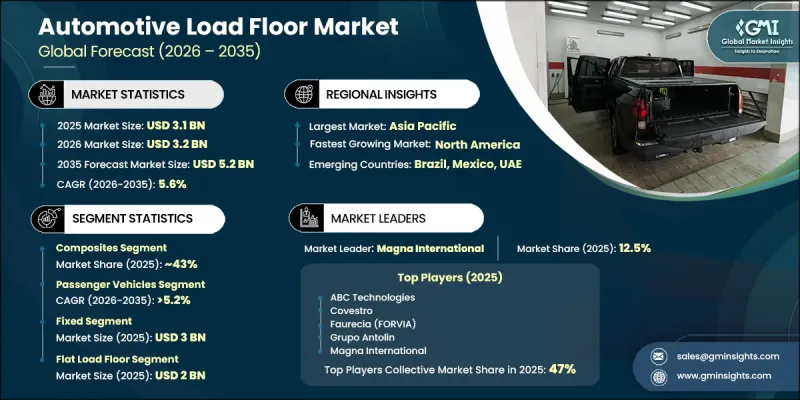
這一成長源自於消費者對靈活內裝配置日益成長的需求,這種配置既能最大限度地利用儲存空間,又能降低整車重量。汽車製造商正優先考慮先進的內裝工程解決方案,以滿足消費者對實用性、舒適性和適應性的不斷變化的需求。隨著SUV和電動車的普及,對支援輕量化結構和多功能性的創新貨艙地板系統的需求進一步增加。同時,排放氣體和油耗方面的監管壓力正在加速向先進材料和最佳化結構設計的轉變。對複合材料、熱塑性塑膠和模組化結構的持續投資正在重塑產品開發策略。製造商和供應商越來越關注擴充性和可客製化的貨艙地板系統,以適應下一代汽車平臺和不斷發展的旅行趨勢。
| 市場範圍 | |
|---|---|
| 開始年份 | 2025 |
| 預測期 | 2026-2035 |
| 初始市場規模 | 31億美元 |
| 預測金額 | 52億美元 |
| 複合年成長率 | 5.6% |
電動車平台和新一代汽車內裝系統的快速發展進一步影響著這個市場,這些系統需要高度靈活且空間利用率高的貨物解決方案。隨著車輛減重、高效利用內部空間和增強模組化變得日益重要,靈活的貨物地板配置創新正在蓬勃發展。製造商正在加速開發具有滑動機構和佈局調節功能的系統,從而實現與原廠配套和售後市場的無縫整合。
預計到2025年,複合材料市佔率將達到43%,並在2026年至2035年間以5.7%的複合年成長率成長。該細分市場的主導地位歸功於其卓越的強度重量比、耐久性和設計柔軟性,使其成為現代汽車應用的理想之選。複合材料廣泛應用於乘用車、SUV和商用車,用於支撐輕量化結構並實現模組化、多功能的貨艙地板解決方案。電動和混合動力汽車的日益普及進一步推動了對複合材料的需求,因為它們有助於提高能源效率,並便於與可調節、空間最佳化的內裝系統整合。
預計到2025年,乘用車市佔率將達到76%,並在2026年至2035年間以5.2%的複合年成長率成長。這一主導地位主要得益於全球乘用車、SUV和電動車的高產量,以及消費者對靈活實用內裝解決方案日益成長的偏好。消費者對更最佳化的行李箱空間佈局、模組化收納系統和更佳的內裝實用性的需求不斷成長,正在加速相關技術的普及應用。經濟型、中階和豪華車型中可擴展後行李箱地板系統的標準化,進一步鞏固了該細分市場在全球汽車市場的主導地位。
中國汽車貨艙地板市場佔55%的全球佔有率,預計2025年市場規模將達到7.222億美元。中國在該市場的主導地位得益於其龐大的汽車製造地、完善的供應鏈網路以及強大的內裝系統供應商網路。主要生產基地正在乘用車、SUV和電動車中推廣輕量化和模組化貨艙地板技術的應用,以提高貨物裝載效率、降低整車重量並增強車內空間的柔軟性和功能性。
目錄
第1章:調查方法和範圍
第2章執行摘要
第3章業界考察
- 生態系分析
- 供應商情況
- 利潤率
- 成本結構
- 每個階段增加的價值
- 影響價值鏈的因素
- 中斷
- 影響產業的因素
- 促進因素
- 汽車的快速電氣化
- SUV、跨界車銷售成長
- 專注於輕量材料
- OEM和售後市場成長
- 產業潛在風險與挑戰
- 原料成本和生產成本高昂
- 汽車平臺之間的標準化程度有限。
- 市場機遇
- 與電動汽車和混合動力平台整合
- 為售後市場提供客製化和模組化解決方案
- 電動車(EV)的廣泛普及
- 模組化和可自訂的內部成長
- 促進因素
- 成長潛力分析
- 價格分析(基於初步調查)
- 對過去價格趨勢的分析
- 按業務類型分類的定價策略(溢價/價值/成本加成)
- 監理情勢
- 北美洲
- 美國:EPA、CARB、NHTSA 標準
- 加拿大:加拿大運輸部,CMVSS
- 歐洲
- 德國:BMDV,歐洲 6/7
- 法國:運輸部,6/7歐元
- 英國:運輸部,Euro 6/7
- 義大利:基礎設施和運輸部
- 亞太地區
- 中國:工業與資訊化部(工信部),中國6/7標準
- 日本:國土交通省,JIS標準
- 韓國:國土交通部(MOLIT)、韓國標準協會(KS)
- 印度:道路和城市發展部 (MoRTH),BS6 標準
- 拉丁美洲
- 巴西:DENATRAN、CONAMA 標準
- 墨西哥:通訊與運輸部
- 中東和非洲
- 阿拉伯聯合大公國:RTA 和 ESMA 法規
- 沙烏地阿拉伯:運輸部,SASO
- 北美洲
- 波特五力分析
- PESTEL 分析
- 專利分析(基於初步研究)
- 貿易數據分析(基於付費資料庫)
- 進出口量和進出口額的趨勢
- 主要貿易走廊和關稅的影響
- 人工智慧和生成式人工智慧對市場的影響
- 利用人工智慧改造現有經營模式
- 按細分市場分類的生成式人工智慧用例和部署藍圖
- 風險、局限性和監管考量
- 生產能力和生產趨勢(基於初步調查)
- 按地區和主要生產商分類的設備產能
- 設備運轉率和擴建計劃
- 科技與創新趨勢
- 當前技術趨勢
- 新興技術
- 成本細分分析
- 永續性和環境方面
- 永續計劃
- 減少廢棄物策略
- 生產中的能源效率
- 環保意識的舉措
- 關於碳足跡的考量
- 預測假設和情境分析(基於初步研究)
- 基本案例-驅動複合年成長率的關鍵宏觀經濟與產業變量
- 樂觀情境-有利的宏觀經濟和產業利好因素
- 悲觀情景-宏觀經濟放緩或產業逆風
第4章 競爭情勢
- 介紹
- 企業市佔率分析
- 主要市場公司的競爭分析
- 競爭定位矩陣
- 戰略展望矩陣
- 主要進展
- 併購
- 夥伴關係與合作
- 新產品發布
- 業務拓展計劃及資金籌措
第5章 市場估計與預測:依材料分類,2022-2035年
- 複合材料
- 蜂窩狀聚丙烯
- 瓦楞聚丙烯
- 硬紙板
- 其他
第6章 市場估價與預測:依車輛類型分類,2022-2035年
- 搭乘用車
- 掀背車
- 轎車
- SUV
- 商用車輛
- 輕型商用車(LCV)
- 中型商用車(MCV)
- 重型商用車(HCV)
第7章 市場估計與預測:依應用領域分類,2022-2035年
- 固定的
- 滑動式
第8章 市場估算與預測:依裝載床配置分類,2022-2035年
- 平坦的道路地面
- 高架貨物平台
- 模組化貨床
第9章 市場估價與預測:依銷售管道分類,2022-2035年
- OEM
- 售後市場
第10章 市場估價與預測:依地區分類,2022-2035年
- 北美洲
- 美國
- 加拿大
- 歐洲
- 英國
- 德國
- 法國
- 義大利
- 西班牙
- 比利時
- 荷蘭
- 瑞典
- 亞太地區
- 中國
- 印度
- 日本
- 澳洲
- 新加坡
- 韓國
- 越南
- 印尼
- 拉丁美洲
- 巴西
- 墨西哥
- 阿根廷
- 中東和非洲(MEA)
- 阿拉伯聯合大公國
- 南非
- 沙烏地阿拉伯
第11章:公司簡介
- Global Player
- ABC Technologies
- Adient
- Borgers
- CIE Automotive
- Covestro
- Faurecia(FORVIA)
- Grupo Antolin
- IAC
- Magna International
- Woodbridge
- Regional Player
- BASF
- BorgWarner
- Daimler Mobility Services
- Dana
- Hanon Systems
- Hanwa
- Hitachi Astemo
- Inteva Products
- Sekisui Chemical
- Toyota Boshoku
The Global Automotive Load Floor Market was valued at USD 3.1 billion in 2025 and is estimated to grow at a CAGR of 5.6% to reach USD 5.2 billion by 2035.
Growth is driven by increasing demand for flexible interior configurations that maximize usable storage space while reducing overall vehicle weight. Automakers are prioritizing advanced interior engineering solutions to meet evolving consumer expectations for practicality, comfort, and adaptability. Rising adoption of SUVs and electric vehicles is further strengthening demand for innovative load floor systems that support lightweight construction and multifunctional usability. At the same time, regulatory pressure related to emissions and fuel efficiency is accelerating the shift toward advanced materials and optimized structural designs. Continuous investment in composite materials, thermoplastics, and modular architectures is reshaping product development strategies. Manufacturers and suppliers are increasingly focusing on scalable and customizable load floor systems that align with next-generation vehicle platforms and evolving mobility trends.
| Market Scope | |
|---|---|
| Start Year | 2025 |
| Forecast Year | 2026-2035 |
| Start Value | $3.1 Billion |
| Forecast Value | $5.2 Billion |
| CAGR | 5.6% |
The market is further influenced by the rapid evolution of electric vehicle platforms and next-generation automotive interior systems, which require highly adaptable and space-efficient cargo solutions. Growing emphasis on vehicle weight reduction, improved interior utilization, and enhanced modular functionality is encouraging innovation in flexible load floor configurations. Manufacturers are increasingly developing systems that support sliding mechanisms, adjustable layouts, and seamless integration with both OEM and aftermarket applications.
The composites segment accounted for 43% share in 2025 and is projected to grow at a CAGR of 5.7% from 2026 to 2035. This segment leads due to its superior strength-to-weight ratio, durability, and design flexibility, making it highly suitable for modern automotive applications. Composite materials are widely used in passenger cars, SUVs, and commercial vehicles, as they support lightweight construction and enable modular and multifunctional load floor solutions. Increasing adoption of electric and hybrid vehicles is further driving demand for composites, as they contribute to improved energy efficiency and better integration with adjustable and space-optimized interior systems.
The passenger vehicles segment held a 76% share in 2025 and is expected to grow at a CAGR of 5.2% between 2026 and 2035. This dominance is attributed to high global production volumes of passenger cars, SUVs, and electric vehicles, along with growing consumer preference for flexible and practical interior solutions. Increasing demand for enhanced cargo organization, modular storage systems, and improved interior usability is accelerating adoption. Standardization of scalable load floor systems across economy, mid-range, and premium vehicle categories is further reinforcing segment leadership across global automotive markets.
China Automotive Load Floor Market held a 55% share, generating USD 722.2 million in 2025. The country's leadership is supported by its extensive automotive manufacturing base, well-established supply chain network, and strong presence of interior system suppliers. Major production hubs are increasingly adopting lightweight and modular load floor technologies across passenger vehicles, SUVs, and electric vehicles to improve cargo efficiency, reduce overall vehicle weight, and enhance interior flexibility and functionality.
Key companies operating in the Global Automotive Load Floor Market include Faurecia (FORVIA), Magna International, Adient, Grupo Antolin, Covestro, ABC Technologies, IAC, Borgers, CIE Automotive, and Woodbridge. Companies in the Global Automotive Load Floor Market are focusing on material innovation and lightweight engineering to strengthen their competitive position. They are increasingly investing in advanced composites, thermoplastics, and honeycomb structures to enhance durability while reducing vehicle weight. Strategic collaborations with automotive OEMs are enabling the development of customized and platform-specific load floor systems. Manufacturers are also emphasizing modular and scalable product designs that align with evolving electric and hybrid vehicle architectures. Expansion of production capabilities and global supply chain integration is supporting faster market penetration. Additionally, firms are prioritizing sustainability by incorporating recyclable materials and improving lifecycle efficiency, while continuous R&D efforts are enhancing functionality, adjustability, and interior space optimization across vehicle segments.
Table of Contents
Chapter 1 Methodology & Scope
- 1.1 Research approach
- 1.2 Quality commitments
- 1.3 GMI AI policy & data integrity commitment
- 1.4 Research trail & confidence scoring
- 1.4.1 Research trail components
- 1.4.2 Scoring components
- 1.5 Data collection
- 1.5.1 Partial list of primary sources
- 1.6 Data mining sources
- 1.6.1 Paid sources
- 1.7 Base estimates and calculations
- 1.7.1 Base year calculation
- 1.8 Forecast model
- 1.9 Research transparency addendum
Chapter 2 Executive Summary
- 2.1 Industry 360° synopsis, 2022 - 2035
- 2.2 Key market trends
- 2.2.1 Regional
- 2.2.2 Material
- 2.2.3 Vehicle
- 2.2.4 Load Floor Configuration
- 2.2.5 Operation
- 2.2.6 Sales Channel
- 2.3 TAM Analysis, 2026-2035
- 2.4 CXO perspectives: Strategic imperatives
Chapter 3 Industry Insights
- 3.1 Industry ecosystem analysis
- 3.1.1 Supplier Landscape
- 3.1.2 Profit Margin
- 3.1.3 Cost structure
- 3.1.4 Value addition at each stage
- 3.1.5 Factor affecting the value chain
- 3.1.6 Disruptions
- 3.2 Industry impact forces
- 3.2.1 Growth drivers
- 3.2.1.1 Rapid Electrification of Vehicles
- 3.2.1.2 Rising SUV and Crossover Sales
- 3.2.1.3 Focus on Lightweight Materials
- 3.2.1.4 OEM and Aftermarket Growth
- 3.2.2 Industry pitfalls and challenges
- 3.2.2.1 High Material and Production Costs
- 3.2.2.2 Limited Standardization Across Vehicle Platforms
- 3.2.3 Market opportunities
- 3.2.3.1 Integration with EV and Hybrid Platforms
- 3.2.3.2 Aftermarket Customization and Modular Solutions
- 3.2.3.3 Rising Electric Vehicle (EV) Adoption
- 3.2.3.4 Growth of Modular and Customizable Interiors
- 3.2.1 Growth drivers
- 3.3 Growth potential analysis
- 3.4 Pricing analysis (Driven by Primary Research)
- 3.4.1 Historical price trend analysis
- 3.4.2 Pricing strategy by player type (premium / value / cost-plus)
- 3.5 Regulatory landscape
- 3.5.1 North America
- 3.5.1.1 U.S.: EPA, CARB, NHTSA Standards
- 3.5.1.2 Canada: Transport Canada, CMVSS
- 3.5.2 Europe
- 3.5.2.1 Germany: BMDV, Euro 6/7
- 3.5.2.2 France: Ministry of Transport, Euro 6/7
- 3.5.2.3 UK: Department for Transport, Euro 6/7
- 3.5.2.4 Italy: Ministry of Infrastructure & Transport
- 3.5.3 Asia Pacific
- 3.5.3.1 China: MIIT, China 6/7 Standards
- 3.5.3.2 Japan: MLIT, JIS Regulations
- 3.5.3.3 South Korea: MOLIT, KS Standards
- 3.5.3.4 India: MoRTH, BS6 Norms
- 3.5.4 Latin America
- 3.5.4.1 Brazil: DENATRAN, CONAMA Standards
- 3.5.4.2 Mexico: Ministry of Communications & Transport
- 3.5.5 Middle East and Africa
- 3.5.5.1 UAE: RTA, ESMA Regulations
- 3.5.5.2 Saudi Arabia: Ministry of Transport, SASO
- 3.5.1 North America
- 3.6 Porter's analysis
- 3.7 PESTEL analysis
- 3.8 Patent analysis (Driven by Primary Research)
- 3.9 Trade data analysis (Driven by paid database)
- 3.9.1 Import/export volume & value trends
- 3.9.2 Key trade corridors & tariff impact
- 3.10 Impact of AI & Generative AI on the Market
- 3.10.1 AI-driven disruption of existing business models
- 3.10.2 Gen AI use cases & adoption roadmap by segment
- 3.10.3 Risks, limitations & regulatory considerations
- 3.11 Capacity & production landscape (Driven by primary research)
- 3.11.1 Installed capacity by region & key producer
- 3.11.2 Capacity utilization rates & expansion pipelines
- 3.12 Technology and innovation landscape
- 3.12.1 Current technological trends
- 3.12.2 Emerging technologies
- 3.13 Cost breakdown analysis
- 3.14 Sustainability and environmental aspects
- 3.14.1 Sustainable practices
- 3.14.2 Waste reduction strategies
- 3.14.3 Energy efficiency in production
- 3.14.4 Eco-friendly initiatives
- 3.14.5 Carbon footprint considerations
- 3.15 Forecast assumptions & scenario analysis (Driven by primary research)
- 3.15.1 Base Case - key macro & industry variables driving CAGR
- 3.15.2 Optimistic Scenarios - Favorable macro and industry tailwinds
- 3.15.3 Pessimistic Scenario - Macroeconomic slowdown or industry headwinds
Chapter 4 Competitive Landscape, 2025
- 4.1 Introduction
- 4.2 Company market share analysis
- 4.2.1 North America
- 4.2.2 Europe
- 4.2.3 Asia Pacific
- 4.2.4 Latin America
- 4.2.5 Middle East & Africa
- 4.3 Competitive analysis of major market players
- 4.4 Competitive positioning matrix
- 4.5 Strategic outlook matrix
- 4.6 Key developments
- 4.6.1 Mergers & acquisitions
- 4.6.2 Partnerships & collaborations
- 4.6.3 New product launches
- 4.6.4 Expansion plans and funding
Chapter 5 Market Estimates & Forecast, By Material, 2022 - 2035 ($Bn, Units)
- 5.1 Key trends
- 5.2 Composites
- 5.3 Honeycomb polypropylene
- 5.4 Fluted polypropylene
- 5.5 Hardboard
- 5.6 Others
Chapter 6 Market Estimates & Forecast, By Vehicle, 2022 - 2035 ($Bn, Units)
- 6.1 Key trends
- 6.2 Passenger vehicles
- 6.2.1 Hatchbacks
- 6.2.2 Sedans
- 6.2.3 SUV
- 6.3 Commercial vehicles
- 6.3.1 Light commercial vehicles (LCV)
- 6.3.2 Medium commercial vehicles (MCV)
- 6.3.3 Heavy commercial vehicles (HCV)
Chapter 7 Market Estimates & Forecast, By Operation, 2022 - 2035 ($Bn, Units)
- 7.1 Key trends
- 7.2 Fixed
- 7.3 Sliding
Chapter 8 Market Estimates & Forecast, By Load Floor Configuration, 2022 - 2035 ($Bn, Units)
- 8.1 Key trends
- 8.2 Flat Load Floor
- 8.3 Raised Load Floor
- 8.4 Modular Load Floor
Chapter 9 Market Estimates & Forecast, By Sales Channel, 2022 - 2035 ($Bn, Units)
- 9.1 Key trends
- 9.2 OEM
- 9.3 Aftermarket
Chapter 10 Market Estimates & Forecast, By Region, 2022 - 2035 ($Bn, Units)
- 10.1 Key trends
- 10.2 North America
- 10.2.1 US
- 10.2.2 Canada
- 10.3 Europe
- 10.3.1 UK
- 10.3.2 Germany
- 10.3.3 France
- 10.3.4 Italy
- 10.3.5 Spain
- 10.3.6 Belgium
- 10.3.7 Netherlands
- 10.3.8 Sweden
- 10.4 Asia Pacific
- 10.4.1 China
- 10.4.2 India
- 10.4.3 Japan
- 10.4.4 Australia
- 10.4.5 Singapore
- 10.4.6 South Korea
- 10.4.7 Vietnam
- 10.4.8 Indonesia
- 10.5 Latin America
- 10.5.1 Brazil
- 10.5.2 Mexico
- 10.5.3 Argentina
- 10.6 MEA
- 10.6.1 UAE
- 10.6.2 South Africa
- 10.6.3 Saudi Arabia
Chapter 11 Company Profiles
- 11.1 Global Player
- 11.1.1 ABC Technologies
- 11.1.2 Adient
- 11.1.3 Borgers
- 11.1.4 CIE Automotive
- 11.1.5 Covestro
- 11.1.6 Faurecia (FORVIA)
- 11.1.7 Grupo Antolin
- 11.1.8 IAC
- 11.1.9 Magna International
- 11.1.10 Woodbridge
- 11.2 Regional Player
- 11.2.1 BASF
- 11.2.2 BorgWarner
- 11.2.3 Daimler Mobility Services
- 11.2.4 Dana
- 11.2.5 Hanon Systems
- 11.2.6 Hanwa
- 11.2.7 Hitachi Astemo
- 11.2.8 Inteva Products
- 11.2.9 Sekisui Chemical
- 11.2.10 Toyota Boshoku


