


 |
市場調查報告書
商品編碼
2038339
氧化鈰奈米顆粒市場:商業機會、成長要素、產業趨勢分析及2026-2035年預測Cerium Oxide Nanoparticles Market Opportunity, Growth Drivers, Industry Trend Analysis, and Forecast 2026 - 2035 |
||||||

2025年全球氧化鈰奈米顆粒市場價值為11億美元,預計2035年將以20.3%的複合年成長率成長至69億美元。
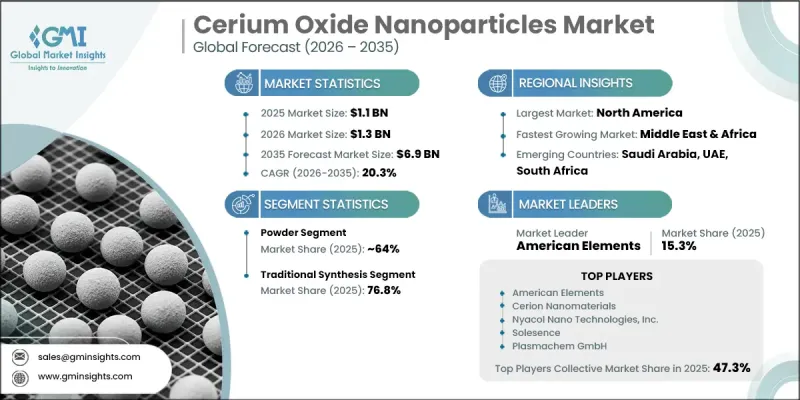
由於氧化鈰奈米顆粒具有獨特的功能特性,例如紫外線吸收、觸媒活性和儲氧能力,該市場呈現出強勁的成長勢頭。這些特性使得氧化鈰奈米顆粒非常適合催化劑、燃料電池、生物醫學應用以及玻璃和陶瓷表面的精密拋光等眾多領域。工業界對符合永續性目標的高性能催化劑的需求不斷成長,進一步加速了其在製造業的應用。電子和汽車應用領域的廣泛應用也推動了市場成長。在這些領域,氧化鈰奈米顆粒能夠改善表面品質、耐久性和性能效率。人們對可再生能源系統的興趣日益濃厚,這也是一個關鍵促進因素,因為氧化鈰奈米顆粒有助於提高燃料電池和太陽能技術的效率。然而,複雜的合成過程帶來高昂的製造成本仍阻礙了其廣泛的商業化應用,導致成本敏感型應用領域難以實現價格擴充性,並限制了其大規模生產的潛力。
| 市場範圍 | |
|---|---|
| 開始年份 | 2025 |
| 預測期 | 2026-2035 |
| 上市時的市場規模 | 11億美元 |
| 預測金額 | 69億美元 |
| 複合年成長率 | 20.3% |
預計到2025年,粉狀產品將佔據64%的市場佔有率,並在2035年之前以20.1%的複合年成長率成長。其市場主導地位源自於其細小的顆粒特性、高表面反應活性以及對催化、電子和拋光應用的高度適用性。粉末配方在製造過程中仍然被廣泛應用,尤其是在提高玻璃和陶瓷產品的性能和結構品質方面。
預計到2025年,傳統合成方法將佔據76.8%的市場。成熟的製造技術因其能夠以相對較低的營運成本實現大規模生產而繼續佔據主導地位。溶膠-凝膠法、共沉澱法和水熱法等方法常用於確保產品品質穩定和高收率,但這些方法能耗高且有安全隱患。儘管存在這些挑戰,但其可靠性和成本優勢仍使其在市場中保持主導地位。
預計到2025年,北美氧化鈰奈米顆粒市場規模將達到3.682億美元,並在2026年至2035年間以19.8%的複合年成長率成長。這一區域成長主要得益於汽車催化劑、能源儲存系統和電子應用領域的技術進步。強大的工業基礎和永續技術的日益普及也持續推動全部區域市場的擴張。
目錄
第1章:調查方法和範圍
第2章執行摘要
第3章業界考察
- 生態系分析
- 供應商情況
- 利潤率
- 每個階段增加的價值
- 影響價值鏈的因素
- 中斷
- 影響產業的因素
- 促進因素
- 在電子和汽車產業的應用日益廣泛
- 玻璃和陶瓷用磨料的應用範圍不斷擴大
- 燃料電池和可再生能源技術的應用不斷擴展
- 產業潛在風險與挑戰
- 高昂的生產成本
- 奈米材料安全性方面的監管不確定性
- 市場機遇
- 新興綠色合成技術
- 對永續製造流程的需求日益成長
- 促進因素
- 成長潛力分析
- 監理情勢
- 波特五力分析
- PESTEL 分析
- 價格趨勢
- 按地區
- 按形式
- 未來市場趨勢
- 科技與創新趨勢
- 當前技術趨勢
- 新興技術
- 專利趨勢
- 貿易統計(HS編碼)
- 主要進口國
- 主要出口國
- 永續性和環境方面
- 永續計劃
- 減少廢棄物策略
- 生產中的能源效率
- 環保意識的舉措
- 考慮碳足跡
第4章 競爭情勢
- 介紹
- 企業市佔率分析
- 按地區
- 北美洲
- 歐洲
- 亞太地區
- 拉丁美洲
- 中東和非洲(MEA)
- 按地區
- 主要市場公司的競爭分析
- 競爭定位矩陣
- 主要進展
- 併購
- 夥伴關係和聯盟
- 新產品發布
- 業務拓展計劃
第5章 市場估計與預測:依類型分類,2022-2035年
- 分散液
- 水性分散體
- 有機溶劑分散體
- 粉末
- 微米級粉末
- 奈米級粉末
第6章 市場估計與預測:綜合法,2022-2035年
- 傳統合成法
- 降水法
- 溶膠-凝膠法
- 水熱合成
- 熱解
- 綠色合成
第7章 市場估計與預測:依應用領域分類,2022-2035年
- 儲能
- 鋰離子電池
- 超級電容
- 燃料電池
- 化學機械拋光(CMP)
- 磨料
- 玻璃拋光
- 陶瓷拋光
- 半導體晶片拋光
- 催化劑
- 汽車觸媒轉換器
- 工業催化劑
- 塗層
- 保護塗層
- 光學鍍膜
- 個人護理和化妝品
- 防曬油和紫外線防護
- 抗衰老產品
- 藥物和藥物輸送
- 藥物輸送系統
- 應用於癌症治療
- 抗氧化療法
- 其他用途
第8章 市場估算與預測:依最終用途產業分類,2022-2035年
- 能源
- 電子學
- 車
- 生物醫學
- 其他
第9章 市場估計與預測:依地區分類,2022-2035年
- 北美洲
- 美國
- 加拿大
- 歐洲
- 德國
- 英國
- 法國
- 西班牙
- 義大利
- 其他歐洲地區
- 亞太地區
- 中國
- 印度
- 日本
- 澳洲
- 韓國
- 亞太其他地區
- 拉丁美洲
- 巴西
- 墨西哥
- 阿根廷
- 其他拉丁美洲地區
- 中東和非洲
- 沙烏地阿拉伯
- 南非
- 阿拉伯聯合大公國
- 其他中東和非洲地區
第10章:公司簡介
- American Elements
- Cerion Nanomaterials
- Hongwu International Group Ltd
- ITEC Co., Ltd
- MKnano
- Nanorh
- Nyacol Nano Technologies, Inc.
- Plasmachem GmbH
- SAT Nano Technology Material Co., Ltd.
- Solesence
- UrbanMines Technology Ltd
The Global Cerium Oxide Nanoparticles Market was valued at USD 1.1 billion in 2025 and is estimated to grow at a CAGR of 20.3% to reach USD 6.9 billion by 2035.
The market is experiencing strong momentum due to the unique functional properties of cerium oxide nanoparticles, including ultraviolet light absorption, catalytic activity, and oxygen storage capability. These characteristics make the material highly suitable for use across catalysis, fuel cells, biomedical applications, and precision polishing of glass and ceramic surfaces. Rising industrial demand for high-performance catalysts aligned with sustainability goals is further accelerating adoption across manufacturing sectors. Growth is also supported by increasing utilization in electronics and automotive applications, where the material enhances surface quality, durability, and performance efficiency. Expanding interest in renewable energy systems is another key driver, as cerium oxide nanoparticles contribute to improved efficiency in fuel cells and solar energy technologies. However, high production costs associated with complex synthesis routes continue to restrain broader commercialization, limiting affordability in cost-sensitive applications and reducing scalability potential for large-volume production.
| Market Scope | |
|---|---|
| Start Year | 2025 |
| Forecast Year | 2026-2035 |
| Start Value | $1.1 Billion |
| Forecast Value | $6.9 Billion |
| CAGR | 20.3% |
The powder form segment held a 64% share in 2025 and is projected to grow at a CAGR of 20.1% through 2035. Its dominance is attributed to fine particle characteristics, high surface reactivity, and strong suitability for catalytic, electronic, and polishing applications. Powder-based formulations remain widely used in manufacturing processes, particularly in improving the performance and structural quality of glass and ceramic products.
The traditional synthesis segment accounted for 76.8% share in 2025. Established production techniques continue to dominate due to their ability to support large-scale manufacturing at relatively lower operational costs. Methods such as sol-gel, co-precipitation, and hydrothermal processing are commonly used to ensure consistent product quality and high output levels, although they involve energy-intensive processes and safety concerns. Despite these challenges, their reliability and cost advantages sustain their market leadership.
North America Cerium Oxide Nanoparticles Market reached USD 368.2 million in 2025 and is projected to grow at a CAGR of 19.8% from 2026 to 2035. Regional growth is supported by advancements in automotive catalysts, energy storage systems, and electronic applications. Strong industrial presence and increasing adoption of sustainable technologies continue to reinforce market expansion across the region.
Key companies operating in the Global Cerium Oxide Nanoparticles Industry include American Elements, Cerion Nanomaterials, Hongwu International Group Ltd, UrbanMines Technology Ltd, ITEC Co., Ltd, MKnano, Solesence, Nanorh, Nyacol Nano Technologies, Inc., Plasmachem GmbH, and SAT Nano Technology Material Co., Ltd. Companies in the Cerium Oxide Nanoparticles Market are strengthening their position through continuous innovation, capacity expansion, and process optimization. Manufacturers are investing in advanced synthesis technologies to improve product purity, consistency, and scalability while working to reduce production costs. Strategic collaborations with end-use industries such as automotive, electronics, and energy are helping firms expand application reach. Increased focus on sustainable manufacturing practices is also supporting compliance with environmental standards and improving market acceptance. In addition, companies are enhancing R&D efforts to develop high-performance formulations tailored for specialized applications.
Table of Contents
Chapter 1 Methodology & Scope
- 1.1 Market scope and definition
- 1.2 Research design
- 1.2.1 Research approach
- 1.2.2 Data collection methods
- 1.3 Data mining sources
- 1.3.1 Global
- 1.3.2 Regional/Country
- 1.4 Base estimates and calculations
- 1.4.1 Base year calculation
- 1.4.2 Key trends for market estimation
- 1.5 Primary research and validation
- 1.5.1 Primary sources
- 1.6 Forecast model
- 1.7 Research assumptions and limitations
Chapter 2 Executive Summary
- 2.1 Industry 360° synopsis
- 2.2 Key market trends
- 2.2.1 Regional
- 2.2.2 Form
- 2.2.3 Synthesis method
- 2.2.4 Application
- 2.2.5 End use industry
- 2.3 TAM Analysis, 2026-2035
- 2.4 CXO perspectives: Strategic imperatives
Chapter 3 Industry Insights
- 3.1 Industry ecosystem analysis
- 3.1.1 Supplier landscape
- 3.1.2 Profit margin
- 3.1.3 Value addition at each stage
- 3.1.4 Factor affecting the value chain
- 3.1.5 Disruptions
- 3.2 Industry impact forces
- 3.2.1 Growth drivers
- 3.2.1.1 Growing utilization in electronics & automotive industries
- 3.2.1.2 Expanding usage in polishing agents for glass & ceramics
- 3.2.1.3 Rising applications in fuel cells & renewable energy technologies
- 3.2.2 Industry pitfalls and challenges
- 3.2.2.1 High production costs
- 3.2.2.2 Regulatory uncertainties in nanomaterial safety
- 3.2.3 Market opportunities
- 3.2.3.1 Emerging green synthesis technologies
- 3.2.3.2 Growing demand for sustainable manufacturing processes
- 3.2.1 Growth drivers
- 3.3 Growth potential analysis
- 3.4 Regulatory landscape
- 3.4.1 North America
- 3.4.2 Europe
- 3.4.3 Asia Pacific
- 3.4.4 Latin America
- 3.4.5 Middle East & Africa
- 3.5 Porter's analysis
- 3.6 PESTEL analysis
- 3.7 Price trends
- 3.7.1 By region
- 3.7.2 By form
- 3.8 Future market trends
- 3.9 Technology and innovation landscape
- 3.9.1 Current technological trends
- 3.9.2 Emerging technologies
- 3.10 Patent Landscape
- 3.11 Trade statistics (HS code)
- 3.11.1 Major importing countries
- 3.11.2 Major exporting countries
- 3.12 Sustainability and environmental aspects
- 3.12.1 Sustainable practices
- 3.12.2 Waste reduction strategies
- 3.12.3 Energy efficiency in production
- 3.12.4 Eco-friendly initiatives
- 3.13 Carbon footprint consideration
Chapter 4 Competitive Landscape, 2025
- 4.1 Introduction
- 4.2 Company market share analysis
- 4.2.1 By region
- 4.2.1.1 North America
- 4.2.1.2 Europe
- 4.2.1.3 Asia Pacific
- 4.2.1.4 LATAM
- 4.2.1.5 MEA
- 4.2.1 By region
- 4.3 Competitive analysis of major market players
- 4.4 Competitive positioning matrix
- 4.5 Key developments
- 4.5.1 Mergers & acquisitions
- 4.5.2 Partnerships & collaborations
- 4.5.3 New Product Launches
- 4.5.4 Expansion Plans
Chapter 5 Market Estimates and Forecast, By Form, 2022-2035 (USD Billion) (Kilo Tons)
- 5.1 Key trends
- 5.2 Dispersion
- 5.2.1 Aqueous dispersion
- 5.2.2 Organic solvent-based dispersion
- 5.3 Powder
- 5.3.1 Micron-sized powder
- 5.3.2 Nano-sized powder
Chapter 6 Market Estimates and Forecast, By Synthesis Method, 2022-2035 (USD Billion) (Kilo Tons)
- 6.1 Key trends
- 6.2 Traditional synthesis
- 6.2.1 Precipitation method
- 6.2.2 Sol-gel method
- 6.2.3 Hydrothermal synthesis
- 6.2.4 Thermal decomposition
- 6.3 Green synthesis
Chapter 7 Market Estimates and Forecast, By Application, 2022-2035 (USD Billion) (Kilo Tons)
- 7.1 Key trends
- 7.2 Energy storage
- 7.2.1 Lithium-ion batteries
- 7.2.2 Supercapacitors
- 7.2.3 Fuel cells
- 7.3 Chemical mechanical planarization (CMP)
- 7.4 Polishing agent
- 7.4.1 Glass polishing
- 7.4.2 Ceramics polishing
- 7.4.3 Semiconductor wafer polishing
- 7.5 Catalyst
- 7.5.1 Automotive catalytic converters
- 7.5.2 Industrial catalysis
- 7.6 Coatings
- 7.6.1 Protective coatings
- 7.6.2 Optical coatings
- 7.7 Personal care & cosmetics
- 7.7.1 Sunscreens & uv protection
- 7.7.2 Anti-aging products
- 7.8 Pharmaceuticals & drug delivery
- 7.8.1 Drug delivery systems
- 7.8.2 Cancer treatment applications
- 7.8.3 Antioxidant therapy
- 7.9 Other applications
Chapter 8 Market Estimates and Forecast, By End Use Industry, 2022-2035 (USD Billion) (Kilo Tons)
- 8.1 Key trends
- 8.2 Energy
- 8.3 Electronics
- 8.4 Automotive
- 8.5 Biomedical
- 8.6 Others
Chapter 9 Market Estimates and Forecast, By Region, 2022-2035 (USD Million) (Kilo Tons)
- 9.1 Key trends
- 9.2 North America
- 9.2.1 U.S.
- 9.2.2 Canada
- 9.3 Europe
- 9.3.1 Germany
- 9.3.2 UK
- 9.3.3 France
- 9.3.4 Spain
- 9.3.5 Italy
- 9.3.6 Rest of Europe
- 9.4 Asia Pacific
- 9.4.1 China
- 9.4.2 India
- 9.4.3 Japan
- 9.4.4 Australia
- 9.4.5 South Korea
- 9.4.6 Rest of Asia Pacific
- 9.5 Latin America
- 9.5.1 Brazil
- 9.5.2 Mexico
- 9.5.3 Argentina
- 9.5.4 Rest of Latin America
- 9.6 Middle East and Africa
- 9.6.1 Saudi Arabia
- 9.6.2 South Africa
- 9.6.3 UAE
- 9.6.4 Rest of Middle East and Africa
Chapter 10 Company Profiles
- 10.1 American Elements
- 10.2 Cerion Nanomaterials
- 10.3 Hongwu International Group Ltd
- 10.4 ITEC Co., Ltd
- 10.5 MKnano
- 10.6 Nanorh
- 10.7 Nyacol Nano Technologies, Inc.
- 10.8 Plasmachem GmbH
- 10.9 SAT Nano Technology Material Co., Ltd.
- 10.10 Solesence
- 10.11 UrbanMines Technology Ltd

 氧化鈰奈米顆粒市場規模、佔有率和成長分析:按產品類型、粒徑、應用、終端用戶產業和地區分類-2026-2033年產業預測
 氧化鈰奈米顆粒市場報告:按形態、合成方法、應用和地區分類(2026-2034 年)
 氧化鈰奈米顆粒市場:2026-2032年全球市場預測(依產品類型、形態、等級、合成方法、應用及通路分類)
 全球氧化鈰奈米顆粒市場規模、佔有率、趨勢和成長分析報告(2026-2034)氧化物奈米顆粒分散體市場:按產品類型、形貌、合成方法、應用和最終用途產業分類 - 全球預測(2026-2032年)
 二氧化鈰奈米顆粒市場-全球產業規模、佔有率、趨勢、機會和預測,按形式、應用、地區和競爭細分,2020-2030 年
 氧化鈰奈米顆粒的全球市場預測(~2030 年):按形式、應用、最終用戶和地區進行分析