

 |
市場調查報告書
商品編碼
2038333
高跟鞋市場:成長機會、成長要素、產業趨勢分析及2026-2035年預測High Heels Footwear Market Opportunity, Growth Drivers, Industry Trend Analysis, and Forecast 2026 - 2035 |
||||||

2025 年全球高跟鞋市場價值為 391 億美元,預計到 2035 年將達到 600 億美元,年複合成長率為 4.3%。
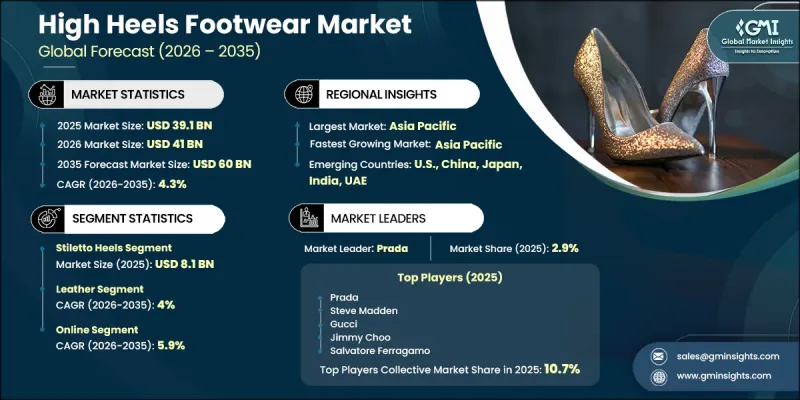
在都市化加快和時尚意識日益增強的推動下,消費者積極投資於能夠提升自身風格和整體形象的鞋履。高跟鞋依然是極具吸引力的時尚之選,尤其受到追求精緻潮流設計的消費者的青睞。全球趨勢的影響力不斷增強,加上數位平台帶來的曝光度提升,進一步推動了市場需求。此外,持續的產品創新和製造流程的改進,提升了鞋履的舒適度、耐用性和設計多樣性。儘管舒適度和長期穿著的耐用性仍是人們關注的焦點,但製造商正積極透過符合人體工學的設計和材料改良來應對這些挑戰。因此,市場正在風格與功能之間尋求平衡,從而確保不同客戶群對鞋履的持續興趣和長期成長潛力。
| 市場範圍 | |
|---|---|
| 開始年份 | 2025 |
| 預測期 | 2026-2035 |
| 上市時的市場規模 | 391億美元 |
| 預計金額 | 600億美元 |
| 複合年成長率 | 4.3% |
數位零售通路的擴張對高跟鞋市場的發展產生了顯著影響,使消費者能夠輕鬆獲得種類繁多、價格各異的產品。線上平台不僅提供了便利的購物體驗,也突破了地理限制,拓展了產品的供應範圍。同時,女性勞動參與率的不斷提高也支撐了市場需求,時尚鞋履也持續融入商務服裝。高跟鞋往往給人以優雅自信的印象,這也是它們在商務和半正式場合依然備受歡迎的原因之一。製造流程的進步也提升了產品的品質和多樣性,但人們對舒適性和健康的關注仍然存在,並持續影響產品開發策略。
預計到2025年,細高跟鞋市場規模將達到81億美元,並在2026年至2035年間以3.9%的複合年成長率成長。由於細高跟鞋與優雅和正式的時尚風格緊密相關,因此該細分市場保持著強勁的市場偏好。可支配收入的增加和時尚潮流的日益明朗正在影響消費者的購買行為,並維持著他們對這一品類的興趣,從而支撐著持續的需求。
預計到2025年,皮革鞋履市佔率將達到40%,並在2026年至2035年間以4%的複合年成長率成長。這個細分市場受益於消費者對耐用、高品質材料的強烈偏好,使皮革成為高跟鞋市場的高階之選。消費者對奢侈品的需求不斷成長,以及對精湛工藝的重視,持續推動皮革鞋履在各個消費群體中的廣泛普及。
預計到2025年,美國高跟鞋市場將佔據80%的市場佔有率,市場規模將達到44億美元。美國市場成長的主要驅動力是消費者偏好的轉變和可支配收入的增加。在時尚意識強、奢侈品購買通路便利的都市區,高跟鞋的需求依然強勁。完善的零售體系和大規模的勞動市場也為各種場合和風格的高跟鞋提供了穩定的市場偏好。
目錄
第1章:調查方法和範圍
第2章執行摘要
第3章業界考察
- 生態系分析
- 供應商情況
- 利潤率
- 每個階段增加的價值
- 影響價值鏈的因素
- 中斷
- 影響產業的因素
- 促進因素
- 產業潛在風險與挑戰
- 機會
- 成長潛力分析
- 2025年價格分析(基於初步調查)
- 對過去價格趨勢的分析
- 按業務類型分類的定價策略(溢價/價值/成本加成)
- 產品類型和技術世代導致的價格波動
- 消費者價格敏感度分析
- 監理情勢
- 各地區主要法規
- 歐盟:遵守 REACH 法規、皮革採購、勞工標準
- 美國:消費品安全委員會 (CPSC) 標準
- 中國:鞋類安全與標籤GB標準
- 印度:印度標準局 (BIS) 的品質標誌
- 合規要求
- 材料安全和化學品法規
- 勞工和道德採購認證
- 各地區主要法規
- 波特五力分析
- PESTEL 分析
- 科技與創新趨勢
- 當前技術趨勢
- 新興技術
- 未來市場趨勢
- 貿易資料分析(基於付費資料庫)(HS編碼:640299)
- 進出口數量和價值的變化趨勢
- 主要貿易走廊及關稅的影響
- 按技術類型和產品類型分類的分銷趨勢
- 人工智慧和生成式人工智慧對市場的影響
- 利用人工智慧改造現有經營模式
- 按細分市場分類的生成式人工智慧用例和部署藍圖
- 風險、限制和監管考量
- 分銷基礎設施和通路滲透狀況(基於初步調查)
- 按地區與業態(現代零售與傳統零售)分類的通路涵蓋範圍
- 最後一公里基礎設施缺口與新興管道變化
- 消費者購買行為
- 購買模式
- 偏好分析
- 不同地區的消費行為差異
- 電子商務對購買決策的影響
第4章 競爭情勢
- 介紹
- 企業市佔率分析
- 企業矩陣分析
- 主要市場公司的競爭分析
- 競爭定位矩陣
- 主要進展
- 併購
- 夥伴關係與合作
- 新產品發布
- 業務拓展計劃
第5章 市場估算與預測:依產品類型分類,2022-2035年
- 厚底高跟鞋
- 細高跟鞋
- 高跟靴
- 坡跟鞋
- 水泵浦
- 其他(古巴跟鞋、露跟鞋等)
第6章 市場估計與預測:依材料分類,2022-2035年
- 皮革
- 合成
- 材料
- 絨面革
第7章 市場估價與預測:依鞋跟高度分類,2022-2035年
- 低跟鞋(低於2吋)
- 中跟(2-3吋)
- 高跟鞋(3吋或以上)
第8章 市場估計與預測:依應用領域分類,2022-2035年
- 正裝/辦公服裝
- 派對和晚禮服
- 新娘
- 休閒裝/日常裝
- 其他(運動、表演等)
第9章 市場估價與預測:依最終用戶分類,2022-2035年
- 男性
- 女士
第10章 市場估價與預測:依通路分類,2022-2035年
- 線上
- 電子商務
- 企業網站
- 離線
- 超級市場/大賣場
- 專業零售店
- 其他(獨立零售商等)
第11章 市場估價與預測:按地區分類,2022-2035年
- 北美洲
- 美國
- 加拿大
- 歐洲
- 德國
- 英國
- 法國
- 西班牙
- 義大利
- 荷蘭
- 亞太地區
- 中國
- 日本
- 印度
- 澳洲
- 韓國
- 拉丁美洲
- 巴西
- 墨西哥
- 阿根廷
- 中東和非洲(MEA)
- 南非
- 沙烏地阿拉伯
- 阿拉伯聯合大公國
第12章:公司簡介
- 全球主要公司
- Gucci(Kering)
- Jimmy Choo
- Manolo Blahnik
- Prada Group
- Salvatore Ferragamo
- Stella International
- Steve Madden
- 按地區分類的主要公司
- Calcados Beira Rio
- Casadei
- Diana Corporation
- Giuseppe Zanotti
- Kangnai Group
- Rene Caovilla
- Vulcabras
- Emerging And Specialized Players
- Badgley Mischka
- Betsey Johnson
- M.Gemi
- Sergio Rossi
- Shoedazzle
- Suecomma Bonnie
- Tamara Mellon
The Global High Heels Footwear Market was valued at USD 39.1 billion in 2025 and is estimated to grow at a CAGR of 4.3% to reach USD 60 billion by 2035.
Increasing urbanization and heightened fashion awareness are encouraging consumers to invest in footwear that enhances style and overall appearance. High heels continue to hold strong appeal as a fashion-forward choice, particularly among consumers seeking sophisticated and trend-driven designs. The growing influence of global fashion trends, combined with increased exposure through digital platforms, is further strengthening demand. In addition, continuous product innovation and improvements in manufacturing techniques are enhancing comfort, durability, and design variety. While concerns around comfort and long-term wearability persist, manufacturers are actively addressing these issues through ergonomic designs and improved materials. As a result, the market is balancing style with functionality, ensuring sustained consumer interest and long-term growth potential across diverse customer segments.
| Market Scope | |
|---|---|
| Start Year | 2025 |
| Forecast Year | 2026-2035 |
| Start Value | $39.1 Billion |
| Forecast Value | $60 Billion |
| CAGR | 4.3% |
The expansion of digital retail channels has significantly influenced the growth of the high heels footwear market, providing consumers with easy access to a wide variety of products and price ranges. Online platforms enable convenient purchasing experiences and broaden product availability across regions. At the same time, increasing workforce participation among women is supporting demand, as professional attire continues to include fashion-oriented footwear. High heels are often associated with a polished and confident appearance, which contributes to their continued relevance in professional and semi-formal settings. Advancements in production processes are also enhancing product quality and variety, although ongoing concerns related to comfort and health considerations continue to shape product development strategies.
The stiletto heels segment generated USD 8.1 billion in 2025 and is expected to grow at a CAGR of 3.9% during 2026-2035. This segment maintains a strong presence due to its association with elegance and formal fashion preferences. Continued demand is supported by rising disposable income levels and increasing visibility of fashion trends, which influence consumer purchasing behavior and sustain interest in this category.
The leather segment accounted for 40% share in 2025 and is projected to grow at a CAGR of 4% from 2026 to 2035. This segment benefits from strong consumer preference for durable and high-quality materials, positioning leather as a premium choice in the high heels footwear market. The growing demand for luxury products and emphasis on craftsmanship continue to support the adoption of leather-based footwear across various consumer groups.
U.S. High Heels Footwear Market held 80% share in 2025, generating USD 4.4 billion. Market growth in the country is driven by evolving consumer preferences and increasing disposable income levels. Demand remains strong in urban areas, where fashion awareness and access to premium products are high. A well-established retail environment, combined with a large working population, continues to support consistent demand for high heels footwear across multiple occasions and style preferences.
Key companies operating in the Global High Heels Footwear Market include Gucci (Kering), Prada Group, Jimmy Choo, Manolo Blahnik, Salvatore Ferragamo, Steve Madden, Stella International, Giuseppe Zanotti, Casadei, Rene Caovilla, Kangnai Group, Vulcabras, Calcados Beira Rio, Diana Corporation, Sergio Rossi, M.Gemi, Badgley Mischka, Betsey Johnson, Shoedazzle, Suecomma Bonnie, and Tamara Mellon. Companies in the Global High Heels Footwear Market are strengthening their market position by focusing on design innovation, premium branding, and enhanced customer engagement. They are investing in new materials and ergonomic designs to improve comfort without compromising style. Expanding digital presence through e-commerce platforms and direct-to-consumer channels is a key strategy to reach a wider audience. Collaborations with fashion influencers and designers are being used to boost brand visibility and appeal. Companies are also diversifying product portfolios across price segments to cater to varying consumer preferences.
Table of Contents
Chapter 1 Methodology and scope
- 1.1 Research approach
- 1.2 Quality Commitments
- 1.2.1 GMI AI policy & data integrity commitment
- 1.2.1.1 Source consistency protocol
- 1.2.1 GMI AI policy & data integrity commitment
- 1.3 Research Trail & Confidence Scoring
- 1.3.1 Research Trail Components
- 1.3.2 Scoring Components
- 1.4 Data Collection
- 1.4.1 Partial list of primary sources
- 1.5 Data mining sources
- 1.5.1 Paid sources
- 1.5.1.1 Sources, by region
- 1.5.1 Paid sources
- 1.6 Base estimates and calculations
- 1.6.1 Base year calculation for any one approach
- 1.7 Forecast model
- 1.7.1 Quantified market impact analysis
- 1.7.1.1 Mathematical impact of growth parameters on forecast
- 1.7.1 Quantified market impact analysis
- 1.8 Research transparency addendum
- 1.8.1 Source attribution framework
- 1.8.2 Quality assurance metrics
- 1.8.3 Our commitment to trust
Chapter 2 Executive summary
- 2.1 Industry 360° synopsis
- 2.2 Key market trends
- 2.2.1 Regional
- 2.2.2 Product Type
- 2.2.3 Material
- 2.2.4 Heel Height
- 2.2.5 Application
- 2.2.6 End User
- 2.2.7 Distribution Channel
Chapter 3 Industry insights
- 3.1 Industry ecosystem analysis
- 3.1.1 Supplier landscape
- 3.1.2 Profit margin
- 3.1.3 Value addition at each stage
- 3.1.4 Factor affecting the value chain
- 3.1.5 Disruptions
- 3.2 Industry impact forces
- 3.2.1 Growth drivers
- 3.2.2 Industry pitfalls & challenges
- 3.2.3 Opportunities
- 3.3 Growth potential analysis
- 3.4 Pricing analysis, 2025 (driven by primary research)
- 3.4.1 Historical price trend analysis
- 3.4.2 Pricing strategy by player type (premium / value / cost-plus)
- 3.4.3 Price variation by product type & technology generation
- 3.4.4 Consumer price sensitivity analysis
- 3.5 Regulatory landscape
- 3.5.1 Key regulations by region
- 3.5.1.1 EU: REACH compliance, leather sourcing, labor standards
- 3.5.1.2 US: Consumer Product Safety Commission (CPSC) standards
- 3.5.1.3 China: GB standards for footwear safety and labeling
- 3.5.1.4 India: Bureau of Indian Standards (BIS) quality marks
- 3.5.2 Compliance requirements
- 3.5.2.1 Material safety and chemical restrictions
- 3.5.2.2 Labor and ethical sourcing certifications
- 3.5.1 Key regulations by region
- 3.6 Porter's analysis
- 3.7 PESTEL analysis
- 3.8 Technological and innovation landscape
- 3.8.1 Current technological trends
- 3.8.2 Emerging technologies
- 3.9 Future market trends
- 3.10 Trade data analysis (driven by paid database) (HS Code: 640299)
- 3.10.1 Import/export volume & value trends
- 3.10.2 Key trade corridors & tariff impact
- 3.10.3 Trade flow by technology type & product category
- 3.11 Impact of AI & generative ai on the market
- 3.11.1 AI-driven disruption of existing business models
- 3.11.2 GenAI use cases & adoption roadmap by segment
- 3.11.3 Risks, limitations & regulatory considerations
- 3.12 Distribution infrastructure & channel penetration landscape (driven by primary research)
- 3.12.1 Channel coverage by region & format (modern vs. traditional trade)
- 3.12.2 Last-mile infrastructure gaps & emerging channel shifts
- 3.13 Consumer buying behaviour
- 3.13.1 Purchasing patterns
- 3.13.2 Preference analysis
- 3.13.3 Regional variations in consumer behaviour
- 3.13.4 Impact of e-commerce on buying decisions
Chapter 4 Competitive landscape, 2025
- 4.1 Introduction
- 4.2 Company market share analysis
- 4.2.1 North America
- 4.2.2 Europe
- 4.2.3 Asia Pacific
- 4.2.4 Latin America
- 4.2.5 MEA
- 4.3 Company matrix analysis
- 4.4 Competitive analysis of major market players
- 4.5 Competitive positioning matrix
- 4.6 Key developments
- 4.6.1 Mergers & acquisitions
- 4.6.2 Partnerships & collaborations
- 4.6.3 New product launches
- 4.6.4 Expansion plans
Chapter 5 Market Estimates & Forecast, By Product Type, 2022 - 2035 ($Billion, Thousand Units)
- 5.1 Key trends
- 5.2 Platform heels
- 5.3 Stiletto heels
- 5.4 Heeled boots
- 5.5 Wedge heels
- 5.6 Pump heels
- 5.7 Others (cuban heels, slingbacks etc.)
Chapter 6 Market Estimates & Forecast, By Material, 2022 - 2035 ($Billion, Thousand Units)
- 6.1 Key trends
- 6.2 Leather
- 6.3 Synthetic
- 6.4 Fabric
- 6.5 Suede
Chapter 7 Market Estimates & Forecast, By Heel Height, 2022 - 2035 ($Billion, Thousand Units)
- 7.1 Key trends
- 7.2 Low heels (under 2 inches)
- 7.3 Mid heels (2-3 inches)
- 7.4 High heels (above 3 inches)
Chapter 8 Market Estimates & Forecast, By Application, 2022 - 2035 ($Billion, Thousand Units)
- 8.1 Key trends
- 8.2 Formal/office wear
- 8.3 Party/evening wear
- 8.4 Bridal
- 8.5 Casual/daily wear
- 8.6 Others (sports & performance etc.)
Chapter 9 Market Estimates & Forecast, By End User, 2022 - 2035 ($Billion, Thousand Units)
- 9.1 Key trends
- 9.2 Men
- 9.3 Women
Chapter 10 Market Estimates & Forecast, By Distribution Channel, 2022 - 2035 ($Billion, Thousand Units)
- 10.1 Key trends
- 10.2 Online
- 10.2.1 E-commerce
- 10.2.2 Company websites
- 10.3 Offline
- 10.3.1 Supermarkets/hypermarket
- 10.3.2 Specialty retail stores
- 10.3.3 Others (independent retailer etc.)
Chapter 11 Market Estimates & Forecast, By Region, 2022 - 2035 ($Billion, Thousand Units)
- 11.1 Key trends
- 11.2 North America
- 11.2.1 U.S.
- 11.2.2 Canada
- 11.3 Europe
- 11.3.1 Germany
- 11.3.2 UK
- 11.3.3 France
- 11.3.4 Spain
- 11.3.5 Italy
- 11.3.6 Netherlands
- 11.4 Asia Pacific
- 11.4.1 China
- 11.4.2 Japan
- 11.4.3 India
- 11.4.4 Australia
- 11.4.5 South Korea
- 11.5 Latin America
- 11.5.1 Brazil
- 11.5.2 Mexico
- 11.5.3 Argentina
- 11.6 MEA
- 11.6.1 South Africa
- 11.6.2 Saudi Arabia
- 11.6.3 UAE
Chapter 12 Company Profiles
- 12.1 Top Global Players
- 12.1.1 Gucci (Kering)
- 12.1.2 Jimmy Choo
- 12.1.3 Manolo Blahnik
- 12.1.4 Prada Group
- 12.1.5 Salvatore Ferragamo
- 12.1.6 Stella International
- 12.1.7 Steve Madden
- 12.2 Regional Key Players
- 12.2.1 Calcados Beira Rio
- 12.2.2 Casadei
- 12.2.3 Diana Corporation
- 12.2.4 Giuseppe Zanotti
- 12.2.5 Kangnai Group
- 12.2.6 Rene Caovilla
- 12.2.7 Vulcabras
- 12.3 Emerging And Specialized Players
- 12.3.1 Badgley Mischka
- 12.3.2 Betsey Johnson
- 12.3.3 M.Gemi
- 12.3.4 Sergio Rossi
- 12.3.5 Shoedazzle
- 12.3.6 Suecomma Bonnie
- 12.3.7 Tamara Mellon

 舒適鞋履市場:規模、佔有率、成長、全球產業分析、區域趨勢及2026-2034年預測
 騎行鞋市場規模、佔有率和成長分析:按產品類型、緊固件類型、踏板相容性、材料類型、最終用戶、分銷管道和地區分類-2026-2033年產業預測
 PVC鞋類市場規模、佔有率和成長分析:按產品類型、最終用戶、應用、分銷管道、價格範圍、材料類型和地區分類-2026-2033年產業預測
 女性用非運動鞋市場-全球產業規模、佔有率、趨勢、機會、預測:按類型、類別、銷售管道、地區和競爭格局分類,2021-2031年
 鞋類市場:依類別、消費者群、零售通路及地區分類赤腳鞋市場:依鞋扣類型、材料、銷售管道和地區分類。
 鞋用防磨膠帶市場規模、佔有率和成長分析:按產品類型、材料、價格範圍、應用、最終用途、消費者群體、分銷管道和地區分類-產業預測,2026-2033年
 赤腳鞋市場:2026-2032年全球市場預測(按產品類型、鞋頭設計、材料、應用、最終用戶和分銷管道分類)訓練鞋市場規模、佔有率、成長及全球產業分析:按類型、應用和地區分類的洞察,2026-2034 年預測鞋類市場:2026-2032年全球預測,依產品類型、材料類型、年齡層、最終用途、類別及分銷通路分類