

 |
市場調查報告書
商品編碼
2038323
商業清潔市場機會、成長要素、產業趨勢分析及2026-2035年預測。Commercial Cleaning Market Opportunity, Growth Drivers, Industry Trend Analysis, and Forecast 2026 - 2035 |
||||||

預計到 2025 年,全球商業清潔市場價值將達到 672 億美元,並預計以 7.6% 的複合年成長率成長,到 2035 年達到 1,404 億美元。
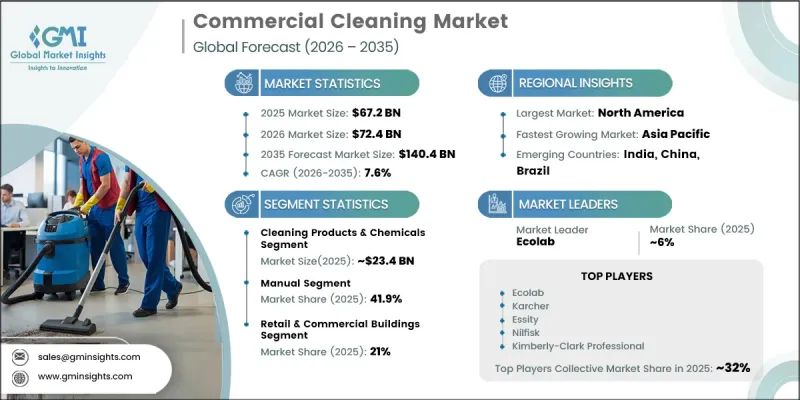
由於先進技術和自動化技術在清潔營運整體的融合,清潔產業正蓬勃發展。企業越來越重視維持衛生清潔的環境,以滿足不斷變化的客戶期望和監管標準。這種轉變加速了對更有效率、更具創新性的清潔解決方案的需求。人工智慧 (AI) 和機器學習驅動的機器人清潔設備的興起,透過實現自主導航和精準清潔,正在顯著提升營運效率。這些系統能夠分析環境、最佳化清潔路線並自主運行,使其在各種商業場所中展現出卓越的效能。技術創新持續推動產業擴張,重塑清潔服務的交付方式,同時提升了整個產業的生產力和一致性。
| 市場範圍 | |
|---|---|
| 開始年份 | 2025 |
| 預測期 | 2026-2035 |
| 上市時的市場規模 | 672億美元 |
| 預測金額 | 1404億美元 |
| 複合年成長率 | 7.6% |
預計到2025年,清潔用品和化學品市場規模將達到234億美元,並在2026年至2035年間以8.2%的複合年成長率成長。該細分市場在日常清潔流程中發揮著至關重要的作用,因此仍然是市場的核心組成部分。此細分市場涵蓋了各種消耗性解決方案,例如消毒劑、清潔劑、除油劑和表面處理劑,這些產品廣泛應用於從一般維護到專業衛生管理等各種場合。由於這些產品在需要頻繁且徹底清潔的環境中持續使用,因此市場需求穩定。對這些消耗品的定期採購需求確保了穩定的收入來源,並鞏固了該細分市場在市場格局中的領先地位。
由於其柔軟性和成本效益,人工清潔預計到2025年將佔據41.9%的市場佔有率。該領域涵蓋需要注重細節和靈活應變的實際清潔任務,而這些任務可能無法完全透過自動化系統實現。人工清潔方法仍然被廣泛使用,因為它能夠進行針對性清潔並立即應對不斷變化的情況。儘管自動化技術取得了進步,但人工清潔在維持清潔標準方面仍然發揮著至關重要的作用,尤其是在需要精準操作和現場判斷的情況下。
美國商業清潔市場預計到2025年將達到194億美元,並在2026年至2035年間以7.5%的複合年成長率成長,從而帶動北美市場的發展。美國強大的市場地位得益於其完善的商業基礎設施、嚴格的法規結構以及成熟的清潔服務外包文化。高標準的衛生和安全要求,以及環保清潔方案的普及和不斷完善的、強調遵守健康衛生標準的職場政策,持續推動市場需求的穩定成長。
目錄
第1章:調查方法和範圍
第2章執行摘要
第3章業界考察
- 生態系分析
- 零件供應商
- 製造地
- 配電網結構
- 供應鏈脆弱性與風險因素
- 垂直整合趨勢
- 利潤率
- 每個階段增加的價值
- 影響價值鏈的因素
- 影響產業的因素
- 促進因素
- 提高衛生標準和感染控制意識
- 人手不足和人事費用上升正在推動自動化技術的普及。
- 對永續和環保清潔產品的需求
- 挑戰與限制
- 對機器人/自動化設備的高初始投資
- 價格敏感型市場採用延遲
- 機會
- 對衛生和健康標準的需求日益成長
- 拓展專業且環保的清潔服務
- 促進因素
- 成長潛力分析
- 未來市場趨勢
- 科技與創新趨勢
- 當前技術趨勢
- 新興技術
- 價格趨勢
- 按地區
- 依產品
- 對過去價格趨勢的分析
- 按玩家類型分類的定價策略
- 監理情勢
- 全球監管標準
- 歐洲
- 設備安全標準(EN標準)
- 化學品監管
- 環境和廢棄物管理要求
- 各國監管狀況
- 德國
- 英國
- 法國
- 義大利
- 西班牙
- 亞太地區
- 中國
- GB標準
- CCC認證
- 環境保護法
- 印度
- 日本
- 韓國
- 中國
- 東協內部協調努力
- 北美洲
- 美國
- OSHA 要求
- 美國環保署環境設計計劃
- 州級法規
- 加拿大
- 美國
- 新的監管趨勢
- 自主設備安全標準
- 物聯網清潔系統的資料隱私
- 碳足跡和ESG資訊揭露要求
- 關鍵市場趨勢與轉型
- 科技與創新趨勢
- 當前技術趨勢
- 新興技術
- 2025年價格分析
- 按地區
- 對過去價格趨勢的分析(基於初步研究)
- 根據球員類型(高階/超值/成本加成)制定的定價策略(基於初步研究)
- 區域價格波動分析
- 未來市場趨勢
- 貿易資料分析(基於付費資料庫)(HS編碼998533)
- 進出口量及進口額趨勢
- 設備貿易流量
- 產品貿易流量
- 進出口的區域集中度
- 主要貿易路線及關稅的影響(基於初步調查)
- 人工智慧和生成式人工智慧對市場的影響
- 利用人工智慧改造現有經營模式
- GenAI 各細分市場的應用案例與實施藍圖
- 風險、限制和監管考量
- 波特五力分析
- PESTEL 分析
- 基礎架構和部署狀態
- 按地區和最終用戶群體分類的採用率和滲透率
- 自動化和機器人設備的滲透率
- 按設施類型分類的實施狀態
- 基礎設施投資的可擴展性限制和趨勢
- 購買行為和採購分析(基於初步研究)
- 決策單元(DMU)的結構
- 按最終使用者類型分類的關鍵決策者
- 有影響力的相關人員的作用
- 核准層級與預算權限
- 基於組織規模的差異
- 採購標準和供應商評估流程
- 購買與租賃/租用偏好
- 設備更換週期和升級
- 各型號平均壽命
- 更新
- 終端用戶產業採購行為的差異
- 決策單元(DMU)的結構
第4章 競爭情勢
- 介紹
- 企業市佔率分析
- 按地區
- 北美洲
- 歐洲
- 亞太地區
- 拉丁美洲
- 中東和非洲
- 按地區
- 企業矩陣分析
- 主要市場公司的競爭分析
- 競爭定位矩陣
- 主要進展
- 併購
- 夥伴關係與合作
- 新產品發布
- 業務拓展計劃
第5章 市場估算與預測:依產品類型分類,2022-2035年
- 洗地機
- 推式地面清潔機
- 搭乘用式地面清潔機
- 小型地面清潔機
- 大型工業地面清洗機
- 地板吸塵器
- 推式地面清掃機
- 搭乘用式地面清潔機
- 小型地面清掃機
- 大型工業地面清洗機
- 工業吸塵器
- 乾式吸塵器
- 濕式吸塵器
- 乾濕兩用吸塵器
- 高壓清洗機和蒸氣清洗機
- 電動高壓清洗機
- 汽油動力高壓清洗機
- 熱水高壓清洗機
- 蒸氣清潔器
- 地毯清潔設備
- 地毯清洗機
- 地毯清洗機
- 引擎蓋清潔劑
- 乾式地毯清洗機
- 專用清潔設備
- 地板拋光機和打磨機
- 窗戶清潔設備
- 電扶梯清潔機
- 紫外線消毒器
- 其他(游泳池清潔機、廁所衛生設備)
- 清潔產品和化學品
- 消毒劑和清潔劑
- 脫脂劑
- 地板清潔和維護設備
- 玻璃和表面清潔劑
- 多用途清潔劑
- 專業清潔劑(適用於地毯、浴室、廚房和室外)
- 環保/綠色清潔產品
- 清潔工具/耗材
- 拖把桶
- 掃帚和簸箕
- 擦拭巾和抹布
- 紙製品(紙巾、毛巾)
- 其他(手推車、平板車、刷子)
第6章 市場估計與預測:依投資類型分類,2022-2035年
- 手動清潔裝置
- 半自動清潔裝置
- 全自動清潔系統
- 室內機器人清潔設備
- 戶外機器人清潔設備
第7章 市場估計與預測:依最終用途產業分類,2022-2035年
- 衛生保健
- 飯店業
- 零售和商業設施
- 製造和工業設施
- 教育
- 運輸
- 倉儲/物流
- 食品/飲料加工
- 政府和公共基礎設施
- 其他
第8章 市場估計與預測:依地區分類,2022-2035年
- 北美洲
- 美國
- 加拿大
- 歐洲
- 德國
- 英國
- 法國
- 義大利
- 西班牙
- 亞太地區
- 中國
- 印度
- 日本
- 韓國
- 澳洲
- 拉丁美洲
- 巴西
- 墨西哥
- 阿根廷
- 中東和非洲(MEA)
- 沙烏地阿拉伯
- 阿拉伯聯合大公國
- 南非
第9章:公司簡介
- 世界公司
- Tennant Company
- Karcher
- Nilfisk
- Hako
- IPC Group
- Ecolab
- Diversey
- Rubbermaid Commercial Products
- Kimberly-Clark Professional
- 3M Commercial Solutions
- Essity
- Georgia-Pacific Professional
- 當地公司
- Fimap
- Columbus
- Minuteman International
- Betco Corporation
- Aebi Schmidt
- Windsor
- Sanitaire Commercial
- Spartan Chemical
- Vikan
- 新興企業
- Gaussian Robotics
- Avidbots
- LionsBot
- ICE Cobotics
The Global Commercial Cleaning Market was valued at USD 67.2 billion in 2025 and is estimated to grow at a CAGR of 7.6% to reach USD 140.4 billion by 2035.
The industry is gaining momentum through the integration of advanced technologies and automation across cleaning operations. Businesses are placing greater importance on maintaining hygienic, sanitized environments to align with evolving customer expectations and regulatory standards. This shift is accelerating the demand for more efficient and innovative cleaning solutions. The rise of robotic cleaning equipment, powered by artificial intelligence and machine learning, is transforming operational efficiency by enabling autonomous navigation and precision-based cleaning. These systems can analyze environments, optimize cleaning routes, and function independently, making them highly effective across a variety of commercial settings. Technological innovation continues to serve as a major catalyst for industry expansion, reshaping how cleaning services are delivered while improving productivity and consistency across the sector.
| Market Scope | |
|---|---|
| Start Year | 2025 |
| Forecast Year | 2026-2035 |
| Start Value | $67.2 Billion |
| Forecast Value | $140.4 Billion |
| CAGR | 7.6% |
The cleaning products and chemicals segment generated USD 23.4 billion in 2025 and is expected to grow at a CAGR of 8.2% from 2026 through 2035. This segment remains a core component of the market due to its essential role in everyday cleaning processes. It includes a broad portfolio of consumable solutions such as disinfectants, detergents, degreasers, and surface treatment agents that are required for both general maintenance and specialized sanitation needs. Demand for these products remains steady due to their continuous usage in environments that require frequent and thorough cleaning. The recurring nature of these supplies ensures consistent revenue generation, reinforcing the segment's strong position within the overall market landscape.
The manual cleaning segment accounted for 41.9% share in 2025, owing to its flexibility and cost efficiency. This segment involves hands-on cleaning tasks that require attention to detail and adaptability, which automated systems may not fully achieve. Manual methods remain widely utilized because they allow for targeted cleaning and immediate response to varying conditions. Despite advancements in automation, human-driven cleaning continues to play a crucial role in maintaining cleanliness standards, particularly where precision and situational judgment are required.
United States Commercial Cleaning Market reached USD 19.4 billion in 2025 and is forecasted to grow at a CAGR of 7.5% between 2026 and 2035, leading the North American region. The country's strong market position is supported by extensive commercial infrastructure, strict regulatory frameworks, and a well-established culture of outsourcing cleaning services. High standards for hygiene and safety continue to drive consistent demand, along with the adoption of environmentally responsible cleaning solutions and evolving workplace policies that emphasize health and sanitation compliance.
Key companies operating in the Global Commercial Cleaning Market include Tennant Company, Karcher, Nilfisk, Hako, IPC Group, Ecolab, Diversey, Rubbermaid Commercial Products, Kimberly-Clark Professional, 3M Commercial Solutions, Essity, Georgia-Pacific Professional, Fimap, Columbus, Minuteman International, Betco Corporation, Aebi Schmidt, Windsor, Sanitaire Commercial, Spartan Chemical, Vikan, Gaussian Robotics, Avidbots, LionsBot, and ICE Cobotics. Companies in the Commercial Cleaning Market are focusing on innovation, strategic partnerships, and geographic expansion to strengthen their competitive position. Many players are investing heavily in research and development to introduce advanced cleaning technologies, including AI-powered and autonomous equipment. Firms are also forming collaborations and distribution alliances to enhance market reach and improve supply chain efficiency. Sustainability initiatives, such as eco-friendly product development and reduced chemical usage, are becoming central to brand positioning. Additionally, companies are expanding service portfolios and offering integrated cleaning solutions to meet diverse client needs.
Table of Contents
Chapter 1 Methodology & Scope
- 1.1 Market scope & definitions
- 1.2 Research design
- 1.2.1 Research approach
- 1.2.2 Data collection methods
- 1.3 Base estimates and calculations
- 1.3.1 Base year calculation
- 1.3.2 Market estimates & forecasts parameters
- 1.4 Forecast Model
- 1.4.1 Key trends for market estimates
- 1.4.2 Quantified market impact analysis
- 1.4.2.1 Mathematical impact of growth parameters on forecast
- 1.4.3 Scenario analysis framework
- 1.5 Primary research and validation
- 1.5.1 Some of the primary sources (but not limited to)
- 1.6 Data mining sources
- 1.6.1 Paid Sources
- 1.7 Primary research and validation
- 1.7.1 Primary sources
- 1.8 Research Trail & confidence scoring
- 1.8.1 Research trail components
- 1.8.2 Scoring components
- 1.9 Research transparency addendum
- 1.9.1 Source attribution framework
- 1.9.2 Quality assurance metrics
- 1.9.3 Our commitment to trust
- 1.10 Market Definitions
Chapter 2 Executive Summary
- 2.1 Industry 360° synopsis
- 2.2 Key market trends
- 2.2.1 Regional
- 2.2.2 Product type
- 2.2.3 Mode of Operation
- 2.2.4 End use industry
Chapter 3 Industry Insights
- 3.1 Industry ecosystem analysis
- 3.1.1 Component suppliers
- 3.1.2 Manufacturing hubs
- 3.1.3 Distribution network structure
- 3.1.4 Supply chain vulnerabilities & risk factors
- 3.1.5 Vertical integration trends
- 3.1.6 Profit margin
- 3.1.7 Value addition at each stage
- 3.1.8 Factor affecting the value chain
- 3.2 Industry impact forces
- 3.2.1 Growth drivers
- 3.2.1.1 Rising hygiene standards and infection control awareness
- 3.2.1.2 Labor shortage and rising labor costs driving automation adoption
- 3.2.1.3 Sustainability and green cleaning product demand
- 3.2.2 Challenges & restraints
- 3.2.2.1 High initial capital investment for robotic/automated equipment
- 3.2.2.2 Slow adoption in price-sensitive markets
- 3.2.3 Opportunities
- 3.2.3.1 Growing demand for hygiene & health standards
- 3.2.3.2 Expansion of specialized & eco-friendly cleaning services
- 3.2.1 Growth drivers
- 3.3 Growth potential analysis
- 3.4 Future market trends
- 3.5 Technology and innovation landscape
- 3.5.1 Current technological trends
- 3.5.2 Emerging technologies
- 3.6 Price trends
- 3.6.1 By region
- 3.6.2 By product
- 3.6.3 Historical price trend analysis
- 3.6.4 Pricing strategy by player type
- 3.7 Regulatory landscape
- 3.7.1 Global regulatory standards
- 3.7.2 Europe
- 3.7.2.1 Equipment Safety Standards (EN Standards)
- 3.7.2.2 Chemical Product Regulations
- 3.7.2.3 Environmental and Waste Management Requirements
- 3.7.3 Country specific regulatory scenario
- 3.7.3.1 Germany
- 3.7.3.2 UK
- 3.7.3.3 France
- 3.7.3.4 Italy
- 3.7.3.5 Spain
- 3.7.4 Asia Pacific
- 3.7.4.1 China
- 3.7.4.1.1 GB Standards
- 3.7.4.1.2 CCC Certification
- 3.7.4.1.3 Environmental Protection Law
- 3.7.4.2 India
- 3.7.4.3 Japan
- 3.7.4.4 South Korea
- 3.7.4.1 China
- 3.7.5 ASEAN Harmonization Efforts
- 3.7.6 North America
- 3.7.6.1 United States
- 3.7.6.1.1 OSHA Requirements
- 3.7.6.1.2 EPA DfE Program
- 3.7.6.2 State-Level Regulations
- 3.7.6.3 Canada
- 3.7.6.1 United States
- 3.7.7 Emerging Regulatory Trends
- 3.7.8 Autonomous equipment safety standards
- 3.7.9 Data privacy for IoT-enabled cleaning systems
- 3.7.10 Carbon footprint and ESG Disclosure Requirements
- 3.8 Major market trends and disruptions
- 3.9 Technological and innovation landscape
- 3.9.1 Current technological trends
- 3.9.2 Emerging technologies
- 3.10 Pricing analysis, 2025
- 3.10.1 By region
- 3.10.2 Historical Price Trend Analysis (Driven by Primary Research)
- 3.10.3 Pricing Strategy by Player Type (Premium / Value / Cost-Plus) (Driven by Primary Research)
- 3.10.4 Regional Price Variance Analysis
- 3.11 Future market trends
- 3.12 Trade data analysis (driven by paid database) (HS Code 998533)
- 3.12.1 Import/Export Volume & Value Trends
- 3.12.2 Equipment Trade Flows
- 3.12.3 Product Trade Flows
- 3.12.4 Regional Import/Export Concentration
- 3.12.5 Key Trade Corridors & Tariff Impact (Driven by Primary Research)
- 3.13 Impact of AI & generative AI on the market
- 3.13.1 AI-driven disruption of existing business models
- 3.13.2 GenAI use cases & adoption roadmap by segment
- 3.13.3 Risks, limitations & regulatory considerations
- 3.14 Porter's analysis
- 3.15 PESTEL analysis
- 3.16 Infrastructure & deployment landscape
- 3.16.1 Deployment penetration by region & end-user segment
- 3.16.2 Automated/robotic equipment penetration rates
- 3.16.3 Facility type adoption
- 3.16.4 Scalability constraints & infrastructure investment trends
- 3.17 Buyer Behavior & Procurement Analysis (Driven by Primary Research)
- 3.17.1 Decision-Making Unit (DMU) Structure
- 3.17.1.1 Key Decision Makers by End-User Type
- 3.17.1.2 Influencer Roles
- 3.17.1.3 Approval Hierarchy and Budget Authority
- 3.17.1.4 Differences Across Organization Sizes
- 3.17.2 Purchase Criteria & Vendor Evaluation Process
- 3.17.3 Buy vs. Lease/Rental Preferences
- 3.17.4 Equipment Replacement Cycles & Upgrade
- 3.17.4.1 Average Equipment Lifespan by Type
- 3.17.4.2 Replacement
- 3.17.5 Procurement Behavior Variations by End-User Industry
- 3.17.1 Decision-Making Unit (DMU) Structure
Chapter 4 Competitive Landscape, 2025
- 4.1 Introduction
- 4.2 Company market share analysis
- 4.2.1 By Region
- 4.2.1.1 North America
- 4.2.1.2 Europe
- 4.2.1.3 Asia Pacific
- 4.2.1.4 Latin America
- 4.2.1.5 Middle East & Africa
- 4.2.1 By Region
- 4.3 Company matrix analysis
- 4.4 Competitive analysis of major market players
- 4.5 Competitive positioning matrix
- 4.6 Key developments
- 4.6.1 Mergers & acquisitions
- 4.6.2 Partnerships & collaborations
- 4.6.3 New product launches
- 4.6.4 Expansion plans
Chapter 5 Market Estimates & Forecast, By Product Type, 2022 - 2035, (USD Billion) (Thousand Units)
- 5.1 Key trends
- 5.2 Floor scrubbers
- 5.2.1 Walk-behind floor scrubbers
- 5.2.2 Ride-on floor scrubbers
- 5.2.3 Compact floor scrubbers
- 5.2.4 Industrial heavy-duty floor scrubbers
- 5.3 Floor sweepers
- 5.3.1 Walk-behind floor sweepers
- 5.3.2 Ride-on floor sweepers
- 5.3.3 Compact floor sweepers
- 5.3.4 Industrial heavy-duty floor sweepers
- 5.4 Industrial vacuums
- 5.4.1 Dry vacuums
- 5.4.2 Wet vacuums
- 5.4.3 Wet-dry combination vacuums
- 5.5 Pressure washers & steam cleaners
- 5.5.1 Electric pressure washers
- 5.5.2 Gas-powered pressure washers
- 5.5.3 Hot water pressure washers
- 5.5.4 Steam cleaners
- 5.6 Carpet cleaning equipment
- 5.6.1 Carpet extractors
- 5.6.2 Carpet shampooers
- 5.6.3 Bonnet cleaners
- 5.6.4 Dry carpet cleaning machines
- 5.7 Specialty cleaning equipment
- 5.7.1 Floor polishers & buffers
- 5.7.2 Window cleaning equipment
- 5.7.3 Escalator cleaners
- 5.7.4 UV disinfection equipment
- 5.7.5 Others (pool cleaners, restroom sanitation equipment)
- 5.8 Cleaning products & chemicals
- 5.8.1 Disinfectants & sanitizers
- 5.8.2 Degreasers
- 5.8.3 Floor cleaners & maintainers
- 5.8.4 Glass & surface cleaners
- 5.8.5 All-purpose cleaners
- 5.8.6 Specialty cleaners (carpet, bathroom, kitchen, outdoor)
- 5.8.7 Eco-friendly/green cleaning products
- 5.9 Cleaning tools & supplies
- 5.9.1 Mops & buckets
- 5.9.2 Brooms & dustpans
- 5.9.3 Wipes & cloths
- 5.9.4 Paper products (tissue, towels)
- 5.9.5 Others (trolleys, carts, brushes)
Chapter 6 Market Estimates & Forecast, By Mode of Operation, 2022 - 2035, (USD Billion) (Thousand Units)
- 6.1 Key trends
- 6.2 Manual cleaning equipment
- 6.3 Semi-automated cleaning equipment
- 6.4 Fully automated cleaning equipment
- 6.4.1 Indoor robotic cleaning equipment
- 6.4.2 Outdoor robotic cleaning equipment
Chapter 7 Market Estimates & Forecast, By End Use Industry, 2022 - 2035, (USD Billion) (Thousand Units)
- 7.1 Key trends
- 7.2 Healthcare
- 7.3 Hospitality
- 7.4 Retail & commercial buildings
- 7.5 Manufacturing & industrial facilities
- 7.6 Education
- 7.7 Transportation
- 7.8 Warehousing & logistics
- 7.9 Food & beverage processing
- 7.10 Government & public infrastructure
- 7.11 Others
Chapter 8 Market Estimates & Forecast, By Region, 2022 - 2035, (USD Billion) (Thousand Units)
- 8.1 Key trends
- 8.2 North America
- 8.2.1 U.S.
- 8.2.2 Canada
- 8.3 Europe
- 8.3.1 Germany
- 8.3.2 UK
- 8.3.3 France
- 8.3.4 Italy
- 8.3.5 Spain
- 8.4 Asia Pacific
- 8.4.1 China
- 8.4.2 India
- 8.4.3 Japan
- 8.4.4 South Korea
- 8.4.5 Australia
- 8.5 Latin America
- 8.5.1 Brazil
- 8.5.2 Mexico
- 8.5.3 Argentina
- 8.6 MEA
- 8.6.1 Saudi Arabia
- 8.6.2 UAE
- 8.6.3 South Africa
Chapter 9 Company Profiles
- 9.1 Global Players
- 9.1.1 Tennant Company
- 9.1.2 Karcher
- 9.1.3 Nilfisk
- 9.1.4 Hako
- 9.1.5 IPC Group
- 9.1.6 Ecolab
- 9.1.7 Diversey
- 9.1.8 Rubbermaid Commercial Products
- 9.1.9 Kimberly-Clark Professional
- 9.1.10 3M Commercial Solutions
- 9.1.11 Essity
- 9.1.12 Georgia-Pacific Professional
- 9.2 Regional Players
- 9.2.1 Fimap
- 9.2.2 Columbus
- 9.2.3 Minuteman International
- 9.2.4 Betco Corporation
- 9.2.5 Aebi Schmidt
- 9.2.6 Windsor
- 9.2.7 Sanitaire Commercial
- 9.2.8 Spartan Chemical
- 9.2.9 Vikan
- 9.3 Emerging Players
- 9.3.1 Gaussian Robotics
- 9.3.2 Avidbots
- 9.3.3 LionsBot
- 9.3.4 ICE Cobotics

 乾洗衣櫃市場規模、佔有率和成長分析:按產品類型、材料、應用、產能、分銷管道和地區分類-2026-2033年產業預測
 商用清潔用品市場:全球市場預測(2026-2032)桌面及辦公室清潔劑市場:全球市場按產品類型、包裝、應用、最終用戶和分銷管道分類的預測,2026-2032年
 商用清潔用品市場 - 全球產業規模、佔有率、趨勢、競爭格局、機會及預測(按產品、最終用途、分銷管道、地區和競爭格局分類),2021-2031年
 商用清潔用品市場規模、佔有率和成長分析(按產品類型、最終用途、包裝類型、清潔機制、分銷管道和地區分類)-2026-2033年產業預測
 全球商用清潔產品市場