

 |
市場調查報告書
商品編碼
2038303
量子退火處理器市場機會、成長要素、產業趨勢分析及2026-2035年預測Quantum Annealing Processor Market Opportunity, Growth Drivers, Industry Trend Analysis, and Forecast 2026 - 2035 |
||||||

全球量子退火處理器市場預計到 2025 年將價值 2,750 萬美元,年複合成長率達 46.4%,到 2035 年將達到 12 億美元。
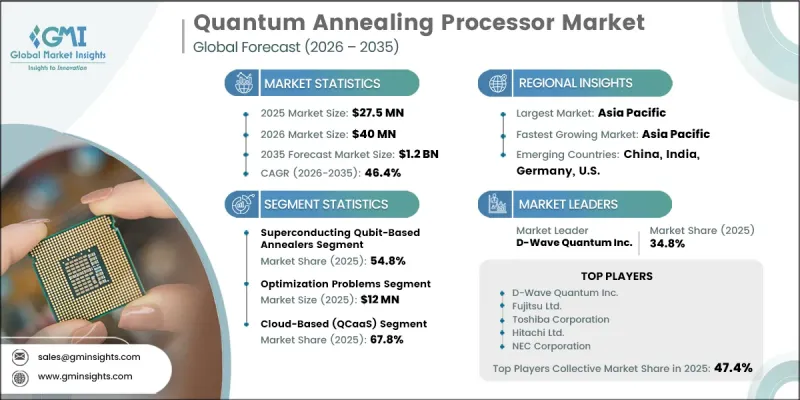
推動市場擴張的因素包括:對能夠處理大型複雜資料集的先進計算系統的需求不斷成長,以及基於最佳化的計算在物流和金融等行業的日益普及。企業環境中智慧決策支援工具的廣泛應用進一步刺激了這項需求。公共和私人對量子技術研發的大力投資正在加速其商業化進程。此外,提高組合和最佳化密集型問題的處理速度的需求正促使各行業轉向基於量子退火的解決方案。不斷擴大的研發舉措以及量子運算與傳統系統的日益整合也進一步推動了市場滲透。
| 市場範圍 | |
|---|---|
| 開始年份 | 2025 |
| 預測期 | 2026-2035 |
| 上市時的市場規模 | 2750萬美元 |
| 預測金額 | 12億美元 |
| 複合年成長率 | 46.4% |
對先進高效能運算能力日益成長的需求是市場成長的主要驅動力。隨著運算挑戰日趨複雜,傳統運算系統難以高效處理大規模最佳化問題。這一限制推動了基於量子計算方法的開發和應用。同時,政府和企業正在加大對量子基礎設施的投資,以增強其研發和部署能力。交通規劃、供應鏈管理和金融建模等領域對最佳化密集型流程的日益依賴也加速了量子運算方法的應用。各組織越來越注重透過更快、更準確的決策工具來提高營運效率,這推動了對量子退火處理器的需求。量子運算與企業分析平台的日益融合,以及混合運算模型實驗研究的不斷增多,也促進了市場的發展。
基於超導性量子位元的退火裝置憑藉其相對成熟的架構和高效處理大規模最佳化任務的能力,預計到2025年將佔據54.8%的市場佔有率。這些系統非常適合解決複雜問題,因為它們具有更高的量子位元連接性和更優的運算映射能力。在商業和研究領域的不斷擴展應用進一步鞏固了其市場主導地位。
預計從2025年到2035年,本地部署市場將以60%的複合年成長率成長。這一成長主要得益於越來越多的組織機構需要安全、可控且低延遲地存取量子處理系統。研究機構、政府機構和企業用戶更傾向於採用本地環境來處理敏感操作和關鍵任務工作負載。此外,系統配置的可自訂性和嚴格的資料控制能力也進一步推動了對這種部署模式的需求。
預計到2025年,北美量子退火處理器市佔率將達到31.4%。該地區正經歷強勁成長,這得益於聯邦政府持續的研究舉措以及領先科技公司和國家研究機構主導的早期商業化進程。國防、能源最佳化和科學研究領域日益成長的需求正在加速系統部署。高度發展的計算生態系統為快速實驗和部署提供了支援。除了政府的持續支持外,專注於量子技術進步的公私合營合作計畫也進一步推動了該地區的市場成長。
目錄
第1章:調查方法和範圍
第2章執行摘要
第3章業界考察
- 生態系分析
- 供應商情況
- 利潤率
- 成本結構
- 每個階段增加的價值
- 影響價值鏈的因素
- 中斷
- 影響產業的因素
- 促進因素
- 對高效能運算的需求日益成長
- 物流和金融領域需要解決複雜的最佳化問題
- 人工智慧和機器學習的發展
- 政府和科技公司對量子計算研究的投資
- 對更快數據處理的需求
- 產業潛在風險與挑戰
- 量子退火處理器系統成本高且基礎設施複雜
- 量子退火技術的應用領域及其局限性
- 市場機遇
- 在多個產業中擴展最佳化應用
- 量子退火技術在人工智慧和機器學習工作流程中的應用日益廣泛
- 促進因素
- 成長潛力分析
- 監理情勢
- 波特五力分析
- PESTEL 分析
- 科技與創新趨勢
- 當前技術趨勢
- 新興技術
- 價格趨勢
- 按地區
- 依產品
- 定價策略
- 新興經營模式
- 合規要求
- 專利和智慧財產權分析
第4章 競爭情勢
- 介紹
- 企業市佔率分析
- 按地區
- 市場集中度分析
- 主要公司的競爭標竿分析
- 財務績效比較
- 銷售量
- 利潤率
- 研究與發展(R&D)
- 產品系列比較
- 產品線寬度
- 科技
- 創新
- 區域擴張比較
- 全球擴張分析
- 服務網路覆蓋
- 按地區分類的市場滲透率
- 競爭定位矩陣
- 領導者
- 挑戰者
- 追蹤者
- 小眾玩家
- 戰略展望矩陣
- 財務績效比較
- 主要進展
- 併購
- 夥伴關係和聯盟
- 技術進步
- 業務拓展與投資策略
- 數位轉型計劃
- 新興/新創競爭對手的發展趨勢
第5章 市場估算與預測:依處理器架構分類,2022-2035年
- 基於超導性量子位元的退火裝置
- 磁通量子比特系統
- RF-SQUID架構
- 其他
- 新興架構
- 光子/光退火器
- 離子阱退火系統
- 中性原子平台
- 混合多量子位元系統
第6章 市場估計與預測:依應用領域分類,2022-2035年
- 最佳化問題
- 材料科學與分子模擬
- 抽樣和機率建模
第7章 市場估算與預測:依部署類型分類,2022-2035年
- 基於雲端的(QCaaS)
- 現場
第8章 市場估算與預測:依最終用戶產業分類,2022-2035年
- BFSI
- 醫療和製藥
- 物流/運輸
- 製造業和工業
- 能源與公共產業
- 政府、國防和研究
- 其他
第9章 市場估計與預測:依地區分類,2022-2035年
- 北美洲
- 美國
- 加拿大
- 歐洲
- 德國
- 英國
- 法國
- 西班牙
- 義大利
- 俄羅斯
- 亞太地區
- 中國
- 印度
- 日本
- 澳洲
- 韓國
- 拉丁美洲
- 巴西
- 墨西哥
- 阿根廷
- 中東和非洲
- 南非
- 沙烏地阿拉伯
- 阿拉伯聯合大公國
第10章:公司簡介
- 全球主要公司
- D-Wave Quantum Inc.
- Fujitsu Ltd.
- Toshiba Corporation
- Hitachi Ltd.
- NEC Corporation
- 按地區分類的主要公司
- 北美洲
- IBM
- Microsoft
- Rigetti Computing
- IonQ
- 亞太地區
- NTT(Nippon Telegraph and Telephone)
- 歐洲
- Pasqal
- 北美洲
- 特殊玩家/干擾者
- Quantum Computing Inc.
- 1QB Information Technologies
- Zapata AI
The Global Quantum Annealing Processor Market was valued at USD 27.5 million in 2025 and is estimated to grow at a CAGR of 46.4% to reach USD 1.2 billion in 2035.
The market expansion is supported by the rising demand for advanced computational systems capable of handling large-scale and complex datasets, along with the growing application of optimization-based computing across industries such as logistics and finance. Increasing adoption of intelligent decision-support tools in enterprise environments is further strengthening demand. Strong public and private investments in quantum technology development are also accelerating commercialization efforts. In addition, the need for faster processing of combinatorial and optimization-heavy problems is pushing industries toward quantum annealing-based solutions. Expanding research initiatives and growing integration of quantum computing with classical systems are further supporting market penetration.
| Market Scope | |
|---|---|
| Start Year | 2025 |
| Forecast Year | 2026-2035 |
| Start Value | $27.5 Million |
| Forecast Value | $1.2 Billion |
| CAGR | 46.4% |
The increasing requirement for advanced high-performance computing capabilities is a key driver of market growth. As computational problems become more complex, conventional computing systems struggle to efficiently handle large-scale optimization challenges. This limitation is encouraging the development and adoption of quantum-based approaches. At the same time, governments and enterprises are increasing investments in quantum infrastructure to strengthen research and deployment capabilities. Growing reliance on optimization-intensive processes across sectors such as transportation planning, supply chain management, and financial modeling is also accelerating adoption. Organizations are increasingly focusing on improving operational efficiency through faster and more accurate decision-making tools, which is reinforcing demand for quantum annealing processors. Expanding integration of quantum computing with enterprise analytics platforms and rising experimentation with hybrid computing models are further contributing to market development.
The superconducting qubit-based annealers segment accounted for 54.8% share in 2025, supported by their relatively mature architecture and ability to address large-scale optimization tasks efficiently. These systems offer higher qubit connectivity and improved computational mapping, making them suitable for complex problem-solving. Their growing deployment in both commercial and research environments continues to reinforce their dominant position in the market.
The on-premise deployment segment is projected to grow at a CAGR of 60% during 2025-2035. This growth is driven by rising adoption among organizations requiring secure, controlled, and low-latency access to quantum processing systems. Research institutions, government agencies, and enterprise users prefer on-premise setups for handling sensitive and mission-critical workloads. The ability to customize system configurations and maintain strict data control further supports demand for this deployment model.
North America Quantum Annealing Processor Market accounted for a 31.4% share in 2025. The region is witnessing strong growth due to sustained federal research initiatives and early commercialization activities led by advanced technology companies and national research institutions. Increasing demand from defense, energy optimization, and scientific research applications is accelerating system deployment. The presence of a highly developed computing ecosystem is enabling rapid experimentation and adoption. Continuous government support, along with public-private collaboration programs focused on quantum technology advancement, is further strengthening regional market growth.
Prominent players operating in the Global Quantum Annealing Processor Industry are as mentioned below: D-Wave Quantum Inc., IBM, Google, Microsoft, Fujitsu Ltd., Hitachi Ltd., Toshiba Corporation, NEC Corporation, NTT (Nippon Telegraph and Telephone), Rigetti Computing, IonQ, Quantum Computing Inc., 1QB Information Technologies, Zapata AI, and Pasqal. Key strategies adopted by companies in the quantum annealing processor market focus on expanding quantum hardware capabilities through increased qubit scaling, improved coherence, and enhanced system stability. Firms are forming strategic collaborations with governments, research institutions, and enterprises to accelerate commercialization and real-world adoption. Investment in hybrid quantum-classical computing platforms is helping bridge current technological gaps. Companies are also strengthening cloud-based quantum access models to widen user accessibility. Continuous R&D in optimization algorithms and system architecture is improving performance efficiency.
Table of Contents
Chapter 1 Methodology and Scope
- 1.1 Market scope and definition
- 1.2 Research design
- 1.2.1 Research approach
- 1.2.2 Data collection methods
- 1.3 Data mining sources
- 1.3.1 Global
- 1.3.2 Regional/Country
- 1.4 Base estimates and calculations
- 1.4.1 Base year calculation
- 1.4.2 Key trends for market estimation
- 1.5 Primary research and validation
- 1.5.1 Primary sources
- 1.6 Forecast model
- 1.7 Research assumptions and limitations
Chapter 2 Executive Summary
- 2.1 Industry 360° synopsis, 2022 - 2035
- 2.2 Key market trends
- 2.2.1 Processor architecture trends
- 2.2.2 Application trends
- 2.2.3 Deployment mode trends
- 2.2.4 End-user industry trends
- 2.2.5 Regional trends
- 2.3 TAM Analysis, 2026-2035
- 2.4 CXO perspectives: Strategic imperatives
Chapter 3 Industry Insights
- 3.1 Industry ecosystem analysis
- 3.1.1 Supplier Landscape
- 3.1.2 Profit Margin
- 3.1.3 Cost structure
- 3.1.4 Value addition at each stage
- 3.1.5 Factor affecting the value chain
- 3.1.6 Disruptions
- 3.2 Industry impact forces
- 3.2.1 Growth drivers
- 3.2.1.1 Increasing demand for high-performance computing
- 3.2.1.2 Need to solve complex optimization problems in logistics and finance
- 3.2.1.3 Growth of artificial intelligence and machine learning
- 3.2.1.4 Investments in quantum computing research by governments and tech companies
- 3.2.1.5 Need for faster data processing
- 3.2.2 Industry pitfalls and challenges
- 3.2.2.1 High system cost and infrastructure complexity of quantum annealing processors
- 3.2.2.2 Limited problem scope and application specificity of quantum annealing
- 3.2.3 Market opportunities
- 3.2.3.1 Expansion of optimization applications across multiple industries
- 3.2.3.2 Growing adoption of quantum annealing within artificial intelligence and machine learning workflows
- 3.2.1 Growth drivers
- 3.3 Growth potential analysis
- 3.4 Regulatory landscape
- 3.4.1 North America
- 3.4.2 Europe
- 3.4.3 Asia Pacific
- 3.4.4 Latin America
- 3.4.5 Middle East & Africa
- 3.5 Porter's analysis
- 3.6 PESTEL analysis
- 3.7 Technology and Innovation landscape
- 3.7.1 Current technological trends
- 3.7.2 Emerging technologies
- 3.8 Price trends
- 3.8.1 By region
- 3.8.2 By product
- 3.9 Pricing Strategies
- 3.10 Emerging Business Models
- 3.11 Compliance Requirements
- 3.12 Patent and IP analysis
Chapter 4 Competitive Landscape, 2025
- 4.1 Introduction
- 4.2 Company market share analysis
- 4.2.1 By region
- 4.2.1.1 North America
- 4.2.1.2 Europe
- 4.2.1.3 Asia Pacific
- 4.2.1.4 Latin America
- 4.2.1.5 Middle East & Africa
- 4.2.2 Market concentration analysis
- 4.2.1 By region
- 4.3 Competitive benchmarking of key players
- 4.3.1 Financial performance comparison
- 4.3.1.1 Revenue
- 4.3.1.2 Profit margin
- 4.3.1.3 R&D
- 4.3.2 Product portfolio comparison
- 4.3.2.1 Product range breadth
- 4.3.2.2 Technology
- 4.3.2.3 Innovation
- 4.3.3 Geographic presence comparison
- 4.3.3.1 Global footprint analysis
- 4.3.3.2 Service network coverage
- 4.3.3.3 Market penetration by region
- 4.3.4 Competitive positioning matrix
- 4.3.4.1 Leaders
- 4.3.4.2 Challengers
- 4.3.4.3 Followers
- 4.3.4.4 Niche players
- 4.3.5 Strategic outlook matrix
- 4.3.1 Financial performance comparison
- 4.4 Key developments
- 4.4.1 Mergers and acquisitions
- 4.4.2 Partnerships and collaborations
- 4.4.3 Technological advancements
- 4.4.4 Expansion and investment strategies
- 4.4.5 Digital transformation initiatives
- 4.5 Emerging/ startup competitors landscape
Chapter 5 Market Estimates and Forecast, By Processor Architecture, 2022 - 2035 (USD Million)
- 5.1 Key trends
- 5.2 Superconducting qubit-based annealers
- 5.2.1 Flux qubit systems
- 5.2.2 rf-SQUID architecture
- 5.2.3 Other
- 5.3 Emerging architectures
- 5.3.1 Photonic/optical annealers
- 5.3.2 Trapped-ion annealing systems
- 5.3.3 Neutral atom platforms
- 5.3.4 Hybrid multi-qubit systems
Chapter 6 Market Estimates and Forecast, By Application, 2022 - 2035 (USD Million)
- 6.1 Key trends
- 6.2 Optimization problems
- 6.3 Material science & molecular simulation
- 6.4 Sampling & probabilistic modeling
Chapter 7 Market Estimates and Forecast, By Deployment Mode, 2022 - 2035 (USD Million)
- 7.1 Key trends
- 7.2 Cloud-based (QCaaS)
- 7.3 On-premise
Chapter 8 Market Estimates and Forecast, By End-User Industry, 2022 - 2035 (USD Million)
- 8.1 Key trends
- 8.2 BFSI
- 8.3 Healthcare & pharmaceuticals
- 8.4 Logistics & transportation
- 8.5 Manufacturing & industrial
- 8.6 Energy & utilities
- 8.7 Government, defense & research
- 8.8 Others
Chapter 9 Market Estimates and Forecast, By Region, 2022 - 2035 (USD Million)
- 9.1 Key trends
- 9.2 North America
- 9.2.1 U.S.
- 9.2.2 Canada
- 9.3 Europe
- 9.3.1 Germany
- 9.3.2 UK
- 9.3.3 France
- 9.3.4 Spain
- 9.3.5 Italy
- 9.3.6 Russia
- 9.4 Asia Pacific
- 9.4.1 China
- 9.4.2 India
- 9.4.3 Japan
- 9.4.4 Australia
- 9.4.5 South Korea
- 9.5 Latin America
- 9.5.1 Brazil
- 9.5.2 Mexico
- 9.5.3 Argentina
- 9.6 Middle East and Africa
- 9.6.1 South Africa
- 9.6.2 Saudi Arabia
- 9.6.3 UAE
Chapter 10 Company Profiles
- 10.1 Global Key Players
- 10.1.1 D-Wave Quantum Inc.
- 10.1.2 Fujitsu Ltd.
- 10.1.3 Toshiba Corporation
- 10.1.4 Hitachi Ltd.
- 10.1.5 NEC Corporation
- 10.2 Regional key players
- 10.2.1 North America
- 10.2.1.1 IBM
- 10.2.1.2 Google
- 10.2.1.3 Microsoft
- 10.2.1.4 Rigetti Computing
- 10.2.1.5 IonQ
- 10.2.2 Asia Pacific
- 10.2.2.1 NTT (Nippon Telegraph and Telephone)
- 10.2.3 Europe
- 10.2.3.1 Pasqal
- 10.2.1 North America
- 10.3 Niche Players/Disruptors
- 10.3.1 Quantum Computing Inc.
- 10.3.2 1QB Information Technologies
- 10.3.3 Zapata AI


