

 |
市場調查報告書
商品編碼
2027670
液態薄膜市場機會、成長要素、產業趨勢分析及2026-2035年預測。Liquid Membrane Market Opportunity, Growth Drivers, Industry Trend Analysis, and Forecast 2026 - 2035 |
||||||

預計到 2025 年,全球液態薄膜市場價值將達到 64 億美元,並預計以 6.3% 的複合年成長率成長,到 2035 年達到 118 億美元。
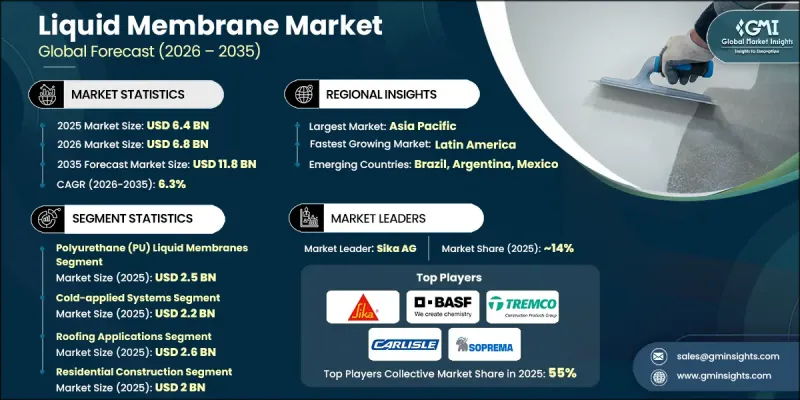
市場成長主要受基礎設施投資增加、公私合作加強以及新建和維修項目施工要求不斷變化等因素所驅動。此外,日益嚴格的建築法規強調能源效率、防潮性和結構性能,也推動了住宅、商業和工業領域的需求成長。與傳統材料相比,液態膜因其固化時間短、施工簡單、使用壽命長等優點,在新興市場備受關注。快速的都市化和現代建築的建設推動了聚氨酯、丙烯酸和水泥基材料等先進複合材料的應用。丙烯酸膜以其成本效益和低環境影響而著稱,在永續發展認證中優先考慮永續性材料的已開發地區,丙烯酸膜的應用日益廣泛。此外,水性解決方案因其與現有結構的兼容性以及符合最新標準,在維修專案中也變得越來越重要。
| 市場範圍 | |
|---|---|
| 開始年份 | 2025 |
| 預測期 | 2026-2035 |
| 上市時的市場規模 | 64億美元 |
| 預測金額 | 118億美元 |
| 複合年成長率 | 6.3% |
2025年,聚氨酯液態防水片材市場規模將達25億美元。從產品細分來看,市場對高性能材料的需求不斷成長,而聚氨酯憑藉其柔軟性、耐久性和耐受惡劣環境條件的能力,佔據了主導地位。這些特性使聚氨酯成為需要長期可靠性和結構保護的應用的理想選擇。
預計到2025年,住宅建築市場規模將達到20億美元,並繼續維持其作為主要終端用戶類別的地位。住宅需求、城市發展和房屋維修活動的持續成長正在推動液態膜的應用。其成本效益和易於安裝的特點進一步增強了其在住宅應用中的吸引力。
預計到2025年,北美液態膜市場規模將達到16億美元。美國憑藉著強勁的住宅維修、商業建築和大規模基礎設施建設活動,繼續保持該地區領先市場的地位。監管舉措和現代化項目也持續推動對先進液態膜系統的需求。同時,加拿大透過更加重視永續建築實踐和採用環保防水材料,為區域市場擴張做出了貢獻。
目錄
第1章:調查方法和範圍
第2章執行摘要
第3章業界考察
- 生態系分析
- 供應商情況
- 利潤率
- 每個階段增加的價值
- 影響價值鏈的因素
- 中斷
- 影響產業的因素
- 促進因素
- 建設產業需求不斷成長
- 基礎設施建設和都市化
- 人們越來越關注建築物的耐久性。
- 產業潛在風險與挑戰
- 原物料價格波動
- 技術應用挑戰
- 市場機遇
- 永續解決方案和生物基解決方案
- 智慧膜技術
- 促進因素
- 成長潛力分析
- 監理情勢
- 北美洲
- 歐洲
- 亞太地區
- 拉丁美洲
- 中東和非洲
- 波特的分析
- PESTEL 分析
- 價格趨勢
- 按地區
- 依產品類型
- 未來市場趨勢
- 專利趨勢
- 貿易統計資料(HS編碼)(註:僅提供主要國家的貿易統計資料)
- 主要進口國
- 主要出口國
- 永續性和環境方面
- 永續計劃
- 減少廢棄物策略
- 生產中的能源效率
- 環保意識的舉措
- 關於碳足跡的考量
第4章 競爭情勢
- 介紹
- 企業市佔率分析
- 按地區
- 北美洲
- 歐洲
- 亞太地區
- 拉丁美洲
- 中東和非洲
- 按地區
- 企業矩陣分析
- 主要市場公司的競爭分析
- 競爭定位矩陣
- 主要進展
- 併購
- 夥伴關係與合作
- 新產品發布
- 業務拓展計劃
第5章 市場估算與預測:依產品類型分類,2022-2035年
- 聚氨酯(PU)液態防水片材
- 芳香型聚氨酯
- 脂肪族聚氨酯
- 生物基/永續聚氨酯
- 壓克力液態防水板
- 純丙烯酸
- 苯乙烯-丙烯酸酯(改質)
- 矽丙烯酸酯混合物
- 水泥基液態防水膜
- 柔軟性水泥
- 硬質水泥型
- 聚合物改質水泥體系
- 結晶質防水系統
- 混合薄膜和特種薄膜
- 聚脲
- 矽基防水片
- 瀝青改質系統
- 其他特殊配方
第6章 市場估算與預測:依施工方法分類,2022-2035年
- 室溫應用系統
- 熱力建築系統
- 噴塗應用系統
- 無氣噴塗
- 多成分噴霧
- 刷輥塗佈系統
- 其他方法
第7章 市場估計與預測:依應用領域分類,2022-2035年
- 屋頂工程
- 平屋頂防水
- 在傾斜屋頂上安裝
- 綠色屋頂系統
- 屋頂維修和維修
- 地下防水
- 地下室防水
- 基本防水
- 地下結構
- 隧道防水
- 地上部份的用途
- 陽台和露台防水
- 浴室和潮濕區域的防水
- 外牆和牆體的保護
- 防水泳池
- 基礎設施應用
- 橋面防水
- 在停車場平台上安裝
- 水處理廠
- 工業地板塗料
- 特殊用途
- 船舶和海上結構
- 交通基礎設施
- 農業用途
- 採礦和重工業
第8章 市場估算與預測:依最終用途產業分類,2022-2035年
- 住宅
- 新建住宅
- 住宅翻新和維修
- 多用戶住宅
- 獨立式住宅
- 商業建築
- 辦公大樓
- 零售和購物中心
- 飯店和娛樂
- 醫療設施
- 產業建設
- 製造工廠
- 倉庫和物流中心
- 化工和加工工業
- 餐飲設施
- 基礎設施和公共工程
- 交通基礎設施
- 用水和污水處理
- 能源和發電
- 政府和公共設施
第9章 市場估計與預測:依地區分類,2022-2035年
- 北美洲
- 美國
- 加拿大
- 歐洲
- 德國
- 英國
- 法國
- 西班牙
- 義大利
- 其他歐洲地區
- 亞太地區
- 中國
- 印度
- 日本
- 澳洲
- 韓國
- 亞太其他地區
- 拉丁美洲
- 巴西
- 墨西哥
- 其他拉丁美洲地區
- 中東和非洲
- 沙烏地阿拉伯
- 南非
- 阿拉伯聯合大公國
- 其他中東和非洲地區
第10章:公司簡介
- Sika AG
- BASF SE
- Tremco Incorporated
- 凱雷集團
- Soprema Group
- GAF Materials Corporation
- Johns Manville Corporation
- Firestone Building Products
- Dow Chemical Company
- Huntsman Corporation
- Pidilite Industries Limited
- Fosroc International Limited
- MAPEI SpA
The Global Liquid Membrane Market was valued at USD 6.4 billion in 2025 and is estimated to grow at a CAGR of 6.3% to reach USD 11.8 billion by 2035.
Growth in the market is driven by rising investments in infrastructure, increasing collaboration between public and private sectors, and evolving construction requirements across new developments and renovation projects. Demand is further supported by stricter building regulations focused on energy efficiency, moisture protection, and structural performance across residential, commercial, and industrial sectors. Liquid membranes are gaining traction in emerging economies due to their quick curing time, ease of application, and longer lifecycle compared to conventional alternatives. Rapid urbanization and the construction of modern structures are encouraging the use of advanced formulations such as polyurethane, acrylic, and cementitious materials. Acrylic-based membranes, known for their cost efficiency and lower environmental impact, are witnessing growing adoption in developed regions where sustainability certifications emphasize environmentally responsible materials. Additionally, water-based solutions are becoming increasingly relevant in renovation activities due to their compatibility with existing structures and compliance with updated standards.
| Market Scope | |
|---|---|
| Start Year | 2025 |
| Forecast Year | 2026-2035 |
| Start Value | $6.4 Billion |
| Forecast Value | $11.8 Billion |
| CAGR | 6.3% |
The polyurethane liquid membranes segment accounted for USD 2.5 billion in 2025. Product segmentation indicates a growing preference for high-performance materials, with polyurethane leading due to its flexibility, durability, and ability to withstand demanding environmental conditions. These characteristics make it a preferred choice for applications requiring long-term reliability and structural protection.
The residential construction segment was valued at USD 2 billion in 2025, maintaining its position as the leading end-use category in terms of volume. Continued growth in housing demand, urban development, and renovation activities is driving the adoption of liquid membranes. Their cost-effectiveness and ease of installation further enhance their appeal in residential applications.
North America Liquid Membrane Market generated USD 1.6 billion in 2025. The United States remains the dominant market in the region, supported by robust activity in residential upgrades, commercial construction, and large-scale infrastructure development. Regulatory initiatives and modernization programs continue to drive demand for advanced liquid membrane systems. Meanwhile, Canada is contributing to regional expansion through its increasing focus on sustainable construction practices and the adoption of environmentally efficient waterproofing materials.
Key companies operating in the Global Liquid Membrane Market include Sika AG, BASF SE, Tremco Incorporated, Carlisle Companies Inc., Soprema Group, GAF Materials Corporation, Johns Manville Corporation, Firestone Building Products, Dow Chemical Company, Huntsman Corporation, Pidilite Industries Limited, Fosroc International Limited, and MAPEI S.p.A. Companies in the Liquid Membrane Market are reinforcing their competitive position by prioritizing innovation, expanding product portfolios, and enhancing distribution networks. Many are investing in advanced formulations that improve durability, environmental performance, and ease of application to meet evolving construction standards. Strategic collaborations and partnerships are being used to strengthen market reach and improve access to large-scale infrastructure projects. Firms are also focusing on digital transformation to streamline supply chains and improve customer engagement.
Table of Contents
Chapter 1 Methodology & Scope
- 1.1 Market scope and definition
- 1.2 Research design
- 1.2.1 Research approach
- 1.2.2 Data collection methods
- 1.3 Data mining sources
- 1.3.1 Global
- 1.3.2 Regional/Country
- 1.4 Base estimates and calculations
- 1.4.1 Base year calculation
- 1.4.2 Key trends for market estimation
- 1.5 Primary research and validation
- 1.5.1 Primary sources
- 1.6 Forecast model
- 1.7 Research assumptions and limitations
Chapter 2 Executive Summary
- 2.1 Industry 360° synopsis
- 2.2 Key market trends
- 2.2.1 Regional
- 2.2.2 Product type
- 2.2.3 Application
- 2.2.4 End user industry
- 2.2.5 Technology
- 2.3 TAM Analysis, 2026-2035
- 2.4 CXO perspectives: Strategic imperatives
- 2.4.1 Executive decision points
- 2.4.2 Critical success factors
- 2.5 Future Outlook and strategic recommendations
Chapter 3 Industry Insights
- 3.1 Industry ecosystem analysis
- 3.1.1 Supplier Landscape
- 3.1.2 Profit Margin
- 3.1.3 Value addition at each stage
- 3.1.4 Factor affecting the value chain
- 3.1.5 Disruptions
- 3.2 Industry impact forces
- 3.2.1 Growth drivers
- 3.2.1.1 Growing construction industry demand
- 3.2.1.2 Infrastructure development and urbanization
- 3.2.1.3 Increasing focus on building durability
- 3.2.2 Industry pitfalls and challenges
- 3.2.2.1 Raw material price volatility
- 3.2.2.2 Technical application challenges
- 3.2.3 Market opportunities
- 3.2.3.1 Sustainable and bio-based solutions
- 3.2.3.2 Smart membrane technologies
- 3.2.1 Growth drivers
- 3.3 Growth potential analysis
- 3.4 Regulatory landscape
- 3.4.1 North America
- 3.4.2 Europe
- 3.4.3 Asia Pacific
- 3.4.4 Latin America
- 3.4.5 Middle East & Africa
- 3.5 Porter's analysis
- 3.6 PESTEL analysis
- 3.6.1 Technology and innovation landscape
- 3.6.2 Current technological trends
- 3.6.3 Emerging technologies
- 3.7 Price trends
- 3.7.1 By region
- 3.7.2 By product type
- 3.8 Future market trends
- 3.9 Patent Landscape
- 3.10 Trade statistics (HS code) (Note: the trade statistics will be provided for key countries only)
- 3.10.1 Major importing countries
- 3.10.2 Major exporting countries
- 3.11 Sustainability and environmental aspects
- 3.11.1 Sustainable practices
- 3.11.2 Waste reduction strategies
- 3.11.3 Energy efficiency in production
- 3.11.4 Eco-friendly initiatives
- 3.12 Carbon Footprint Considerations
Chapter 4 Competitive Landscape, 2025
- 4.1 Introduction
- 4.2 Company market share analysis
- 4.2.1 By region
- 4.2.1.1 North America
- 4.2.1.2 Europe
- 4.2.1.3 Asia Pacific
- 4.2.1.4 LATAM
- 4.2.1.5 MEA
- 4.2.1 By region
- 4.3 Company matrix analysis
- 4.4 Competitive analysis of major market players
- 4.5 Competitive positioning matrix
- 4.6 Key developments
- 4.6.1 Mergers & acquisitions
- 4.6.2 Partnerships & collaborations
- 4.6.3 New product launches
- 4.6.4 Expansion plans
Chapter 5 Market Estimates and Forecast, By Product Type, 2022 - 2035 (USD Billion) (Kilo Tons)
- 5.1 Key trends
- 5.2 Polyurethane (PU) liquid membranes
- 5.2.1 Aromatic PU
- 5.2.2 Aliphatic PU
- 5.2.3 Bio-Based/Sustainable PU
- 5.3 Acrylic liquid membranes
- 5.3.1 Pure Acrylic
- 5.3.2 Styrene-Acrylic (Modified)
- 5.3.3 Silicone-Acrylic Hybrids
- 5.4 Cementitious liquid membranes
- 5.4.1 Flexible Cementitious
- 5.4.2 Rigid Cementitious
- 5.4.3 Polymer-Modified Cementitious
- 5.4.4 Crystalline Waterproofing Systems
- 5.5 Hybrid and specialty membranes
- 5.5.1 Polyurea systems
- 5.5.2 Silicone-based membranes
- 5.5.3 Bitumen-modified systems
- 5.5.4 Other specialty formulations
Chapter 6 Market Estimates and Forecast, By Application Method, 2022 - 2035 (USD Billion) (Kilo Tons)
- 6.1 Key trends
- 6.2 Cold-applied systems
- 6.3 Hot-applied systems
- 6.4 Spray-applied systems
- 6.4.1 Airless spray
- 6.4.2 Plural component spray
- 6.5 Brush/roller-applied systems
- 6.6 Other methods
Chapter 7 Market Estimates and Forecast, By Application, 2022 - 2035 (USD Billion) (Kilo Tons)
- 7.1 Key trends
- 7.2 Roofing applications
- 7.2.1 Flat roof waterproofing
- 7.2.2 Pitched roof applications
- 7.2.3 Green roof systems
- 7.2.4 Roof renovation and repair
- 7.3 Below-grade waterproofing
- 7.3.1 Basement waterproofing
- 7.3.2 Foundation waterproofing
- 7.3.3 Underground structures
- 7.3.4 Tunnel waterproofing
- 7.4 Above-grade applications
- 7.4.1 Balcony and terrace waterproofing
- 7.4.2 Bathroom and wet area waterproofing
- 7.4.3 Facade and wall protection
- 7.4.4 Swimming pool waterproofing
- 7.5 Infrastructure applications
- 7.5.1 Bridge deck waterproofing
- 7.5.2 Parking deck applications
- 7.5.3 Water treatment facilities
- 7.5.4 Industrial floor coatings
- 7.6 Specialty applications
- 7.6.1 Marine and offshore structures
- 7.6.2 Transportation infrastructure
- 7.6.3 Agricultural applications
- 7.6.4 Mining and heavy industry
Chapter 8 Market Estimates and Forecast, By End Use Industry, 2022 - 2035 (USD Billion) (Kilo Tons)
- 8.1 Key trends
- 8.2 Residential construction
- 8.2.1 New residential construction
- 8.2.2 Residential renovation and repair
- 8.2.3 Multi-family housing
- 8.2.4 Single-family housing
- 8.3 Commercial Construction
- 8.3.1 Office buildings
- 8.3.2 Retail and shopping centers
- 8.3.3 Hospitality and entertainment
- 8.3.4 Healthcare facilities
- 8.4 Industrial Construction
- 8.4.1 Manufacturing facilities
- 8.4.2 Warehouses and distribution centers
- 8.4.3 Chemical and process industries
- 8.4.4 Food and beverage facilities
- 8.5 Infrastructure and Public Works
- 8.5.1 Transportation infrastructure
- 8.5.2 Water and wastewater treatment
- 8.5.3 Energy and power generation
- 8.5.4 Government and public buildings
Chapter 9 Market Estimates and Forecast, By Region, 2022 - 2035 (USD Billion) (Kilo Tons)
- 9.1 Key trends
- 9.2 North America
- 9.2.1 U.S.
- 9.2.2 Canada
- 9.3 Europe
- 9.3.1 Germany
- 9.3.2 UK
- 9.3.3 France
- 9.3.4 Spain
- 9.3.5 Italy
- 9.3.6 Rest of Europe
- 9.4 Asia Pacific
- 9.4.1 China
- 9.4.2 India
- 9.4.3 Japan
- 9.4.4 Australia
- 9.4.5 South Korea
- 9.4.6 Rest of Asia Pacific
- 9.5 Latin America
- 9.5.1 Brazil
- 9.5.2 Mexico
- 9.5.3 Rest of Latin America
- 9.6 Middle East and Africa
- 9.6.1 Saudi Arabia
- 9.6.2 South Africa
- 9.6.3 UAE
- 9.6.4 Rest of Middle East and Africa
Chapter 10 Company Profiles
- 10.1 Sika AG
- 10.2 BASF SE
- 10.3 Tremco Incorporated
- 10.4 Carlisle Companies Inc.
- 10.5 Soprema Group
- 10.6 GAF Materials Corporation
- 10.7 Johns Manville Corporation
- 10.8 Firestone Building Products
- 10.9 Dow Chemical Company
- 10.10 Huntsman Corporation
- 10.11 Pidilite Industries Limited
- 10.12 Fosroc International Limited
- 10.13 MAPEI S.p.A.

