


 |
市場調查報告書
商品編碼
2027663
可程式邏輯控制器 (PLC) 市場機會、成長要素、產業趨勢分析及 2026-2035 年預測Programmable Logic Controller (PLC) Market Opportunity, Growth Drivers, Industry Trend Analysis, and Forecast 2026 - 2035 |
||||||

全球可程式邏輯控制器 (PLC) 市場預計到 2025 年將達到 117 億美元,預計到 2035 年將達到 342 億美元,複合年成長率為 11.4%。
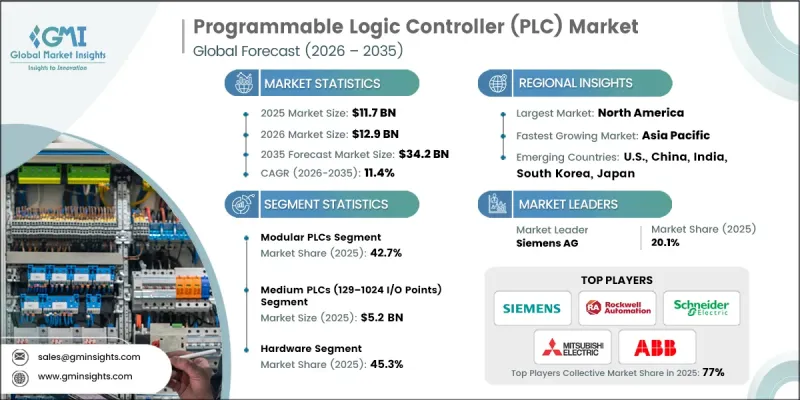
汽車和電子製造業工廠自動化的快速發展、離散產業對工業4.0技術的日益普及、石油和天然氣產業對即時製程控制需求的成長,以及PLC與數位化工業平台整合技術的進步,共同推動了市場的擴張。此外,可再生能源專案和高精度製造環境中自動化系統的持續部署也加速了市場成長。 PLC在管理複雜的生產流程、協調機器人以及提高營運效率方面發揮著日益關鍵的作用。製造商優先考慮智慧工廠理念、機器互聯和基於雲端的監控,以最大限度地減少停機時間並提高生產率,這促進了PLC在各個工業領域的廣泛應用。
| 市場範圍 | |
|---|---|
| 開始年份 | 2025 |
| 預測期 | 2026-2035 |
| 上市時的市場規模 | 117億美元 |
| 預測金額 | 342億美元 |
| 複合年成長率 | 11.4% |
到2025年,模組化PLC市佔率將達到42.7%。這些系統非常適合汽車、石油天然氣和製造業等行業,因為它們提供可擴展的解決方案,能夠處理複雜的工業操作,同時與其他自動化技術無縫整合。
中型 PLC 市場(I/O 點數為 129 至 1024)預計到 2025 年將達到 52 億美元。這些 PLC 在性能和成本效益之間實現了極佳的平衡,能夠支援中型工廠向半自動化和數位化連接的生產系統過渡時,實現中等到複雜的自動化流程。
到2025年,北美可程式邏輯控制器(PLC)市佔率將達到36.3%。該地區的成長主要得益於汽車、石油天然氣和食品加工等產業對工業自動化的大力應用,以及智慧製造和工業IoT解決方案的不斷擴展。 PLC與雲端控制系統的整合提高了營運效率和即時監控能力。為了最大限度地減少停機時間並提高生產柔軟性,傳統工廠正在實施大規模的PLC升級。政府和私人對數位製造和彈性供應鏈的投資進一步鞏固了北美在自動化技術領域的領先地位。
目錄
第1章:調查方法和範圍
第2章執行摘要
第3章業界考察
- 生態系分析
- 供應商情況
- 利潤率
- 成本結構
- 每個階段增加的價值
- 影響價值鏈的因素
- 中斷
- 影響產業的因素
- 促進因素
- 汽車和電子製造領域的快速工廠自動化
- 擴大工業4.0在各行業的應用
- 石油和天然氣產業對即時製程控制的需求日益成長。
- PLC與SCADA和MES系統的整合
- 可再生能源發電自動化專案的成長
- 產業潛在風險與挑戰
- 互聯PLC環境中的網路安全漏洞
- 高級PLC程式設計熟練工人短缺
- 市場機遇
- 用於低延遲工業分析的邊緣PLC
- 擴大PLC在電動車電池生產線的應用
- 促進因素
- 成長潛力分析
- 監理情勢
- 北美洲
- 歐洲
- 亞太地區
- 拉丁美洲
- 中東和非洲
- 波特的分析
- PESTEL 分析
- 科技與創新趨勢
- 當前技術趨勢
- 新興技術
- 價格趨勢
- 按地區
- 依產品
- 定價策略
- 新興經營模式
- 合規要求
- 專利和智慧財產權分析
第4章 競爭情勢
- 介紹
- 企業市佔率分析
- 按地區
- 北美洲
- 歐洲
- 亞太地區
- 拉丁美洲
- 中東和非洲
- 市場集中度分析
- 按地區
- 主要公司的競爭標竿分析
- 財務績效比較
- 銷售量
- 利潤率
- 研究與開發
- 產品系列比較
- 產品線寬度
- 科技
- 創新
- 區域擴張比較
- 全球擴張分析
- 服務網路覆蓋
- 按地區分類的市場滲透率
- 競爭定位矩陣
- 領導者
- 挑戰者
- 追蹤者
- 小眾玩家
- 戰略展望矩陣
- 財務績效比較
- 主要進展
- 併購
- 夥伴關係與合作
- 技術進步
- 擴張和投資策略
- 數位轉型計劃
- 新興競爭對手和新創競爭對手的發展趨勢
第5章 市場估計與預測:依類型分類,2022-2035年
- 緊湊型/整合式PLC
- 模組化PLC
- 機架式PLC
第6章 市場估計與預測:依產能分類,2022-2035年
- Nano/micro PLC(32 個 I/O 點或更少)
- 小型PLC(33-128個I/O點)
- 中型PLC(129-1024個I/O點)
- 大型PLC(超過1024個I/O點)
第7章 市場估計與預測:依組件分類,2022-2035年
- CPU/處理器模組
- I/O模組
- 電源模組
- 通訊模組
第8章 市場估算與預測:依產品/服務分類,2022-2035年
- 硬體
- 軟體
- 服務
第9章 市場估計與預測:依功能分類,2022-2035年
- 離散控制
- 過程控制
- 運動控制
- 安全控制
第10章 市場估價與預測:依安裝類型分類,2022-2035年
- 新安裝
- 維修和更換
第11章 市場估價與預測:依最終用戶產業分類,2022-2035年
- 車
- 石油和天然氣
- 能源與電力
- 食品/飲料
- 製藥
- 用水和污水
- 化學
- 金屬和採礦
- 紙漿和造紙
- 其他
第12章 市場估計與預測:依地區分類,2022-2035年
- 北美洲
- 美國
- 加拿大
- 歐洲
- 德國
- 英國
- 法國
- 西班牙
- 義大利
- 亞太地區
- 中國
- 印度
- 日本
- 澳洲
- 韓國
- 拉丁美洲
- 巴西
- 墨西哥
- 中東和非洲
- 南非
- 沙烏地阿拉伯
- 阿拉伯聯合大公國
第13章:公司簡介
- 全球主要公司
- Siemens AG
- Rockwell Automation
- Schneider Electric
- ABB Ltd.
- Mitsubishi Electric
- 按地區分類的主要公司
- 北美洲
- Emerson Electric Co.
- Honeywell International Inc.
- 亞太地區
- Omron Corporation
- Delta Electronics
- Fuji Electric
- Hitachi Industrial Equipment Systems
- Panasonic Industry
- 歐洲
- Bosch Rexroth AG
- Phoenix Contact
- 北美洲
- 特殊玩家/干擾者
- Beckhoff Automation
The Global Programmable Logic Controller (PLC) Market was valued at USD 11.7 billion in 2025 and is estimated to grow at a CAGR of 11.4% to reach USD 34.2 billion by 2035.
The market expansion is driven by rapid factory automation across automotive and electronics manufacturing, increasing adoption of Industry 4.0 technologies in discrete industries, growing demand for real-time process control in oil & gas operations, and wider integration of PLCs with digital industrial platforms. Additionally, the rising deployment of automation systems in renewable energy projects and high-precision manufacturing environments is accelerating market growth. PLCs are increasingly critical for managing complex production processes, coordinating robotics, and enhancing operational efficiency. Manufacturers are prioritizing smart factory initiatives, interconnected machines, and cloud-based monitoring to minimize downtime and improve productivity, supporting robust market adoption across diverse industrial sectors.
| Market Scope | |
|---|---|
| Start Year | 2025 |
| Forecast Year | 2026-2035 |
| Start Value | $11.7 Billion |
| Forecast Value | $34.2 Billion |
| CAGR | 11.4% |
The modular PLCs segment held a 42.7% share in 2025. These systems offer scalable solutions that can handle complex industrial operations while allowing seamless integration with other automation technologies, making them ideal for automotive, oil, gas, and manufacturing environments.
The medium PLCs, with 129-1024 I/O points, segment reached USD 5.2 billion in 2025. They provide a balance of performance and cost efficiency, supporting moderate-to-complex automation processes in mid-sized plants transitioning toward semi-automated, digitally connected production systems.
North America Programmable Logic Controller (PLC) Market held a 36.3% share in 2025. The region's growth is driven by strong adoption of industrial automation across automotive, oil & gas, and food processing sectors, coupled with increased deployment of smart manufacturing and industrial IoT solutions. Integration of PLCs with cloud-based control systems enhances operational efficiency and real-time monitoring. The focus on minimizing downtime and boosting production flexibility has led to widespread PLC upgrades across legacy facilities. Government initiatives and private investments in digital manufacturing and resilient supply chains further reinforce North America's leadership in automation technologies.
Key players operating in the Global Programmable Logic Controller (PLC) Market include ABB Ltd., Beckhoff Automation, Bosch Rexroth AG, Delta Electronics, Emerson Electric Co., Fuji Electric, Hitachi Industrial Equipment Systems, Honeywell International Inc., Mitsubishi Electric, Omron Corporation, Panasonic Industry, Phoenix Contact, Rockwell Automation, Schneider Electric, and Siemens AG. Key strategies adopted by companies in the Global Programmable Logic Controller (PLC) Market include expanding product portfolios with modular and medium-capacity controllers, investing in R&D for Industry 4.0-compatible solutions, and strengthening partnerships with system integrators to access new industrial sectors. Companies focus on developing IoT-enabled PLCs with cloud connectivity, cybersecurity features, and advanced analytics to improve operational efficiency for clients. Strategic mergers, acquisitions, and collaborations with technology providers help enhance market reach and adoption in high-growth regions. Continuous innovation in scalable, flexible, and energy-efficient PLC solutions supports companies in maintaining a competitive advantage and increasing their global footprint.
Table of Contents
Chapter 1 Methodology and Scope
- 1.1 Market scope and definition
- 1.2 Research design
- 1.2.1 Research approach
- 1.2.2 Data collection methods
- 1.3 Data mining sources
- 1.3.1 Global
- 1.3.2 Regional/Country
- 1.4 Base estimates and calculations
- 1.4.1 Base year calculation
- 1.4.2 Key trends for market estimation
- 1.5 Primary research and validation
- 1.5.1 Primary sources
- 1.6 Forecast model
- 1.7 Research assumptions and limitations
Chapter 2 Executive Summary
- 2.1 Industry 360° synopsis, 2022 - 2035
- 2.2 Key market trends
- 2.3 Type trends
- 2.3.1 Capacity trends
- 2.3.2 Component trends
- 2.3.3 Offering trends
- 2.3.4 Functionality trends
- 2.3.5 Installation type trends
- 2.3.6 End-user industry trends
- 2.3.7 Regional trends
- 2.4 TAM Analysis, 2026-2035
- 2.5 CXO perspectives: Strategic imperatives
Chapter 3 Industry Insights
- 3.1 Industry ecosystem analysis
- 3.1.1 Supplier Landscape
- 3.1.2 Profit Margin
- 3.1.3 Cost structure
- 3.1.4 Value addition at each stage
- 3.1.5 Factor affecting the value chain
- 3.1.6 Disruptions
- 3.2 Industry impact forces
- 3.2.1 Growth drivers
- 3.2.1.1 Rapid factory automation across automotive and electronics manufacturing
- 3.2.1.2 Increasing adoption of Industry 4.0 in discrete industries
- 3.2.1.3 Rising demand for real-time process control in oil & gas
- 3.2.1.4 Integration of PLCs with SCADA and MES systems
- 3.2.1.5 Growth in renewable energy plant automation projects
- 3.2.2 Industry pitfalls and challenges
- 3.2.2.1 Cybersecurity vulnerabilities in connected PLC environments
- 3.2.2.2 Skilled workforce shortage for advanced PLC programming
- 3.2.3 Market opportunities
- 3.2.3.1 Edge-enabled PLCs for low-latency industrial analytics
- 3.2.3.2 Increasing PLC deployment in EV battery manufacturing lines
- 3.2.1 Growth drivers
- 3.3 Growth potential analysis
- 3.4 Regulatory landscape
- 3.4.1 North America
- 3.4.2 Europe
- 3.4.3 Asia Pacific
- 3.4.4 Latin America
- 3.4.5 Middle East & Africa
- 3.5 Porter’s analysis
- 3.6 PESTEL analysis
- 3.7 Technology and Innovation landscape
- 3.7.1 Current technological trends
- 3.7.2 Emerging technologies
- 3.8 Price trends
- 3.8.1 By region
- 3.8.2 By product
- 3.9 Pricing Strategies
- 3.10 Emerging Business Models
- 3.11 Compliance Requirements
- 3.12 Patent and IP analysis
Chapter 4 Competitive Landscape, 2025
- 4.1 Introduction
- 4.2 Company market share analysis
- 4.2.1 By region
- 4.2.1.1 North America
- 4.2.1.2 Europe
- 4.2.1.3 Asia Pacific
- 4.2.1.4 Latin America
- 4.2.1.5 Middle East & Africa
- 4.2.2 Market concentration analysis
- 4.2.1 By region
- 4.3 Competitive benchmarking of key players
- 4.3.1 Financial performance comparison
- 4.3.1.1 Revenue
- 4.3.1.2 Profit margin
- 4.3.1.3 R&D
- 4.3.2 Product portfolio comparison
- 4.3.2.1 Product range breadth
- 4.3.2.2 Technology
- 4.3.2.3 Innovation
- 4.3.3 Geographic presence comparison
- 4.3.3.1 Global footprint analysis
- 4.3.3.2 Service network coverage
- 4.3.3.3 Market penetration by region
- 4.3.4 Competitive positioning matrix
- 4.3.4.1 Leaders
- 4.3.4.2 Challengers
- 4.3.4.3 Followers
- 4.3.4.4 Niche players
- 4.3.5 Strategic outlook matrix
- 4.3.1 Financial performance comparison
- 4.4 Key developments
- 4.4.1 Mergers and acquisitions
- 4.4.2 Partnerships and collaborations
- 4.4.3 Technological advancements
- 4.4.4 Expansion and investment strategies
- 4.4.5 Digital transformation initiatives
- 4.5 Emerging/ startup competitors landscape
Chapter 5 Market Estimates and Forecast, By Type, 2022 - 2035 (USD Million)
- 5.1 Key trends
- 5.2 Compact/integrated PLCs
- 5.3 Modular PLCs
- 5.4 Rack-mounted PLCs
Chapter 6 Market Estimates and Forecast, By Capacity, 2022 - 2035 (USD Million)
- 6.1 Key trends
- 6.2 Nano/micro PLCs (≤32 I/O Points)
- 6.3 Small PLCs (33-128 I/O Points)
- 6.4 Medium PLCs (129-1024 I/O Points)
- 6.5 Large PLCs (>1024 I/O Points)
Chapter 7 Market Estimates and Forecast, By Component, 2022 - 2035 (USD Million)
- 7.1 Key trends
- 7.2 CPU/processor modules
- 7.3 I/O modules
- 7.4 Power supply modules
- 7.5 Communication modules
Chapter 8 Market Estimates and Forecast, By Offering, 2022 - 2035 (USD Million)
- 8.1 Key trends
- 8.2 Hardware
- 8.3 Software
- 8.4 Services
Chapter 9 Market Estimates and Forecast, By Functionality, 2022 - 2035 (USD Million)
- 9.1 Key trends
- 9.2 Discrete control
- 9.3 Process control
- 9.4 Motion control
- 9.5 Safety control
Chapter 10 Market Estimates and Forecast, By Installation Type, 2022 - 2035 (USD Million)
- 10.1 Key trends
- 10.2 New installations
- 10.3 Retrofit/replacement
Chapter 11 Market Estimates and Forecast, By End-User Industry, 2022 - 2035 (USD Million)
- 11.1 Key trends
- 11.2 Automotive
- 11.3 Oil & gas
- 11.4 Energy & power
- 11.5 Food & beverage
- 11.6 Pharmaceuticals
- 11.7 Water & wastewater
- 11.8 Chemicals
- 11.9 Metals & mining
- 11.10 Pulp & paper
- 11.11 Others
Chapter 12 Market Estimates and Forecast, By Region, 2022 - 2035 (USD Million)
- 12.1 Key trends
- 12.2 North America
- 12.2.1 U.S.
- 12.2.2 Canada
- 12.3 Europe
- 12.3.1 Germany
- 12.3.2 UK
- 12.3.3 France
- 12.3.4 Spain
- 12.3.5 Italy
- 12.4 Asia Pacific
- 12.4.1 China
- 12.4.2 India
- 12.4.3 Japan
- 12.4.4 Australia
- 12.4.5 South Korea
- 12.5 Latin America
- 12.5.1 Brazil
- 12.5.2 Mexico
- 12.6 Middle East and Africa
- 12.6.1 South Africa
- 12.6.2 Saudi Arabia
- 12.6.3 UAE
Chapter 13 Company Profiles
- 13.1 Global Key Players
- 13.1.1 Siemens AG
- 13.1.2 Rockwell Automation
- 13.1.3 Schneider Electric
- 13.1.4 ABB Ltd.
- 13.1.5 Mitsubishi Electric
- 13.2 Regional key players
- 13.2.1 North America
- 13.2.1.1 Emerson Electric Co.
- 13.2.1.2 Honeywell International Inc.
- 13.2.2 Asia Pacific
- 13.2.2.1 Omron Corporation
- 13.2.2.2 Delta Electronics
- 13.2.2.3 Fuji Electric
- 13.2.2.4 Hitachi Industrial Equipment Systems
- 13.2.2.5 Panasonic Industry
- 13.2.3 Europe
- 13.2.3.1 Bosch Rexroth AG
- 13.2.3.2 Phoenix Contact
- 13.2.1 North America
- 13.3 Niche Players/Disruptors
- 13.3.1 Beckhoff Automation

 嵌入式控制器市場報告:趨勢、預測與競爭分析(至2035年)
 可程式邏輯控制器(PLC)市場-2026-2032年全球市場預測
 2026-2030年全球可程式邏輯控制器(PLC)市場
 可程式材料市場預測至2034年-按材料類型、刺激類型、功能、應用、形態和地區分類的全球分析可程式邏輯控制器 (PLC) 市場預測至 2034 年——按類型、組件、行業、應用、最終用戶和地區分類的全球分析
 2026年全球可程式邏輯控制器(PLC)市場報告
 可程式邏輯控制器 (PLC) 市場:按程式語言、規模、產業和地區分類嵌入式控制器市場:依控制器類型、核心數、應用、最終用戶產業和銷售管道分類-2026-2032年全球預測可程式邏輯控制器 (PLC) 市場:全球市場分析、市場規模、市場佔有率及按應用、規模、最終用途、產品形式、程式語言、類型、國家和地區分類的預測 – 2025 年至 2032 年
 可程式邏輯控制器 (PLC) 市場分析及預測(至 2035 年):按類型、產品類型、技術、元件、應用、部署類型、最終用戶、功能、安裝類型和解決方案分類