


 |
市場調查報告書
商品編碼
2027639
鉻鹽市場機會、成長要素、產業趨勢分析及2026-2035年預測Chromium Salt Market Opportunity, Growth Drivers, Industry Trend Analysis, and Forecast 2026 - 2035 |
||||||

預計到 2025 年,全球鉻鹽市場價值將達到 51 億美元,並預計以 5% 的複合年成長率成長,到 2035 年達到 84 億美元。
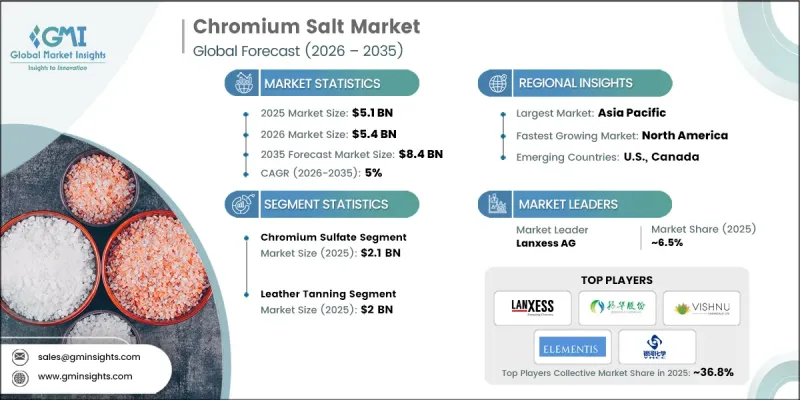
表面處理和金屬加工領域對鉻鹽的需求不斷成長,是推動市場成長的主要因素。各行業越來越依賴這些化合物來提高零件的耐腐蝕性、表面硬度和美觀度。製造業、重型機械和消費品等行業的產量持續成長,也進一步支撐了材料的消耗。此外,對產品使用壽命更長、生命週期性能更佳的需求也正在推動市場擴張。在精煉過程中,鉻鹽擴大被添加到催化劑中,以提高反應效率和製程選擇性,進一步刺激了對新建和改進型加工設施的投資。在汽車和航太領域,這些化合物也被用於開發塗層、表面處理和高性能材料,這些領域對強度、熱穩定性和耐腐蝕性有著至關重要的要求。
| 市場範圍 | |
|---|---|
| 開始年份 | 2025 |
| 預測期 | 2026-2035 |
| 上市時的市場規模 | 51億美元 |
| 預測金額 | 84億美元 |
| 複合年成長率 | 5% |
預計到2025年,硫酸鉻市場規模將達到21億美元。鉻鹽大致可分為中間體化學品和成品,其中硫酸鉻是主要的工業原料。其應用範圍廣泛,包括皮革製造;而氧化鉻和鉻酸主要用於表面處理以及作為各種塗料的顏料。
預計到2025年,皮革鞣製產業市場規模將達到20億美元,主要得益於鉻鹽能夠提升皮革的柔軟性、耐久性和整體產品品質。這些化合物在金屬表面處理和電鍍領域也至關重要,能夠確保長期的防腐蝕性能和表面完整性。在顏料和染料領域,鉻化合物因其優異的顏色穩定性、卓越的性能以及在塗料和建築材料中的增強作用而被廣泛應用。
預計到2025年,北美鉻鹽市場規模將達到14億美元。該地區受益於成熟的產業體系、持續的基礎設施建設以及對先進材料的積極研究。市場成長主要由高價值應用而非單純的銷售所驅動,並著重於永續替代方案和回收技術。由於鉻鹽具有更高的耐久性和抗環境劣化,因此在汽車、航太和建築等行業的需求顯著成長。此外,該地區的監管要求正在推動更安全、更環保的鉻化合物的研發,這在確保合規性的同時,也為市場擴張提供了機會。
目錄
第1章:調查方法和範圍
第2章執行摘要
第3章業界考察
- 生態系分析
- 供應商情況
- 利潤率
- 每個階段增加的價值
- 影響價值鏈的因素
- 中斷
- 影響產業的因素
- 促進因素
- 電鍍和金屬表面處理行業的需求增加
- 在石油煉製用催化劑的應用日益廣泛
- 汽車和航太產業的成長
- 產業潛在風險與挑戰
- 與六價鉻相關的環境問題
- 嚴格的監理合規要求
- 市場機遇
- 開發環保鉻鹽配方
- 將數位技術融入生產
- 促進因素
- 成長潛力分析
- 監理情勢
- 波特五力分析
- PESTEL 分析
- 價格趨勢
- 按地區
- 產品類型
- 未來市場趨勢
- 科技與創新趨勢
- 當前技術趨勢
- 新興技術
- 專利趨勢
- 貿易統計資料(HS編碼)(註:貿易統計僅提供主要國家的資料)
- 主要進口國
- 主要出口國
- 永續性和環境方面
- 永續計劃
- 減少廢棄物策略
- 生產中的能源效率
- 環保意識的舉措
第4章 競爭情勢
- 介紹
- 企業市佔率分析
- 按地區
- 北美洲
- 歐洲
- 亞太地區
- 拉丁美洲
- 中東和非洲
- 按地區
- 企業矩陣分析
- 主要市場公司的競爭分析
- 競爭定位矩陣
- 主要進展
- 併購
- 夥伴關係與合作
- 新產品發布
- 業務拓展計劃
第5章 市場估算與預測:依產品類型分類,2022-2035年
- 重鉻酸鈉
- 工業級
- 技術級
- 重鉻酸鉀
- 硫酸鉻
- 氧化鉻
- 鉻酸
- 其他
- 氯化鉻
- 乙酸鉻
- 硝酸鉻
- 特殊鉻化合物
第6章 市場估計與預測:依應用領域分類,2022-2035年
- 皮革鞣製
- 鉻鞣
- 複合鞣革
- 金屬表面處理和電鍍
- 裝飾性鍍鉻
- 硬鉻電鍍
- 防腐蝕塗層
- 顏料和染料
- 油漆和塗料
- 塑膠顏料
- 陶瓷和玻璃用著色劑
- 紡織染料
- 木材防腐處理
- 鉻酸銅砷(CCA)處理
- 工業木材防腐處理
- 催化劑
- 石油煉製用催化劑
- 化學合成催化劑
- 環境催化劑
- 耐火材料
- 鉻鎂磚
- 高溫爐襯材料
- 其他
- 腐蝕抑制劑
- 水處理化學品
- 特殊工業應用
第7章 市場估計與預測:依地區分類,2022-2035年
- 北美洲
- 美國
- 加拿大
- 歐洲
- 德國
- 英國
- 法國
- 西班牙
- 義大利
- 其他歐洲地區
- 亞太地區
- 中國
- 印度
- 日本
- 澳洲
- 韓國
- 亞太其他地區
- 拉丁美洲
- 巴西
- 墨西哥
- 其他拉丁美洲地區
- 中東和非洲
- 沙烏地阿拉伯
- 南非
- 阿拉伯聯合大公國
- 其他中東和非洲地區
第8章:公司簡介
- American Elements
- Lanxess AG
- Loba Chemie
- Merck Group
- Thermo Fisher Scientific
- Sichuan Yinhe Chemical
- Hubei Zhenhua Chemical
- Vishnu Chemicals
- Elementis plc
- NPCC(Nippon Chemical Industrial)
- Thermo Fisher Scientific
- Anchor chemicals
The Global Chromium Salt Market was valued at USD 5.1 billion in 2025 and is estimated to grow at a CAGR of 5% to reach USD 8.4 billion by 2035.
The growth is driven by rising demand for chromium salts in surface finishing and metal treatment processes. Industries increasingly rely on these compounds to enhance corrosion resistance, improve surface hardness, and deliver superior aesthetic finishes for components. Rising production across sectors such as manufacturing, heavy machinery, and consumer goods continues to sustain material consumption. Additionally, the demand for longer-lasting products and better lifecycle performance is fueling market expansion. In refining operations, chromium salts are increasingly incorporated into catalysts to boost reaction efficiency and process selectivity, further encouraging investments in new and upgraded processing facilities. The automotive and aerospace sectors also rely on these compounds for coatings, surface treatments, and high-performance material development, where strength, thermal stability, and corrosion resistance are critical requirements.
| Market Scope | |
|---|---|
| Start Year | 2025 |
| Forecast Year | 2026-2035 |
| Start Value | $5.1 Billion |
| Forecast Value | $8.4 Billion |
| CAGR | 5% |
The chromium sulfate segment reached USD 2.1 billion in 2025. Chromium salts are broadly categorized into intermediate chemicals and finished products, with chromium sulfate serving as a key industrial material. Its extensive applications include leather production, while chromium oxide and chromic acid are primarily used in surface treatments and as pigments in various coatings.
The leather tanning segment captured USD 2 billion in 2025, driven by chromium salts' ability to improve flexibility, durability, and overall product quality. Metal finishing and electroplating also depend on these compounds to ensure long-term corrosion protection and surface integrity. The pigments and dyes sector relies on chromium-based compounds for their color stability, superior performance, and ability to enhance coating and construction materials.
North America Chromium Salt Market accounted for USD 1.4 billion in 2025. The region benefits from established industries, ongoing infrastructure development, and active research in advanced materials. Market growth is predominantly fueled by high-value applications rather than sheer volume, emphasizing sustainable alternatives and recycling technologies. Sectors such as automotive, aerospace, and construction generate significant demand, as chromium salts enhance durability and resistance to environmental degradation. Regulatory requirements in the region also encourage the development of safer and eco-friendly chromium compounds, offering opportunities for market expansion while maintaining compliance standards.
Key companies shaping the Global Chromium Salt Market include American Elements, Lanxess AG, Loba Chemie, Merck Group, Thermo Fisher Scientific, Sichuan Yinhe Chemical, Hubei Zhenhua Chemical, Vishnu Chemicals, Elementis plc, NPCC (Nippon Chemical Industrial), Thermo Fisher Scientific, and Anchor Chemicals. Market players are increasingly adopting strategies such as expanding production capacities, investing in research and development to introduce eco-friendly and high-performance compounds, and forming strategic partnerships to broaden distribution networks. Companies are focusing on geographic expansion to enter emerging markets while strengthening relationships with end-use industries to secure long-term contracts. Technological innovations aimed at improving product efficiency, surface performance, and lifecycle durability are key to gaining a competitive edge. Additionally, mergers and acquisitions are being leveraged to consolidate market presence and enhance global footprint. Firms are also emphasizing regulatory compliance and sustainability initiatives to meet the growing demand for environmentally safe chromium-based solutions, positioning themselves as leaders in both quality and responsible manufacturing practices.
Table of Contents
Chapter 1 Methodology & Scope
- 1.1 Market scope and definition
- 1.2 Research design
- 1.2.1 Research approach
- 1.2.2 Data collection methods
- 1.3 Data mining sources
- 1.3.1 Global
- 1.3.2 Regional/Country
- 1.4 Base estimates and calculations
- 1.4.1 Base year calculation
- 1.4.2 Key trends for market estimation
- 1.5 Primary research and validation
- 1.5.1 Primary sources
- 1.6 Forecast model
- 1.7 Research assumptions and limitations
Chapter 2 Executive Summary
- 2.1 Industry 360° synopsis
- 2.2 Key market trends
- 2.2.1 Regional
- 2.2.2 Product Type
- 2.2.3 Application
- 2.3 TAM Analysis, 2026-2035
- 2.4 CXO perspectives: Strategic imperatives
- 2.4.1 Executive decision points
- 2.4.2 Critical success factors
- 2.5 Future Outlook and Strategic Recommendations
Chapter 3 Industry Insights
- 3.1 Industry ecosystem analysis
- 3.1.1 Supplier Landscape
- 3.1.2 Profit Margin
- 3.1.3 Value addition at each stage
- 3.1.4 Factor affecting the value chain
- 3.1.5 Disruptions
- 3.2 Industry impact forces
- 3.2.1 Growth drivers
- 3.2.1.1 Increasing demand in electroplating & metal finishing industries
- 3.2.1.2 Rising use in catalysts for petroleum refining
- 3.2.1.3 Growth in automotive & aerospace manufacturing
- 3.2.2 Industry pitfalls and challenges
- 3.2.2.1 Environmental concerns related to hexavalent chromium
- 3.2.2.2 Stringent regulatory compliance requirements
- 3.2.3 Market opportunities
- 3.2.3.1 Development of eco-friendly chromium salt formulations
- 3.2.3.2 Integration of digital technologies in production
- 3.2.1 Growth drivers
- 3.3 Growth potential analysis
- 3.4 Regulatory landscape
- 3.4.1 North America
- 3.4.2 Europe
- 3.4.3 Asia Pacific
- 3.4.4 Latin America
- 3.4.5 Middle East & Africa
- 3.5 Porter's analysis
- 3.6 PESTEL analysis
- 3.7 Price trends
- 3.7.1 By region
- 3.7.2 Product type
- 3.8 Future market trends
- 3.9 Technology and Innovation Landscape
- 3.9.1 Current technological trends
- 3.9.2 Emerging technologies
- 3.10 Patent Landscape
- 3.11 Trade statistics (HS code) (Note: the trade statistics will be provided for key countries only)
- 3.11.1 Major importing countries
- 3.11.2 Major exporting countries
- 3.12 Sustainability and environmental aspects
- 3.12.1 Sustainable practices
- 3.12.2 Waste reduction strategies
- 3.12.3 Energy efficiency in production
- 3.12.4 Eco-friendly initiatives
Chapter 4 Competitive Landscape, 2025
- 4.1 Introduction
- 4.2 Company market share analysis
- 4.2.1 By region
- 4.2.1.1 North America
- 4.2.1.2 Europe
- 4.2.1.3 Asia Pacific
- 4.2.1.4 LATAM
- 4.2.1.5 MEA
- 4.2.1 By region
- 4.3 Company matrix analysis
- 4.4 Competitive analysis of major market players
- 4.5 Competitive positioning matrix
- 4.6 Key developments
- 4.6.1 Mergers & acquisitions
- 4.6.2 Partnerships & collaborations
- 4.6.3 New product launches
- 4.6.4 Expansion plans
Chapter 5 Market Estimates and Forecast, By Product Type, 2022 - 2035 (USD Billion) (Tons)
- 5.1 Key trends
- 5.2 Sodium dichromate
- 5.2.1 Industrial grade
- 5.2.2 Technical grade
- 5.3 Potassium dichromate
- 5.4 Chromium sulfate
- 5.5 Chromium oxide
- 5.6 Chromic acid
- 5.7 Others
- 5.7.1 Chromium chloride
- 5.7.2 Chromium acetate
- 5.7.3 Chromium nitrate
- 5.7.4 Specialty chromium compounds
Chapter 6 Market Estimates and Forecast, By Application, 2022 - 2035 (USD Billion) (Tons)
- 6.1 Key trends
- 6.2 Leather tanning
- 6.2.1 Chrome tanning
- 6.2.2 Combination tanning
- 6.3 Metal finishing & electroplating
- 6.3.1 Decorative chromium plating
- 6.3.2 Hard chromium plating
- 6.3.3 Corrosion protection coatings
- 6.4 Pigments & dyes
- 6.4.1 Paints & coatings
- 6.4.2 Plastics pigmentation
- 6.4.3 Ceramic & glass colorants
- 6.4.4 Textile dyes
- 6.5 Wood preservation
- 6.5.1 Chromated copper arsenate (CCA) treatment
- 6.5.2 Industrial lumber preservation
- 6.6 Catalysts
- 6.6.1 Petroleum refining catalysts
- 6.6.2 Chemical synthesis catalysts
- 6.6.3 Environmental catalysts
- 6.7 Refractory materials
- 6.7.1 Chromite-magnesia bricks
- 6.7.2 High-temperature furnace linings
- 6.8 Others
- 6.8.1 Corrosion inhibitors
- 6.8.2 Water treatment chemicals
- 6.8.3 Specialty industrial applications
Chapter 7 Market Estimates and Forecast, By Region, 2022 - 2035 (USD Billion) (Tons)
- 7.1 Key trends
- 7.2 North America
- 7.2.1 U.S.
- 7.2.2 Canada
- 7.3 Europe
- 7.3.1 Germany
- 7.3.2 UK
- 7.3.3 France
- 7.3.4 Spain
- 7.3.5 Italy
- 7.3.6 Rest of Europe
- 7.4 Asia Pacific
- 7.4.1 China
- 7.4.2 India
- 7.4.3 Japan
- 7.4.4 Australia
- 7.4.5 South Korea
- 7.4.6 Rest of Asia Pacific
- 7.5 Latin America
- 7.5.1 Brazil
- 7.5.2 Mexico
- 7.5.3 Rest of Latin America
- 7.6 Middle East and Africa
- 7.6.1 Saudi Arabia
- 7.6.2 South Africa
- 7.6.3 UAE
- 7.6.4 Rest of Middle East and Africa
Chapter 8 Company Profiles
- 8.1 American Elements
- 8.2 Lanxess AG
- 8.3 Loba Chemie
- 8.4 Merck Group
- 8.5 Thermo Fisher Scientific
- 8.6 Sichuan Yinhe Chemical
- 8.7 Hubei Zhenhua Chemical
- 8.8 Vishnu Chemicals
- 8.9 Elementis plc
- 8.10 NPCC (Nippon Chemical Industrial)
- 8.11 Thermo Fisher Scientific
- 8.12 Anchor chemicals

 全球磷酸鉻市場規模、佔有率、趨勢和成長分析報告(2026-2034年)
 鉻化學品市場:全球市場預測,2026-2032年磷酸鉻市場-2026-2032年全球市場預測
 鉻鹽市場規模、佔有率和趨勢分析報告:按產品、最終用途、地區和細分市場分類(2026-2033 年)
 鉻礦開採市場報告:按類型、最終用戶和地區分類(2026-2034 年)鉻市場規模、佔有率、趨勢和預測:按等級、應用、產業和地區分類,2026-2034年甲吡啶甲酸鉻市場:以產品形式、通路、最終用戶和應用分類的全球市場預測,2026-2032年鉻市場:2026-2032年全球市場預測(依產品類型、原料、純度等級、最終用途產業及分銷通路分類)碳化鉻市場:依形態、等級、純度、應用、終端用戶產業和銷售管道-2026-2032年全球預測
 磷酸鐵市場分析及預測(至2035年):類型、產品、應用、技術、終端用戶、成分、形態