

 |
市場調查報告書
商品編碼
2027636
家用堆肥機市場機會、成長要素、產業趨勢分析及2026-2035年預測Household Composters Market Opportunity, Growth Drivers, Industry Trend Analysis, and Forecast 2026 - 2035 |
||||||

預計到 2025 年,全球家用堆肥市場價值將達到 5.05 億美元,並預計以 6.6% 的複合年成長率成長,到 2035 年達到 9.444 億美元。
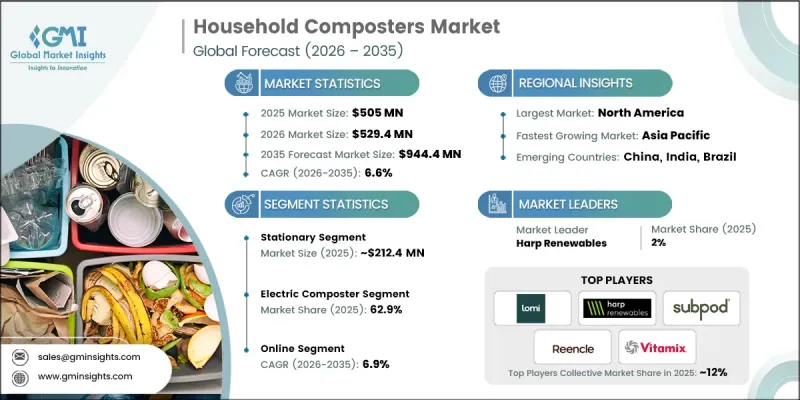
推動這一市場成長的因素之一是政府主導的減少家庭垃圾和回收掩埋有機物的措施不斷增加。地方政府計畫提供財政獎勵和宣傳宣傳活動,在某些情況下,還制定法規強制要求對有機廢棄物進行分類,鼓勵家庭採用堆肥解決方案。隨著消費者越來越重視永續生活和環保行為,堆肥已成為家庭垃圾管理的核心要素。小型自動化堆肥機因其便利性和符合環保法規的特點而備受關注,使家庭能夠以最少的努力減少對環境的影響。人們對食物廢棄物及其環境影響的日益關注正在推動電動和智慧堆肥機的普及。這些設備簡化了堆肥過程,同時還具有除臭、加速分解和自動監控功能,符合消費者日益增強的環保意識。
| 市場範圍 | |
|---|---|
| 開始年份 | 2025 |
| 預測期 | 2026-2035 |
| 上市時的市場規模 | 5.05億美元 |
| 預計金額 | 9.444億美元 |
| 複合年成長率 | 6.6% |
預計到2025年,固定式堆肥機市場規模將達到2.124億美元,並在2035年之前維持7%的複合年成長率。這些產品因其價格實惠、經久耐用且維護成本低而備受歡迎,非常適合注重預算的家庭和社區用戶。其模組化設計符合標準的「綠色和棕色」堆肥流程,提供了一種無需能源消耗的「設定好即可運行」的簡單解決方案。固定式堆肥機尤其受到擁有戶外空間的使用者以及希望透過自然微生物過程獲得營養豐富堆肥的使用者的青睞。零售商店的廣泛供應以及園藝愛好者群體中的良好口碑也支撐著其穩定的需求。
預計到2025年,線上銷售管道將佔據52.9%的市場佔有率,並在2035年之前以6.9%的複合年成長率成長。電子商務之所以佔據主導地位,是因為買家可以在購買昂貴的產品之前比較容量、功能、噪音水平和用戶評價。線上平台提供詳細的產品資訊、解說影片、永續發展案例以及便捷的退貨政策。直接面對消費者(D2C)的品牌正在透過訂閱、更換零件、應用程式整合和教育內容等方式加強售後互動,以提高客戶留存率和忠誠度。
預計到2025年,美國家用堆肥機市場規模將達到1.254億美元,主要得益於人們對零浪費生活方式日益成長的興趣以及地方政府強制收集有機垃圾的政策。都市區家庭,尤其是居住在廢棄物管理法規嚴格的州的家庭,由於戶外空間有限,往往更傾向於選擇電動、帶除臭功能的室內堆肥機。強大的電子商務基礎設施和消費者日益增強的永續發展意識也推動了高階堆肥機市場的成長。便利性、自動化和除臭功能仍然是影響消費者購買決策的關鍵因素。
目錄
第1章:調查方法和範圍
第2章執行摘要
第3章業界考察
- 生態系分析
- 供應商情況
- 利潤率
- 每個階段增加的價值
- 影響價值鏈的因素
- 影響產業的因素
- 促進因素
- 政府法規和廢棄物管理政策
- 人們越來越關注食物廢棄物和永續發展意識。
- 都市化和生活空間限制正在推動對室內解決方案的需求。
- 陷阱與挑戰
- 誤導性的產品標籤
- 電動堆肥機的初始成本較高
- 機會
- 除臭和害蟲防治的產品創新
- 面向具有環保意識的消費者的木質堆肥小眾市場。
- 促進因素
- 成長潛力分析
- 未來市場趨勢
- 科技與創新趨勢
- 當前技術趨勢
- 新興技術
- 價格趨勢
- 按地區
- 依產品
- 監理情勢
- 區域廢棄物管理法規
- 永續性標準和認證
- 補貼計畫和政府獎勵
- 專利趨勢(基於初步調查)
- 按技術類型分類的專利申請趨勢
- 領先的專利擁有者和創新領導者
- 新興技術專利(智慧感測器、快速堆肥)
- 貿易資料分析(基於一手調查)-(HS編碼 - 48237010)
- 進出口量及進口額趨勢
- 主要貿易路線及關稅的影響
- 人工智慧和生成式人工智慧對市場的影響
- 利用人工智慧改造現有經營模式
- 針對特定領域的生成式人工智慧應用案例和實施藍圖
- 風險、限制和監管考量
- 波特五力分析
- PESTEL 分析
- 消費者購買行為分析
- 購買決策因素
- 品牌認知與影響因素
- 環境意識對購買決策的影響
第4章 競爭情勢
- 介紹
- 企業市佔率分析
- 按地區
- 企業矩陣分析
- 主要市場公司的競爭分析
- 競爭定位矩陣
- 主要進展
- 併購
- 夥伴關係與合作
- 新產品發布
- 業務拓展計劃
第5章 市場估算與預測:依產品類型分類,2022-2035年
- 固定式
- 不倒翁
- 其他(壓縮機等)
第6章 市場估計與預測:依類型分類,2022-2035年
- 電動堆肥機
- 桌上型電動堆肥機
- 落地式電動堆肥箱
- 人工堆肥
- 傳統手工堆肥
- 好氧人工堆肥
第7章 市場估計與預測:依產能分類,2022-2035年
- 少於10公升
- 10L~20L
- 20L~40L
- 超過40公升
第8章 市場估計與預測:依價格分類,2022-2035年
- 低的
- 中等的
- 高的
第9章 市場估計與預測:依應用領域分類,2022-2035年
- 室內的
- 廚房檯面
- 水槽下方
- 陽台/露台
- 戶外的
- 後院/花園
- 露臺
第10章 市場估價與預測:依通路分類,2022-2035年
- 線上
- 企業網站
- 電子商務
- 離線
- 超級市場/大賣場
- 專賣店
- 其他(例如,大型零售商店)
第11章 市場估價與預測:按地區分類,2022-2035年
- 北美洲
- 美國
- 加拿大
- 歐洲
- 德國
- 英國
- 法國
- 義大利
- 西班牙
- 亞太地區
- 中國
- 印度
- 日本
- 韓國
- 澳洲
- 拉丁美洲
- 巴西
- 墨西哥
- 阿根廷
- 中東和非洲(MEA)
- 沙烏地阿拉伯
- 阿拉伯聯合大公國
- 南非
第12章:公司簡介
- Airthereal
- Beyond Green Biotech
- Geme
- GRAF
- Harp Renewables
- Lasso
- Lomi
- Lotech Products
- Mantis
- Reencle
- Subpod
- Topmake Environment
- Vego
- Vitamix
- Zeosta
The Global Household Composters Market was valued at USD 505 million in 2025 and is estimated to grow at a CAGR of 6.6% to reach USD 944.4 million by 2035.
The market growth is driven by increasing government initiatives to reduce household waste and divert organic materials from landfills. Municipal programs provide financial incentives, educational campaigns, and in some cases, regulations mandating the separation of organic waste, prompting households to adopt composting solutions. Consumers are increasingly prioritizing sustainable living and environmentally responsible practices, making composting a core part of home waste management. Compact and automated composters are gaining traction because they combine convenience with compliance, allowing households to reduce their environmental footprint effortlessly. The rising concern over food waste and its impact on the environment is pushing the adoption of electric and smart composters, which simplify the process while delivering odor control, faster decomposition, and automated monitoring, aligning with the growing eco-conscious mindset of consumers.
| Market Scope | |
|---|---|
| Start Year | 2025 |
| Forecast Year | 2026-2035 |
| Start Value | $505 Million |
| Forecast Value | $944.4 Million |
| CAGR | 6.6% |
In 2025, the stationary composters segment generated USD 212.4 million and is expected to grow at a CAGR of 7% through 2035. These units remain popular due to their affordability, durability, and low maintenance, making them suitable for budget-conscious households and community users. Their modular designs fit standard green/brown composting routines, offering a low-tech "set and forget" solution without energy consumption. Stationary composters are particularly favored by users with outdoor space and those seeking biologically rich compost through natural microbial processes. Widespread retail availability and strong word-of-mouth among gardening communities sustain steady demand.
The online sales channels accounted for 52.9% share in 2025 and are projected to grow at a CAGR of 6.9% through 2035. E-commerce dominates because buyers can compare capacities, features, noise levels, and reviews before purchasing premium appliances. Online platforms provide detailed product information, instructional videos, sustainability stories, and easy return policies. Direct-to-consumer brands leverage post-purchase engagement through subscriptions, replacement parts, app integration, and educational content, boosting customer retention and advocacy.
U.S. Household Composters Market captured USD 125.4 million in 2025, fueled by the rising interest in zero-waste lifestyles and municipal organics collection mandates. Urban households, particularly in states with stricter waste management regulations, prefer electric and odor-controlled indoor composters due to limited outdoor space. Strong e-commerce infrastructure and sustainability-conscious consumer behavior support the growth of premium composting units. Convenience, automation, and odor-control features remain key factors influencing purchasing decisions.
Key players in the Global Household Composters Market include Lomi, Zeosta, GRAF, Harp Renewables, Airthereal, Vego, Subpod, Reencle, Lasso, Topmake Environment, Mantis, Vitamix, Geme, and Lotech Products. Companies in the Household Composters Market are employing several strategies to strengthen their market presence. They are focusing on developing smart, electric, and odor-controlled composting units that simplify composting while enhancing user experience. Expanding e-commerce channels and direct-to-consumer marketing help reach urban households and environmentally conscious consumers. Investment in R&D enables product differentiation with faster decomposition, automated monitoring, and app integration. Brands are leveraging sustainability storytelling, social media, and educational campaigns to build loyalty and awareness. Strategic partnerships with municipal programs, garden centers, and lifestyle brands increase market visibility. Offering post-purchase services, subscription models for consumables, and replacement parts ensures higher retention and long-term customer engagement.
Table of Contents
Chapter 1 Methodology & Scope
- 1.1 Market scope & definitions
- 1.2 Research design
- 1.2.1 Research approach
- 1.2.2 Data collection methods
- 1.3 Base estimates and calculations
- 1.3.1 Base year calculation
- 1.3.2 Market estimates & forecasts parameters
- 1.4 Forecast Model
- 1.4.1 Key trends for market estimates
- 1.4.2 Quantified market impact analysis
- 1.4.2.1 Mathematical impact of growth parameters on forecast
- 1.4.3 Scenario analysis framework
- 1.5 Primary research and validation
- 1.5.1 Some of the primary sources (but not limited to)
- 1.6 Data mining sources
- 1.6.1 Paid Sources
- 1.7 Primary research and validation
- 1.7.1 Primary sources
- 1.8 Research Trail & confidence scoring
- 1.8.1 Research trail components
- 1.8.2 Scoring components
- 1.9 Research transparency addendum
- 1.9.1 Source attribution framework
- 1.9.2 Quality assurance metrics
- 1.9.3 Our commitment to trust
- 1.10 Market Definitions
Chapter 2 Executive Summary
- 2.1 Industry 360° synopsis
- 2.2 Key market trends
- 2.2.1 Regional
- 2.2.2 Product type
- 2.2.3 Type
- 2.2.4 Capacity
- 2.2.5 Price
- 2.2.6 Application
- 2.2.7 Distribution channel
- 2.3 CXO perspectives: Strategic imperatives
- 2.3.1 Key decision points for industry executives
- 2.3.2 Critical success factors for market players
- 2.4 Future outlook and strategic recommendations
Chapter 3 Industry Insights
- 3.1 Industry ecosystem analysis
- 3.1.1 Supplier landscape
- 3.1.2 Profit margin
- 3.1.3 Value addition at each stage
- 3.1.4 Factor affecting the value chain
- 3.2 Industry impact forces
- 3.2.1 Growth drivers
- 3.2.1.1 Government regulations & waste management policies
- 3.2.1.2 Rising food waste concerns & sustainability awareness
- 3.2.1.3 Urbanization & space-constrained living driving indoor solutions
- 3.2.2 Pitfalls & Challenges
- 3.2.2.1 Misleading product claims
- 3.2.2.2 High upfront cost of electric composters
- 3.2.3 Opportunities
- 3.2.3.1 Product innovation in odor control & pest prevention
- 3.2.3.2 Wooden composter niche for eco-conscious consumers
- 3.2.1 Growth drivers
- 3.3 Growth potential analysis
- 3.4 Future market trends
- 3.5 Technology and innovation landscape
- 3.5.1 Current technological trends
- 3.5.2 Emerging technologies
- 3.6 Price trends
- 3.6.1 By region
- 3.6.2 By product
- 3.7 Regulatory landscape
- 3.7.1 Waste management regulations by region
- 3.7.2 Sustainability standards & certifications
- 3.7.3 Subsidy programs & government incentives
- 3.8 Patent landscape (driven by primary research)
- 3.8.1 Patent filing trends by technology type
- 3.8.2 Key patent holders & innovation leaders
- 3.8.3 Emerging technology patents (smart sensors, rapid composting)
- 3.9 Trade data analysis (driven by primary research) - (HS Code - 48237010)
- 3.9.1 Import/export volume & value trends
- 3.9.2 Key trade corridors & tariff impact
- 3.10 Impact of AI & Generative AI on the Market
- 3.10.1 AI-driven disruption of existing business models
- 3.10.2 GenAI use cases & adoption roadmap by segment
- 3.10.3 Risks, limitations & regulatory considerations
- 3.11 Porter's analysis
- 3.12 PESTEL analysis
- 3.13 Consumer buying behaviour analysis
- 3.13.1 Purchase decision factors
- 3.13.2 Brand awareness & influence
- 3.13.3 Environmental consciousness impact on purchasing
Chapter 4 Competitive Landscape, 2025
- 4.1 Introduction
- 4.2 Company market share analysis
- 4.2.1 By Region
- 4.2.1.1 North America
- 4.2.1.2 Europe
- 4.2.1.3 Asia Pacific
- 4.2.1.4 Latin America
- 4.2.1.5 Middle East & Africa
- 4.2.1 By Region
- 4.3 Company matrix analysis
- 4.4 Competitive analysis of major market players
- 4.5 Competitive positioning matrix
- 4.6 Key developments
- 4.6.1 Mergers & acquisitions
- 4.6.2 Partnerships & collaborations
- 4.6.3 New product launches
- 4.6.4 Expansion plans
Chapter 5 Market Estimates & Forecast, By Product Type, 2022 - 2035, (USD Million) (Thousand Units)
- 5.1 Key trends
- 5.2 Stationary
- 5.3 Tumbler
- 5.4 Others (compacting etc.)
Chapter 6 Market Estimates & Forecast, By Type, 2022 - 2035, (USD Million) (Thousand Units)
- 6.1 Key trends
- 6.2 Electric composter
- 6.2.1 Countertop electric composters
- 6.2.2 Floor-standing electric composters
- 6.3 Manual composter
- 6.3.1 Traditional manual composters
- 6.3.2 Aerobic manual composters
Chapter 7 Market Estimates & Forecast, By Capacity, 2022 - 2035, (USD Million) (Thousand Units)
- 7.1 Key trends
- 7.2 Below 10L
- 7.3 10L to 20L
- 7.4 20L to 40L
- 7.5 Above 40L
Chapter 8 Market Estimates & Forecast, By Price, 2022 - 2035, (USD Million) (Thousand Units)
- 8.1 Key trends
- 8.2 Low
- 8.3 Medium
- 8.4 High
Chapter 9 Market Estimates & Forecast, By Application, 2022 - 2035, (USD Million) (Thousand Units)
- 9.1 Key trends
- 9.2 Indoor
- 9.2.1 Kitchen countertop
- 9.2.2 Under-sink
- 9.2.3 Balcony/terrace
- 9.3 Outdoor
- 9.3.1 Backyard/garden
- 9.3.2 Patio
Chapter 10 Market Estimates & Forecast, By Distribution Channel, 2022 - 2035, (USD Million) (Thousand Units)
- 10.1 Key trends
- 10.2 Online
- 10.2.1 Company websites
- 10.2.2 E-commerce
- 10.3 Offline
- 10.3.1 Supermarket/hypermarket
- 10.3.2 Specialty store
- 10.3.3 Others (mega retail store etc.)
Chapter 11 Market Estimates & Forecast, By Region, 2022 - 2035, (USD Million) (Thousand Units)
- 11.1 Key trends
- 11.2 North America
- 11.2.1 U.S.
- 11.2.2 Canada
- 11.3 Europe
- 11.3.1 Germany
- 11.3.2 UK
- 11.3.3 France
- 11.3.4 Italy
- 11.3.5 Spain
- 11.4 Asia Pacific
- 11.4.1 China
- 11.4.2 India
- 11.4.3 Japan
- 11.4.4 South Korea
- 11.4.5 Australia
- 11.5 Latin America
- 11.5.1 Brazil
- 11.5.2 Mexico
- 11.5.3 Argentina
- 11.6 MEA
- 11.6.1 Saudi Arabia
- 11.6.2 UAE
- 11.6.3 South Africa
Chapter 12 Company Profiles
- 12.1 Airthereal
- 12.2 Beyond Green Biotech
- 12.3 Geme
- 12.4 GRAF
- 12.5 Harp Renewables
- 12.6 Lasso
- 12.7 Lomi
- 12.8 Lotech Products
- 12.9 Mantis
- 12.10 Reencle
- 12.11 Subpod
- 12.12 Topmake Environment
- 12.13 Vego
- 12.14 Vitamix
- 12.15 Zeosta

 2026-2030年全球家用堆肥機市場
 垃圾處理器市場:按產品類型、應用和地區分類
 垃圾袋市場-2026-2031年預測
 廚房廚餘處理機市場按產品類型、技術、安裝方式、功率等級、最終用戶和分銷管道分類-2026-2032年全球預測廚房廚餘處理機市場按類型、額定功率、材質、應用和通路-2026-2032年全球預測廚餘處理機市場:2026-2032年全球預測(按產品類型、額定功率、安裝類型、材質、最終用戶和分銷管道分類)北美和歐洲廢棄物收集車輛市場(2025-2030 年)
 全球可堆肥和生物分解性垃圾袋市場
 垃圾壓實機市場-全球產業規模、佔有率、趨勢、機會和預測,按產品類型、廢棄物類型、應用、地區和競爭細分,2020-2030 年全球商用垃圾壓縮機市場