

 |
市場調查報告書
商品編碼
2027634
雞尾酒調酒器市場機會、成長要素、產業趨勢分析及2026-2035年預測Cocktail Shakers Market Opportunity, Growth Drivers, Industry Trend Analysis, and Forecast 2026 - 2035 |
||||||

2025 年全球雞尾酒調酒器市場價值為 7.856 億美元,預計到 2035 年將以 6% 的複合年成長率成長至 13.8 億美元。
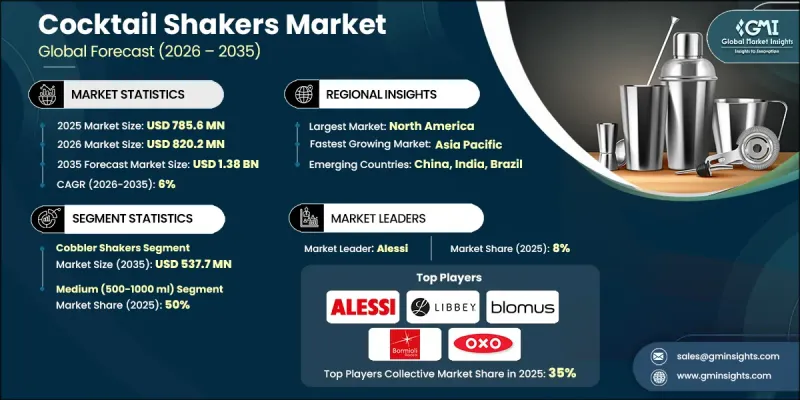
消費者生活方式的轉變、可支配收入的增加以及人們對調酒術作為創造性活動的興趣日益濃厚,正在推動市場擴張。對高階體驗日益成長的需求促使老牌企業和新興企業推出創新產品,以吸引現代消費者。酒吧用品製造商與飯店餐飲品牌之間的策略合作進一步提升了產品的吸引力,尤其是在高價位產品領域。此外,在家調製飲品的日益普及正在改變需求模式,導致消費者對高品質、美觀的工具的需求增加。消費者更重視產品設計、可及性和價格,力求在功能性和視覺吸引力之間取得平衡。市場成長持續加速,尤其受到追求體驗式消費的年輕一代的推動,雞尾酒調酒器正逐漸成為家庭和商用酒吧的必備品。
| 市場範圍 | |
|---|---|
| 開始年份 | 2025 |
| 預測期 | 2026-2035 |
| 上市時的市場規模 | 7.856億美元 |
| 預測金額 | 13.8億美元 |
| 複合年成長率 | 6% |
預計到2025年,攪拌機市場規模將達到3.138億美元,到2035年將達到5.377億美元,憑藉其一體化和人性化的設計,將保持主導地位。在產品細分方面,不同類型的攪拌機各有其獨特的功能特性,某些款式旨在提升普通消費者的使用便利性,而另一些款式則具有更高級的性能需求。
到2025年,容量在500毫升至1000毫升之間的中型攪拌器將佔據50%的市場佔有率,憑藉其實用性、易用性和可靠的性能保持領先地位。此容量等級因其兼具處理效率和混合能力而廣受歡迎,適用於多種應用情境。此等級常用的材料因其耐用性、成本效益以及能夠承受日常使用和清潔過程而備受青睞。
預計到2025年,北美雞尾酒調酒器市場規模將達到2.336億美元。這一成長主要得益於消費者強大的購買力、根深蒂固的飲品調製文化以及人們對居家體驗日益成長的興趣。此外,該地區蓬勃發展的飯店餐飲業也持續推動著對高品質酒吧用具的需求。同時,完善的零售和電商網路使製造商能夠觸及廣泛的客戶群,從而有效促進市場成長。
目錄
第1章:調查方法和範圍
第2章執行摘要
第3章業界考察
- 生態系分析
- 供應商情況
- 利潤率
- 每個階段增加的價值
- 影響價值鏈的因素
- 影響產業的因素
- 促進因素
- 飯店餐飲業人手不足與技能差距
- 優質化和更嚴格的衛生標準
- 產業潛在風險與挑戰
- 高階整合的複雜性
- 與仿冒品相關的風險增加
- 機會
- 對酒吧用品即服務 (BAAS) 的需求不斷成長
- 向永續和環保材料過渡
- 促進因素
- 成長潛力分析
- 未來市場趨勢
- 科技與創新趨勢
- 當前技術趨勢
- 新興技術
- 價格趨勢
- 按地區
- 依產品類型
- 監理情勢
- 標準和合規要求
- 過去價格趨勢分析(基於初步調查)(2022-2025 年)
- 根據業務類型(高階/經濟/預算)制定的定價策略(基於初步研究)
- 波特五力分析
- PESTEL 分析
- 專利趨勢(基於初步調查)
- 按技術領域分類的專利申請趨勢
- 領先的專利擁有者和創新領導者
- 新興專利叢集(智慧技術、永續材料)
- 交易數據分析(基於初步調查)
- 按地區分類的進出口量和進口額趨勢(基於初步調查)
- 主要貿易走廊及關稅影響(基於初步調查)
- 主要出口國及進口國
- 貿易平衡趨勢
- 人工智慧和生成式人工智慧對市場的影響
- 利用人工智慧變革產品設計和客製化。
- 生成式人工智慧的應用案例(個人化雕刻、設計提案、食譜應用)
- 人工智慧在供應鏈最佳化和需求預測的應用
- 與風險、限制和消費者接受度相關的挑戰
- 分銷基礎設施和通路滲透狀況(基於初步調查)
- 按地區和業務類型(現代貿易與傳統貿易)分類的通路覆蓋率(基於初步調查)
- 最後一公里基礎設施缺口及向新管道的轉變(基於初步研究)
- 電子商務滲透率與履約網路分析
- 專業商店網路的密度和地理覆蓋範圍
第4章 競爭情勢
- 介紹
- 企業市佔率分析
- 按地區
- 企業矩陣分析
- 主要市場公司的競爭分析
- 競爭定位矩陣
- 主要進展
- 併購
- 夥伴關係與合作
- 新產品發布
- 業務拓展計劃
第5章 市場估算與預測,2022-2035年
- 鞋匠搖杯
- 波士頓搖酒器
- 法式搖酒器
- 巴黎式/歐陸式搖床
第6章 市場估計與預測:依材料分類,2022-2035年
- 鋼
- 塑膠
- 玻璃
- 丙烯酸纖維
- 鋁
- 陶瓷製品
- 其他(例如矽膠)
第7章 市場估計與預測:依產能分類,2022-2035年
- 小容量(小於500毫升)
- 中等容量(500-1000毫升)
- 大容量(超過1000毫升)
第8章 市場估算與預測:依價格區間分類,2022-2035年
- 價格低廉(20 美元以下)
- 中價位(20-50美元)
- 高價位(50美元以上)
第9章 市場估計與預測:依應用領域分類,2022-2035年
- 個人
- 商業的
- 酒吧/酒館
- 餐廳
- 飯店
- 餐飲服務
- 其他
第10章 市場估價與預測:依通路分類,2022-2035年
- 線上
- 企業網站
- 電子商務網站
- 離線
- 大賣場和超級市場
- 專賣店
- 百貨公司
- 其他
第11章 市場估價與預測:按地區分類,2022-2035年
- 北美洲
- 美國
- 加拿大
- 歐洲
- 德國
- 英國
- 法國
- 義大利
- 西班牙
- 亞太地區
- 中國
- 日本
- 印度
- 澳洲
- 韓國
- 拉丁美洲
- 巴西
- 墨西哥
- 阿根廷
- 中東和非洲
- 南非
- 沙烏地阿拉伯
- 阿拉伯聯合大公國
第12章:公司簡介
- Alessi
- Barfly
- Blomus
- Bormioli Rocco
- Cocktail Kingdom
- Crafthouse
- Final Touch
- Houdini
- Libbey
- Norpro
- OXO
- Rabbit
- Tablecraft
- True Brands
- Viski
- Winco
- Zulay Kitchen
The Global Cocktail Shakers Market was valued at USD 785.6 million in 2025 and is estimated to grow at a CAGR of 6% to reach USD 1.38 billion by 2035.
Evolving consumer lifestyles, rising disposable incomes, and a growing appreciation for mixology as a creative pursuit fuel market expansion. Increasing interest in premium experiences is encouraging both established brands and emerging players to introduce innovative offerings that appeal to modern consumers. Strategic collaborations between barware manufacturers and hospitality-driven brands are further elevating product appeal, particularly within higher-value segments. In addition, the increasing popularity of preparing beverages at home is reshaping demand patterns, driving the need for high-quality and aesthetically appealing tools. Consumers are placing greater emphasis on product design, accessibility, and pricing, seeking a balance between functionality and visual appeal. The influence of younger demographics, particularly those drawn to experience-driven consumption, continues to accelerate market growth, positioning cocktail shakers as essential components in both home and professional bar setups.
| Market Scope | |
|---|---|
| Start Year | 2025 |
| Forecast Year | 2026-2035 |
| Start Value | $785.6 Million |
| Forecast Value | $1.38 Billion |
| CAGR | 6% |
The cobbler shaker segment generated USD 313.8 million in 2025 and is projected to reach USD 537.7 million by 2035, maintaining a leading position due to its integrated and convenient design. Product segmentation highlights varying functional attributes across shaker types, with certain formats offering enhanced usability for everyday consumers, while others cater to more advanced performance requirements.
In 2025, the medium capacity segment, ranging from 500 ml to 1000 ml, accounted for 50% share, sustaining its leadership due to its practicality, ease of use, and dependable performance. This size category is widely preferred for its balance between handling efficiency and mixing capacity, making it suitable for a broad range of applications. Materials commonly used in this segment are valued for their durability, cost efficiency, and ability to withstand regular use and cleaning processes.
North America Cocktail Shakers Market captured USD 233.6 million in 2025. Growth in this region is supported by strong consumer purchasing power, a well-established culture around beverage preparation, and increasing interest in at-home experiences. The region also benefits from a robust hospitality sector that consistently drives demand for high-quality bar tools. Furthermore, well-developed retail and e-commerce networks enable manufacturers to reach a wide customer base, reinforcing market growth effectively.
Key players operating in the Global Cocktail Shakers Market include OXO, Cocktail Kingdom, Viski, Winco, Tablecraft, Blomus, Rabbit, Norpro, True Brands, Libbey, Final Touch, Barfly, Crafthouse, Bormioli Rocco, Zulay Kitchen, Houdini, and Alessi. Companies in the Cocktail Shakers Market are enhancing their market position by focusing on product innovation, premiumization, and brand differentiation. Many are introducing visually appealing designs and high-quality materials to attract style-conscious consumers. Strategic partnerships and co-branded product launches are being used to expand brand visibility and tap into new customer segments. Digital sales channels are receiving increased attention, allowing companies to improve accessibility and strengthen direct-to-consumer engagement. In addition, firms are optimizing their supply chains and expanding distribution networks to improve product availability. Emphasis on competitive pricing, combined with consistent quality and functionality, is also helping companies build strong customer loyalty and sustain long-term growth.
Table of Contents
Chapter 1 Methodology and Scope
- 1.1 Market scope and definition
- 1.2 Research design
- 1.2.1 Research approach
- 1.2.2 Data collection methods
- 1.3 Data mining sources
- 1.3.1 Global
- 1.3.2 Regional/Country
- 1.4 Base estimates and calculations
- 1.4.1 Base year calculation
- 1.4.2 Key trends for market estimation
- 1.5 Primary research and validation
- 1.5.1 Primary sources
- 1.6 Forecast model
- 1.7 Research assumptions and limitations
Chapter 2 Executive Summary
- 2.1 Industry 360° synopsis
- 2.2 Key market trends
- 2.2.1 Regional
- 2.2.2 Product Type
- 2.2.3 Material
- 2.2.4 End User
- 2.2.5 Capacity
- 2.2.6 Price Range
- 2.2.7 Application
- 2.2.8 Distribution Channel
- 2.3 CXO perspectives: Strategic imperatives
- 2.3.1 Key decision points for industry executives
- 2.3.2 Critical success factors for market players
- 2.4 Future outlook and strategic recommendations
Chapter 3 Industry Insights
- 3.1 Industry ecosystem analysis
- 3.1.1 Supplier landscape
- 3.1.2 Profit margin
- 3.1.3 Value addition at each stage
- 3.1.4 Factor affecting the value chain
- 3.2 Industry impact forces
- 3.2.1 Growth drivers
- 3.2.1.1 Labor shortages & skill gaps in hospitality
- 3.2.1.2 Premiumization & stricter hygiene standards
- 3.2.2 Industry pitfalls & challenges
- 3.2.2.1 High integration complexity
- 3.2.2.2 Increasing risks related to counterfeit products
- 3.2.3 Opportunities
- 3.2.3.1 Rising demand for barware-as-a-service (baas)
- 3.2.3.2 Shift toward sustainable & eco-friendly materials
- 3.2.1 Growth drivers
- 3.3 Growth potential analysis
- 3.4 Future market trends
- 3.5 Technology and innovation landscape
- 3.5.1 Current technological trends
- 3.5.2 Emerging technologies
- 3.6 Price trends
- 3.6.1 By region
- 3.6.2 By Product type
- 3.7 Regulatory landscape
- 3.7.1 Standards and compliance requirements
- 3.7.2 Historical Price Trend Analysis (Driven by Primary Research) (2022-2025)
- 3.7.3 Pricing Strategy by Player Type (Premium/Value/Budget) (Driven by Primary)
- 3.8 Porter's analysis
- 3.9 PESTEL analysis
- 3.10 Patent Landscape (Driven by Primary Research)
- 3.10.1 Patent Filing Trends by Technology Area
- 3.10.2 Key Patent Holders & Innovation Leaders
- 3.10.3 Emerging Patent Clusters (Smart Technology, Sustainable Materials)
- 3.11 Trade Data Analysis (Driven by Primary Research)
- 3.11.1 Import/Export Volume & Value Trends by Region (Driven by Primary Research)
- 3.11.2 Key Trade Corridors & Tariff Impact (Driven by Primary Research)
- 3.11.3 Top Importing & Exporting Countries
- 3.11.4 Trade Balance Dynamics
- 3.12 Impact of AI & Generative AI on the Market
- 3.12.1 AI-Driven Disruption of Product Design & Customization
- 3.12.2 GenAI Use Cases (Personalized Engravings, Design Recommendations, Recipe Apps)
- 3.12.3 AI in Supply Chain Optimization & Demand Forecasting
- 3.12.4 Risks, Limitations & Consumer Acceptance Challenges
- 3.13 Distribution Infrastructure & Channel Penetration Landscape (Driven by Primary Research)
- 3.13.1 Channel Coverage by Region & Format (Modern vs Traditional Trade) (Driven by Primary Research)
- 3.13.2 Last-Mile Infrastructure Gaps & Emerging Channel Shifts (Driven by Primary Research)
- 3.13.3 E-commerce Penetration & Fulfillment Network Analysis
- 3.13.4 Specialty Store Network Density & Geographic Reach
Chapter 4 Competitive Landscape, 2025
- 4.1 Introduction
- 4.2 Company market share analysis
- 4.2.1 By region
- 4.2.1.1 North America
- 4.2.1.2 Europe
- 4.2.1.3 Asia Pacific
- 4.2.1.4 Latin America
- 4.2.1.5 Middle East and Africa
- 4.2.1 By region
- 4.3 Company matrix analysis
- 4.4 Competitive analysis of major market players
- 4.5 Competitive positioning matrix
- 4.6 Key developments
- 4.6.1 Mergers & acquisitions
- 4.6.2 Partnerships & collaborations
- 4.6.3 New product launches
- 4.6.4 Expansion plans
Chapter 5 Market Estimates and Forecast, 2022 - 2035 (USD Million) (Thousand Units)
- 5.1 Key trends
- 5.2 Cobbler Shakers
- 5.3 Boston Shakers
- 5.4 French Shakers
- 5.5 Parisian/Continental Shakers
Chapter 6 Market Estimates and Forecast, By Material, 2022 - 2035 (USD Million) (Thousand Units)
- 6.1 Key trends
- 6.2 Steel
- 6.3 Plastic
- 6.4 Glass
- 6.5 Acrylic
- 6.6 Aluminium
- 6.7 Ceramic
- 6.8 Others (Silicone, etc.)
Chapter 7 Market Estimates and Forecast, By Capacity, 2022 - 2035 (USD Million) (Thousand Units)
- 7.1 Key trends
- 7.2 Small (Less than 500 ml)
- 7.3 Medium (500- 1000 ml)
- 7.4 Large (Above 1000 ml)
Chapter 8 Market Estimates and Forecast, By Price Range, 2022 - 2035 (USD Million) (Thousand Units)
- 8.1 Key trends
- 8.2 Low (Under USD 20)
- 8.3 Medium (USD 20 - USD 50)
- 8.4 High (Above USD 50)
Chapter 9 Market Estimates and Forecast, By Application, 2022 - 2035 (USD Million) (Thousand Units)
- 9.1 Key trends
- 9.2 Individual
- 9.3 Commercial
- 9.3.1 Bars and Pubs
- 9.3.2 Restaurants
- 9.3.3 Hotels
- 9.3.4 Catering Services
- 9.3.5 Others
Chapter 10 Market Estimates & Forecast, By Distribution Channel, 2022 - 2035 (USD Million) (Thousand Units)
- 10.1 Key trends
- 10.2 Online
- 10.2.1 Company Website
- 10.2.2 E-commerce Website
- 10.3 Offline
- 10.3.1 Hypermarkets and Supermarkets
- 10.3.2 Specialty Stores
- 10.3.3 Department Stores
- 10.3.4 Others
Chapter 11 Market Estimates and Forecast, By Region, 2022 - 2035 (USD Million) (Thousand Units)
- 11.1 Key trends
- 11.2 North America
- 11.2.1 U.S.
- 11.2.2 Canada
- 11.3 Europe
- 11.3.1 Germany
- 11.3.2 UK
- 11.3.3 France
- 11.3.4 Italy
- 11.3.5 Spain
- 11.4 Asia Pacific
- 11.4.1 China
- 11.4.2 Japan
- 11.4.3 India
- 11.4.4 Australia
- 11.4.5 South Korea
- 11.5 Latin America
- 11.5.1 Brazil
- 11.5.2 Mexico
- 11.5.3 Argentina
- 11.6 Middle East and Africa
- 11.6.1 South Africa
- 11.6.2 Saudi Arabia
- 11.6.3 UAE
Chapter 12 Company Profiles
- 12.1 Alessi
- 12.2 Barfly
- 12.3 Blomus
- 12.4 Bormioli Rocco
- 12.5 Cocktail Kingdom
- 12.6 Crafthouse
- 12.7 Final Touch
- 12.8 Houdini
- 12.9 Libbey
- 12.10 Norpro
- 12.11 OXO
- 12.12 Rabbit
- 12.13 Tablecraft
- 12.14 True Brands
- 12.15 Viski
- 12.16 Winco
- 12.17 Zulay Kitchen


