


 |
市場調查報告書
商品編碼
2027631
醫療鞋類市場機會、成長要素、產業趨勢分析及2026-2035年預測。Medical Footwear Market Opportunity, Growth Drivers, Industry Trend Analysis, and Forecast 2026 - 2035 |
||||||

全球醫用鞋類市場預計到 2025 年將價值 113 億美元,預計到 2035 年將以 6.5% 的複合年成長率成長至 211 億美元。
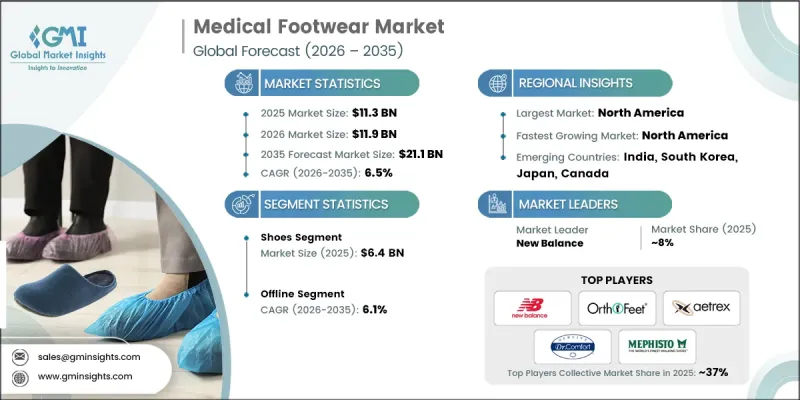
糖尿病及其併發症的日益普遍推動了這個市場的成長,進而增加了對旨在預防損傷和改善行動能力的專用鞋的需求。醫療保健專業人員和足科醫生擴大將醫用鞋和矯形鞋墊作為綜合糖尿病管理和預防保健計劃的一部分。除了人們對早期療育意識的提高外,緩衝、足弓支撐和透氣材料的技術創新也推動了醫院、診所和電商平台對這些產品的採用。此外,某些地區的保險覆蓋範圍和報銷政策也促進了更廣泛的應用。人口老化也是推動需求成長的因素之一,因為老年人面臨行動不便、關節疼痛和足部畸形等問題,需要能夠提供穩定性、矯正性和舒適性的鞋履來保持獨立性並降低受傷風險。
| 市場範圍 | |
|---|---|
| 開始年份 | 2025 |
| 預測期 | 2026-2035 |
| 上市時的市場規模 | 113億美元 |
| 預測金額 | 211億美元 |
| 複合年成長率 | 6.5% |
預計到2025年,鞋類市場規模將達到64億美元,並在2026年至2035年間以6.8%的複合年成長率成長。醫用鞋因其能夠滿足各種治療和整形外科需求而佔據市場主導地位。這些鞋為糖尿病、關節炎、足底筋膜炎以及術後復健等患者提供結構支撐、壓力緩解和穩定性。寬大的鞋頭、先進的緩衝系統、減震鞋底和可調節的鞋帶等特性增強了舒適性和靈活性,使其成為醫院、復健中心和居家照護場所的必備之選。慢性足部疾病的日益普遍以及人們對預防保健意識的不斷提高,鞏固了鞋類市場作為市場成長主要驅動力的地位,有助於維護足部長期健康,並改善患者的生活品質。
線下分銷通路佔72.9%的市場佔有率,預計2026年至2035年將以6.1%的複合年成長率成長。線下管道仍然佔據主導地位,因為面對面的評估和試穿對於有特定整形外科需求的患者至關重要。專業的醫療用品商店、復健中心和醫院提供舒適度、合腳度和支撐性的專家評估。醫療保健專業人員通常建議患者親自購買,以確保正確的足部姿勢和壓力緩解,尤其對於糖尿病患者或足部手術復健患者。認證零售商的存在、產品的即時供應以及個性化的指導強化了線下管道的優勢,使其成為預防性和治療性鞋類的首選。
美國醫用鞋類市場預計到2025年將達到27億美元,並在2026年至2035年間以7.3%的複合年成長率成長。這一成長主要受糖尿病、關節炎和需要持續整形外科支持的慢性足部疾病盛行率不斷上升的推動。隨著人口老化,人們對旨在預防壓瘡、提高行走穩定性和減輕日常活動壓力的定製鞋的需求日益成長。醫院、足病診所和復健中心經常為術後護理和長期整形外科管理患者開立醫用鞋類。隨著越來越多的消費者尋求預防足底筋膜炎、足跟痛和足部結構畸形的措施,零售通路的銷售量也在成長。人們對運動醫學和損傷復健的認知不斷提高,進一步推動了對具有支撐和治療功能的鞋類的需求。
目錄
第1章:調查方法和範圍
第2章執行摘要
第3章業界考察
- 生態系分析
- 供應商情況
- 利潤率
- 每個階段增加的價值
- 影響價值鏈的因素
- 影響產業的因素
- 促進因素
- 糖尿病和足部併發症的盛行率增加
- 需要整形外科支撐的老年人口不斷增加。
- 擴大足科診所和整形外科護理服務
- 挑戰與挑戰
- 高階整形外科和訂製鞋高成本
- 人們對早期療育足部疾病的重要性認知不足。
- 機會
- 3D列印和訂製足部矯正器具的需求日益成長
- 整合智慧感測器進行步態分析和壓力監測
- 促進因素
- 成長潛力分析
- 未來市場趨勢
- 科技與創新趨勢
- 當前技術趨勢
- 新興技術
- 監理情勢
- 標準和合規要求
- 區域法規結構
- 認證標準
- 波特五力分析
- PESTEL 分析
第4章 競爭情勢
- 介紹
- 企業市佔率分析
- 按地區
- 企業矩陣分析
- 主要市場公司的競爭分析
- 競爭定位矩陣
- 主要進展
- 併購
- 夥伴關係與合作
- 新產品發布
- 業務拓展計劃
第5章 市場估算與預測:依產品類型分類,2022-2035年
- 鞋
- 涼鞋
- 其他
第6章 市場估計與預測:依價格分類,2022-2035年
- 不到50美元
- 50-100美元
- 超過100美元
第7章 市場估計與預測:依應用領域分類,2022-2035年
- 糖尿病鞋
- 關節炎專用鞋
- 拇趾滑液囊炎外翻鞋
- 扁平足鞋
- 其他
第8章 市場估算與預測:依最終使用者分類,2022-2035年
- 男性
- 女士
第9章 市場估價與預測:依銷售管道分類,2022-2035年
- 線上
- 離線
第10章 市場估價與預測:依地區分類,2022-2035年
- 北美洲
- 美國
- 加拿大
- 歐洲
- 德國
- 英國
- 法國
- 義大利
- 西班牙
- 亞太地區
- 中國
- 印度
- 日本
- 韓國
- 澳洲
- 拉丁美洲
- 巴西
- 墨西哥
- 阿根廷
- 中東和非洲(MEA)
- 沙烏地阿拉伯
- 阿拉伯聯合大公國
- 南非
第11章:公司簡介
- Aetrex Worldwide, Inc.
- Clearwell Mobility Ltd
- DARCO International, Inc.
- Duna Srl
- Dr. Comfort
- Dr. Foot Inc.
- Drewshoe, Incorporated
- Foot Shop Limited
- Gravity Defyer Corp.
- Horng Shin Footwear Co.
- Kinetec Medical Products Ltd
- Mephisto
- New Balance
- Orthofeet Inc.
- Watts Footwear
The Global Medical Footwear Market was valued at USD 11.3 billion in 2025 and is estimated to grow at a CAGR of 6.5% to reach USD 21.1 billion by 2035.
The growth of this market is driven by the rising prevalence of diabetes and foot-related complications, which increases demand for specialized footwear designed to prevent injuries and improve mobility. Medical shoes and orthotic insoles are increasingly recommended by healthcare providers and podiatrists as part of comprehensive diabetes management and preventive care programs. Rising awareness of early intervention, coupled with innovations in cushioning, arch support, and breathable materials, is driving adoption across hospitals, clinics, and e-commerce platforms. Additionally, insurance coverage and reimbursement policies in certain regions are supporting wider access. A growing geriatric population is also fueling demand, as older individuals experience mobility challenges, joint pain, and foot deformities, requiring footwear that provides stability, alignment, and comfort to maintain independence and reduce injury risk.
| Market Scope | |
|---|---|
| Start Year | 2025 |
| Forecast Year | 2026-2035 |
| Start Value | $11.3 Billion |
| Forecast Value | $21.1 Billion |
| CAGR | 6.5% |
The shoes segment accounted for USD 6.4 billion in 2025 and is anticipated to grow at a CAGR of 6.8% from 2026 to 2035. Medical shoes dominate the market due to their ability to address a broad range of therapeutic and orthopedic needs. They offer structured support, pressure relief, and stability for individuals managing conditions such as diabetes, arthritis, plantar fasciitis, and post-operative recovery. Features such as wide toe boxes, advanced cushioning, shock-absorbing soles, and adjustable closures enhance comfort and mobility, making them essential for hospital, rehabilitation, and home-care settings. The increasing prevalence of chronic foot disorders and heightened awareness of preventive care continue to solidify the shoes segment as the primary contributor to market growth, supporting long-term foot health and improving patient quality of life.
The offline distribution segment held a 72.9% share and is expected to grow at a CAGR of 6.1% from 2026 to 2035. Offline channels remain dominant due to the importance of in-person assessment and fitting for patients with specific orthopedic needs. Specialty medical stores, rehabilitation centers, and hospitals enable professional evaluation of comfort, fit, and support features. Healthcare providers often recommend in-person purchases to ensure proper alignment and pressure relief, especially for patients with diabetes or recovering from foot surgery. The presence of certified retailers, immediate product availability, and personalized guidance reinforce the strength of offline channels, making them a preferred choice for both preventive and therapeutic footwear.
U.S. Medical Footwear Market reached USD 2.7 billion in 2025, and is projected to grow at a CAGR of 7.3% from 2026 to 2035. Growth is driven by the increasing prevalence of diabetes, arthritis, and chronic foot conditions requiring continuous orthopedic support. The aging population boosts demand for custom-fit shoes designed to prevent pressure injuries, improve gait stability, and reduce strain during daily mobility. Hospitals, podiatry clinics, and rehabilitation centers frequently prescribe medical footwear for post-operative care and long-term orthopedic management. Retail channels are also witnessing higher sales as consumers seek preventive solutions for plantar fasciitis, heel pain, and structural foot deformities. Expanding awareness in sports medicine and injury recovery is further fueling demand for supportive and therapeutic footwear.
Major players operating in the Global Medical Footwear Market include Foot Shop Limited, Dr. Comfort, Orthofeet Inc., Aetrex Worldwide, Inc., Drewshoe, Incorporated, Mephisto, Gravity Defyer Corp., New Balance, DARCO International, Inc., Watts Footwear, Horng Shin Footwear Co., Kinetec Medical Products Ltd, Duna Srl, Dr. Foot Inc., and Clearwell Mobility Ltd. Companies in the Medical Footwear Market are strengthening their market presence through multiple strategic initiatives. They are investing in research and development to improve cushioning, arch support, and ergonomics, ensuring higher comfort and therapeutic efficiency. Expanding offline and online distribution networks allows them to reach broader patient and consumer bases. Collaborations with hospitals, podiatrists, and rehabilitation centers enhance product credibility and adoption. Strategic partnerships with insurers and healthcare providers facilitate coverage and reimbursement support. Digital marketing, telehealth consultations, and virtual fitting tools are being integrated to provide personalized shopping experiences. Companies are also diversifying product lines to address diabetes, arthritis, orthopedic recovery, and geriatric mobility needs, ensuring long-term customer loyalty and brand recognition.
Table of Contents
Chapter 1 Methodology & Scope
- 1.1 Market scope and definition
- 1.2 Research design
- 1.2.1 Research approach
- 1.2.2 Data collection methods
- 1.3 Data mining sources
- 1.3.1 Global
- 1.3.2 Regional/Country
- 1.4 Base estimates and calculations
- 1.4.1 Base year calculation
- 1.4.2 Key trends for market estimation
- 1.5 Primary research and validation
- 1.5.1 Primary sources
- 1.6 Forecast model
- 1.7 Research assumptions and limitations
Chapter 2 Executive Summary
- 2.1 Industry 360° synopsis
- 2.2 Key market trends
- 2.2.1 Regional
Chapter 3 Industry Insights
- 3.1 Industry ecosystem analysis
- 3.1.1 Supplier landscape
- 3.1.2 Profit margin
- 3.1.3 Value addition at each stage
- 3.1.4 Factor affecting the value chain
- 3.2 Industry impact forces
- 3.2.1 Growth drivers
- 3.2.1.1 Increasing prevalence of diabetes and foot-related complications
- 3.2.1.2 Growing geriatric population requiring orthopedic support
- 3.2.1.3 Expansion of podiatry clinics and orthopedic care services
- 3.2.2 Pitfalls & Challenges
- 3.2.2.1 High cost of premium orthopedic and custom-made footwear
- 3.2.2.2 Low awareness of early intervention for foot disorders
- 3.2.3 Opportunities
- 3.2.3.1 Growing demand for 3D-printed and customized foot orthotics
- 3.2.3.2 Integration of smart sensors for gait analysis and pressure monitoring
- 3.2.1 Growth drivers
- 3.3 Growth potential analysis
- 3.4 Future market trends
- 3.5 Technology and innovation landscape
- 3.5.1 Current technological trends
- 3.5.2 Emerging technologies
- 3.6 Regulatory landscape
- 3.6.1 Standards and compliance requirements
- 3.6.2 Regional regulatory frameworks
- 3.6.3 Certification standards
- 3.7 Porter's analysis
- 3.8 PESTEL analysis
Chapter 4 Competitive Landscape, 2025
- 4.1 Introduction
- 4.2 Company market share analysis
- 4.2.1 By Region
- 4.2.1.1 North America
- 4.2.1.2 Europe
- 4.2.1.3 Asia Pacific
- 4.2.1.4 Latin America
- 4.2.1.5 Middle East & Africa
- 4.2.1 By Region
- 4.3 Company matrix analysis
- 4.4 Competitive analysis of major market players
- 4.5 Competitive positioning matrix
- 4.6 Key developments
- 4.6.1 Mergers & acquisitions
- 4.6.2 Partnerships & collaborations
- 4.6.3 New product launches
- 4.6.4 Expansion plans
Chapter 5 Market Estimates & Forecast, By Product Type, 2022 - 2035, (USD Billion) (Thousand Units)
- 5.1 Key trends
- 5.2 Shoes
- 5.3 Sandals
- 5.4 Others
Chapter 6 Market Estimates & Forecast, By Price, 2022 - 2035, (USD Billion) (Thousand Units)
- 6.1 Key trends
- 6.2 Less than 50 USD
- 6.3 50-100 USD
- 6.4 Above 100 USD
Chapter 7 Market Estimates & Forecast, By Application, 2022 - 2035, (USD Billion) (Thousand Units)
- 7.1 Key trends
- 7.2 Diabetic shoes
- 7.3 Arthritis shoes
- 7.4 Bunions & hallux valgus shoes
- 7.5 Flat feet shoes
- 7.6 Others
Chapter 8 Market Estimates & Forecast, By End User, 2022 - 2035, (USD Billion) (Thousand Units)
- 8.1 Key trends
- 8.2 Men
- 8.3 Women
Chapter 9 Market Estimates & Forecast, By Distribution Channel, 2022 - 2035, (USD Billion) (Thousand Units)
- 9.1 Key trends
- 9.2 Online
- 9.3 Offline
Chapter 10 Market Estimates & Forecast, By Region, 2022 - 2035, (USD Billion) (Thousand Units)
- 10.1 Key trends
- 10.2 North America
- 10.2.1 U.S.
- 10.2.2 Canada
- 10.3 Europe
- 10.3.1 Germany
- 10.3.2 UK
- 10.3.3 France
- 10.3.4 Italy
- 10.3.5 Spain
- 10.4 Asia Pacific
- 10.4.1 China
- 10.4.2 India
- 10.4.3 Japan
- 10.4.4 South Korea
- 10.4.5 Australia
- 10.5 Latin America
- 10.5.1 Brazil
- 10.5.2 Mexico
- 10.5.3 Argentina
- 10.6 MEA
- 10.6.1 Saudi Arabia
- 10.6.2 UAE
- 10.6.3 South Africa
Chapter 11 Company Profiles
- 11.1 Aetrex Worldwide, Inc.
- 11.2 Clearwell Mobility Ltd
- 11.3 DARCO International, Inc.
- 11.4 Duna Srl
- 11.5 Dr. Comfort
- 11.6 Dr. Foot Inc.
- 11.7 Drewshoe, Incorporated
- 11.8 Foot Shop Limited
- 11.9 Gravity Defyer Corp.
- 11.10 Horng Shin Footwear Co.
- 11.11 Kinetec Medical Products Ltd
- 11.12 Mephisto
- 11.13 New Balance
- 11.14 Orthofeet Inc.
- 11.15 Watts Footwear

 醫用靴套市場分析及預測(至2035年):類型、產品、技術、應用、材料類型、製程、部署、最終用戶、功能、安裝類型
 醫用鞋類市場:按產品類型、材料、應用、分銷管道和地區分類
 2026年全球醫用鞋市場報告
 2026-2030年全球醫用鞋市場
 一次性防滑鞋套市場:依材質、產品類型、包裝形式、最終用戶和分銷管道分類,全球預測(2026-2032年)潔淨室鞋市場按產品類型、材料、應用、分銷管道和最終用戶分類-2026-2032年全球預測
 全球鞋跟襯墊市場全球醫用鞋套市場
 醫療鞋市場規模、佔有率、成長分析、按鞋類類型、按分銷管道、按價格分佈、按應用、按最終用戶、按地區 - 行業預測 2025-2032
 醫療鞋類市場規模、佔有率、趨勢、行業分析報告:依產品、最終用戶、通路和地區 - 2025-2034年市場預測