

 |
市場調查報告書
商品編碼
2027628
兒童電動搭乘用車的市場機會、成長要素、產業趨勢與預測(2026-2035 年)。Electric Baby Car Market Opportunity, Growth Drivers, Industry Trend Analysis, and Forecast 2026 - 2035 |
||||||

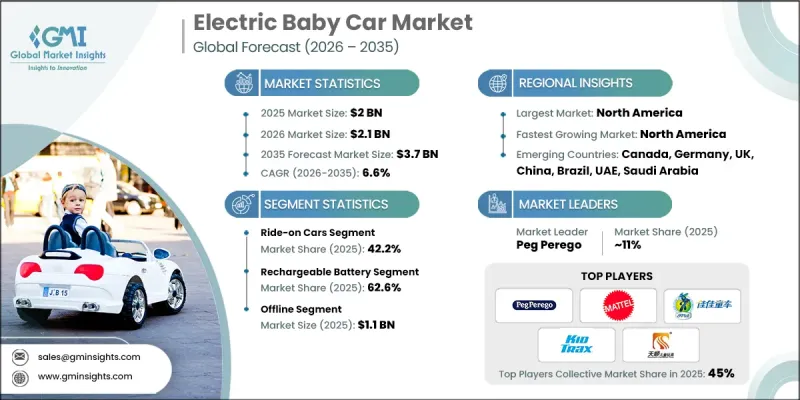
預計到 2025 年,全球兒童電動搭乘用車市場價值將達到 20 億美元,並預計以 6.6% 的複合年成長率成長,到 2035 年達到 37 億美元。
在智慧科技的快速融合推動下,市場正經歷一場變革。這重新定義了電動玩具搭乘用,使其成為連網且功能豐富的產品。製造商透過融入先進功能來提升產品吸引力,從而增強用戶互動和安全性。與行動應用程式的整合已成為核心功能,使家長能夠即時監控和控制車輛性能。這些系統提供速度控制、遠端操作和自動安全響應等功能。連網型設備和物聯網產品的日益普及正在影響消費者的購買決策,尤其是在那些追求創新和安全玩具的科技意識消費者中。因此,兒童電動搭乘用車正在發展成為集娛樂性、安全性和智慧功能於一體的高級產品,為瞄準高價值市場細分領域的品牌創造了新的成長機會。
| 市場範圍 | |
|---|---|
| 開始年份 | 2025 |
| 預測期 | 2026-2035 |
| 上市時的市場規模 | 20億美元 |
| 預測金額 | 37億美元 |
| 複合年成長率 | 6.6% |
先進的安全性和互聯功能在產品開發方向上發揮著至關重要的作用。基於GPS的監控、安全存取系統和增強型控制機制等技術,在提升操作安全性的同時,有效防止了誤用。數位儀錶板提供速度和電池電量等性能指標的即時訊息,營造出更沉浸式、如同真實汽車般的體驗。互動功能的整合有助於早期學習和認知發展,並進一步提升使用者參與度。這些創新滿足了當今消費者對兒童產品安全性和科技含量的雙重需求。
到2025年,兒童電動車市佔率將達到42.2%,成為主要產品類型之一。其受歡迎程度主要得益於模擬真實駕駛體驗的互動式設計,深受兒童和家長的喜愛。照明系統、安全座椅和整合控制系統等功能也促進了其高滲透率。隨著製造商不斷推出具備先進互聯功能、增強安全性能和人性化設計的車型,預計該細分市場將保持穩定成長。
預計到2025年,線下通路的銷售額將達到11億美元。這些管道仍然至關重要,因為它們能夠提供即時的產品供應和個人化的客戶支援。經銷商和經銷商在協助買家選擇產品、提供售後服務以及確保獲得標準規格的產品方面發揮關鍵作用。不斷變化的經銷格局加劇了競爭,促使製造商更直接地參與採購流程,同時加強與整個供應鏈的關係。
美國兒童電動搭乘用車市場預計到2025年將佔84.5%的市場佔有率,並在2035年之前以6.3%的複合年成長率成長。該地區受益於消費者對先進技術的高度接受度、完善的物流基礎設施以及對高階戶外產品的強烈偏好。兒童安全意識的提高和對高科技玩具日益成長的需求進一步推動了市場需求。該地區的消費者偏好具有先進功能的高階車型,這正在推動整個市場的創新和優質化。
目錄
第1章:調查方法和範圍
第2章執行摘要
第3章業界考察
- 生態系分析
- 供應商情況
- 利潤率
- 每個階段增加的價值
- 影響價值鏈的因素
- 影響產業的因素
- 促進因素
- 嚴格執行兒童安全法規
- 提高家長意識,更重視兒童安全
- 智慧座椅技術整合
- 產業潛在風險與挑戰
- 高昂的初始成本和認證座椅系統
- 消費者困惑與安裝難題
- 機會
- 新興國家的成長
- 開發輕巧且針對電子商務最佳化的紙張
- 促進因素
- 成長潛力分析
- 未來市場趨勢
- 科技與創新趨勢
- 當前技術趨勢
- 新興技術
- 價格趨勢
- 按地區
- 按類型
- 監理情勢
- 標準和合規要求
- 區域法規結構
- 認證標準
- 波特五力分析
- PESTEL 分析
第4章 競爭情勢
- 介紹
- 企業市佔率分析
- 按地區
- 企業矩陣分析
- 主要市場公司的競爭分析
- 競爭定位矩陣
- 主要進展
- 併購
- 夥伴關係與合作
- 新產品發布
- 業務拓展計劃
第5章 市場估價與預測:依產品分類,2022-2035年
- 搭乘用玩具車
- 遙控車
- 電池驅動車輛
第6章 市場估計與預測:依年齡層別分類,2022-2035年
- 0-1歲
- 1-3歲
- 3-5歲
第7章 市場估計與預測:依價格分類,2022-2035年
- 低的
- 中等的
- 高的
第8章 市場估算與預測:依電源類型分類,2022-2035年
- 可充電電池
- 插電式電動車
第9章 市場估價與預測:依通路分類,2022-2035年
- 線上
- 電子商務網站
- 公司網站
- 離線
- 實體店面
- 其他
第10章 市場估價與預測:依地區分類,2022-2035年
- 北美洲
- 美國
- 加拿大
- 歐洲
- 德國
- 英國
- 法國
- 義大利
- 西班牙
- 亞太地區
- 中國
- 日本
- 印度
- 澳洲
- 韓國
- 拉丁美洲
- 巴西
- 墨西哥
- 阿根廷
- 中東和非洲
- 南非
- 沙烏地阿拉伯
- 阿拉伯聯合大公國
第11章:公司簡介
- Aosom
- Berghoff Toys
- Best Ride On Cars
- Dynacraft BSC
- Freddo Toys
- Hebei Province Manufacturers
- Kid Trax
- Kids VIP
- Mattel/Fisher-Price
- Peg Perego(PEG)
- RiiRoo
- Ryder Toys
- Solley
- Tobbi(Jaxpety Corp/HONGKONG EIWO Co.)
- Zhejiang Jiajia Ride-on Co., Ltd.
The Global Electric Baby Car Market was valued at USD 2 billion in 2025 and is estimated to grow at a CAGR of 6.6% to reach USD 3.7 billion by 2035.
The market is undergoing a transformation driven by rapid integration of smart technologies, which are redefining electric ride-on vehicles as connected and feature-rich products. Manufacturers are enhancing product appeal by incorporating advanced functionalities that improve both user engagement and safety. Mobile application integration has become a central feature, allowing parents to monitor and control vehicle performance in real time. These systems offer capabilities such as speed regulation, remote operation, and automated safety responses. The growing adoption of connected devices and IoT-enabled products is influencing purchasing decisions, particularly among tech-oriented consumers seeking innovative and secure toys. As a result, electric baby cars are evolving into premium offerings that combine entertainment, safety, and intelligent functionality, creating new growth opportunities for brands targeting higher-value market segments.
| Market Scope | |
|---|---|
| Start Year | 2025 |
| Forecast Year | 2026-2035 |
| Start Value | $2 Billion |
| Forecast Value | $3.7 Billion |
| CAGR | 6.6% |
Advanced safety and connectivity features are playing a critical role in shaping product development. Technologies such as GPS-enabled monitoring, secure access systems, and enhanced control mechanisms are improving operational safety while preventing unauthorized usage. Digital dashboards provide real-time insights into performance metrics, including speed and battery levels, offering a more immersive and vehicle-like experience. Integration of interactive features further enhances engagement while supporting early learning and cognitive development. These innovations align with the expectations of modern consumers who prioritize both safety and technological sophistication in children's products.
The ride-on cars segment accounted for 42.2% share in 2025, making them the leading product category. Their popularity is supported by interactive designs that simulate real driving experiences, appealing to both children and parents. Features such as lighting systems, secure seating, and integrated controls contribute to their strong adoption. The segment is expected to maintain steady growth as manufacturers continue to introduce models equipped with advanced connectivity, improved safety mechanisms, and enhanced user-friendly designs.
The offline distribution channels segment generated USD 1.1 billion in 2025. These channels remain essential due to their ability to provide immediate product availability and personalized customer support. Dealers and distributors play a key role in assisting buyers with product selection, offering after-sales services, and ensuring accessibility to standard configurations. The evolving distribution landscape has increased competition, prompting manufacturers to become more directly involved in the purchasing process while strengthening relationships across the supply chain.
United States Electric Baby Car Market 84.5% share in 2025 and is expected to grow at a CAGR of 6.3% through 2035. The region benefits from strong consumer adoption of advanced technologies, a well-established logistics infrastructure, and a high preference for premium outdoor products. Demand is further supported by increasing awareness of child safety features and a growing inclination toward technologically enhanced toys. Consumers in the region favor high-end models equipped with advanced functionalities, driving innovation and premiumization across the market.
Key players operating in the Global Electric Baby Car Market include Kid Trax, Peg Perego (PEG), Mattel/Fisher-Price, Best Ride On Cars, Aosom, RiiRoo, Kids VIP, Dynacraft BSC, Ryder Toys, Tobbi (Jaxpety Corp/HONGKONG EIWO Co.), Zhejiang Jiajia Ride-on Co., Ltd., Freddo Toys, Berghoff Toys, Solley, and Hebei Province Manufacturers. Companies in the electric baby car market are focusing on product innovation, integrating smart technologies such as app-based controls, connectivity features, and enhanced safety systems to differentiate their offerings. They are expanding manufacturing capabilities and optimizing supply chains to meet rising global demand efficiently. Strategic partnerships with distributors and retailers help improve market penetration and customer reach. Firms are also investing in branding and digital marketing to highlight product quality, safety, and technological advancements. Additionally, companies are introducing premium models with advanced features to target high-income consumers, while maintaining competitive pricing strategies for broader market appeal, ensuring sustained growth and a stronger competitive position.
Table of Contents
Chapter 1 Methodology and Scope
- 1.1 Market scope and definition
- 1.2 Research design
- 1.2.1 Research approach
- 1.2.2 Data collection methods
- 1.3 Data mining sources
- 1.3.1 Global
- 1.3.2 Regional/Country
- 1.4 Base estimates and calculations
- 1.4.1 Base year calculation
- 1.4.2 Key trends for market estimation
- 1.5 Primary research and validation
- 1.5.1 Primary sources
- 1.6 Forecast model
- 1.7 Research assumptions and limitations
Chapter 2 Executive Summary
- 2.1 Industry 360° synopsis
- 2.2 Key market trends
- 2.2.1 Regional
- 2.2.2 Product
- 2.2.3 Power Source
- 2.2.4 Age group
- 2.2.5 Pricing
- 2.2.6 Distribution channel
Chapter 3 Industry Insights
- 3.1 Industry ecosystem analysis
- 3.1.1 Supplier landscape
- 3.1.2 Profit margin
- 3.1.3 Value addition at each stage
- 3.1.4 Factor affecting the value chain
- 3.2 Industry impact forces
- 3.2.1 Growth drivers
- 3.2.1.1 Enforcement of Stringent Child Safety Regulation
- 3.2.1.2 Increased Parental Awareness and Focus on Child Safety
- 3.2.1.3 Technological Integration of Smart Seats
- 3.2.2 Industry pitfalls & challenges
- 3.2.2.1 High Initial Cost and Certified Seat Systems
- 3.2.2.2 Consumer Confusion and Installation Gaps
- 3.2.3 Opportunities
- 3.2.3.1 Growth in Emerging Economies.
- 3.2.3.2 Development of Lightweight and E-commerce Optimized Seats
- 3.2.1 Growth drivers
- 3.3 Growth potential analysis
- 3.4 Future market trends
- 3.5 Technology and innovation landscape
- 3.5.1 Current technological trends
- 3.5.2 Emerging technologies
- 3.6 Price trends
- 3.6.1 By region
- 3.6.2 By type
- 3.7 Regulatory landscape
- 3.7.1 Standards and compliance requirements
- 3.7.2 Regional regulatory frameworks
- 3.7.3 Certification standards
- 3.8 Porter's analysis
- 3.9 PESTEL analysis
Chapter 4 Competitive Landscape, 2025
- 4.1 Introduction
- 4.2 Company market share analysis
- 4.2.1 By region
- 4.2.1.1 North America
- 4.2.1.2 Europe
- 4.2.1.3 Asia Pacific
- 4.2.1.4 Latin America
- 4.2.1.5 Middle East and Africa
- 4.2.1 By region
- 4.3 Company matrix analysis
- 4.4 Competitive analysis of major market players
- 4.5 Competitive positioning matrix
- 4.6 Key developments
- 4.6.1 Mergers & acquisitions
- 4.6.2 Partnerships & collaborations
- 4.6.3 New product launches
- 4.6.4 Expansion plans
Chapter 5 Market Estimates and Forecast, By Product, 2022 - 2035 (USD Billion) (Thousand Units)
- 5.1 Key trends
- 5.2 Ride-on cars
- 5.3 Remote-controlled cars
- 5.4 Battery-powered vehicles
Chapter 6 Market Estimates and Forecast, By Age Group, 2022 - 2035 (USD Billion) (Thousand Units)
- 6.1 Key trends
- 6.2 0-1 years
- 6.3 1-3 years
- 6.4 3-5 years
Chapter 7 Market Estimates and Forecast, By Price, 2022 - 2035 (USD Billion) (Thousand Units)
- 7.1 Key trends
- 7.2 Low
- 7.3 Medium
- 7.4 High
Chapter 8 Market Estimates and Forecast, By Power Source, 2022 - 2035 (USD Billion) (Thousand Units)
- 8.1 Key trends
- 8.2 Rechargeable battery
- 8.3 Plug-in electric
Chapter 9 Market Estimates and Forecast, By Distribution Channel, 2022 - 2035 (USD Billion) (Thousand Units)
- 9.1 Key trends
- 9.2 Online
- 9.2.1 E-commerce site
- 9.2.2 Company owned site
- 9.3 Offline
- 9.3.1 Retail stores
- 9.3.2 Others
Chapter 10 Market Estimates and Forecast, By Region, 2022 - 2035 (USD Billion) (Thousand Units)
- 10.1 Key trends
- 10.2 North America
- 10.2.1 U.S.
- 10.2.2 Canada
- 10.3 Europe
- 10.3.1 Germany
- 10.3.2 UK
- 10.3.3 France
- 10.3.4 Italy
- 10.3.5 Spain
- 10.4 Asia Pacific
- 10.4.1 China
- 10.4.2 Japan
- 10.4.3 India
- 10.4.4 Australia
- 10.4.5 South Korea
- 10.5 Latin America
- 10.5.1 Brazil
- 10.5.2 Mexico
- 10.5.3 Argentina
- 10.6 Middle East and Africa
- 10.6.1 South Africa
- 10.6.2 Saudi Arabia
- 10.6.3 UAE
Chapter 11 Company Profiles
- 11.1 Aosom
- 11.2 Berghoff Toys
- 11.3 Best Ride On Cars
- 11.4 Dynacraft BSC
- 11.5 Freddo Toys
- 11.6 Hebei Province Manufacturers
- 11.7 Kid Trax
- 11.8 Kids VIP
- 11.9 Mattel/Fisher-Price
- 11.10 Peg Perego (PEG)
- 11.11 RiiRoo
- 11.12 Ryder Toys
- 11.13 Solley
- 11.14 Tobbi (Jaxpety Corp/HONGKONG EIWO Co.)
- 11.15 Zhejiang Jiajia Ride-on Co., Ltd.

 永續嬰兒護理產品市場預測至2034年-按產品類型、材料、包裝、分銷管道、最終用戶和地區分類的全球分析
 嬰兒指甲鉗市場-2026-2032年全球市場預測嬰兒護理產品市場:2026-2032年全球市場預測(依產品類型、包裝、成分、銷售管道、最終用戶及年齡層分類)
 兒童電動乘車市場:依產品類型、動力來源、年齡層、銷售管道、國家及地區分類-產業分析、市場規模、市場佔有率及2026年至2033年預測嬰兒護理產品市場報告:趨勢、預測和競爭分析(至2035年)
 嬰兒指甲鉗市場報告:按產品類型、年齡層、銷售管道和地區分類(2026-2034 年)2034年純素嬰兒護理市場預測-全球產品類型、成分類型、認證類型、包裝類型、應用、分銷管道、最終用戶和地區分析嬰兒保暖設備市場:按產品、產品類型、銷售管道、最終用戶和地區分類(2026-2034 年)
 嬰兒指甲銼市場 - 全球產業規模、佔有率、趨勢、機會及預測(按產品類型、分銷管道、地區和競爭格局分類,2021-2031年)日本嬰兒護理產品市場規模、佔有率、趨勢及預測(按產品類型、類別、分銷管道和地區分類,2026-2034年)