


 |
市場調查報告書
商品編碼
2027625
數位生物標記市場機會、成長要素、產業趨勢分析及2026-2035年預測。Digital Biomarkers Market Opportunity, Growth Drivers, Industry Trend Analysis, and Forecast 2026 - 2035 |
||||||

2025 年全球數位生物標記市場價值 48 億美元,預計到 2035 年將達到 606 億美元,年複合成長率為 29.2%。
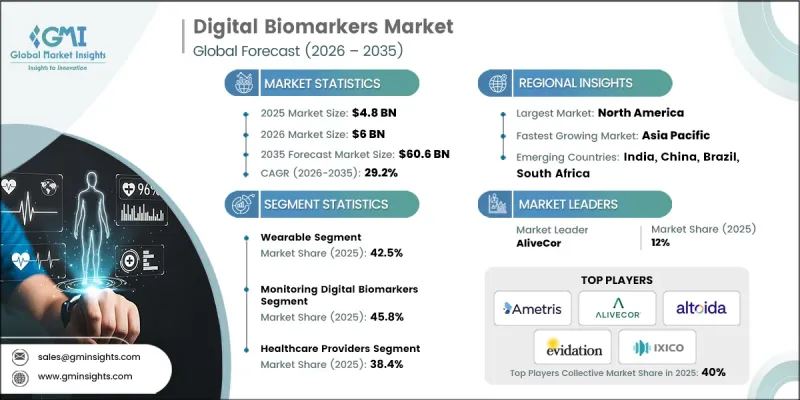
市場成長的驅動力來自感測器技術的進步、遠端患者監護解決方案的日益普及,以及人工智慧驅動的分析技術在臨床研究和醫療服務中的日益融合。隨著技術提供者、製藥公司和研究機構加大對下一代健康監測工具的投資,數位生物標記市場正獲得顯著發展動力。這些相關人員正積極推動研發,以推出可靠且檢驗的數位終點指標,從而提高臨床試驗效率並改善患者預後。數位生物標記是指透過穿戴式裝置和感測器平台等連網裝置收集的生理、行為和環境數據。這些資料點能夠實現持續的健康評估、疾病進展追蹤和治療效果評估。隨著精準醫療和個人化醫療日益受到關注,數位生物標記的應用正在加速,全球數位生物標記市場正成為現代醫療保健系統的一股變革力量。
| 市場範圍 | |
|---|---|
| 開始年份 | 2025 |
| 預測期 | 2026-2035 |
| 上市時的市場規模 | 48億美元 |
| 預測金額 | 606億美元 |
| 複合年成長率 | 29.2% |
隨著各機構將創新置於優先地位並拓展其在以數據為中心的醫療保健技術領域的能力,數位生物標記市場正在快速發展。舉措投入的增加推動了高精度、檢驗的數位測量工具的開發。分析能力的不斷提升提高了對複雜健康數據的解讀能力,從而支持更有效的臨床決策和病患監測。從連續資料流產生可操作見解的能力,正在提升研究成果和醫療服務效率。
預計到2025年,穿戴式裝置領域將成為主要品類之一,佔42.5%的市佔率。穿戴式裝置能夠持續追蹤關鍵的生理和行為指標,提供比定期臨床評估更全面的資料集。這種持續監測有助於及早發現健康狀況的變化,並實現及時的醫療干預。此外,穿戴式裝置提供了一種更便利、非侵入性的健康監測方式,提高了使用者接受度,促進了其更廣泛的應用。便利性、舒適性和即時數據採集的結合,持續推動該領域的成長。
預計到2025年,心血管和代謝疾病領域將佔22.6%的市場。該領域反映了數位生物標記在慢性病監測和管理中日益廣泛的應用。持續追蹤生理參數使醫療專業人員能夠更深入地了解疾病進展,並做出更明智的治療決策。先進的監測解決方案有助於早期發現異常健康模式,從而促進預防醫學和長期疾病管理。對有效監測慢性病日益成長的需求正在推動該領域的需求成長。
預計到2025年,北美數位生物標記市場將佔據顯著佔有率。這主要得益於先進的醫療基礎設施、連網型設備的普及以及人工智慧分析技術在臨床工作流程中的早期應用。該地區擁有完善的法規結構,該框架日益支持數位健康技術和遠端監測解決方案。這些監管方面的進步正在加速數位生物標記在研究和臨床環境中的檢驗和應用。此外,慢性病的高發生率也推動了對持續、即時健康監測的需求,進一步促進了北美市場的成長。
目錄
第1章:調查方法
- 研究途徑
- 品質改進計劃
- GMI人工智慧政策和資料完整性計劃
- 資訊來源一致性協議
- GMI人工智慧政策和資料完整性計劃
- 調查過程和可靠性評分
- 調查過程的組成部分
- 評分組成部分
- 數據收集
- 主要來源部分列表
- 資料探勘資訊來源
- 付費資訊來源
- 區域資訊來源
- 付費資訊來源
- 基本估算和計算方法
- 每種方法中基準年的計算
- 預測模型
- 量化市場影響分析
- 生長參數對預測的數學影響
- 量化市場影響分析
- 關於調查透明度的補充信息
- 資訊來源歸屬框架
- 品質保證指標
- 對信任的承諾
第2章執行摘要
第3章業界考察
- 生態系分析
- 影響產業的因素
- 促進因素
- 慢性病盛行率增加
- 人工智慧和機器學習的進展
- 穿戴式裝置的普及
- 遠端監控正受到越來越多的關注。
- 產業潛在風險與挑戰
- 先進設備高成本
- 熟練專業人員短缺
- 市場機遇
- 基於被動和連續數位生物標記的腦健康監測領域的成長機會
- 促進因素
- 成長潛力分析
- 監理情勢
- 技術趨勢(基於初步調查)
- 目前技術
- 基於心電圖(ECG)的心臟生物標記系統
- 基於環境感測器的數位生物標記用於早期檢測失補償心臟衰竭
- 新興技術
- 利用感測器和生物感測器進行人工智慧輔助生物標記檢測
- 開發用於早期檢測阿茲海默症的數位語音生物標記物
- 目前技術
- 未來市場趨勢(基於初步研究)
- 人工智慧和生成式人工智慧對市場的影響(基於初步研究)
- 專利分析(基於初步研究)
- 波特五力分析
- PESTEL 分析
第4章 競爭情勢
- 介紹
- 企業市佔率分析
- 北美洲
- 歐洲
- 亞太地區
- 企業矩陣分析
- 主要市場公司的競爭分析
- 競爭定位矩陣
- 主要進展
- 併購
- 夥伴關係與合作
- 新產品發布
- 業務拓展計劃
第5章 市場估計與預測:依類型分類,2022-2035年
- 穿戴式裝置
- 基於行動裝置的應用程式
- 感應器
- 其他
第6章 市場估計與預測:依臨床領域分類,2022-2035年
- 用於診斷的數位生物標記
- 用於監測的數位生物標記
- 預測性和預後性數位生物標記物
- 其他臨床領域
第7章 市場估計與預測:依治療領域分類,2022-2035年
- 心血管和代謝疾病(CVMD)
- 糖尿病
- 呼吸系統疾病
- 精神疾病
- 睡眠和運動障礙
- 神經系統疾病
- 肌肉骨骼疾病
- 其他治療領域
第8章 市場估算與預測:依最終用途分類,2022-2035年
- 醫療保健提供者
- 保險公司
- 製藥和生物技術公司
- 學術和研究機構
第9章 市場估計與預測:依地區分類,2022-2035年
- 北美洲
- 美國
- 加拿大
- 歐洲
- 德國
- 英國
- 法國
- 西班牙
- 義大利
- 荷蘭
- 亞太地區
- 中國
- 日本
- 印度
- 澳洲
- 韓國
- 拉丁美洲
- 巴西
- 墨西哥
- 阿根廷
- 中東和非洲
- 南非
- 沙烏地阿拉伯
- 阿拉伯聯合大公國
第10章:公司簡介
- Ametris
- AliveCor
- Altoida
- Amgen Inc.
- Adherium Limited
- Aural Analytic
- Brainomix
- Biogen
- Clario
- Empatica Inc.
- Evidation Health Inc.
- IXICO plc
- Koneksa
- Sonde Health, Inc.
- Vivo Sense
The Global Digital Biomarkers Market was valued at USD 4.8 billion in 2025 and is estimated to grow at a CAGR of 29.2% to reach USD 60.6 billion by 2035.
Market growth is fueled by advancements in sensor technologies, rising adoption of remote patient monitoring solutions, and the growing integration of AI-powered analytics into clinical research and healthcare delivery. The digital biomarkers market is gaining significant momentum as technology providers, pharmaceutical companies, and research organizations intensify investments in next-generation health monitoring tools. These stakeholders are advancing research and development efforts to introduce reliable and validated digital endpoints that enhance clinical trial efficiency and improve patient outcomes. Digital biomarkers refer to physiological, behavioral, and environmental data captured through connected devices such as wearables and sensor-enabled platforms. These data points enable continuous health assessment, disease progression tracking, and treatment evaluation. Increasing emphasis on precision medicine and personalized healthcare is further strengthening the adoption of digital biomarkers, positioning the global digital biomarkers market as a transformative force in modern healthcare systems.
| Market Scope | |
|---|---|
| Start Year | 2025 |
| Forecast Year | 2026-2035 |
| Start Value | $4.8 Billion |
| Forecast Value | $60.6 Billion |
| CAGR | 29.2% |
The digital biomarkers market is advancing rapidly as organizations prioritize innovation and expand capabilities in data-centric healthcare technologies. Increased investment in research initiatives is driving the development of highly accurate and validated digital measurement tools. Continuous progress in analytical capabilities is enabling improved interpretation of complex health data, supporting more effective clinical decision-making and patient monitoring. The ability to generate actionable insights from continuous data streams is enhancing both research outcomes and healthcare delivery efficiency.
The wearable segment accounted for 42.5% share in 2025, making it the leading category. Wearable devices enable continuous tracking of key physiological and behavioral indicators, providing a more comprehensive data set compared to periodic clinical assessments. This constant monitoring supports early detection of health variations and allows timely medical intervention. In addition, wearables offer a more convenient and non-invasive approach to health monitoring, which increases user acceptance and encourages broader adoption. The combination of accessibility, comfort, and real-time data collection continues to drive growth within this segment.
The cardiovascular and metabolic disorders segment held a 22.6% share in 2025. This segment reflects the growing use of digital biomarkers in monitoring and managing chronic health conditions. Continuous tracking of physiological parameters enables healthcare providers to understand disease progression better and make informed treatment decisions. Advanced monitoring solutions support early identification of irregular health patterns, improving preventive care and long-term disease management. The increasing need for effective monitoring of chronic conditions is reinforcing demand within this segment.
North America Digital Biomarkers Market captured a notable share in 2025, supported by advanced healthcare infrastructure, widespread adoption of connected devices, and early implementation of AI-enabled analytics in clinical workflows. The region benefits from established regulatory frameworks that are increasingly supportive of digital health technologies and remote monitoring solutions. These regulatory advancements are accelerating the validation and adoption of digital biomarkers in both research and clinical environments. Additionally, the high prevalence of chronic conditions is driving demand for continuous and real-time health monitoring, further strengthening market growth across North America.
Key companies operating in the Global Digital Biomarkers Market include Ametris, AliveCor, Altoida, Amgen Inc., Adherium Limited, Aural Analytic, Brainomix, Biogen, Clario, Empatica Inc., Evidation Health Inc., IXICO plc, Koneksa, Sonde Health, Inc., and Vivo Sense. Companies in the Digital Biomarkers Market are adopting strategic initiatives to enhance their competitive position and expand their global footprint. A primary focus is placed on advancing research and development to create highly accurate, validated, and scalable digital health solutions. Organizations are increasingly integrating artificial intelligence and advanced analytics to improve data interpretation and clinical relevance. Strategic collaborations with healthcare providers, research institutions, and technology firms are enabling faster innovation and broader adoption. Companies are also investing in regulatory compliance and validation processes to strengthen credibility and accelerate market entry. Expanding product portfolios and enhancing platform capabilities are helping businesses address diverse healthcare needs. Additionally, improving user experience through intuitive interfaces and seamless device integration supports higher adoption rates and long-term customer engagement.
Table of Contents
Chapter 1 Research Methodology
- 1.1 Research approach
- 1.2 Quality commitments
- 1.2.1 GMI AI policy & data integrity commitment
- 1.2.1.1 Source consistency protocol
- 1.2.1 GMI AI policy & data integrity commitment
- 1.3 Research trail & confidence scoring
- 1.3.1 Research trail components
- 1.3.2 Scoring components
- 1.4 Data collection
- 1.4.1 Partial list of primary sources
- 1.5 Data mining sources
- 1.5.1 Paid sources
- 1.5.1.1 Sources, by region
- 1.5.1 Paid sources
- 1.6 Base estimates and calculations
- 1.6.1 Base year calculation for any one approach
- 1.7 Forecast model
- 1.7.1 Quantified market impact analysis
- 1.7.1.1 Mathematical impact of growth parameters on forecast
- 1.7.1 Quantified market impact analysis
- 1.8 Research transparency addendum
- 1.8.1 Source attribution framework
- 1.8.2 Quality assurance metrics
- 1.8.3 Our commitment to trust
Chapter 2 Executive Summary
- 2.1 Industry 360° synopsis
- 2.2 Key market trends
- 2.3 Type trends
- 2.4 Clinical practice trends
- 2.5 Therapeutic area trends
- 2.6 End use trends
- 2.7 CXO perspectives: Strategic imperatives
Chapter 3 Industry Insights
- 3.1 Industry ecosystem analysis
- 3.2 Industry impact forces
- 3.2.1 Growth drivers
- 3.2.1.1 Rising prevalence of chronic diseases
- 3.2.1.2 Advancements in AI and machine learning
- 3.2.1.3 Adoption of wearable devices
- 3.2.1.4 Growing focus on remote monitoring
- 3.2.2 Industry pitfalls and challenges
- 3.2.2.1 High costs of advanced devices
- 3.2.2.2 Lack of skilled professionals
- 3.2.3 Market opportunity
- 3.2.3.1 Growing opportunity in brain health monitoring through passive, continuous digital biomarkers
- 3.2.1 Growth drivers
- 3.3 Growth potential analysis
- 3.4 Regulatory landscape
- 3.4.1 North America
- 3.4.2 Europe
- 3.4.3 Asia Pacific
- 3.4.4 Latin America
- 3.4.5 Middle East and Africa
- 3.5 Technological landscape (Driven by Primary Research)
- 3.5.1 Current technologies
- 3.5.1.1 ECG based cardiac biomarker systems
- 3.5.1.2 Ambient sensor-based digital biomarkers for early detection of heart failure decompensation
- 3.5.2 Emerging technologies
- 3.5.2.1 AI assisted detection of biomarkers using sensors and biosensors
- 3.5.2.2 Development of digital voice biomarkers for early Alzheimer's detection
- 3.5.1 Current technologies
- 3.6 Future market trends (Driven by Primary Research)
- 3.7 Impact of AI and Generative AI on the market (Driven by Primary Research)
- 3.8 Patent analysis (Driven by Primary Research)
- 3.9 Porter's analysis
- 3.10 PESTEL analysis
Chapter 4 Competitive Landscape, 2025
- 4.1 Introduction
- 4.2 Company market share analysis
- 4.2.1 North America
- 4.2.2 Europe
- 4.2.3 Asia Pacific
- 4.3 Company matrix analysis
- 4.4 Competitive analysis of major market players
- 4.5 Competitive positioning matrix
- 4.6 Key developments
- 4.6.1 Merger and acquisition
- 4.6.2 Partnership and collaboration
- 4.6.3 New product launches
- 4.6.4 Expansion plans
Chapter 5 Market Estimates and Forecast, By Type, 2022-2035 ($ Mn)
- 5.1 Key trends
- 5.2 Wearable
- 5.3 Mobile-based applications
- 5.4 Sensors
- 5.5 Other types
Chapter 6 Market Estimates and Forecast, By Clinical Practice, 2022-2035 ($ Mn)
- 6.1 Key trends
- 6.2 Diagnostic digital biomarkers
- 6.3 Monitoring digital biomarkers
- 6.4 Predictive and prognostic digital biomarkers
- 6.5 Other clinical practices
Chapter 7 Market Estimates and Forecast, By Therapeutic Area, 2022-2035 ($ Mn)
- 7.1 Key trends
- 7.2 Cardiovascular and metabolic disorders (CVMD)
- 7.3 Diabetes
- 7.4 Respiratory disorders
- 7.5 Psychiatric disorders
- 7.6 Sleep and movement diseases
- 7.7 Neurological disorders
- 7.8 Musculoskeletal disorders
- 7.9 Other therapeutic areas
Chapter 8 Market Estimates and Forecast, By End Use, 2022-2035 ($ Mn)
- 8.1 Key trends
- 8.2 Healthcare providers
- 8.3 Payers
- 8.4 Pharmaceutical and biotechnology companies
- 8.5 Academic and research institutions
Chapter 9 Market Estimates and Forecast, By Region, 2022-2035 ($ Mn)
- 9.1 Key trends
- 9.2 North America
- 9.2.1 U.S.
- 9.2.2 Canada
- 9.3 Europe
- 9.3.1 Germany
- 9.3.2 UK
- 9.3.3 France
- 9.3.4 Spain
- 9.3.5 Italy
- 9.3.6 Netherlands
- 9.4 Asia Pacific
- 9.4.1 China
- 9.4.2 Japan
- 9.4.3 India
- 9.4.4 Australia
- 9.4.5 South Korea
- 9.5 Latin America
- 9.5.1 Brazil
- 9.5.2 Mexico
- 9.5.3 Argentina
- 9.6 Middle East and Africa
- 9.6.1 South Africa
- 9.6.2 Saudi Arabia
- 9.6.3 UAE
Chapter 10 Company Profiles
- 10.1 Ametris
- 10.2 AliveCor
- 10.3 Altoida
- 10.4 Amgen Inc.
- 10.5 Adherium Limited
- 10.6 Aural Analytic
- 10.7 Brainomix
- 10.8 Biogen
- 10.9 Clario
- 10.10 Empatica Inc.
- 10.11 Evidation Health Inc.
- 10.12 IXICO plc
- 10.13 Koneksa
- 10.14 Sonde Health, Inc.
- 10.15 Vivo Sense

 多重生物標記成像市場規模、佔有率和成長分析:按組件、成像技術、應用、最終用戶和地區分類—2026-2033年產業預測
 數位生物標記市場預測至2034年—按類型、資料收集方法、技術、臨床實踐、應用、最終用戶和地區分類的全球分析
 數位生物標記市場:按類型、資料類型、技術平台、最終用戶和地區分類
 全球數位生物標記市場:按類型、治療領域、應用、最終用戶和地區分類-預測至2031年
 數位生物標記市場:按組件、生物標記類型、功能、治療領域、應用和最終用戶分類——2026年至2032年全球市場預測
 數位生物標記市場分析及預測(至2035年):按類型、產品類型、服務、技術、組件、應用、設備、最終用戶、功能、解決方案分類
 全球數位生物標記市場規模、佔有率、趨勢和成長分析報告(2026-2034)
 數位生物標記市場規模、佔有率和成長分析(按類型、臨床實踐、治療領域、最終用戶和地區分類):產業預測(2026-2033 年)
 數位生物標記市場-全球產業規模、佔有率、趨勢、機會和預測,按成分、類型、治療領域、最終用戶、地區和競爭細分,2020-2030 年預測
 全球數位生物標記市場