


 |
市場調查報告書
商品編碼
2027613
葵花籽市場機會、成長要素、產業趨勢分析及2026-2035年預測Sunflower Seeds Market Opportunity, Growth Drivers, Industry Trend Analysis, and Forecast 2026 - 2035 |
||||||

預計到 2025 年,全球葵花籽市場價值將達到 40 億美元,並有望以 8.8% 的複合年成長率成長,到 2035 年達到 95 億美元。
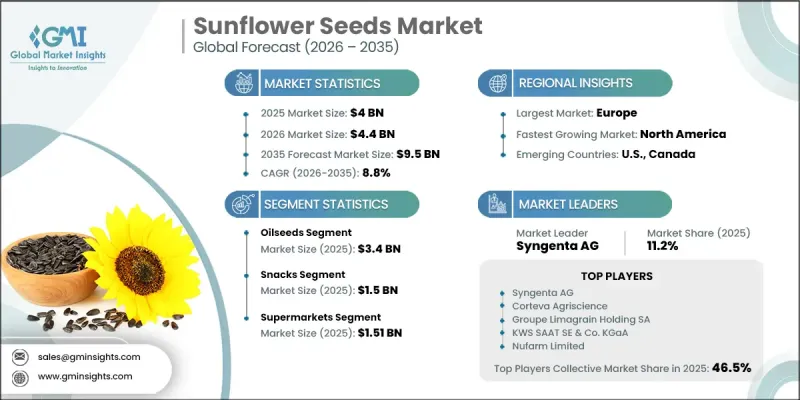
葵花籽是從向日葵植株上獲得的可食用種子,因其豐富的營養價值而廣為人知,富含健康脂肪、蛋白質和必需微量元素。這些種子被一層保護性的外殼包裹,根據加工方法和消費者偏好,可以以多種形式食用。由於其用途廣泛,葵花籽不僅可以直接食用,還可以作為各種加工食品的基礎原料。隨著消費者越來越傾向於選擇營養豐富的植物來源食品以促進均衡飲食,葵花籽市場呈現出強勁的成長動能。此外,飲食習慣的改變和消費者對「潔淨標示」食品意識的提高也影響著他們的購買決策。葵花籽產品具有很強的適應性,能夠滿足不同的消費模式,從而支撐著廣泛的消費者群體的穩定需求。加工技術的進步和供應鏈效率的提升進一步提高了產品的供應量、品質穩定性和擴充性,增強了整體市場前景。
| 市場範圍 | |
|---|---|
| 開始年份 | 2025 |
| 預測期 | 2026-2035 |
| 上市時的市場規模 | 40億美元 |
| 預計金額 | 95億美元 |
| 複合年成長率 | 8.8% |
預計到2025年,油籽市場規模將達到34億美元,並透過加工效率和萃取技術的不斷提升保持其市場主導地位。種子品質的提高和農業耕作方式的改進有助於產量的穩定,從而促進其在食用油生產中的廣泛應用。消費者對精煉程度較低的烹飪原料的需求日益成長,進一步鞏固了該細分市場在全球市場的重要性。
預計到2025年,零食市場規模將達到15億美元,主要得益於消費者對天然食品日益成長的需求。葵花籽因其能夠改善食品口感和營養價值,正被擴大應用於各種食品中。葵花籽在加工食品中的應用反映了消費者對健康功能性食材的偏好轉變,也符合現代食品發展趨勢。
北美葵花籽市場預計將從2025年的10億美元成長到2035年的25億美元,反映出該地區強勁的需求。消費模式受到家庭烹飪中葵花籽的持續使用以及消費者對便捷營養食品偏好。穩定的供應鏈和消費者在各種消費情境下對種子類食品的持續興趣也進一步推動了市場擴張。
目錄
第1章:調查方法和範圍
第2章執行摘要
第3章業界考察
- 生態系分析
- 供應商情況
- 利潤率
- 每個階段增加的價值
- 影響價值鏈的因素
- 中斷
- 影響產業的因素
- 促進因素
- 人們對植物來源營養的偏好日益成長
- 逐漸成為日常零食
- 用途廣泛,可用於家庭烹飪
- 陷阱與挑戰
- 氣候變遷導致的作物問題脆弱性
- 季節性變化導致供應波動
- 機會
- 人們對高營養食品的興趣日益濃厚
- 對鳥類和寵物飼料的需求不斷成長
- 促進因素
- 成長潛力分析
- 監理情勢
- 波特五力分析
- PESTEL 分析
- 科技與創新趨勢
- 當前技術趨勢
- 新興技術
- 價格趨勢
- 按地區
- 依產品類型
- 未來市場趨勢
- 科技與創新趨勢
- 當前技術趨勢
- 新興技術
- 專利趨勢
- 貿易統計(HS編碼)
- 主要進口國
- 主要出口國
- 永續性和環境方面
- 永續計劃
- 減少廢棄物策略
- 生產中的能源效率
- 環保意識的舉措
- 考慮碳足跡
第4章 競爭情勢
- 介紹
- 企業市佔率分析
- 按地區
- 北美洲
- 歐洲
- 亞太地區
- 拉丁美洲
- 中東和非洲
- 按地區
- 企業矩陣分析
- 主要市場公司的競爭分析
- 競爭定位矩陣
- 主要進展
- 併購
- 夥伴關係與合作
- 新產品發布
- 業務拓展計劃
第5章 市場估算與預測:依產品類型分類,2022-2035年
- 油籽
- 非油籽
第6章 市場估計與預測:依應用領域分類,2022-2035年
- 小吃
- 烘焙產品
- 糖果甜點
- 其他
第7章 市場估價與預測:依通路分類,2022-2035年
- 超級市場
- 零售店
- 線上
- 其他
第8章 市場估計與預測:依地區分類,2022-2035年
- 北美洲
- 美國
- 加拿大
- 歐洲
- 德國
- 英國
- 法國
- 西班牙
- 義大利
- 其他歐洲地區
- 亞太地區
- 中國
- 印度
- 日本
- 澳洲
- 韓國
- 亞太其他地區
- 拉丁美洲
- 巴西
- 墨西哥
- 阿根廷
- 其他拉丁美洲地區
- 中東和非洲
- 沙烏地阿拉伯
- 南非
- 阿拉伯聯合大公國
- 其他中東和非洲地區
第9章:公司簡介
- Land O'Lakes
- Syngenta AG(acquired by ChemChina)
- Corteva Agriscience
- BASF SE
- Advanta Seeds
- Nufarm Limited
- Limagrain
- Sakata Seed America.
- Red River Commodities Fargo
- KWS SAAT SE & Co. KGaA
The Global Sunflower Seeds Market was valued at USD 4 billion in 2025 and is estimated to grow at a CAGR of 8.8% to reach USD 9.5 billion by 2035.
Sunflower seeds are edible kernels derived from sunflower plants and are widely recognized for their nutritional composition, including healthy fats, protein, and essential micronutrients. These seeds are enclosed within protective outer shells and are consumed in multiple forms depending on processing and consumer preference. Their versatility allows them to be used both as a direct food product and as a base ingredient in various processed applications. The market is witnessing strong momentum as consumers increasingly favor nutrient-rich, plant-based food options that support balanced diets. Additionally, evolving dietary habits and growing awareness regarding clean-label food products are influencing purchasing decisions. The product's adaptability across multiple consumption formats supports its consistent demand across diverse demographics. Improvements in processing technologies and supply chain efficiency are further enhancing product availability, quality consistency, and scalability, strengthening the overall market outlook.
| Market Scope | |
|---|---|
| Start Year | 2025 |
| Forecast Year | 2026-2035 |
| Start Value | $4 Billion |
| Forecast Value | $9.5 Billion |
| CAGR | 8.8% |
The oilseeds segment generated USD 3.4 billion in 2025, maintaining its dominant position due to ongoing advancements in processing efficiency and improved extraction techniques. Enhanced seed quality and agricultural practices contribute to consistent output levels, supporting widespread use in edible oil production. Increasing consumer inclination toward minimally refined cooking ingredients continues to reinforce the segment's significance across global markets.
The snacks segment accounted for USD 1.5 billion in 2025, supported by growing demand for natural ingredient-based food products. Sunflower seeds are increasingly incorporated into a wide range of food formats due to their ability to enhance texture and nutritional value. Their inclusion in various prepared food products reflects shifting consumer preferences toward wholesome and functional ingredients that align with modern dietary trends.
North America Sunflower Seeds Market is anticipated to grow from USD 1 billion in 2025 to USD 2.5 billion by 2035, reflecting strong regional demand. Consumption patterns are shaped by increased preference for convenient and nutritious food options, alongside sustained usage in home-based food preparation. Market expansion is further supported by stable supply chains and consistent consumer interest in seed-based food products across different consumption occasions.
Key companies operating in the Global Sunflower Seeds Market include Land O'Lakes, Syngenta AG (acquired by ChemChina), Corteva Agriscience, BASF SE, Advanta Seeds, Nufarm Limited, Limagrain, Sakata Seed America, Red River Commodities Fargo, and KWS SAAT SE & Co. KGaA. Companies in the Sunflower Seeds Market are strengthening their position by focusing on product innovation, improved seed genetics, and advanced processing technologies. They are investing in research to enhance yield quality, disease resistance, and nutritional value, ensuring consistent supply and product differentiation. Strategic collaborations with farmers and distributors help optimize supply chain efficiency and expand geographic reach. Firms are also emphasizing sustainable farming practices and environmentally responsible production methods to align with evolving regulatory standards and consumer expectations. Additionally, companies are diversifying their product portfolios by introducing value-added and ready-to-consume formats. Branding, packaging innovation, and expansion into emerging markets further support competitive positioning and long-term growth.
Table of Contents
Chapter 1 Methodology & Scope
- 1.1 Market scope and definition
- 1.2 Research design
- 1.2.1 Research approach
- 1.2.2 Data collection methods
- 1.3 Data mining sources
- 1.3.1 Global
- 1.3.2 Regional/Country
- 1.4 Base estimates and calculations
- 1.4.1 Base year calculation
- 1.4.2 Key trends for market estimation
- 1.5 Primary research and validation
- 1.5.1 Primary sources
- 1.6 Forecast model
- 1.7 Research assumptions and limitations
Chapter 2 Executive Summary
- 2.1 Industry 360° synopsis
- 2.2 Key market trends
- 2.2.1 Product Type
- 2.2.2 Application
- 2.2.3 Distribution Channel
- 2.2.4 Regional
- 2.3 TAM Analysis, 2026-2035
- 2.4 CXO perspectives: Strategic imperatives
- 2.5 Future outlook and strategic recommendations
Chapter 3 Industry Insights
- 3.1 Industry ecosystem analysis
- 3.1.1 Supplier landscape
- 3.1.2 Profit margin
- 3.1.3 Value addition at each stage
- 3.1.4 Factor affecting the value chain
- 3.1.5 Disruptions
- 3.2 Industry impact forces
- 3.2.1 Growth drivers
- 3.2.1.1 Rising preference for plant-based nutrition
- 3.2.1.2 Expanding use in everyday snacking
- 3.2.1.3 Broader applications in home cooking
- 3.2.2 Pitfalls/challenge
- 3.2.2.1 Vulnerability to climate-related crop issues
- 3.2.2.2 Fluctuating availability during seasonal shifts
- 3.2.3 Opportunities
- 3.2.3.1 Growing interest in nutrient-dense foods
- 3.2.3.2 Rising demand in bird and pet feed
- 3.2.1 Growth drivers
- 3.3 Growth potential analysis
- 3.4 Regulatory landscape
- 3.4.1 North America
- 3.4.2 Europe
- 3.4.3 Asia Pacific
- 3.4.4 Latin America
- 3.4.5 Middle East & Africa
- 3.5 Porter's analysis
- 3.6 PESTEL analysis
- 3.7 Technology and innovation landscape
- 3.7.1 Current technological trends
- 3.7.2 Emerging technologies
- 3.8 Price trends
- 3.8.1 By region
- 3.8.2 By product type
- 3.9 Future market trends
- 3.10 Technology and innovation landscape
- 3.10.1 Current technological trends
- 3.10.2 Emerging technologies
- 3.11 Patent landscape
- 3.12 Trade statistics (HS code)
- 3.12.1 Major importing countries
- 3.12.2 Major exporting countries
- 3.13 Sustainability and environmental aspects
- 3.13.1 Sustainable practices
- 3.13.2 Waste reduction strategies
- 3.13.3 Energy efficiency in production
- 3.13.4 Eco-friendly initiatives
- 3.14 Carbon footprint consideration
Chapter 4 Competitive Landscape, 2025
- 4.1 Introduction
- 4.2 Company market share analysis
- 4.2.1 By region
- 4.2.1.1 North America
- 4.2.1.2 Europe
- 4.2.1.3 Asia Pacific
- 4.2.1.4 LATAM
- 4.2.1.5 MEA
- 4.2.1 By region
- 4.3 Company matrix analysis
- 4.4 Competitive analysis of major market players
- 4.5 Competitive positioning matrix
- 4.6 Key developments
- 4.6.1 Mergers & acquisitions
- 4.6.2 Partnerships & collaborations
- 4.6.3 New product launches
- 4.6.4 Expansion plans
Chapter 5 Market Estimates and Forecast, By Product Type, 2022-2035 (USD Billion) (Kilo Tons)
- 5.1 Key trends
- 5.2 Oilseed
- 5.3 Non-oilseed
Chapter 6 Market Estimates and Forecast, By Application, 2022-2035 (USD Billion) (Kilo Tons)
- 6.1 Key trends
- 6.2 Snacks
- 6.3 Bakery products
- 6.4 Confectionery
- 6.5 Others
Chapter 7 Market Estimates and Forecast, By Distribution Channel, 2022-2035 (USD Billion) (Kilo Tons)
- 7.1 Key trends
- 7.2 Supermarkets
- 7.3 Retail shops
- 7.4 Online
- 7.5 Others
Chapter 8 Market Estimates and Forecast, By Region, 2022-2035 (USD Billion) (Kilo Tons)
- 8.1 Key trends
- 8.2 North America
- 8.2.1 U.S.
- 8.2.2 Canada
- 8.3 Europe
- 8.3.1 Germany
- 8.3.2 UK
- 8.3.3 France
- 8.3.4 Spain
- 8.3.5 Italy
- 8.3.6 Rest of Europe
- 8.4 Asia Pacific
- 8.4.1 China
- 8.4.2 India
- 8.4.3 Japan
- 8.4.4 Australia
- 8.4.5 South Korea
- 8.4.6 Rest of Asia Pacific
- 8.5 Latin America
- 8.5.1 Brazil
- 8.5.2 Mexico
- 8.5.3 Argentina
- 8.5.4 Rest of Latin America
- 8.6 Middle East and Africa
- 8.6.1 Saudi Arabia
- 8.6.2 South Africa
- 8.6.3 UAE
- 8.6.4 Rest of Middle East and Africa
Chapter 9 Company Profiles
- 9.1 Land O'Lakes
- 9.2 Syngenta AG (acquired by ChemChina)
- 9.3 Corteva Agriscience
- 9.4 BASF SE
- 9.5 Advanta Seeds
- 9.6 Nufarm Limited
- 9.7 Limagrain
- 9.8 Sakata Seed America.
- 9.9 Red River Commodities Fargo
- 9.10 KWS SAAT SE & Co. KGaA


![葵花籽粕市場評估,依產品類型 [脫殼葵花籽粕、無殼葵花籽粕]、依牲畜 [家禽、反芻動物、養豬、水產養殖]、依應用 [動物飼料、肥料]、依地區、機會和預測,2018年至2032年](/sample/img/cover/42/default_cover_mx.png)