


 |
市場調查報告書
商品編碼
2027532
金屬粉末積層製造市場機會、成長促進因素、產業趨勢分析及預測(2026-2035年)Additive Manufacturing With Metal Powders Market Opportunity, Growth Drivers, Industry Trend Analysis, and Forecast 2026 - 2035 |
||||||

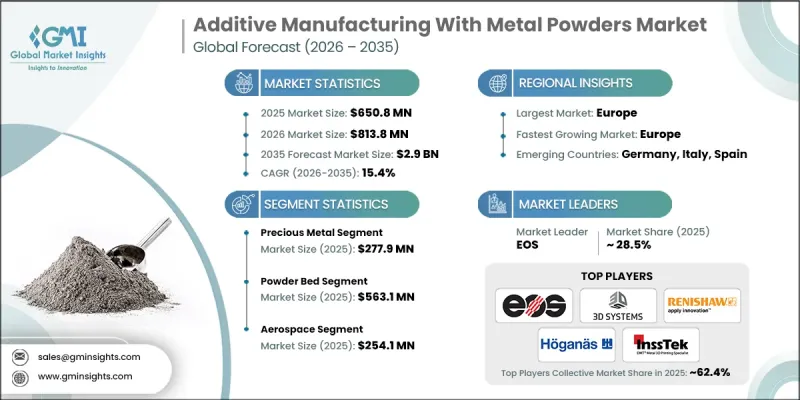
2025 年全球金屬粉末積層製造市場規模預計為 6.508 億美元,預計到 2035 年將達到 29 億美元,年複合成長率為 15.4%。
市場擴張的驅動力在於多個高性能工業領域對輕量化、耐用組件日益成長的需求。製造商正擴大採用金屬積層製造技術,以提高效率、減少材料浪費,並實現傳統方法難以實現的複雜形狀的生產。這種轉變正在重塑製造策略,尤其是在各行業優先考慮提升性能和能源效率的情況下。 3D列印技術的不斷進步,包括雷射系統、電子束製程和多雷射配置的改進,顯著提高了建造速度和精度。這些創新增強了製程可靠性,並擴大了金屬粉末製造解決方案的商業性可行性。此外,積層製造在醫療領域的應用不斷擴展,也促進了需求的成長,對客製化、高精度組件的需求持續成長。總而言之,技術創新、產業應用以及對先進製造能力的需求正在融合,共同推動全球市場的持續成長。
| 市場範圍 | |
|---|---|
| 開始年份 | 2025 |
| 預測期 | 2026-2035 |
| 起始金額 | 6.508億美元 |
| 預測金額 | 29億美元 |
| 複合年成長率 | 15.4% |
預計到2025年,粉末床製造市場規模將達到5.631億美元,並在2026年至2035年間以15.6%的複合年成長率成長。該領域憑藉其高精度、高品質製造複雜金屬零件的能力,持續保持主導地位。其在製造複雜結構方面的適用性使其在精密加工產業中廣泛應用。同時,吹粉技術因其在修復、改造和製造大型零件方面的柔軟性而備受關注。將精密製造與經濟高效的修復方案結合的能力,正顯著推動市場對金屬粉末積層製造技術的需求。
預計到2025年,航太領域的市場規模將達到2.541億美元,市佔率為39%,到2035年年複合成長率(CAGR)將達到15.9%。隨著企業擴大利用金屬積層製造技術生產輕量化、高性能和高精度零件,航太、汽車和醫療等關鍵產業的成長正在加速。在航太領域,對先進結構和功能部件的需求是推動成長的主要動力;而在汽車領域,這些技術正被用於滿足原型製作、模具製造和特殊生產需求。同時,在醫療領域,對客製化、高精度零件日益成長的需求正在推動應用領域的快速擴張。這些行業的總合需求正在推動向基於金屬粉末的先進製造流程轉型。
預計2025年,北美金屬粉末積層製造市場規模將達2.531億美元。該地區正經歷金屬積層製造技術的快速普及,這得益於其完善的工業基礎設施和持續的研發投入。原型製作、模具製造和特種生產等領域的廣泛應用正在推動多個行業的需求成長。自動化和混合製造流程的進步進一步提升了營運效率,並加速了市場擴張。該地區強大的工業基礎和早期應用趨勢將繼續鞏固其作為全球成長主要驅動力的地位。
目錄
第1章:調查方法
第2章執行摘要
第3章業界考察
- 產業生態系分析
- 供應商情況
- 利潤率
- 每個階段增加的價值
- 影響價值鏈的因素
- 中斷
- 影響產業的因素
- 成長促進因素
- 產業潛在風險與挑戰
- 市場機遇
- 成長潛力分析
- 監理情勢
- 北美洲
- 歐洲
- 亞太地區
- 拉丁美洲
- 中東和非洲
- 波特的分析
- PESTEL 分析
- 價格趨勢
- 按地區
- 依產品
- 未來市場趨勢
- 科技與創新趨勢
- 當前技術趨勢
- 新興技術
- 專利趨勢
- 貿易統計(註:僅提供主要國家的貿易統計)
- 主要進口國
- 主要出口國
- 永續性和環境方面
- 永續計劃
- 減少廢棄物策略
- 生產中的能源效率
- 具有環保意識的舉措
- 關於碳足跡的考量
第4章 競爭情勢
- 介紹
- 企業市佔率分析
- 按地區
- 北美洲
- 歐洲
- 亞太地區
- 拉丁美洲
- 中東和非洲
- 按地區
- 企業矩陣分析
- 主要市場公司的競爭分析
- 競爭定位矩陣
- 主要進展
- 併購
- 夥伴關係與合作
- 新產品發布
- 業務拓展計劃
第5章 市場估計與預測:依材料分類,2022-2035年
- 合金
- 鈦
- Ti6Al4V
- Ti6Al4V(ELI)
- 其他
- 鈷
- CoCr
- CoCrWC
- CoCrMo
- 銅
- C18150
- CuCr1Zr
- CuNi2SiCr
- 鎳
- Inconel 625
- Inconel 718
- 哈氏合金X
- 鋁
- ALSi12
- ALSi7Mg
- ALSi10Mg
- AL6061
- 其他
- 鈦
- 不銹鋼
- 奧氏體鋼
- 馬氏體鋼
- 雙相鋼
- 鐵素體鋼
- 其他鋼材
- 高速鋼
- 工具鋼
- 低合金鋼
- 貴金屬
- 鉑
- 其他貴金屬
- 鎢
- 碳化矽
- 氧化鋁粉末
- 鋯
- 二氧化鋯
- 鉬
- 鎂
- 氮化鋁
- 碳化鎢
第6章 市場估計與預測:依技術分類,2022-2035年
- 粉末層
- 直接金屬雷射燒結(DMLS)
- 選擇性雷射熔融(SLM)
- 電子束熔化(EBM)
- 吹粉
- 直接金屬沉積(DMD)
- 雷射工程淨成形(LENS)
- 其他
第7章 市場估計與預測:依應用領域分類,2022-2035年
- 航太
- 車
- 醫療保健
- 石油和天然氣
- 能源
- 核能
- 可再生能源
- 其他
第8章 市場估計與預測:依地區分類,2022-2035年
- 北美洲
- 美國
- 加拿大
- 歐洲
- 德國
- 英國
- 法國
- 義大利
- 西班牙
- 其他歐洲地區
- 亞太地區
- 中國
- 印度
- 日本
- 澳洲
- 韓國
- 亞太其他地區
- 拉丁美洲
- 巴西
- 墨西哥
- 阿根廷
- 其他拉丁美洲地區
- 中東和非洲
- 沙烏地阿拉伯
- 南非
- 阿拉伯聯合大公國
- 其他中東和非洲地區
第9章:公司簡介
- 3D Systems Corporation
- Additive Industries
- Advanced Powder &Coatings, Inc
- Aubert &Duval SA
- Aerojet Rocketdyne(L3Harris)
- Airbus SE
- Allegheny Technologies(ATI)
- APWorks
- Xi'an Bright Laser Technologies
- Carpenter Technologies Corp
- Colibrium Additive(GE Additive)
- Constellium
- Cookson Precious Metals Ltd
- EOS GmbH
- Equispheres, Inc
- ExOne
- Fabrisonic, LLC
- Farsoon Technologies
- Fonon Technologies
- Elmet Technologies(HC Starck)
- Hilderbrand &Cie SA
- Hoganas AB
- Insstek GmbH
- Legor Group SpA
- Materialise NV
- PyroGenesis Canada, Inc
- Renishaw PLC
- Sandvik Group
- STELIA Aerospace
- Linde AMT(Praxair Surface Technologies)
The Global Additive Manufacturing with Metal Powders Market was valued at USD 650.8 million in 2025 and is estimated to grow at a CAGR of 15.4% to reach USD 2.9 billion by 2035.
Market expansion is fueled by the rising demand for lightweight yet durable components across multiple high-performance industries. Manufacturers are increasingly adopting metal-based additive manufacturing technologies to enhance efficiency, reduce material waste, and enable the production of complex geometries that are difficult to achieve through conventional methods. This shift is redefining manufacturing strategies, particularly as industries prioritize improved performance and energy efficiency. Continuous advancements in 3D printing technologies, including improvements in laser-based systems, electron beam processes, and multi-laser configurations, are significantly enhancing build speed and precision. These innovations are strengthening process reliability and expanding the commercial viability of metal powder-based manufacturing solutions. Additionally, the growing application of additive manufacturing in healthcare is contributing to rising demand, as the need for customized and high-precision components continues to increase. Overall, the convergence of technological innovation, industrial adoption, and demand for advanced manufacturing capabilities is driving sustained growth in the global market.
| Market Scope | |
|---|---|
| Start Year | 2025 |
| Forecast Year | 2026-2035 |
| Start Value | $650.8 Million |
| Forecast Value | $2.9 Billion |
| CAGR | 15.4% |
The powder bed segment accounted for USD 563.1 million in 2025 and is expected to grow at a CAGR of 15.6% from 2026 to 2035. This segment continues to lead due to its ability to produce intricate metal components with high accuracy and consistent quality. Its suitability for manufacturing complex structures has made it widely adopted across precision-driven industries. At the same time, blown powder technologies are gaining traction because of their flexibility in repairing, modifying, and producing larger components. The ability to combine precision manufacturing with cost-effective repair solutions is significantly boosting the demand for metal powder-based additive manufacturing technologies.
The aerospace segment generated USD 254.1 million in 2025 and held a share of 39%, with a projected CAGR of 15.9% through 2035. Growth across key industries such as aerospace, automotive, and healthcare is accelerating as companies increasingly utilize metal additive manufacturing to produce lightweight, high-performance, and highly accurate components. Aerospace applications are driving demand for advanced structural and functional parts, while the automotive sector is leveraging these technologies for prototyping, tooling, and specialized production needs. Meanwhile, healthcare applications continue to expand rapidly due to the increasing requirement for customized, high-precision components. The combined demand across these industries is reinforcing the shift toward advanced manufacturing processes based on metal powders.
North America Additive Manufacturing with Metal Powders Market accounted for USD 253.1 million in 2025. The region is experiencing rapid adoption of metal additive manufacturing technologies, supported by well-established industrial infrastructure and continuous investments in research and development. Increasing use in prototyping, tooling, and specialized production is driving demand across multiple sectors. Advancements in automation and hybrid manufacturing processes are further enhancing operational efficiency and accelerating market expansion. Strong industry presence and early adoption trends continue to position the region as a key contributor to global growth.
Key companies operating in the Additive Manufacturing With Metal Powders Market include 3D Systems Corporation, Additive Industries, Advanced Powder & Coatings, Inc., Aubert & Duval S.A, Aerojet Rocketdyne (L3Harris), Airbus SE, Allegheny Technologies (ATI), APWorks, Xi'an Bright Laser Technologies, Carpenter Technologies Corp, Colibrium Additive (GE Additive), Constellium, Cookson Precious Metals Ltd, EOS GmbH, Equispheres, Inc., ExOne, Fabrisonic, LLC, Farsoon Technologies, Fonon Technologies, Elmet Technologies (HC Starck), Hilderbrand & Cie SA, Hoganas AB, Insstek GmbH, Legor Group SpA, Materialise NV, PyroGenesis Canada, Inc., Renishaw PLC, Sandvik Group, STELIA Aerospace, Linde AMT (Praxair Surface Technologies), and others. Companies in the Additive Manufacturing with Metal Powders Market are focusing on technological innovation, capacity expansion, and strategic collaborations to strengthen their market position. Investments in advanced printing systems, improved powder materials, and process optimization are enhancing product performance and manufacturing efficiency. Firms are also expanding production capabilities and global distribution networks to meet rising demand. Partnerships with end-use industries are enabling faster adoption and application development. Additionally, companies are emphasizing research and development to improve precision, reduce costs, and enhance scalability.
Table of Contents
Chapter 1 Methodology
- 1.1 Market scope and definition
- 1.2 Research design
- 1.2.1 Research approach
- 1.2.2 Data collection methods
- 1.3 Data mining sources
- 1.3.1 Global
- 1.3.2 Regional/Country
- 1.4 Base estimates and calculations
- 1.4.1 Base year calculation
- 1.4.2 Key trends for market estimation
- 1.5 Primary research and validation
- 1.5.1 Primary sources
- 1.6 Forecast model
- 1.7 Research assumptions and limitations
Chapter 2 Executive Summary
- 2.1 Industry 360° synopsis
- 2.2 Key market trends
- 2.2.1 Regional
- 2.2.2 Material
- 2.2.3 Technology
- 2.2.4 Application
- 2.3 TAM Analysis, 2026-2035
- 2.4 CXO perspectives: Strategic imperatives
- 2.5 Future Outlook and Strategic Recommendations
Chapter 3 Industry Insights
- 3.1 Industry ecosystem analysis
- 3.1.1 Supplier Landscape
- 3.1.2 Profit Margin
- 3.1.3 Value addition at each stage
- 3.1.4 Factor affecting the value chain
- 3.1.5 Disruptions
- 3.2 Industry impact forces
- 3.2.1 Growth drivers
- 3.2.2 Industry pitfalls and challenges
- 3.2.3 Market opportunities
- 3.3 Growth potential analysis
- 3.4 Regulatory landscape
- 3.4.1 North America
- 3.4.2 Europe
- 3.4.3 Asia Pacific
- 3.4.4 Latin America
- 3.4.5 Middle East & Africa
- 3.5 Porter’s analysis
- 3.6 PESTEL analysis
- 3.7 Price trends
- 3.7.1 By region
- 3.7.2 By product
- 3.8 Future market trends
- 3.9 Technology and Innovation landscape
- 3.9.1 Current technological trends
- 3.9.2 Emerging technologies
- 3.10 Patent Landscape
- 3.11 Trade statistics (Note: the trade statistics will be provided for key countries only)
- 3.11.1 Major importing countries
- 3.11.2 Major exporting countries
- 3.12 Sustainability and Environmental Aspects
- 3.12.1 Sustainable Practices
- 3.12.2 Waste Reduction Strategies
- 3.12.3 Energy Efficiency in Production
- 3.12.4 Eco-friendly Initiatives
- 3.13 Carbon Footprint Considerations
Chapter 4 Competitive Landscape, 2025
- 4.1 Introduction
- 4.2 Company market share analysis
- 4.2.1 By region
- 4.2.1.1 North America
- 4.2.1.2 Europe
- 4.2.1.3 Asia Pacific
- 4.2.1.4 LATAM
- 4.2.1.5 MEA
- 4.2.1 By region
- 4.3 Company matrix analysis
- 4.4 Competitive analysis of major market players
- 4.5 Competitive positioning matrix
- 4.6 Key developments
- 4.6.1 Mergers & acquisitions
- 4.6.2 Partnerships & collaborations
- 4.6.3 New Product Launches
- 4.6.4 Expansion Plans
Chapter 5 Market Estimates and Forecast, By Material, 2022- 2035 (USD Million, Kilo Tons)
- 5.1 Key trends
- 5.2 Alloy
- 5.2.1 Titanium
- 5.2.1.1 Ti6Al4V
- 5.2.1.2 Ti6Al4V (ELI)
- 5.2.1.3 Others
- 5.2.2 Cobalt
- 5.2.2.1 CoCr
- 5.2.2.2 CoCrWC
- 5.2.2.3 CoCrMo
- 5.2.3 Copper
- 5.2.3.1 C18150
- 5.2.3.2 CuCr1Zr
- 5.2.3.3 CuNi2SiCr
- 5.2.4 Nickel
- 5.2.4.1 Inconel 625
- 5.2.4.2 Inconel 718
- 5.2.4.3 Hastelloy X
- 5.2.5 Aluminium
- 5.2.5.1 ALSi12
- 5.2.5.2 ALSi7Mg
- 5.2.5.3 ALSi10Mg
- 5.2.5.4 AL6061
- 5.2.5.5 Others
- 5.2.1 Titanium
- 5.3 Stainless Steel
- 5.3.1 Austenitic Steel
- 5.3.2 Martensitic Steel
- 5.3.3 Duplex steel
- 5.3.4 Ferritic Steel
- 5.4 Other Steel
- 5.4.1 High Speed Steel
- 5.4.2 Tool Steel
- 5.4.3 Low Alloy Steel
- 5.5 Precious Metal
- 5.5.1 Platinum
- 5.5.2 Other precious metal
- 5.6 Tungsten
- 5.7 Silicon carbide
- 5.8 Aluminium oxide powder
- 5.9 Zirconium
- 5.10 Zirconium dioxide
- 5.11 Molybdenum
- 5.12 Magnesium
- 5.13 Aluminium nitride
- 5.14 Tungsten carbide
Chapter 6 Market Estimates and Forecast, By Technology, 2022 - 2035 (USD Million, Kilo Tons)
- 6.1 Key trends
- 6.2 Powder Bed
- 6.2.1 Direct Metal Laser Sintering (DMLS)
- 6.2.2 Selective Laser Melting (SLM)
- 6.2.3 Electron Beam Melting (EBM)
- 6.3 Blown powder
- 6.3.1 Direct Metal Deposition (DMD)
- 6.3.2 Laser Engineering Net Shapes (LENS)
- 6.4 Others
Chapter 7 Market Estimates and Forecast, By Application, 2022 - 2035 (USD Million, Kilo Tons)
- 7.1 Key trends
- 7.2 Aerospace
- 7.3 Automotive
- 7.4 Medical
- 7.5 Oil & Gas
- 7.6 Energy
- 7.6.1 Nuclear
- 7.6.2 Renewable
- 7.7 Other
Chapter 8 Market Estimates and Forecast, By Region, 2022 - 2035 (USD Million, Kilo Tons)
- 8.1 Key trends
- 8.2 North America
- 8.2.1 U.S.
- 8.2.2 Canada
- 8.3 Europe
- 8.3.1 Germany
- 8.3.2 UK
- 8.3.3 France
- 8.3.4 Italy
- 8.3.5 Spain
- 8.3.6 Rest of Europe
- 8.4 Asia Pacific
- 8.4.1 China
- 8.4.2 India
- 8.4.3 Japan
- 8.4.4 Australia
- 8.4.5 South Korea
- 8.4.6 Rest of Asia Pacific
- 8.5 Latin America
- 8.5.1 Brazil
- 8.5.2 Mexico
- 8.5.3 Argentina
- 8.5.4 Rest of Latin America
- 8.6 Middle East & Africa
- 8.6.1 Saudi Arabia
- 8.6.2 South Africa
- 8.6.3 UAE
- 8.6.4 Rest of Middle East & Africa
Chapter 9 Company Profiles
- 9.1 3D Systems Corporation
- 9.2 Additive Industries
- 9.3 Advanced Powder & Coatings, Inc
- 9.4 Aubert & Duval S.A
- 9.5 Aerojet Rocketdyne (L3Harris)
- 9.6 Airbus SE
- 9.7 Allegheny Technologies (ATI)
- 9.8 APWorks
- 9.9 Xi'an Bright Laser Technologies
- 9.10 Carpenter Technologies Corp
- 9.11 Colibrium Additive (GE Additive)
- 9.12 Constellium
- 9.13 Cookson Precious Metals Ltd
- 9.14 EOS GmbH
- 9.15 Equispheres, Inc
- 9.16 ExOne
- 9.17 Fabrisonic, LLC
- 9.18 Farsoon Technologies
- 9.19 Fonon Technologies
- 9.20 Elmet Technologies (HC Starck)
- 9.21 Hilderbrand & Cie SA
- 9.22 Hoganas AB
- 9.23 Insstek GmbH
- 9.24 Legor Group SpA
- 9.25 Materialise NV
- 9.26 PyroGenesis Canada, Inc
- 9.27 Renishaw PLC
- 9.28 Sandvik Group
- 9.29 STELIA Aerospace
- 9.30 Linde AMT (Praxair Surface Technologies)

 全球積層製造市場規模、佔有率、趨勢和成長分析報告(2026-2034 年,採用金屬粉末)
 金屬積層製造市場:預測至2034年-按產品、材料類型、技術、應用、最終用戶和地區分類的全球分析全球金屬積層製造市場規模、佔有率、趨勢和成長分析報告(2026-2034年)
 金屬積層製造及斷層掃描市場:依軟體、技術、材料、最終用途、檢測技術、國家及地區分類-全球產業分析、市場規模、市場佔有率及2026年至2033年預測
 印度金屬積層製造:市場佔有率分析、產業趨勢與統計及成長預測(2026-2031)積層製造市場預測至2034年-按產品類型、材料、技術、應用、最終用戶和地區分類的全球分析
 2026-2030年全球金屬積層製造市場
 金屬黏結劑噴射 (BJT) 3D 列印機市場:依類型(全自動、半自動)、材料(不銹鋼、鈦、鋁、工具鋼、鎳合金)和應用劃分 - 全球預測至 2036 年
 日本金屬積層製造市場規模、佔有率、趨勢及預測(按類型、組件、最終用途產業及地區分類),2026-2034年
 2026年全球金屬積層製造市場報告