


 |
市場調查報告書
商品編碼
2027490
農業信息素市場商機、成長要素、產業趨勢分析及2026-2035年預測。Agriculture Pheromones Market Opportunity, Growth Drivers, Industry Trend Analysis, and Forecast 2026 - 2035 |
||||||

2025 年全球農業費洛蒙市場價值 52 億美元,預計到 2035 年將達到 228 億美元,年複合成長率為 15.7%。
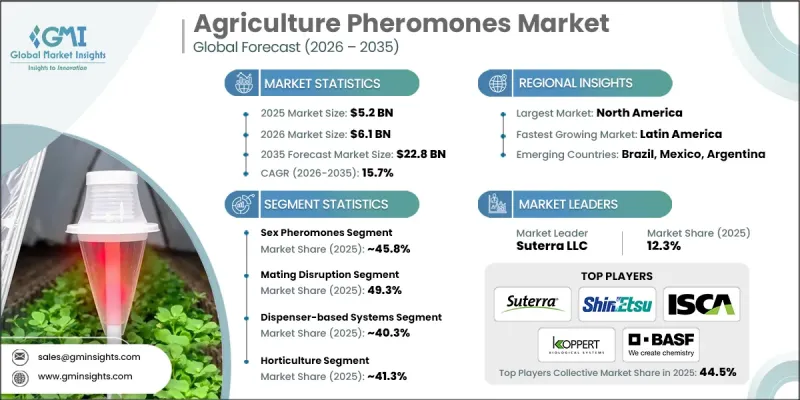
推動該市場成長的主要因素是農民對環保永續害蟲防治方案日益成長的需求。費洛蒙作為一種化學訊號,能夠吸引或驅趕特定害蟲,為傳統的化學農藥提供了環境安全的替代方案。這些天然來源的費洛蒙有助於捕獲昆蟲、抑制其交配行為並監測其活動,從而保護水果、蔬菜和穀物等作物。市場擴張的主要驅動力是有機耕作方式和綜合蟲害管理(IPM)系統的日益普及。消費者和農民都在尋求無農藥產品,這增加了他們對基於信息素的解決方案的興趣。信息素配方技術的進步和經濟高效產品的開發進一步促進了市場成長。持續的創新、促進永續農業的監管支援以及智慧誘捕器、自動投放器和物聯網整合等新技術也在加速費洛蒙的應用,並實現更精準的害蟲防治。
| 市場範圍 | |
|---|---|
| 開始年份 | 2025 |
| 預測期 | 2026-2035 |
| 上市時的市場規模 | 52億美元 |
| 預測金額 | 228億美元 |
| 複合年成長率 | 15.7% |
預計到2025年,性費洛蒙市佔率將達到45.8%,並在2035年之前以15.8%的複合年成長率成長。由於性費洛蒙能夠有效防止害蟲繁殖和控制種群成長,且無需使用有害化學物質,因此農民仍然依賴它。這種方法符合全球推廣永續農業實踐的目標,並有助於推廣有機耕作方式。
交配抑制技術佔了49.3%的市場佔有率,預計從2026年到2035年將以15.9%的複合年成長率成長。此方法之所以備受青睞,是因為它能有效破壞害蟲的繁殖週期,進而保護作物,同時也能保護環境和非目標物種。透過吸引和捕獲昆蟲來控制害蟲數量的大規模誘捕器也越來越受到關注,並為高價值作物提供了一種高效的解決方案。
預計到2025年,北美農業費洛蒙市佔率將達到33.7%。美國和加拿大的農民越來越依賴費洛蒙來遵守農藥法規並維持永續的農業實踐。該地區的成長得益於廣泛的研發活動,包括開發創新的害蟲防治方案、推廣綜合蟲害管理(IPM)以及使用物聯網信息素噴霧器。此外,消費者對有機水果、蔬菜和特色作物的需求持續成長,也進一步推動了該地區市場的擴張。
目錄
第1章:調查方法和範圍
第2章執行摘要
第3章業界考察
- 生態系分析
- 供應商情況
- 利潤率
- 每個階段增加的價值
- 影響價值鏈的因素
- 中斷
- 影響產業的因素
- 促進因素
- 產業潛在風險與挑戰
- 市場機遇
- 成長潛力分析
- 監理情勢
- 北美洲
- 歐洲
- 亞太地區
- 拉丁美洲
- 中東和非洲
- 波特的分析
- PESTEL 分析
- 價格趨勢
- 按地區
- 按類型
- 未來市場趨勢
- 科技與創新趨勢
- 當前技術趨勢
- 新興技術
- 專利趨勢
- 貿易統計(HS編碼)
- 主要進口國
- 主要出口國
- 永續性和環境方面
- 永續計劃
- 減少廢棄物策略
- 生產中的能源效率
- 環保意識的舉措
- 考慮碳足跡
第4章 競爭情勢
- 介紹
- 企業市佔率分析
- 按地區
- 北美洲
- 歐洲
- 亞太地區
- 拉丁美洲
- 中東和非洲
- 按地區
- 企業矩陣分析
- 主要市場公司的競爭分析
- 競爭定位矩陣
- 主要進展
- 併購
- 夥伴關係與合作
- 新產品發布
- 業務拓展計劃
第5章 市場估計與預測:依類型分類,2022-2035年
- 性信息素
- 聚集信息素
- 警示信息素
- 追蹤信息素
- 其他
第6章 市場估計與預測:依應用方法分類,2022-2035年
- 交配抑制
- 大規模捕獲
- 誘引劑和殺蟲劑
- 監測和檢測
- 其他
第7章 市場估計與預測:依劑型分類,2022-2035年
- 分配器式系統
- 捕集器整合配方
- 噴霧劑和液體製劑
- 微膠囊製劑
- 其他
第8章 市場估算與預測:依最終用途分類,2022-2035年
- 園藝
- 水果和堅果
- 蔬菜
- 觀賞植物和花卉栽培
- 葡萄種植(葡萄/葡萄酒生產)
- 田間作物
- 糧食
- 油籽
- 纖維作物
- 豆科植物
- 其他
第9章 市場估計與預測:依地區分類,2022-2035年
- 北美洲
- 美國
- 加拿大
- 歐洲
- 德國
- 英國
- 法國
- 西班牙
- 義大利
- 其他歐洲地區
- 亞太地區
- 中國
- 印度
- 日本
- 澳洲
- 韓國
- 亞太其他地區
- 拉丁美洲
- 巴西
- 墨西哥
- 阿根廷
- 其他拉丁美洲地區
- 中東和非洲
- 沙烏地阿拉伯
- 南非
- 阿拉伯聯合大公國
- 其他中東和非洲地區
第10章:公司簡介
- BASF SE
- Bedoukian Research Inc.
- Biobest Group NV
- Hercon Environmental
- ISCA Technologies
- Koppert Biological Systems
- Pacific Biocontrol Corporation
- Pherobank
- Provivi Inc.
- Russell IPM Ltd
- Scentry Biologicals Inc.
- SEDQ Healthy Crops SL
- Shin-Etsu Chemical Co., Ltd.
- Suterra LLC
The Global Agriculture Pheromones Market was valued at USD 5.2 billion in 2025 and is estimated to grow at a CAGR of 15.7% to reach USD 22.8 billion by 2035.
Growth in this market is fueled by the rising need for eco-friendly and sustainable pest control solutions among farmers. Pheromones act as chemical signals that attract or repel specific pests, providing an environmentally safe alternative to traditional chemical pesticides. These natural solutions help capture insects, disrupt their mating patterns, and monitor their activity, protecting crops such as fruits, vegetables, and grains. The market's expansion is largely driven by increasing adoption of organic farming practices and integrated pest management (IPM) systems. Consumers and farmers alike are demanding pesticide-free produce, boosting the appeal of pheromone-based solutions. Advances in pheromone formulation technology and cost-effective product development further support market growth. Continuous innovation, regulatory support promoting sustainable agriculture, and new technologies like smart traps, automated dispensers, and IoT integration are also accelerating adoption and enabling more precise pest management.
| Market Scope | |
|---|---|
| Start Year | 2025 |
| Forecast Year | 2026-2035 |
| Start Value | $5.2 Billion |
| Forecast Value | $22.8 Billion |
| CAGR | 15.7% |
The sex pheromones segment accounted for 45.8% share in 2025 and is projected to grow at a CAGR of 15.8% through 2035. Farmers continue to rely on sex pheromones due to their effectiveness in halting pest reproduction, which reduces population growth without the use of harmful chemicals. This approach aligns with global objectives to implement sustainable agricultural practices and promotes organic farming methods.
The mating disruption segment held a 49.3% share and is expected to grow at a CAGR of 15.9% from 2026 to 2035. This method remains preferred because it effectively protects crops by interfering with pest reproductive cycles while safeguarding the environment and non-target species. Mass trapping is also gaining traction, as it controls pest populations by attracting and capturing insects, offering an efficient solution for high-value crops.
North America Agriculture Pheromones Market held a 33.7% share in 2025. Farmers in the United States and Canada increasingly rely on pheromones to comply with pesticide restrictions and maintain sustainable farming practices. Regional growth is supported by extensive R&D efforts to develop innovative pest control solutions, wider adoption of IPM, and the use of IoT-enabled pheromone dispensers. The demand for organic fruits, vegetables, and specialized crops continues to rise, further boosting market expansion in this region.
Key players driving the Global Agriculture Pheromones Market include BASF SE, Bedoukian Research Inc., Biobest Group NV, Hercon Environmental, ISCA Technologies, Koppert Biological Systems, Pacific Biocontrol Corporation, Pherobank, Provivi Inc., Russell IPM Ltd, Scentry Biologicals Inc., SEDQ Healthy Crops S.L., Shin-Etsu Chemical Co., Ltd., and Suterra LLC. Leading companies in the Agriculture Pheromones Market employ several strategies to strengthen their presence and market position. They invest heavily in R&D to develop next-generation pheromone solutions, including automated dispensers and IoT-enabled monitoring systems. Strategic partnerships with agricultural technology firms enhance product innovation and expand distribution networks. Companies focus on cost-effective manufacturing while maintaining high-quality standards to attract a broader customer base. Additionally, marketing campaigns emphasize the environmental benefits of pheromone-based pest control and the alignment with organic farming practices, targeting both large-scale commercial farms and smaller, eco-conscious growers. Continuous regulatory compliance and participation in sustainable agriculture initiatives further strengthen their competitive foothold.
Table of Contents
Chapter 1 Methodology & Scope
- 1.1 Market scope and definition
- 1.2 Research design
- 1.2.1 Research approach
- 1.2.2 Data collection methods
- 1.3 Data mining sources
- 1.3.1 Global
- 1.3.2 Regional/Country
- 1.4 Base estimates and calculations
- 1.4.1 Base year calculation
- 1.4.2 Key trends for market estimation
- 1.5 Primary research and validation
- 1.5.1 Primary sources
- 1.6 Forecast model
- 1.7 Research assumptions and limitations
Chapter 2 Executive Summary
- 2.1 Industry 360° synopsis
- 2.2 Key market trends
- 2.2.1 Regional
- 2.2.2 Type
- 2.2.3 Mode of application
- 2.2.4 Formulation type
- 2.2.5 End use
- 2.3 TAM Analysis, 2026-2035
- 2.4 CXO perspectives: Strategic imperatives
- 2.4.1 Executive decision points
Chapter 3 Industry Insights
- 3.1 Industry ecosystem analysis
- 3.1.1 Supplier landscape
- 3.1.2 Profit margin
- 3.1.3 Value addition at each stage
- 3.1.4 Factor affecting the value chain
- 3.1.5 Disruptions
- 3.2 Industry impact forces
- 3.2.1 Growth drivers
- 3.2.2 Industry pitfalls and challenges
- 3.2.3 Market opportunities
- 3.3 Growth potential analysis
- 3.4 Regulatory landscape
- 3.4.1 North America
- 3.4.2 Europe
- 3.4.3 Asia Pacific
- 3.4.4 Latin America
- 3.4.5 Middle East & Africa
- 3.5 Porter’s analysis
- 3.6 PESTEL analysis
- 3.7 Price trends
- 3.7.1 By region
- 3.7.2 By type
- 3.8 Future market trends
- 3.9 Technology and Innovation landscape
- 3.9.1 Current technological trends
- 3.9.2 Emerging technologies
- 3.10 Patent Landscape
- 3.11 Trade statistics (HS code)
- 3.11.1 Major importing countries
- 3.11.2 Major exporting countries
- 3.12 Sustainability and environmental aspects
- 3.12.1 Sustainable practices
- 3.12.2 Waste reduction strategies
- 3.12.3 Energy efficiency in production
- 3.12.4 Eco-friendly initiatives
- 3.13 Carbon footprint consideration
Chapter 4 Competitive Landscape, 2025
- 4.1 Introduction
- 4.2 Company market share analysis
- 4.2.1 By region
- 4.2.1.1 North America
- 4.2.1.2 Europe
- 4.2.1.3 Asia Pacific
- 4.2.1.4 LATAM
- 4.2.1.5 MEA
- 4.2.1 By region
- 4.3 Company matrix analysis
- 4.4 Competitive analysis of major market players
- 4.5 Competitive positioning matrix
- 4.6 Key developments
- 4.6.1 Mergers & acquisitions
- 4.6.2 Partnerships & collaborations
- 4.6.3 New Product Launches
- 4.6.4 Expansion Plans
Chapter 5 Market Estimates and Forecast, By Type, 2022-2035 (USD Billion) (Kilo Tons)
- 5.1 Key trends
- 5.2 Sex pheromones
- 5.3 Aggregation pheromones
- 5.4 Alarm pheromones
- 5.5 Trail pheromones
- 5.6 Others
Chapter 6 Market Estimates and Forecast, By Mode of Application, 2022-2035 (USD Billion) (Kilo Tons)
- 6.1 Key trends
- 6.2 Mating disruption
- 6.3 Mass trapping
- 6.4 Attract-and-kill
- 6.5 Monitoring and detection
- 6.6 Others
Chapter 7 Market Estimates and Forecast, By Formulation Type, 2022-2035 (USD Billion) (Kilo Tons)
- 7.1 Key trends
- 7.2 Dispenser-based systems
- 7.3 Trap-integrated formulations
- 7.4 Spray & liquid formulations
- 7.5 Microencapsulated formulations
- 7.6 Others
Chapter 8 Market Estimates and Forecast, By End Use, 2022-2035 (USD Billion) (Kilo Tons)
- 8.1 Key trends
- 8.2 Horticulture
- 8.2.1 Fruits & Nuts
- 8.2.2 Vegetables
- 8.2.3 Ornamentals & Floriculture
- 8.2.4 Viticulture (Grapes/Wine Production)
- 8.3 Field Crops
- 8.3.1 Cereals & Grains
- 8.3.2 Oilseeds
- 8.3.3 Fiber Crops
- 8.3.4 Pulses & Legumes
- 8.4 Others
Chapter 9 Market Estimates and Forecast, By Region, 2022-2035 (USD Billion) (Kilo Tons)
- 9.1 Key trends
- 9.2 North America
- 9.2.1 U.S.
- 9.2.2 Canada
- 9.3 Europe
- 9.3.1 Germany
- 9.3.2 UK
- 9.3.3 France
- 9.3.4 Spain
- 9.3.5 Italy
- 9.3.6 Rest of Europe
- 9.4 Asia Pacific
- 9.4.1 China
- 9.4.2 India
- 9.4.3 Japan
- 9.4.4 Australia
- 9.4.5 South Korea
- 9.4.6 Rest of Asia Pacific
- 9.5 Latin America
- 9.5.1 Brazil
- 9.5.2 Mexico
- 9.5.3 Argentina
- 9.5.4 Rest of Latin America
- 9.6 Middle East and Africa
- 9.6.1 Saudi Arabia
- 9.6.2 South Africa
- 9.6.3 UAE
- 9.6.4 Rest of Middle East and Africa
Chapter 10 Company Profiles
- 10.1 BASF SE
- 10.2 Bedoukian Research Inc.
- 10.3 Biobest Group NV
- 10.4 Hercon Environmental
- 10.5 ISCA Technologies
- 10.6 Koppert Biological Systems
- 10.7 Pacific Biocontrol Corporation
- 10.8 Pherobank
- 10.9 Provivi Inc.
- 10.10 Russell IPM Ltd
- 10.11 Scentry Biologicals Inc.
- 10.12 SEDQ Healthy Crops S.L.
- 10.13 Shin-Etsu Chemical Co., Ltd.
- 10.14 Suterra LLC

 農業信息素市場規模、佔有率和趨勢分析報告:按產品類型、施用方法、作物類型、種植系統、地區和細分市場預測(2026-2033 年)
 農業信息素市場-2026-2032年全球市場預測
 農業費洛蒙市場規模、佔有率、成長及全球產業分析:按類型、應用和地區的洞察,2026-2034年預測
 2026年全球農業費洛蒙市場報告
 農業費洛蒙市場-全球產業規模、佔有率、趨勢、機會和預測,按類型、功能、作物類型、應用方式、地區和競爭格局分類,2020-2030年預測
 合成資訊素:全球市場佔有率和排名、總收入和需求預測(2025-2031年)
 植物殺蟎劑市場報告:趨勢、預測和競爭分析(至 2031 年)
 農業資訊素市場規模、佔有率和成長分析(按類型、作物類型、功能、應用和地區)- 2025-2032 年行業預測農業資訊化學品市場報告:趨勢、預測和競爭分析(至 2031 年)農業資訊素市場報告:趨勢、預測和競爭分析(至 2031 年)