

 |
市場調查報告書
商品編碼
2027489
廚具市場機會、成長要素、產業趨勢分析及2026-2035年預測Kitchenware Market Opportunity, Growth Drivers, Industry Trend Analysis, and Forecast 2026 - 2035 |
||||||

預計到 2025 年,全球廚具市場價值將達到 759 億美元,並預計以 4.5% 的複合年成長率成長,到 2035 年達到 1,177 億美元。
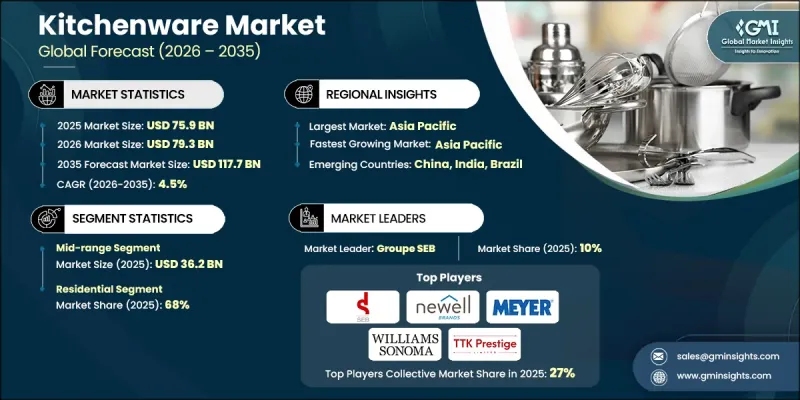
全球對家庭烹飪的興趣日益濃厚,人們越來越注重健康飲食習慣,並渴望擁有設計精良的居住空間,這些因素共同推動了廚具市場的成長。烹飪節目、線上教學和社群媒體內容強調烹飪的便利性、高效性和創造性,提高了消費者在家烹飪的動機。現代家庭需要兼具耐用性、功能性和時尚感的產品,從而帶動了對高階炊具、廚房用品和收納解決方案的需求。智慧家電和應用程式連接工具等科技產品融入廚房用品,透過提供精準性、便利性和長期可用性,重新定義了消費者的期望。永續性也發揮著至關重要的作用,消費者越來越傾向於選擇採用環保材料、負責任採購的組件以及在保持性能的同時減少廢棄物的產品。這些因素共同推動廚具市場走上穩定且長期的成長軌道。
| 市場範圍 | |
|---|---|
| 開始年份 | 2025 |
| 預測期 | 2026-2035 |
| 上市時的市場規模 | 759億美元 |
| 預計金額 | 1177億美元 |
| 複合年成長率 | 4.5% |
到2025年,中檔廚具市場規模將達到362億美元。消費者越來越青睞價格適中、兼具品質、美觀和實用性的廚具,且高成本。隨著可支配收入的增加,消費者對價格更加敏感,但往往是從入門級產品升級,這使得中檔廚具市場極具吸引力。這些產品經久耐用、易於使用,並符合注重健康的烹飪趨勢,能夠滿足日常家庭烹飪的需求,提升整體烹飪體驗。
到2025年,住宅市場將佔據68%的市場。人們對居家烹飪、健康飲食和個人化廚房設計的日益重視,推動了對高品質、功能齊全且美觀的廚具和餐具的需求成長。如今,居家烹飪者更注重產品的耐用性、多功能性和便利性,許多人選擇購買成套的廚房用品,而非單件購買。隨著居家烹飪文化的興起,消費者致力於打造高效、方便、令人愉悅的烹飪空間,住宅市場也因此蓬勃發展。
美國廚具市場目前佔約77%的市場佔有率,預計到2025年市場規模將達到150億美元。推動市場成長的因素包括:人們養成良好的居家烹飪習慣、對健康生活方式日益成長的關注以及穩定的可支配收入。消費者偏好實用又時尚的產品,這些產品既能節省時間又能提升便利性。烹飪節目、網路紅人和食譜試驗的流行,也帶動了中高階廚具的需求。成熟的電商平台擴大了消費者的購買管道,使他們能夠輕鬆瀏覽和購買符合現代廚房美學和日常烹飪需求的高品質、耐用廚具。
目錄
第1章:調查方法
- 研究途徑
- 品質改進計劃
- GMI人工智慧政策和資料完整性計劃
- 資訊來源一致性協議
- GMI人工智慧政策和資料完整性計劃
- 調查軌跡和置信度評分
- 調查和路線的組成部分
- 評分組成部分
- 數據收集
- 主要來源部分列表
- 資料探勘資訊來源
- 付費資訊來源
- 區域資訊來源
- 付費資訊來源
- 基本估算和計算方法
- 每種方法中基準年的計算
- 預測模型
- 量化市場影響分析
- 生長參數對預測的數學影響
- 量化市場影響分析
- 關於調查透明度的補充信息
- 資訊來源歸屬框架
- 品質保證指標
- 對信任的承諾
第2章執行摘要
第3章業界考察
- 生態系分析
- 原物料供應商
- 製造商和原始設備製造商
- 銷售代理商和批發商
- 零售商與電子商務平台
- 最終用戶
- 依價值鏈階段進行利潤率分析
- 影響因素
- 促進因素
- 家庭烹飪文化的興起與健康生活方式的普及
- 可支配收入增加和城市生活方式的轉變
- 擴大電子商務和數位覆蓋範圍
- 產業潛在風險與挑戰
- 激烈的競爭與市場飽和
- 原物料價格波動
- 機會
- 對智慧多功能廚具的需求日益成長。
- 消費者越來越偏好選擇永續和環保產品。
- 促進因素
- 成長潛力分析
- 技術格局
- 價格分析(基於初步調查)
- 對過去價格趨勢的分析
- 按業務類型分類的定價策略(高階、超值、成本加成)
- 原物料價格波動對零售價格的影響
- 監理情勢
- 消費者購買行為分析
- 人口趨勢
- 影響購買決策的因素
- 產品偏好
- 理想價格範圍
- 優先分銷管道
- 波特的分析
- PESTEL 分析
- 貿易數據分析(基於付費資料庫)
- 進出口數量和價值的變化趨勢
- 主要貿易走廊及關稅的影響
- 反傾銷措施及其對貿易政策的影響
- 人工智慧和生成式人工智慧對市場的影響
- 利用人工智慧改造現有經營模式
- 針對特定領域的生成式人工智慧應用案例和實施藍圖
- 人工智慧驅動的產品設計與個人化
- 語音和人工智慧整合的智慧廚房電器
- 人工智慧驅動的供應鏈最佳化
- 生成式人工智慧在行銷與消費者互動中的應用
- 風險、限制和監管考量
第4章 競爭情勢
- 介紹
- 企業市佔率分析
- 企業矩陣分析
- 主要市場公司的競爭分析
- 競爭定位矩陣
- 主要進展
- 併購
- 夥伴關係與合作
- 新產品發布
- 業務拓展計劃
第5章 市場估價與預測:依產品分類,2022-2035年
- 炊具
- 鍋
- 平底鍋
- 壓力鍋
- 專用烹飪用具
- 烘焙用品
- 麵包模具和麵包條模具
- 烤盤和烤架
- 蛋糕模具和鬆餅模具
- 專業烘焙用品
- 烹飪用具和工具
- 切割和準備工具
- 混合和測量工具
- 餐具
- 專用工具
- 刀叉餐具和刀具
- 廚刀
- 多功能刀和削皮刀
- 特製刀具
- 刀具套裝和刀架
- 餐具
- 餐盤和大盤子
- 碗和餐具
- 飲具和玻璃器皿
- 廚房小家電
- 攪拌機和食品加工機
- 咖啡機和濃縮咖啡機
- 烤麵包機和烤箱
- 廚房檯面電器
- 攪拌機和研磨機
- 榨汁機和萃取機
- 儲存和整理
- 食品儲存容器
- 廚房收納用品和置物架
- 瓶子和罐子
第6章 市場估計與預測:依價格區間分類,2022-2035年
- 尺度/值
- 中價位
- 高階/豪華
第7章 市場估計與預測:依材料分類,2022-2035年
- 不銹鋼
- 鋁
- 鑄鐵
- 陶瓷玻璃
- 矽膠和不沾塗層
- 其他
第8章 市場估算與預測:依最終用途分類,2022-2035年
- 住宅
- 商業的
- 飯店及餐飲業
- 餐廳和咖啡館
- 商用廚房
- 餐飲服務
第9章 市場估價與預測:依通路分類,2022-2035年
- 線上
- 電子商務網站
- 品牌官方網站
- 離線
- 超級市場/大賣場
- 專賣店
- 百貨公司
第10章 市場估價與預測:依地區分類,2022-2035年
- 北美洲
- 美國
- 加拿大
- 歐洲
- 英國
- 德國
- 法國
- 義大利
- 西班牙
- 俄羅斯
- 亞太地區
- 中國
- 印度
- 日本
- 韓國
- 澳洲
- 拉丁美洲
- 巴西
- 墨西哥
- 中東和非洲(MEA)
- 阿拉伯聯合大公國
- 沙烏地阿拉伯
- 南非
第11章:公司簡介
- Breville Group Limited
- Fissler GmbH
- Groupe SEB
- Helen of Troy Limited
- Joseph Joseph Ltd.
- Le Creuset
- Lodge Manufacturing Company
- Mauviel 1830
- Meyer Corporation
- Newell Brands
- Scanpan International
- TTK Prestige Limited
- Werhahn KG
- Whirlpool Corporation
- Williams-Sonoma Inc.
The Global Kitchenware Market was valued at USD 75.9 billion in 2025 and is estimated to grow at a CAGR of 4.5% to reach USD 117.7 billion by 2035.
The market's growth is fueled by a rising global interest in home cooking, healthier eating habits, and well-designed living spaces. Consumers are increasingly motivated to prepare meals at home, influenced by cooking shows, online tutorials, and social media content that highlight convenience, efficiency, and creativity in cooking. Modern households are seeking products that combine durability, functionality, and style, driving demand for premium cookware, utensils, and storage solutions. Technological integration in kitchenware, such as smart appliances and app-enabled tools, is reshaping consumer expectations by offering precision, convenience, and long-term usability. Sustainability also plays a key role, with consumers showing a preference for environmentally responsible materials, responsibly sourced components, and products that reduce waste while maintaining performance. These factors collectively position the kitchenware market for steady and long-term growth.
| Market Scope | |
|---|---|
| Start Year | 2025 |
| Forecast Year | 2026-2035 |
| Start Value | $75.9 Billion |
| Forecast Value | $117.7 Billion |
| CAGR | 4.5% |
The mid-range segment reached USD 36.2 billion in 2025. Consumers are increasingly drawn to mid-priced kitchenware that balances quality, aesthetics, and practicality without high cost. As disposable incomes rise, buyers often upgrade from entry-level products while remaining price-conscious, making the mid-tier segment highly attractive. These products offer durability, ease of use, and alignment with health-focused cooking trends, supporting daily home meal preparation and enhancing the overall cooking experience.
The residential segment held a 68% share in 2025. Rising awareness of home cooking, healthier eating, and personalized kitchen design has boosted demand for high-quality, functional, and visually appealing cookware and utensils. Home cooks now prioritize products that offer long-term durability, versatility, and convenience, with many seeking curated kitchen collections over single-use items. The growing culture of home-prepared meals has strengthened the residential market, as consumers focus on making their kitchens both efficient and enjoyable spaces for cooking.
U.S. Kitchenware Market has around 77% share, generating USD 15 billion in 2025. Strong home cooking habits, rising interest in healthier lifestyles, and steady disposable incomes have fueled growth. Consumers favor practical, stylish products that save time while enhancing convenience. The popularity of cooking shows, online influencers, and recipe experimentation has encouraged demand for mid-range and premium cookware. Mature e-commerce platforms have expanded accessibility, enabling consumers to explore and invest in high-quality, durable kitchenware solutions that complement modern kitchen aesthetics and everyday cooking needs.
Key players in the Global Kitchenware Market include Lodge Manufacturing Company, Le Creuset, TTK Prestige Limited, Joseph Joseph Ltd., Scanpan International, Williams-Sonoma Inc., Breville Group Limited, Helen of Troy Limited, Werhahn KG, Fissler GmbH, Groupe SEB, Newell Brands, Meyer Corporation, Mauviel 1830, and Whirlpool Corporation. Companies in the Kitchenware Market strengthen their position by innovating product designs that merge functionality with modern aesthetics, targeting mid- and premium-tier consumers seeking durability and style. They expand their portfolio with smart, app-enabled, and multi-functional tools, responding to tech-savvy households. Sustainable manufacturing practices, including eco-friendly materials and responsible sourcing, are increasingly emphasized to meet consumer demand for environmentally conscious products. Strategic partnerships with e-commerce platforms and retail chains enhance visibility and accessibility. Marketing initiatives focus on influencer collaborations, lifestyle content, and educational campaigns that promote home cooking culture. Companies also invest in R&D for ergonomic, user-friendly products, ensuring customer satisfaction, brand loyalty, and long-term revenue growth across competitive global markets.
Table of Contents
Chapter 1 Research Methodology
- 1.1 Research approach
- 1.2 Quality Commitments
- 1.2.1 GMI AI policy & data integrity commitment
- 1.2.1.1 Source consistency protocol
- 1.2.1 GMI AI policy & data integrity commitment
- 1.3 Research Trail & Confidence Scoring
- 1.3.1 Research Trail Components
- 1.3.2 Scoring Components
- 1.4 Data Collection
- 1.4.1 Partial list of primary sources
- 1.5 Data mining sources
- 1.5.1 Paid sources
- 1.5.1.1 Sources, by region
- 1.5.1 Paid sources
- 1.6 Base estimates and calculations
- 1.6.1 Base year calculation for any one approach
- 1.7 Forecast model
- 1.7.1 Quantified market impact analysis
- 1.7.1.1 Mathematical impact of growth parameters on forecast
- 1.7.1 Quantified market impact analysis
- 1.8 Research transparency addendum
- 1.8.1 Source attribution framework
- 1.8.2 Quality assurance metrics
- 1.8.3 Our commitment to trust
Chapter 2 Executive Summary
- 2.1 Industry synopsis, 2022-2035
- 2.2 Key Trends
- 2.2.1 Region
- 2.2.2 Product
- 2.2.3 Price range
- 2.2.4 Material
- 2.2.5 End use
- 2.2.6 Distribution channel
Chapter 3 Industry Insights
- 3.1 Industry ecosystem analysis
- 3.1.1 Raw material suppliers
- 3.1.2 Manufacturers and OEMs
- 3.1.3 Distributors and wholesalers
- 3.1.4 Retailers and e-commerce platforms
- 3.1.5 End users
- 3.1.6 Profit margin analysis by value chain stage
- 3.2 Impact forces
- 3.2.1 Growth drivers
- 3.2.1.1 Rising home-cooking culture and health-focused lifestyles
- 3.2.1.2 Increasing disposable income and urban lifestyle shifts
- 3.2.1.3 Expansion of e-commerce and digital reach
- 3.2.2 Industry pitfalls & challenges
- 3.2.2.1 Intense competition and market saturation
- 3.2.2.2 Fluctuating raw material prices
- 3.2.3 Opportunities
- 3.2.3.1 Growing demand for smart and multifunctional kitchenware
- 3.2.3.2 Rising preference for sustainable and eco-friendly products
- 3.2.1 Growth drivers
- 3.3 Growth potential analysis
- 3.4 Technological landscape
- 3.5 Pricing analysis (driven by primary research)
- 3.5.1 Historical price trend analysis
- 3.5.2 Pricing strategy by player type (premium, value, cost-plus)
- 3.5.3 Impact of raw material price fluctuations on retail pricing
- 3.6 Regulatory landscape
- 3.7 Consumer buying behavior analysis
- 3.7.1 Demographic trends
- 3.7.2 Factors affecting buying decisions
- 3.7.3 Product Preference
- 3.7.4 Preferred price range
- 3.7.5 Preferred distribution channel
- 3.8 Porter’s analysis
- 3.9 PESTEL analysis
- 3.10 Trade data analysis (driven by paid database)
- 3.10.1 Import/export volume and value trends
- 3.10.2 Key trade corridors and tariff impact
- 3.10.3 Anti-dumping measures and trade policy implications
- 3.11 Impact of AI and generative AI on the market
- 3.11.1 AI driven disruption of existing business models
- 3.11.2 GenAI use cases and adopt roadmaps by segment
- 3.11.2.1 AI powered product design and personalization
- 3.11.2.2 Smart kitchen appliances with voice/AI integration
- 3.11.2.3 AI enhanced supply chain optimization
- 3.11.2.4 GenAI in marketing and consumer engagement
- 3.11.3 Risks, limitations and regulatory considerations
Chapter 4 Competitive Landscape, 2025
- 4.1 Introduction
- 4.2 Company market share analysis
- 4.2.1 North America
- 4.2.2 Europe
- 4.2.3 Asia Pacific
- 4.2.4 Latin America
- 4.2.5 Middle East and Africa
- 4.3 Company matrix analysis
- 4.4 Competitive analysis of major market players
- 4.5 Competitive positioning matrix
- 4.6 Key developments
- 4.6.1 Mergers & acquisitions
- 4.6.2 Partnerships & collaborations
- 4.6.3 New product launches
- 4.6.4 Expansion plans
Chapter 5 Market Estimates & Forecast, By Product, 2022-2035 (USD Billion) (Million Units)
- 5.1 Key trends
- 5.2 Cookware
- 5.2.1 Pots
- 5.2.2 Pans
- 5.2.3 Pressure cookers
- 5.2.4 Specialty cookware
- 5.3 Bakeware
- 5.3.1 Bread and loaf pans
- 5.3.2 Sheet pans and baking trays
- 5.3.3 Cake pans and muffin tins
- 5.3.4 Specialty bakeware
- 5.4 Cooking utensils & tools
- 5.4.1 Cutting and preparation tools
- 5.4.2 Mixing and measuring tools
- 5.4.3 Serving utensils
- 5.4.4 Specialty tools
- 5.5 Cutlery & knives
- 5.5.1 Chef knives
- 5.5.2 Utility and paring knives
- 5.5.3 Specialty knives
- 5.5.4 Knife sets and blocks
- 5.6 Tableware
- 5.6.1 Serving dishes and platters
- 5.6.2 Bowls and serving accessories
- 5.6.3 Drinkware and glassware
- 5.7 Small kitchen appliances
- 5.7.1 Blenders and food processors
- 5.7.2 Coffee makers and espresso machines
- 5.7.3 Toasters and toaster ovens
- 5.7.4 Countertop cooking appliances
- 5.7.5 Mixers and grinders
- 5.7.6 Juicers and extractors
- 5.7.7 Storage & organization
- 5.7.7.1 Food storage containers
- 5.7.7.2 Kitchen organizers and racks
- 5.7.7.3 Bins and canisters
Chapter 6 Market Estimates & Forecast, By Price Range, 2022-2035 (USD Billion) (Million Units)
- 6.1 Key trends
- 6.2 Economy/value
- 6.3 Mid-range
- 6.4 Premium/luxury
Chapter 7 Market Estimates & Forecast, By Material, 2022-2035 (USD Billion) (Million Units)
- 7.1 Key trends
- 7.2 Stainless steel
- 7.3 Aluminum
- 7.4 Cast iron
- 7.5 Ceramic & glass
- 7.6 Silicone & non-stick coated
- 7.7 Others
Chapter 8 Market Estimates & Forecast, By End Use, 2022-2035 (USD Billion) (Million Units)
- 8.1 Key trends
- 8.2 Residential
- 8.3 Commercial
- 8.3.1 Hotels & hospitality
- 8.3.2 Restaurants & cafes
- 8.3.3 Institutional kitchens
- 8.3.4 Catering services
Chapter 9 Market Estimates & Forecast, By Distribution Channel, 2022-2035 (USD Billion) (Million Units)
- 9.1 Key trends
- 9.2 Online
- 9.2.1 E-commerce websites
- 9.2.2 Brand-owned websites
- 9.3 Offline
- 9.3.1 Supermarkets/hypermarkets
- 9.3.2 Specialty stores
- 9.3.3 Department stores
Chapter 10 Market Estimates & Forecast, By Region, 2022-2035 (USD Billion) (Million Units)
- 10.1 Key trends
- 10.2 North America
- 10.2.1 U.S.
- 10.2.2 Canada
- 10.3 Europe
- 10.3.1 UK
- 10.3.2 Germany
- 10.3.3 France
- 10.3.4 Italy
- 10.3.5 Spain
- 10.3.6 Russia
- 10.4 Asia Pacific
- 10.4.1 China
- 10.4.2 India
- 10.4.3 Japan
- 10.4.4 South Korea
- 10.4.5 Australia
- 10.5 Latin America
- 10.5.1 Brazil
- 10.5.2 Mexico
- 10.6 MEA
- 10.6.1 UAE
- 10.6.2 Saudi Arabia
- 10.6.3 South Africa
Chapter 11 Company Profiles
- 11.1 Breville Group Limited
- 11.2 Fissler GmbH
- 11.3 Groupe SEB
- 11.4 Helen of Troy Limited
- 11.5 Joseph Joseph Ltd.
- 11.6 Le Creuset
- 11.7 Lodge Manufacturing Company
- 11.8 Mauviel 1830
- 11.9 Meyer Corporation
- 11.10 Newell Brands
- 11.11 Scanpan International
- 11.12 TTK Prestige Limited
- 11.13 Werhahn KG
- 11.14 Whirlpool Corporation
- 11.15 Williams-Sonoma Inc.

 兒童矽膠餐具市場按產品類型、年齡層、價格範圍、最終用戶和分銷管道分類,全球預測(2026-2032年)
 全球廚房電器市場規模、佔有率、趨勢和成長分析報告(2026-2034年)
 日本廚具市場規模、佔有率、趨勢和預測:按產品、材料、通路、最終用戶和地區分類,2026-2034年
 廚房電器市場 - 全球產業規模、佔有率、趨勢、機會及預測(按產品類型、最終用戶、銷售管道、地區和競爭格局分類,2021-2031年)兒童廚具和餐具市場按產品類型、材料類型、年齡層、最終用戶和分銷管道分類-2025-2030 年全球預測
 全球廚房電器市場
 廚房電器市場規模、佔有率和成長分析(按產品、應用、分佈和地區)- 產業預測 2025-2032