


 |
市場調查報告書
商品編碼
2027485
HVAC市場商機、成長要素、產業趨勢分析及2026-2035年預測。HVAC Market Opportunity, Growth Drivers, Industry Trend Analysis, and Forecast 2026 - 2035 |
||||||

2025年全球HVAC市場價值為5,249億美元,預計將以8.1%的複合年成長率成長,到2035年達到1.2兆美元。
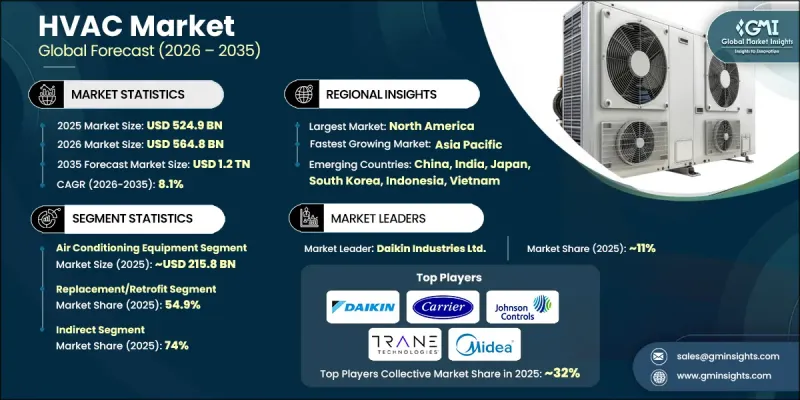
快速的城市發展是經濟成長的主要驅動力,隨著建築數量的增加,對可靠的暖氣、通風和空調(HVAC)解決方案的需求也日益成長。消費者和企業都越來越重視室內環境的舒適度、空氣品質和能源效率。現代建築項目擴大採用HVAC系統來維持穩定的溫度和氣流,而維修項目也推動了市場需求。對更高能源效率和更長系統使用壽命的日益成長的需求,正在推動先進HVAC技術的應用。此外,各領域基礎設施的擴張也催生了對能夠確保穩定環境條件的系統的需求。人們對室內空氣品質標準和永續建築實踐的日益關注,進一步鞏固了全球HVAC市場,使其成為現代基礎設施建設的關鍵要素。
| 市場範圍 | |
|---|---|
| 開始年份 | 2025 |
| 預測期 | 2026-2035 |
| 初始市場規模 | 5249億美元 |
| 預測金額 | 1.2兆美元 |
| 複合年成長率 | 8.1% |
隨著各類設施對環境控制需求的不斷成長,暖通空調(HVAC)市場正受到進一步推動。基礎設施建設的不斷完善,對能夠確保溫度穩定控制和空氣品質的先進系統的需求日益成長。高效能環境中對高效冷卻解決方案的需求不斷增加,也促使人們採用技術先進的暖通空調系統,以提高運作可靠性和效率。
預計到2025年,暖通空調(HVAC)市場規模將達到2,158億美元,並在2026年至2035年間以10.3%的複合年成長率成長。該細分市場在暖通空調市場中佔據主導地位,因為它在各種應用場景中維持室內舒適度方面發揮著至關重要的作用。目前已有多種系統可供選擇,以滿足不同的冷凍需求,而人們對節能解決方案的日益關注也進一步推動了這些解決方案的普及。包括智慧技術和環保冷媒在內的持續創新,正在提升系統性能,並支持市場的長期成長。
預計到2025年,間接銷售管道將佔據74%的市場佔有率,並在2026年至2035年間以10.1%的複合年成長率成長。該通路憑藉其廣泛的經銷商和服務供應商網路,推動著市場發展,這些網路確保了產品的供應和客戶支援。間接銷售使製造商能夠為複雜的暖通空調系統提供必要的安裝服務、維護和技術支援。透過授權銷售管道購買產品,可以獲得專家支援和可靠的服務,這進一步增強了消費者的購買意願,也提升了這種分銷模式的重要性。
美國暖通空調(HVAC)市場預計到2025年將達到1,569億美元,並在2026年至2035年間以10.2%的複合年成長率成長。市場成長的主要驅動力是各行各業對節能系統日益成長的需求。都市化加快、氣候變遷以及老舊基礎設施升級改造的需求,都在推動現代暖通空調解決方案的普及。智慧家庭技術的普及促進了住宅領域的需求成長,而商業和工業領域則持續投資於符合空氣品質和能源效率監管要求的系統。
目錄
第1章:調查方法和範圍
第2章執行摘要
第3章業界考察
- 生態系分析
- 供應商情況
- 利潤率
- 每個階段增加的價值
- 影響價值鏈的因素
- 影響產業的因素
- 促進因素
- 都市化加快,住宅和商業建築數量激增
- 資料中心、醫療設施和工業基礎設施的擴建
- 對室內舒適度和空氣品質的需求日益成長。
- 陷阱與挑戰
- 暖通空調系統的安裝和維護成本高昂
- 銅、鋁、鋼等原物料價格波動。
- 機會
- 物聯網整合智慧暖通空調系統部署的擴展
- 已開發市場老舊暖通空調基礎設施的維修和升級
- 促進因素
- 成長潛力分析
- 未來市場趨勢
- 科技與創新趨勢
- 當前技術趨勢
- 新興技術
- 價格趨勢
- 按地區
- 依產品
- 監理情勢
- 標準和合規要求
- 區域法規結構
- 認證標準
- 波特五力分析
- PESTEL 分析
- 價格分析(基於初步調查)
- 對過去價格趨勢的分析(基於初步研究)
- 根據業務類型分類的定價策略(高階/價值/成本加成)(基於初步調查)
- 貿易數據分析(基於付費資料庫)
- 進出口量和進口額趨勢(基於付費資料庫)
- 主要貿易路線及關稅的影響(基於付費資料庫)
- 依設備類型進行貿易流量分析
- 生產能力和生產趨勢(基於初步調查)
- 按地區和主要生產商分類的設備產能(基於初步調查)
- 運轉率和擴張計劃(基於初步調查)
第4章 競爭情勢
- 介紹
- 企業市佔率分析
- 按地區
- 企業矩陣分析
- 主要市場公司的競爭分析
- 競爭定位矩陣
- 主要進展
- 併購
- 夥伴關係與合作
- 新產品發布
- 業務拓展計劃
第5章 市場估算與預測:依產品類型分類,2022-2035年
- 加熱設備
- 通風設備
- 空調設備
- 冷卻器
- 冷卻塔
第6章 市場估價與預測:依安裝類型分類,2022-2035年
- 新建工程
- 更新和維修
第7章 市場估計與預測:依應用領域分類,2022-2035年
- 住宅
- 商業的
- 工業的
第8章 市場估算與預測:依通路分類,2022-2035年
- 直接地
- 間接
第9章 市場估計與預測:依地區分類,2022-2035年
- 北美洲
- 美國
- 加拿大
- 歐洲
- 德國
- 英國
- 法國
- 義大利
- 西班牙
- 亞太地區
- 中國
- 印度
- 日本
- 韓國
- 澳洲
- 拉丁美洲
- 巴西
- 墨西哥
- 阿根廷
- 中東和非洲(MEA)
- 沙烏地阿拉伯
- 阿拉伯聯合大公國
- 南非
第10章:公司簡介
- Bosch Thermotechnology
- Carrier Global Corporation
- Daikin Industries, Ltd.
- Fujitsu General Limited
- GREE Electric Appliances Inc.
- Haier Smart Home Co., Ltd.
- Johnson Controls International plc
- Lennox International Inc.
- LG Electronics
- Midea Group
- Mitsubishi Electric Corporation
- Panasonic Corporation
- Rheem Manufacturing Company
- Samsung Electronics
- Trane Technologies plc
The Global HVAC Market was valued at USD 524.9 billion in 2025 and is estimated to grow at a CAGR of 8.1% to reach USD 1.2 trillion by 2035.
Rapid urban development is a key factor driving growth, as the increasing number of buildings requires reliable heating, ventilation, and air conditioning solutions. Consumers and businesses alike are prioritizing comfort, air quality, and energy efficiency in indoor environments. Modern construction projects increasingly incorporate HVAC systems to maintain consistent temperature and airflow, while renovation activities are also contributing to market demand. The need for improved energy performance and longer system lifespan is encouraging the adoption of advanced HVAC technologies. Additionally, expanding infrastructure across various sectors is creating demand for systems that ensure stable environmental conditions. The growing emphasis on indoor air quality standards and sustainable building practices is further strengthening the global HVAC market, positioning it as a critical component of modern infrastructure development.
| Market Scope | |
|---|---|
| Start Year | 2025 |
| Forecast Year | 2026-2035 |
| Start Value | $524.9 Billion |
| Forecast Value | $1.2 Trillion |
| CAGR | 8.1% |
The HVAC market is further supported by the rising need for controlled environmental conditions across a wide range of facilities. Increasing infrastructure development is driving demand for advanced systems that ensure consistent temperature regulation and air quality. The need for efficient cooling solutions in high-performance environments is encouraging the adoption of technologically advanced HVAC systems that support operational reliability and efficiency.
The air conditioning equipment segment generated USD 215.8 billion in 2025 and is expected to grow at a CAGR of 10.3% from 2026 to 2035. This segment holds a dominant position within the HVAC market due to its essential role in maintaining indoor comfort across various applications. A wide range of systems is available to meet diverse cooling requirements, and growing awareness of energy-efficient solutions is further driving adoption. Continuous innovation, including smart technologies and environmentally friendly refrigerants, is enhancing system performance and supporting long-term growth.
The indirect distribution channel accounted for 74% share in 2025 and is projected to grow at a CAGR of 10.1% during 2026-2035. This channel leads the market due to the extensive network of distributors and service providers that facilitate product availability and customer support. Indirect sales enable manufacturers to deliver installation services, maintenance, and technical expertise, which are essential for complex HVAC systems. The preference for purchasing through authorized channels ensures access to professional support and reliable service, reinforcing the importance of this distribution model.
United States HVAC Market captured USD 156.9 billion in 2025 and is expected to grow at a CAGR of 10.2% from 2026 to 2035. Market growth is driven by increasing demand for energy-efficient systems across multiple sectors. Rising urbanization, changing climate conditions, and the need to upgrade aging infrastructure are encouraging the adoption of modern HVAC solutions. Residential demand is supported by the growing use of smart home technologies, while commercial and industrial sectors continue to invest in systems that meet regulatory requirements for air quality and energy efficiency.
Key companies operating in the Global HVAC Market include Bosch Thermotechnology, Carrier Global Corporation, Daikin Industries, Ltd., Fujitsu General Limited, GREE Electric Appliances Inc., Haier Smart Home Co., Ltd., Johnson Controls International plc, Lennox International Inc., LG Electronics, Midea Group, Mitsubishi Electric Corporation, Panasonic Corporation, Rheem Manufacturing Company, Samsung Electronics, and Trane Technologies plc. Companies in the Global HVAC Market are implementing a variety of strategies to strengthen their competitive position and expand their global presence. A key focus is placed on technological innovation, particularly in developing energy-efficient and environmentally sustainable systems. Manufacturers are investing in research and development to enhance system performance and integrate smart features such as automation and remote monitoring. Strategic partnerships and collaborations are being pursued to expand distribution networks and improve market reach. Companies are also focusing on expanding their product portfolios to cater to diverse customer needs across different sectors. Strengthening after-sales services, including maintenance and technical support, is helping build long-term customer relationships.
Table of Contents
Chapter 1 Methodology & Scope
- 1.1 Market scope and definition
- 1.2 Research design
- 1.2.1 Research approach
- 1.2.2 Data collection methods
- 1.3 Data mining sources
- 1.3.1 Global
- 1.3.2 Regional/Country
- 1.4 Base estimates and calculations
- 1.4.1 Base year calculation
- 1.4.2 Key trends for market estimation
- 1.5 Primary research and validation
- 1.5.1 Primary sources
- 1.6 Forecast model
- 1.7 Research assumptions and limitations
Chapter 2 Executive Summary
- 2.1 Industry 360° synopsis
- 2.2 Key market trends
- 2.2.1 Regional
- 2.2.2 Product type
- 2.2.3 Installation
- 2.2.4 End use
- 2.2.5 Distribution channel
Chapter 3 Industry Insights
- 3.1 Industry ecosystem analysis
- 3.1.1 Supplier landscape
- 3.1.2 Profit margin
- 3.1.3 Value addition at each stage
- 3.1.4 Factor affecting the value chain
- 3.2 Industry impact forces
- 3.2.1 Growth drivers
- 3.2.1.1 Rapid urbanization and growth in residential and commercial construction
- 3.2.1.2 Expansion of data centers, healthcare facilities, and industrial infrastructure
- 3.2.1.3 Rising demand for indoor thermal comfort and air quality
- 3.2.2 Pitfalls & Challenges
- 3.2.2.1 High installation and maintenance costs of HVAC systems
- 3.2.2.2 Volatility in raw material prices such as copper, aluminum, and steel
- 3.2.3 Opportunities
- 3.2.3.1 Growing adoption of smart HVAC systems with IoT integration
- 3.2.3.2 Retrofit and upgrade of aging HVAC infrastructure in developed markets
- 3.2.1 Growth drivers
- 3.3 Growth potential analysis
- 3.4 Future market trends
- 3.5 Technology and innovation landscape
- 3.5.1 Current technological trends
- 3.5.2 Emerging technologies
- 3.6 Price trends
- 3.6.1 By region
- 3.6.2 By product
- 3.7 Regulatory landscape
- 3.7.1 Standards and compliance requirements
- 3.7.2 Regional regulatory frameworks
- 3.7.3 Certification standards
- 3.8 Porter's analysis
- 3.9 PESTEL analysis
- 3.10 Pricing analysis (driven by primary research)
- 3.10.1 Historical price trend analysis (driven by primary research)
- 3.10.2 Pricing strategy by player type (premium / value / cost-plus) (driven by primary research)
- 3.11 Trade data analysis (driven by paid database)
- 3.11.1 Import/export volume & value trends (driven by paid database)
- 3.11.2 Key trade corridors & tariff impact (driven by paid database)
- 3.11.3 Trade flow analysis by equipment type
- 3.12 Capacity & production landscape (driven by primary research)
- 3.12.1 Installed capacity by region & key producer (driven by primary research)
- 3.12.2 Capacity utilization rates & expansion pipelines (driven by primary research)
Chapter 4 Competitive Landscape, 2025
- 4.1 Introduction
- 4.2 Company market share analysis
- 4.2.1 By Region
- 4.2.1.1 North America
- 4.2.1.2 Europe
- 4.2.1.3 Asia Pacific
- 4.2.1.4 Latin America
- 4.2.1.5 Middle East & Africa
- 4.2.1 By Region
- 4.3 Company matrix analysis
- 4.4 Competitive analysis of major market players
- 4.5 Competitive positioning matrix
- 4.6 Key developments
- 4.6.1 Mergers & acquisitions
- 4.6.2 Partnerships & collaborations
- 4.6.3 New product launches
- 4.6.4 Expansion plans
Chapter 5 Market Estimates & Forecast, By Product Type, 2022 - 2035, (USD Billion) (Thousand Units)
- 5.1 Key trends
- 5.2 Heating equipment
- 5.3 Ventilation equipment
- 5.4 Air conditioning equipment
- 5.5 Chillers
- 5.6 Cooling towers
Chapter 6 Market Estimates & Forecast, By Installation, 2022 - 2035, (USD Billion) (Thousand Units)
- 6.1 Key trends
- 6.2 New construction
- 6.3 Replacement/Retrofit
Chapter 7 Market Estimates & Forecast, By End Use, 2022 - 2035, (USD Billion) (Thousand Units)
- 7.1 Key trends
- 7.2 Residential
- 7.3 Commercial
- 7.4 Industrials
Chapter 8 Market Estimates & Forecast, By Distribution Channel, 2022 - 2035, (USD Billion) (Thousand Units)
- 8.1 Key trends
- 8.2 Direct
- 8.3 Indirect
Chapter 9 Market Estimates & Forecast, By Region, 2022 - 2035, (USD Billion) (Thousand Units)
- 9.1 Key trends
- 9.2 North America
- 9.2.1 U.S.
- 9.2.2 Canada
- 9.3 Europe
- 9.3.1 Germany
- 9.3.2 UK
- 9.3.3 France
- 9.3.4 Italy
- 9.3.5 Spain
- 9.4 Asia Pacific
- 9.4.1 China
- 9.4.2 India
- 9.4.3 Japan
- 9.4.4 South Korea
- 9.4.5 Australia
- 9.5 Latin America
- 9.5.1 Brazil
- 9.5.2 Mexico
- 9.5.3 Argentina
- 9.6 MEA
- 9.6.1 Saudi Arabia
- 9.6.2 UAE
- 9.6.3 South Africa
Chapter 10 Company Profiles
- 10.1 Bosch Thermotechnology
- 10.2 Carrier Global Corporation
- 10.3 Daikin Industries, Ltd.
- 10.4 Fujitsu General Limited
- 10.5 GREE Electric Appliances Inc.
- 10.6 Haier Smart Home Co., Ltd.
- 10.7 Johnson Controls International plc
- 10.8 Lennox International Inc.
- 10.9 LG Electronics
- 10.10 Midea Group
- 10.11 Mitsubishi Electric Corporation
- 10.12 Panasonic Corporation
- 10.13 Rheem Manufacturing Company
- 10.14 Samsung Electronics
- 10.15 Trane Technologies plc

 德國暖通空調市場:市場佔有率分析、產業趨勢與統計及成長預測(2026-2031)
 暖通空調系統市場:2026-2032年全球市場預測(依設備類型、設備配置、最終用途、通路及安裝類型分類)
 測試、調整和平衡服務市場 - 全球產業規模、佔有率、趨勢、機會、預測:按類型、應用、最終用途、地區和競爭對手分類,2021-2031 年
 暖通空調幫浦市場規模、佔有率和成長分析:按泵浦類型、應用、容量、技術、終端用戶產業、分銷管道和地區分類-2026-2033年產業預測
 空調和通風系統市場規模、佔有率和趨勢分析報告:按產品、應用、地區和細分市場預測(2026-2033 年)
 暖氣片市場規模、佔有率和成長分析:按產品類型、材質、應用和地區分類-2026-2033年產業預測
 2026-2030年全球工業暖通空調市場
 2026-2030年全球暖氣、通風和空調(HVAC)售後市場暖通空調租賃設備市場:按設備類型、租賃期限、動力來源和最終用戶分類-2026-2032年全球預測
 2026年全球氫動力攜帶式可攜式空調市場報告