


 |
市場調查報告書
商品編碼
2019234
智慧型藥物輸送系統市場機會、成長要素、產業趨勢分析及2026-2035年預測Smart Drug Delivery Systems Market Opportunity, Growth Drivers, Industry Trend Analysis, and Forecast 2026 - 2035 |
||||||

2025 年全球智慧藥物輸送系統市場價值為 139 億美元,預計到 2035 年將達到 645 億美元,年複合成長率為 16.7%。
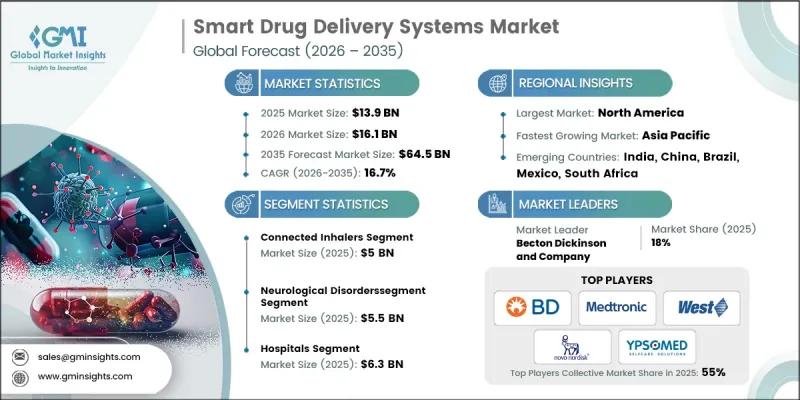
市場成長的促進因素包括慢性病負擔日益加重、數位化醫療解決方案的廣泛應用以及以患者為中心的居家照護模式的轉變。長期健康問題的日益增加促使人們對更精準、更有效率的治療方案的需求不斷成長,因為傳統的給藥方式往往缺乏精確性和一致性。智慧給藥系統技術透過實現可控、標靶和可程式設計的藥物給藥,有效應對了這些挑戰,顯著提高了治療效果和患者依從性。同時,醫療系統越來越重視便利性、成本最佳化和改善病患預後,推動了先進給藥系統在傳統臨床環境之外的應用。持續的技術進步,以及連網設備和數據驅動型醫療模式的融合,進一步加速了這些系統的應用,使其成為現代醫療服務發展演變的關鍵組成部分。
| 市場範圍 | |
|---|---|
| 開始年份 | 2025 |
| 預測期 | 2026-2035 |
| 上市時的市場規模 | 139億美元 |
| 預測金額 | 645億美元 |
| 複合年成長率 | 16.7% |
預計到2025年,智慧吸入器市場規模將達到50億美元,佔據智慧藥物輸送系統市場的重要佔有率。這些設備正被廣泛採用,因為它們解決了呼吸系統護理領域長期存在的難題,例如藥物劑量差異和患者用藥依從性難以追蹤等問題。透過整合數位化追蹤功能,智慧吸入器能夠精準監測患者的使用模式和用藥頻率,進而改善整體治療管理。遠距遠端醫療服務和數位整合治療方案的日益普及,也進一步推動了該領域的成長。
預計到2025年,神經系統疾病市場規模將達55億美元。此市場成長的驅動力在於對精準、穩定給藥的需求,以控制影響神經系統的複雜疾病。這些疾病通常需要持續、可控制的藥物治療,以穩定病情並預防併發症。智慧型藥物輸送系統提供自動給藥和即時監測等先進功能,有助於克服傳統治療方法的挑戰,並改善患者的治療效果。
到2025年,北美智慧藥物輸送系統市佔率將達到45.7%。該地區正經歷強勁成長,這主要得益於慢性病盛行率的上升和數位醫療技術的快速普及。完善的醫療基礎設施以及互聯醫療設備的廣泛應用,為先進藥物輸送解決方案的整合提供了支援。遠端監測、數據驅動型醫療系統和自動化治療方法的日益普及,進一步推動了市場擴張。數位醫療工具和互聯醫療解決方案的持續創新,為智慧藥物傳輸系統技術的應用創造了有利環境。
目錄
第1章:調查方法和範圍
第2章執行摘要
第3章業界考察
- 生態系分析
- 影響產業的因素
- 促進因素
- 慢性病盛行率增加
- 數位健康技術的廣泛應用
- 向以病人為中心的照護和居家照護過渡
- 藥物傳輸技術進步
- 產業潛在風險與挑戰
- 設備研發和製造高成本。
- 缺乏標準化
- 市場機遇
- 拓展互聯互通、數據驅動的藥物傳輸平台。
- 促進因素
- 成長潛力分析(基於初步調查)
- 監理情勢
- 北美洲
- 歐洲
- 技術趨勢(基於初步調查)
- 當前技術趨勢
- 新興技術
- 未來市場趨勢(基於初步研究)
- 人工智慧和生成式人工智慧對市場的影響
- 波特五力分析
- PESTEL 分析
第4章 競爭情勢
- 介紹
- 企業市佔率分析
- 企業矩陣分析
- 主要市場公司的競爭分析
- 競爭定位矩陣
- 戰略儀錶板
- 主要進展
- 併購
- 夥伴關係與合作
- 新產品發布
- 業務拓展計劃
第5章 市場估價與預測:依產品分類,2022-2035年
- 連接式吸入器
- 連接式自動噴油器
- 連接式筆式注射器
- 連網型穿戴式裝置注射器
- 附加元件感測器
- 其他產品
第6章 市場估計與預測:依應用領域分類,2022-2035年
- 代謝性疾病
- 神經系統疾病
- 呼吸系統疾病
- 內分泌系統疾病
- 其他用途
第7章 市場估計與預測:依給藥途徑分類,2022-2035年
- 注射藥物
- 吸入
- 口服
第8章 市場估算與預測:依最終用途分類,2022-2035年
- 醫院
- 診所
- 居家照護
- 門診部
- 其他最終用戶
第9章 市場估計與預測:依地區分類,2022-2035年
- 北美洲
- 美國
- 加拿大
- 歐洲
- 德國
- 英國
- 法國
- 西班牙
- 義大利
- 荷蘭
- 亞太地區
- 中國
- 日本
- 印度
- 澳洲
- 韓國
- 拉丁美洲
- 巴西
- 墨西哥
- 阿根廷
- 中東和非洲
- 南非
- 沙烏地阿拉伯
- 阿拉伯聯合大公國
第10章:公司簡介
- Amiko Digital Health
- Becton, Dickinson and Company
- Biocorp
- Elcam Medical
- Medtronic
- Medtrum
- Nemera
- Novo Nordisk
- Phillips-Medisize
- Portal Instruments
- Teva Pharmaceutical Industries
- West Pharmaceutical Services
- Ypsomed
- Haselmeier
- Insulet
The Global Smart Drug Delivery Systems Market was valued at USD 13.9 billion in 2025 and is estimated to grow at a CAGR of 16.7% to reach USD 64.5 billion by 2035.
Market growth is supported by the increasing burden of chronic diseases, rising adoption of digital healthcare solutions, and a growing shift toward patient-focused and home-based treatment approaches. The rising incidence of long-term health conditions is driving demand for more precise and efficient therapeutic solutions, as conventional drug delivery methods often lack accuracy and consistency. Smart drug delivery technologies address these challenges by enabling controlled, targeted, and programmable drug administration, significantly improving treatment effectiveness and patient compliance. In parallel, healthcare systems are increasingly emphasizing convenience, cost optimization, and improved patient outcomes, encouraging the use of advanced delivery systems outside traditional clinical environments. Continuous technological advancements, combined with the integration of connected devices and data-driven healthcare models, are further accelerating the adoption of these systems, positioning them as a critical component in the evolution of modern healthcare delivery.
| Market Scope | |
|---|---|
| Start Year | 2025 |
| Forecast Year | 2026-2035 |
| Start Value | $13.9 Billion |
| Forecast Value | $64.5 Billion |
| CAGR | 16.7% |
The connected inhalers segment generated USD 5 billion in 2025, holding a substantial share within the smart drug delivery systems market. These devices are gaining widespread adoption due to their ability to address persistent challenges in respiratory care, including inconsistent medication usage and limited visibility into patient adherence. By incorporating digital tracking capabilities, connected inhalers enable accurate monitoring of usage patterns and dosing frequency, improving overall treatment management. The increasing adoption of remote healthcare services and digitally integrated treatment solutions is further supporting the growth of this segment.
The neurological disorders segment accounted for USD 5.5 billion in 2025. This segment is driven by the need for precise and consistent drug administration to manage complex conditions affecting the nervous system. Such conditions often require continuous and controlled medication delivery to maintain stability and prevent complications. Smart drug delivery systems provide advanced capabilities such as automated dosing and real-time monitoring, helping to overcome challenges associated with traditional treatment methods and improving patient outcomes.
North America Smart Drug Delivery Systems Market accounted for 45.7% share in 2025. The region is witnessing strong growth due to the increasing prevalence of chronic conditions and the rapid adoption of digital health technologies. A well-developed healthcare infrastructure, combined with widespread implementation of connected medical devices, is supporting the integration of advanced drug delivery solutions. The growing use of remote monitoring, data-driven healthcare systems, and automated treatment approaches is further enhancing market expansion. Continuous innovation in digital health tools and connected care solutions is creating a favorable environment for the adoption of smart drug delivery technologies.
Key companies operating in the Global Smart Drug Delivery Systems Market include Amiko Digital Health, Becton Dickinson and Company, Biocorp, Elcam Medical, Medtronic, Medtrum, Nemera, Novo Nordisk, Phillips-Medisize, Portal Instruments, Teva Pharmaceutical Industries, West Pharmaceutical Services, Ypsomed, Haselmeier, and Insulet. Companies in the Smart Drug Delivery Systems Market are strengthening their market position through continuous innovation, strategic partnerships, and expansion of digital capabilities. A primary focus is being placed on integrating advanced technologies such as connected devices and data analytics to enhance treatment precision and patient engagement. Firms are investing heavily in research and development to introduce next-generation delivery systems with improved accuracy and usability. Collaborations with healthcare providers and technology companies are helping expand product reach and adoption. Additionally, companies are focusing on developing patient-centric solutions that support home-based care. Geographic expansion, along with the enhancement of product portfolios and digital ecosystems, remains a key strategy to capture emerging opportunities and sustain long-term growth.
Table of Contents
Chapter 1 Methodology and Scope
- 1.1 Market scope and definitions
- 1.2 Research design
- 1.2.1 Research approach
- 1.2.2 Data collection methods
- 1.3 Data mining sources
- 1.3.1 Global
- 1.3.2 Regional/Country
- 1.4 Base estimates and calculations
- 1.4.1 Base year calculation
- 1.4.2 Key trends for market estimation
- 1.5 Primary research and validation
- 1.5.1 Primary sources
- 1.6 Forecast model
- 1.7 Research assumptions and limitations
Chapter 2 Executive Summary
- 2.1 Industry 360° synopsis
- 2.2 Key market trends
- 2.2.1 Product trends
- 2.2.2 Application trends
- 2.2.3 Route of Administration trends
- 2.2.4 End Use trends
- 2.2.5 Regional trends
- 2.3 CXO perspectives: Strategic imperatives
Chapter 3 Industry Insights
- 3.1 Industry ecosystem analysis
- 3.2 Industry impact forces
- 3.2.1 Growth drivers
- 3.2.1.1 Rising prevalence of chronic diseases
- 3.2.1.2 Growing adoption of digital health technologies
- 3.2.1.3 Shift towards patient-centric and home-based care
- 3.2.1.4 Technological advancements in drug delivery
- 3.2.2 Industry pitfalls and challenges
- 3.2.2.1 High cost associated with device development and production
- 3.2.2.2 Lack of standardization
- 3.2.3 Market opportunities
- 3.2.3.1 Expansion of connected and data-driven drug delivery platforms
- 3.2.1 Growth drivers
- 3.3 Growth potential analysis (Driven by Primary Research)
- 3.4 Regulatory landscape
- 3.4.1 North America
- 3.4.2 Europe
- 3.5 Technology landscape (Driven by Primary Research)
- 3.5.1 Current technological trends
- 3.5.2 Emerging technologies
- 3.6 Future market trends (Driven by Primary Research)
- 3.7 Impact of AI and generative AI on the market
- 3.8 Porter's analysis
- 3.9 PESTEL analysis
Chapter 4 Competitive Landscape, 2025
- 4.1 Introduction
- 4.2 Company market share analysis
- 4.3 Company matrix analysis
- 4.4 Competitive analysis of major market players
- 4.5 Competitive positioning matrix
- 4.6 Strategy dashboard
- 4.7 Key developments
- 4.7.1 Mergers and acquisitions
- 4.7.2 Partnerships and collaborations
- 4.7.3 New product launches
- 4.7.4 Expansion plans
Chapter 5 Market Estimates and Forecast, By Product, 2022 - 2035 ($ Mn)
- 5.1 Key trends
- 5.2 Connected inhalers
- 5.3 Connected autoinjectors
- 5.4 Connected pen injectors
- 5.5 Connected wearable injectors
- 5.6 Add-on sensors
- 5.7 Other products
Chapter 6 Market Estimates and Forecast, By Application, 2022 - 2035 ($ Mn)
- 6.1 Key trends
- 6.2 Metabolic disorders
- 6.3 Neurological disorders
- 6.4 Respiratory disorders
- 6.5 Hormonal disorders
- 6.6 Other applications
Chapter 7 Market Estimates and Forecast, By Route of Administration, 2022 - 2035 ($ Mn)
- 7.1 Key trends
- 7.2 Injectable
- 7.3 Inhalation
- 7.4 Oral
Chapter 8 Market Estimates and Forecast, By End Use, 2022 - 2035 ($ Mn)
- 8.1 Key trends
- 8.2 Hospitals
- 8.3 Clinics
- 8.4 Home care
- 8.5 Ambulatory care settings
- 8.6 Other end users
Chapter 9 Market Estimates and Forecast, By Region, 2022 - 2035 ($ Mn)
- 9.1 Key trends
- 9.2 North America
- 9.2.1 U.S.
- 9.2.2 Canada
- 9.3 Europe
- 9.3.1 Germany
- 9.3.2 UK
- 9.3.3 France
- 9.3.4 Spain
- 9.3.5 Italy
- 9.3.6 Netherlands
- 9.4 Asia Pacific
- 9.4.1 China
- 9.4.2 Japan
- 9.4.3 India
- 9.4.4 Australia
- 9.4.5 South Korea
- 9.5 Latin America
- 9.5.1 Brazil
- 9.5.2 Mexico
- 9.5.3 Argentina
- 9.6 Middle East and Africa
- 9.6.1 South Africa
- 9.6.2 Saudi Arabia
- 9.6.3 UAE
Chapter 10 Company Profiles
- 10.1 Amiko Digital Health
- 10.2 Becton, Dickinson and Company
- 10.3 Biocorp
- 10.4 Elcam Medical
- 10.5 Medtronic
- 10.6 Medtrum
- 10.7 Nemera
- 10.8 Novo Nordisk
- 10.9 Phillips-Medisize
- 10.10 Portal Instruments
- 10.11 Teva Pharmaceutical Industries
- 10.12 West Pharmaceutical Services
- 10.13 Ypsomed
- 10.14 Haselmeier
- 10.15 Insulet

 2026-2030年全球先進藥物傳輸系統市場
 2026-2034年全球癌症治療藥物傳遞系統市場規模、佔有率、趨勢和成長分析報告
 新型藥物傳輸系統市場-2026-2032年全球市場預測
 智慧互聯藥物輸送設備市場機會、成長要素、產業趨勢分析及2026-2035年預測
 新型藥物遞送系統市場規模、佔有率和成長分析:按技術、給藥途徑、應用、最終用戶和地區分類-2026-2033年產業預測
 智慧農業噴灑系統市場預測至2034年:按產品類型、農業化學品類型、農場規模、技術、應用、最終用戶和地區分類的全球分析移動式溶離介質製備系統市場:依產品類型、技術、自動化程度、最終用戶和應用分類,全球預測,2026-2032年
 2026年全球先進藥物輸送系統市場報告2026年全球新型藥物遞送系統市場報告
 先進藥物輸送系統市場分析及預測(至2035年):依類型、產品、技術、應用、最終用戶、材料類型、設備、製程及部署方式分類