


 |
市場調查報告書
商品編碼
2019224
甘蔗切割機市場機會、成長要素、產業趨勢分析及2026-2035年預測。Cane Chopper Market Opportunity, Growth Drivers, Industry Trend Analysis, and Forecast 2026 - 2035 |
||||||

2025 年全球甘蔗切割機市場價值為 13 億美元,預計到 2035 年將達到 103 億美元,年複合成長率為 23.1%。
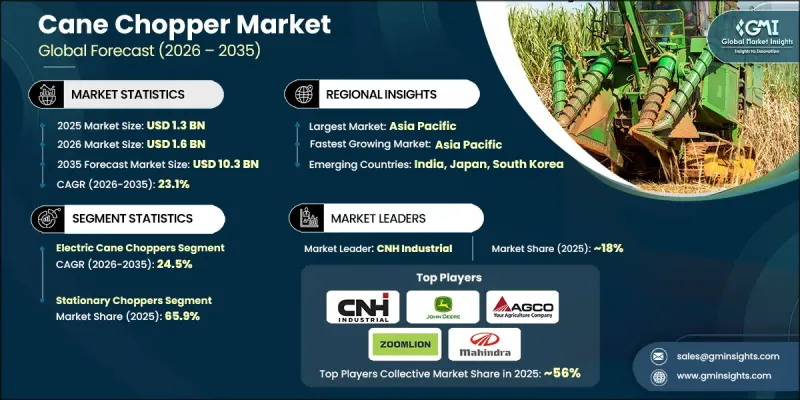
為了提高效率、減少對勞動力的依賴並加快收割速度,農民正從勞力密集的人工收割轉向使用機械化收割機。甘蔗收割機能夠實現更快、更均勻的收割,並廣泛應用於從小規模到大規模的農場。農業承包商正在尋找性能穩定、能夠最大限度減少田間損失的機器。人事費用上升、勞動力短缺以及政府對農業機械化的支持進一步推動了機械化收割機的普及。現代收割機在設計上充分考慮了作物密度和農田條件的變化,同時確保了耐用性和易於維護。糖業生產和加工行業的成長也推動了對機械化收割機的需求,因為糖廠需要及時供應優質甘蔗,以維持糖的回收率和生產的連續性。
| 市場範圍 | |
|---|---|
| 開始年份 | 2025 |
| 預測期 | 2026-2035 |
| 上市時的市場規模 | 13億美元 |
| 預測金額 | 103億美元 |
| 複合年成長率 | 23.1% |
預計到2025年,電動甘蔗切割機市場規模將達到6.332億美元,並在2035年之前以24.5%的複合年成長率成長。這些機器憑藉其高效的運作、均勻的切割效果、低噪音、低排放氣體和極低的維護需求,在市場上佔據領先地位。它們尤其受到果汁攤販、小規模加工商和餐飲服務機構的青睞,這些機構需要衛生可靠的設備。
預計到2025年,固定式切碎機市佔率將達到65.9%,並在2035年之前以5%的複合年成長率成長。其固定式設計確保了卓越的穩定性、可操作性、安全性和穩定的產量,使其成為商業果汁店和加工廠的理想選擇。其堅固的結構使其能夠長期運作且振動極小,滿足大量生產的需求。
預計到2025年,中國甘蔗收割機市場規模將達到1.25億美元,並在2026年至2035年間以24.8%的複合年成長率成長。在甘蔗種植蓬勃發展的南方省份,機械化進程正在加速。農民更傾向於使用能夠處理高大沉重甘蔗的大容量、曳引機式或自走式收割機。製造商則專注於提升產品的耐用性、耐腐蝕性和模組化設計,以便靈活適應不同規模的農場和熱帶環境條件。
目錄
第1章:調查方法和範圍
第2章執行摘要
第3章業界考察
- 生態系分析
- 供應商情況
- 利潤率
- 每個階段增加的價值
- 影響價值鏈的因素
- 影響產業的因素
- 促進因素
- 甘蔗收割機械化技術的進步
- 糖生產和加工業的擴張
- 甘蔗收割一體化機械的廣泛應用
- 陷阱與挑戰
- 機械甘蔗切割設備的高昂購置成本
- 收割機械的維護與操作複雜性
- 機會
- 為小規模農戶開發一種結構緊湊、經濟高效的甘蔗切割機。
- 節能低排放氣體農業機械的需求日益成長
- 促進因素
- 成長潛力分析
- 未來市場趨勢
- 科技與創新趨勢
- 當前技術趨勢
- 新興技術
- 監理情勢
- 標準和合規要求
- 區域法規結構
- 認證標準
- 波特五力分析
- PESTEL 分析
- 價格分析(基於初步調查)
- 過去價格趨勢分析(基於初步調查)(2019-2024 年)
- 根據業務類型分類的定價策略(高階/價值/成本加成)(基於初步調查)
- 區域價格波動及其影響因素
- 原物料成本對設備價格的影響
- 按農場規模分類的需求價格彈性
- 貿易數據分析(基於付費資料庫)
- 進出口量和進口額趨勢(基於付費資料庫)(2019-2024 年)
- 主要貿易路線及關稅的影響(基於付費資料庫)
- 主要出口國
- 主要進口國
- 貿易政策對市場動態的影響
- 生產能力和生產趨勢(基於初步調查)
- 按地區和主要生產商分類的製造能力(基於初步調查)
- 運轉率和擴張計劃(基於初步調查)
第4章 競爭情勢
- 介紹
- 企業市佔率分析
- 按地區
- 企業矩陣分析
- 主要市場公司的競爭分析
- 競爭定位矩陣
- 主要進展
- 併購
- 夥伴關係與合作
- 新產品發布
- 業務拓展計劃
第5章 市場估算與預測:依產品類型分類,2022-2035年
- 手動甘蔗切割機
- 電動甘蔗切割機
- 曳引機式甘蔗切割機
第6章 市場估價與預測:依設計分類,2022-2035年
- 手持式切碎機
- 固定式斬波器
第7章 市場估計與預測:依加工能力分類,2022-2035年
- 小產能(小於5噸/小時)
- 中等產能(5-10噸/小時)
- 大容量(10-20噸/小時)
- 超大產能(20噸/小時或以上)
第8章 市場估算與預測:依最終使用者分類,2022-2035年
- 糖廠
- 農業合作社
- 大型商業農場
- 中小農業企業
- 其他
第9章 市場估價與預測:依通路分類,2022-2035年
- 直接地
- 間接
第10章 市場估價與預測:依地區分類,2022-2035年
- 北美洲
- 美國
- 加拿大
- 歐洲
- 德國
- 英國
- 法國
- 義大利
- 西班牙
- 亞太地區
- 中國
- 印度
- 日本
- 韓國
- 澳洲
- 拉丁美洲
- 巴西
- 墨西哥
- 阿根廷
- 中東和非洲(MEA)
- 沙烏地阿拉伯
- 阿拉伯聯合大公國
- 南非
第11章:公司簡介
- AGCO Corporation
- BMA Group
- CNH Industrial
- Crystal Engineers
- Jacto
- John Deere
- Mahindra & Mahindra
- Pratco
- Rachitech Pvt. Ltd.
- Saisidha Sugar Equipment
- Tata Agrico
- Three Star Engineering
- Trimurti Project Engineers
- Ulka Industries
- Zoomlion
The Global Cane Chopper Market was valued at USD 1.3 billion in 2025 and is estimated to grow at a CAGR of 23.1% to reach USD 10.3 billion by 2035.
Farmers are transitioning from labor-intensive manual methods to mechanized choppers to boost efficiency, reduce workforce dependency, and accelerate the harvesting process. Cane choppers enable faster, uniform cutting, supporting both small farms and large-scale commercial operations. Agricultural contractors seek machines that offer consistent performance and minimize field losses. Rising labor costs, worker shortages, and government incentives for farm mechanization are further driving adoption. Modern choppers are engineered to handle varying crop densities and field conditions while ensuring durability and easy maintenance. The growth of sugar production and processing industries also fuels demand, as mills require a timely, high-quality cane supply to maintain sugar recovery and production continuity.
| Market Scope | |
|---|---|
| Start Year | 2025 |
| Forecast Year | 2026-2035 |
| Start Value | $1.3 Billion |
| Forecast Value | $10.3 Billion |
| CAGR | 23.1% |
The electric cane choppers segment generated USD 633.2 million in 2025 and is expected to grow at a CAGR of 24.5% through 2035. These machines lead the market due to their operational efficiency, uniform cutting, low noise, minimal emissions, and low maintenance needs. They are particularly popular among juice vendors, small processing units, and food service outlets seeking hygienic and reliable equipment.
The stationary choppers segment held 65.9% share in 2025 and is projected to grow at a CAGR of 5% through 2035. Their fixed design offers superior stability, control, safety, and consistent output, making them ideal for commercial juice shops and processing facilities. The robust construction allows for long-term operation with minimal vibration, supporting high-volume requirements.
China Cane Chopper Market reached USD 125 million in 2025 and is expected to grow at a CAGR of 24.8% from 2026 to 2035. Mechanization is increasing in southern provinces with dense sugarcane cultivation. Farmers favor high-capacity, tractor-mounted, and self-propelled choppers capable of handling tall, heavy cane. Manufacturers focus on durability, corrosion resistance, and modular designs to adapt to varying farm sizes and tropical conditions.
Key players in the Global Cane Chopper Market include AGCO Corporation, BMA Group, CNH Industrial, Crystal Engineers, Jacto, John Deere, Mahindra & Mahindra, Pratco, Rachitech Pvt. Ltd., Saisidha Sugar Equipment, Tata Agrico, Three Star Engineering, Trimurti Project Engineers, Ulka Industries, and Zoomlion. Leading companies in the Global Cane Chopper Market are reinforcing their positions by investing in R&D to enhance blade efficiency, durability, and energy consumption. They are introducing modular and customizable designs to cater to diverse farm sizes and crop conditions. Partnerships with local distributors and service providers improve after-sales support and market penetration. Firms are also focusing on developing electric and hybrid models to meet sustainability standards while offering low-maintenance solutions. Marketing campaigns highlighting productivity gains, reduced labor dependency, and operational reliability help strengthen brand recognition. Additionally, expanding production capacities and entering emerging regions further solidify their competitive presence globally.
Table of Contents
Chapter 1 Methodology & Scope
- 1.1 Market scope and definition
- 1.2 Research design
- 1.2.1 Research approach
- 1.2.2 Data collection methods
- 1.3 Data mining sources
- 1.3.1 Global
- 1.3.2 Regional/Country
- 1.4 Base estimates and calculations
- 1.4.1 Base year calculation
- 1.4.2 Key trends for market estimation
- 1.5 Primary research and validation
- 1.5.1 Primary sources
- 1.6 Forecast model
- 1.7 Research assumptions and limitations
Chapter 2 Executive Summary
- 2.1 Industry 360° synopsis
- 2.2 Key market trends
- 2.2.1 Regional
- 2.2.2 Product Type
- 2.2.3 Design
- 2.2.4 Capacity
- 2.2.5 End-User
- 2.2.6 Distribution channel
Chapter 3 Industry Insights
- 3.1 Industry ecosystem analysis
- 3.1.1 Supplier landscape
- 3.1.2 Profit margin
- 3.1.3 Value addition at each stage
- 3.1.4 Factor affecting the value chain
- 3.2 Industry impact forces
- 3.2.1 Growth drivers
- 3.2.1.1 Increasing mechanization in sugarcane harvesting operations
- 3.2.1.2 Expansion of sugar production and processing industries
- 3.2.1.3 Growing adoption of integrated sugarcane harvesting machines
- 3.2.2 Pitfalls & Challenges
- 3.2.2.1 High capital cost of mechanized cane chopping equipment
- 3.2.2.2 Maintenance and operational complexity of harvesting machinery
- 3.2.3 Opportunities
- 3.2.3.1 Development of compact and cost-effective cane choppers for small farms
- 3.2.3.2 Increasing demand for fuel-efficient and low-emission agricultural machinery
- 3.2.1 Growth drivers
- 3.3 Growth potential analysis
- 3.4 Future market trends
- 3.5 Technology and innovation landscape
- 3.5.1 Current technological trends
- 3.5.2 Emerging technologies
- 3.6 Regulatory landscape
- 3.6.1 Standards and compliance requirements
- 3.6.2 Regional regulatory frameworks
- 3.6.3 Certification standards
- 3.7 Porter's analysis
- 3.8 PESTEL analysis
- 3.9 Pricing analysis (driven by primary research)
- 3.9.1 Historical price trend analysis (driven by primary research) (2019-2024)
- 3.9.2 Pricing strategy by player type (premium/value/cost-plus) (driven by primary research)
- 3.9.3 Regional price variations & drivers
- 3.9.4 Impact of raw material costs on equipment pricing
- 3.9.5 Price elasticity of demand by farm size
- 3.10 Trade data analysis (driven by paid database)
- 3.10.1 Import/export volume & value trends (driven by paid database) (2019-2024)
- 3.10.2 Key trade corridors & tariff impact (driven by paid database)
- 3.10.3 Major exporting countries
- 3.10.4 Major importing countries
- 3.10.5 Trade policy impact on market dynamics
- 3.11 Capacity & production landscape (driven by primary research)
- 3.11.1 Installed manufacturing capacity by region & key producer (driven by primary research)
- 3.11.2 Capacity utilization rates & expansion pipelines (driven by primary research)
Chapter 4 Competitive Landscape, 2025
- 4.1 Introduction
- 4.2 Company market share analysis
- 4.2.1 By Region
- 4.2.1.1 North America
- 4.2.1.2 Europe
- 4.2.1.3 Asia Pacific
- 4.2.1.4 Latin America
- 4.2.1.5 Middle East & Africa
- 4.2.1 By Region
- 4.3 Company matrix analysis
- 4.4 Competitive analysis of major market players
- 4.5 Competitive positioning matrix
- 4.6 Key developments
- 4.6.1 Mergers & acquisitions
- 4.6.2 Partnerships & collaborations
- 4.6.3 New product launches
- 4.6.4 Expansion plans
Chapter 5 Market Estimates & Forecast, By Product Type, 2022 - 2035, (USD Billion) (Thousand Units)
- 5.1 Key trends
- 5.2 Manual Cane Choppers
- 5.3 Electric Cane Choppers
- 5.4 Tractor-Mounted Cane Choppers
Chapter 6 Market Estimates & Forecast, By Design, 2022 - 2035, (USD Billion) (Thousand Units)
- 6.1 Key trends
- 6.2 Handheld Choppers
- 6.3 Stationary Choppers
Chapter 7 Market Estimates & Forecast, By Capacity, 2022 - 2035, (USD Billion) (Thousand Units)
- 7.1 Key trends
- 7.2 Small Capacity (Under 5 tons/hour)
- 7.3 Medium Capacity (5-10 tons/hour)
- 7.4 Large Capacity (10-20 tons/hour)
- 7.5 Heavy-Duty Capacity (Over 20 tons/hour)
Chapter 8 Market Estimates & Forecast, By End-User, 2022 - 2035, (USD Billion) (Thousand Units)
- 8.1 Key trends
- 8.2 Sugar Mills
- 8.3 Agricultural Cooperatives
- 8.4 Large Commercial Farms
- 8.5 Small to Medium Farming Enterprises
- 8.6 Others
Chapter 9 Market Estimates & Forecast, By Distribution Channel, 2022 - 2035, (USD Billion) (Thousand Units)
- 9.1 Key trends
- 9.2 Direct
- 9.3 Indirect
Chapter 10 Market Estimates & Forecast, By Region, 2022 - 2035, (USD Billion) (Thousand Units)
- 10.1 Key trends
- 10.2 North America
- 10.2.1 U.S.
- 10.2.2 Canada
- 10.3 Europe
- 10.3.1 Germany
- 10.3.2 UK
- 10.3.3 France
- 10.3.4 Italy
- 10.3.5 Spain
- 10.4 Asia Pacific
- 10.4.1 China
- 10.4.2 India
- 10.4.3 Japan
- 10.4.4 South Korea
- 10.4.5 Australia
- 10.5 Latin America
- 10.5.1 Brazil
- 10.5.2 Mexico
- 10.5.3 Argentina
- 10.6 MEA
- 10.6.1 Saudi Arabia
- 10.6.2 UAE
- 10.6.3 South Africa
Chapter 11 Company Profiles
- 11.1 AGCO Corporation
- 11.2 BMA Group
- 11.3 CNH Industrial
- 11.4 Crystal Engineers
- 11.5 Jacto
- 11.6 John Deere
- 11.7 Mahindra & Mahindra
- 11.8 Pratco
- 11.9 Rachitech Pvt. Ltd.
- 11.10 Saisidha Sugar Equipment
- 11.11 Tata Agrico
- 11.12 Three Star Engineering
- 11.13 Trimurti Project Engineers
- 11.14 Ulka Industries
- 11.15 Zoomlion

 切割泵市場規模、佔有率和成長分析(按泵類型、功率範圍和地區分類)—產業預測(2026-2033 年)
 全球切割幫浦市場全球斬波泵市場
 斬波泵市場,按產品類型、材料、產能、應用、國家和地區 - 2024-2032 年行業分析、市場規模、市場佔有率和預測