


 |
市場調查報告書
商品編碼
2019211
蘋果籽油市場機會、成長要素、產業趨勢分析及2026-2035年預測Apple Seed Oil Market Opportunity, Growth Drivers, Industry Trend Analysis, and Forecast 2026 - 2035 |
||||||

預計到 2025 年,全球蘋果籽油市場價值將達到 57.9 億美元,年複合成長率為 4.6%,到 2035 年將達到 90.1 億美元。
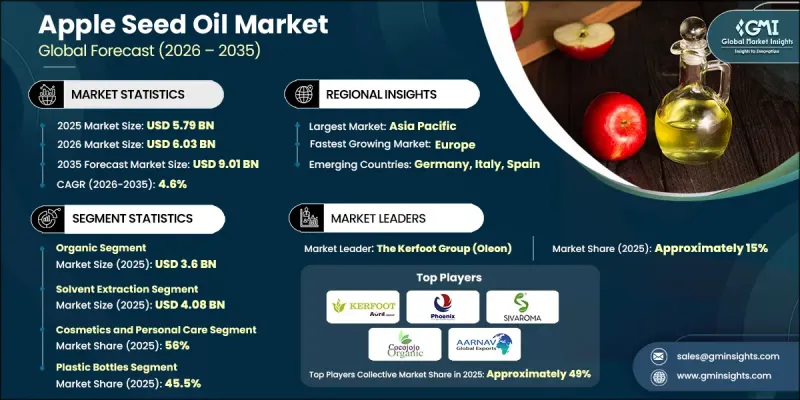
市場成長的驅動力在於消費者對加工水果特定用途和減少廢棄物的日益關注。蘋果籽曾是果汁和蘋果酒生產過程中的廢棄物,如今因其富含脂肪酸和生物活性物質,被視為寶貴的榨油原料。為了保留這些營養和功能特性,冷壓和機械萃取方法被廣泛應用,使蘋果籽油成為一種優質原料,而非普通的食用油。化妝品和個人護理行業是主要驅動力,其需求主要來自護膚、護髮和抗衰老產品的配方。蘋果籽油質地輕盈、具有潤膚功效,且植物來源,迎合了消費者對潔淨標示和永續產品日益成長的偏好。雖然蘋果籽油在食品行業的應用有限,但它作為小眾產品脫穎而出,專注於高階產品和營養補充劑。市場動態取決於蘋果籽的特定用途供應情況,以及製造商能否將永續採購慣例融入其運營,以確保工業化生產的穩定品質和供應。
| 市場規模 | |
|---|---|
| 開始年份 | 2025 |
| 預測期 | 2026-2035 |
| 上市時的市場規模 | 57.9億美元 |
| 預測金額 | 90.1億美元 |
| 複合年成長率 | 4.6% |
2025年,有機蘋果籽油市場規模預計將達到36億美元,並預計在2035年之前以4.4%的複合年成長率成長。隨著消費者越來越重視原料的可靠性、乾淨的來源和可控的種植方式,有機市場正穩步擴張。有機蘋果籽油在高階個人保健產品、營養保健品和健康產品等配方中備受青睞,這些產品注重高品質和天然成分。這種成長得益於與永續發展和道德採購目標的契合,以及高級產品策略的推廣。然而,由於生產過程高度複雜且種植具有選擇性,有機蘋果籽油的快速擴張受到限制,而且該領域往往更注重品質而非數量。消費者對有機認證和環境影響的認知持續影響市場需求,他們更重視長期的信任和信心,而非短期的嘗試。
預計到2025年,溶劑萃取市場規模將達到40.8億美元,並在2026年至2035年間以4.4%的複合年成長率成長。溶劑萃取法因其能夠實現更高的油品回收率和穩定的產率而被廣泛採用,使其適用於大規模生產。當製程擴充性、產率效率和標準化油品特性成為優先考慮因素時,製造商會依賴這種方法。操作的便利性和成本效益支撐了其持續應用,確保了商業應用的穩定供應。儘管永續性問題可能會影響品牌選擇,但對於維持產品品質的穩定性以及滿足大批量生產線的需求而言,尤其是在個人護理和特殊配方中,均勻的成分和混合適用性至關重要,而溶劑萃取法仍然是實現這一目標的關鍵。
預計到2025年,北美蘋果籽油市場規模將達到18.8億美元。個人護理和機能性食品中對天然和植物來源成分日益成長的偏好,正在推動該地區的需求。美國憑藉其成熟的蘋果加工業、對永續性的高度重視以及對添加蘋果籽油的化妝品和營養保健品的高需求,引領著蘋果籽油的普及。加拿大也為該地區的成長做出了貢獻,這得益於其完善的水果加工基礎設施以及消費者對潔淨標示和植物來源成分日益成長的興趣。此外,製造商採用環保的採購慣例,確保可追溯性和質量,進一步鞏固了這一成長,滿足了消費者對透明度和高階定位的期望。
目錄
第1章:調查方法
第2章執行摘要
第3章業界考察
- 生態系分析
- 供應商情況
- 利潤率
- 每個階段增加的價值
- 影響價值鏈的因素
- 中斷
- 影響產業的因素
- 促進因素
- 產業潛在風險與挑戰
- 市場機遇
- 成長潛力分析
- 監理情勢
- 波特五力分析
- PESTEL 分析
- 價格趨勢
- 按地區
- 依產品
- 未來市場趨勢
- 科技與創新趨勢
- 當前技術趨勢
- 新興技術
- 專利趨勢
- 貿易統計
- 主要進口國
- 主要出口國
- 永續性和環境方面
- 永續計劃
- 減少廢棄物策略
- 生產中的能源效率
- 環保意識的舉措
- 關於碳足跡的考量
第4章 競爭情勢
- 介紹
- 企業市佔率分析
- 按地區
- 北美洲
- 歐洲
- 亞太地區
- 拉丁美洲
- 中東和非洲
- 按地區
- 企業矩陣分析
- 主要市場公司的競爭分析
- 競爭定位矩陣
- 主要進展
- 併購
- 夥伴關係與合作
- 新產品發布
- 業務拓展計劃
第5章 市場估計與預測:依類型分類,2022-2035年
- 有機的
- 傳統的
第6章 市場估價與預測:依提取製程分類,2022-2035年
- 溶劑萃取
- 冷壓
第7章 市場估計與預測:依最終用途分類,2022-2035年
- 化妝品和個人護理
- 飲食
- 製藥
- 其他(芳香療法等)
第8章 市場估價與預測:依包裝類型分類,2022-2035年
- 塑膠瓶
- 玻璃瓶
- 其他(塑膠袋、罐頭)
第9章 市場估價與預測:依通路分類,2022-2035年
- 直銷
- 零售店
- 線上零售
- 其他(藥局和保健食品店)
第10章 市場估價與預測:依地區分類,2022-2035年
- 北美洲
- 美國
- 加拿大
- 歐洲
- 德國
- 英國
- 法國
- 義大利
- 西班牙
- 其他歐洲地區
- 亞太地區
- 中國
- 印度
- 日本
- 澳洲
- 韓國
- 亞太其他地區
- 拉丁美洲
- 巴西
- 墨西哥
- 阿根廷
- 其他拉丁美洲地區
- 中東和非洲
- 沙烏地阿拉伯
- 南非
- 阿拉伯聯合大公國
- 其他中東和非洲地區
第11章:公司簡介
- The Kerfoot Group(Oleon)
- CocoJoJo
- Organic Pure Oil
- KK Enterprisers
- Aarnav Global Exports
- Sivaroma Naturals
- Phoenix Group
- Sri Venkatesh Aromas
- FruitSmart Inc.
- AU Natural Organics
- IMCD NV
The Global Apple Seed Oil Market was valued at USD 5.79 billion in 2025 and is estimated to grow at a CAGR of 4.6% to reach USD 9.01 billion by 2035.
Market growth is driven by the rising focus on utilizing fruit processing by-products and reducing waste. Apple seeds, which were once discarded during juice and cider production, are now recognized as a valuable source for oil extraction due to their rich content of fatty acids and bioactive compounds. Cold-pressing and mechanical extraction methods are widely used to preserve these nutritional and functional properties, positioning apple seed oil as a premium ingredient rather than a conventional cooking oil. The cosmetics and personal care sector is a major driver, with demand stemming from formulations for skin, hair, and anti-aging products. Its lightweight texture, emollient qualities, and plant-based origin meet the growing consumer preference for clean-label and sustainable products. Limited applications in the food industry focus on gourmet uses and nutritional blends, highlighting the product's niche positioning. The market's dynamics depend on the availability of apple seed by-products and the ability of manufacturers to integrate sustainable sourcing practices into their operations, ensuring consistent quality and supply for industrial-scale production.
| Market Scope | |
|---|---|
| Start Year | 2025 |
| Forecast Year | 2026-2035 |
| Start Value | $5.79 Billion |
| Forecast Value | $9.01 Billion |
| CAGR | 4.6% |
In 2025, the organic apple seed oil segment was valued at USD 3.6 billion and is expected to grow at a CAGR of 4.4% through 2035. The organic segment is expanding steadily as consumers increasingly prioritize ingredient integrity, clean sourcing, and controlled cultivation practices. Organic apple seed oil is favored in formulations where product quality and natural positioning are critical, including high-end personal care, nutraceutical, and wellness products. Growth is supported by alignment with sustainability and ethical sourcing goals, as well as premium product strategies. However, higher production complexity and selective cultivation limit its aggressive expansion, making the segment more quality-driven than volume-driven. Consumer awareness around organic certifications and environmental impact continues to shape demand, emphasizing long-term trust and credibility over short-term adoption.
The solvent extraction segment reached USD 4.08 billion in 2025 and is projected to grow at a CAGR of 4.4% from 2026 to 2035. Solvent extraction is widely adopted due to its ability to achieve higher oil recovery and consistent output, making it suitable for large-scale production. Manufacturers rely on this method when process scalability, yield efficiency, and standardized oil characteristics are prioritized. Its continued adoption is supported by operational familiarity and cost efficiency, ensuring a stable supply for commercial applications. While sustainability concerns may influence brand choices, the method remains critical for maintaining consistent quality and meeting demand in high-volume production lines, especially where uniform composition and blending compatibility are essential for personal care and specialty formulations.
North America Apple Seed Oil Market accounted for USD 1.88 billion in 2025. Rising preference for natural, plant-based ingredients in personal care and wellness products is driving demand in this region. The United States leads adoption due to established apple processing industries, a strong focus on sustainability, and high demand for cosmetic and nutraceutical formulations incorporating apple seed oil. Canada also contributes to regional growth, supported by its fruit processing infrastructure and increasing emphasis on clean-label and plant-based ingredients. Growth is reinforced by manufacturers integrating eco-friendly sourcing practices, ensuring traceability and quality, which aligns with consumer expectations for transparency and premium positioning.
Major players operating in the Global Apple Seed Oil Market include The Kerfoot Group (Oleon), CocoJoJo, Organic Pure Oil, K.K Enterprisers, Aarnav Global Exports, Sivaroma Naturals, Phoenix Group, Sri Venkatesh Aromas, FruitSmart Inc., AU Natural Organics, IMCD N.V., and other regional suppliers, all contributing to innovation, sustainable sourcing, and niche application development in both personal care and specialty food sectors. Key strategies employed by companies in the apple seed oil market focus on product differentiation, sustainability, and supply chain optimization. Firms invest in advanced extraction technologies such as cold-pressing and mechanical processing to preserve bioactive compounds and enhance oil quality. Strategic partnerships with fruit processing units and juice producers ensure a consistent seed supply and reduce operational costs. Companies focus on organic certification, eco-labeling, and ethical sourcing to appeal to environmentally conscious consumers. Diversifying applications into cosmetics, hair care, nutraceuticals, and gourmet foods helps broaden market reach. Investment in research and development enables formulation improvements, blending with other plant-based oils, and expanding stability and oxidative resistance.
Table of Contents
Chapter 1 Methodology
- 1.1 Market scope and definition
- 1.2 Research design
- 1.2.1 Research approach
- 1.2.2 Data collection methods
- 1.3 Data mining sources
- 1.3.1 Global
- 1.3.2 Regional/Country
- 1.4 Base estimates and calculations
- 1.4.1 Base year calculation
- 1.4.2 Key trends for market estimation
- 1.5 Primary research and validation
- 1.5.1 Primary sources
- 1.6 Forecast model
- 1.7 Research assumptions and limitations
Chapter 2 Executive Summary
- 2.1 Industry 360° synopsis
- 2.2 Key market trends
- 2.2.1 Regional
- 2.2.2 Nature
- 2.2.3 Extraction Process
- 2.2.4 End Use
- 2.2.5 Packaging
- 2.2.6 Distribution Channel
- 2.3 TAM Analysis, 2026-2035
- 2.4 CXO perspectives: Strategic imperatives
Chapter 3 Industry Insights
- 3.1 Industry ecosystem analysis
- 3.1.1 Supplier Landscape
- 3.1.2 Profit Margin
- 3.1.3 Value addition at each stage
- 3.1.4 Factor affecting the value chain
- 3.1.5 Disruptions
- 3.2 Industry impact forces
- 3.2.1 Growth drivers
- 3.2.2 Industry pitfalls and challenges
- 3.2.3 Market opportunities
- 3.3 Growth potential analysis
- 3.4 Regulatory landscape
- 3.4.1 North America
- 3.4.2 Europe
- 3.4.3 Asia Pacific
- 3.4.4 Latin America
- 3.4.5 Middle East & Africa
- 3.5 Porter's analysis
- 3.6 PESTEL analysis
- 3.7 Price trends
- 3.7.1 By region
- 3.7.2 By product
- 3.8 Future market trends
- 3.9 Technology and Innovation landscape
- 3.9.1 Current technological trends
- 3.9.2 Emerging technologies
- 3.10 Patent Landscape
- 3.11 Trade statistics
- 3.11.1 Major importing countries
- 3.11.2 Major exporting countries
- 3.12 Sustainability and Environmental Aspects
- 3.12.1 Sustainable Practices
- 3.12.2 Waste Reduction Strategies
- 3.12.3 Energy Efficiency in Production
- 3.12.4 Eco-friendly Initiatives
- 3.13 Carbon Footprint Considerations
Chapter 4 Competitive Landscape, 2025
- 4.1 Introduction
- 4.2 Company market share analysis
- 4.2.1 By region
- 4.2.1.1 North America
- 4.2.1.2 Europe
- 4.2.1.3 Asia Pacific
- 4.2.1.4 LATAM
- 4.2.1.5 MEA
- 4.2.1 By region
- 4.3 Company matrix analysis
- 4.4 Competitive analysis of major market players
- 4.5 Competitive positioning matrix
- 4.6 Key developments
- 4.6.1 Mergers & acquisitions
- 4.6.2 Partnerships & collaborations
- 4.6.3 New Product Launches
- 4.6.4 Expansion Plans
Chapter 5 Market Estimates and Forecast, By Nature, 2022- 2035 (USD Billion, Kilo Tons)
- 5.1 Key trends
- 5.2 Organic
- 5.3 Conventional
Chapter 6 Market Estimates and Forecast, By Extraction Process, 2022- 2035 (USD Billion, Kilo Tons)
- 6.1 Key trends
- 6.2 Solvent extraction
- 6.3 Cold-pressed
Chapter 7 Market Estimates and Forecast, By End Use, 2022 - 2035 (USD Billion, Kilo Tons)
- 7.1 Key trends
- 7.2 Cosmetics and Personal Care
- 7.3 Food and Beverages
- 7.4 Pharmaceuticals
- 7.5 Others (Aromatherapy, etc.)
Chapter 8 Market Estimates and Forecast, By Packaging, 2022 - 2035 (USD Billion, Kilo Tons)
- 8.1 Key trends
- 8.2 Plastic Bottles
- 8.3 Glass bottles
- 8.4 Other (Plastic pouch, Can)
Chapter 9 Market Estimates and Forecast, By Distribution channel, 2022 - 2035 (USD Billion, Kilo Tons)
- 9.1 Key trends
- 9.2 Direct Sales
- 9.3 Retail Stores
- 9.4 Online Retail
- 9.5 Other (Pharmacies and Health Stores)
Chapter 10 Market Estimates and Forecast, By Region, 2022 - 2035 (USD Billion, Kilo Tons)
- 10.1 Key trends
- 10.2 North America
- 10.2.1 U.S.
- 10.2.2 Canada
- 10.3 Europe
- 10.3.1 Germany
- 10.3.2 UK
- 10.3.3 France
- 10.3.4 Italy
- 10.3.5 Spain
- 10.3.6 Rest of Europe
- 10.4 Asia Pacific
- 10.4.1 China
- 10.4.2 India
- 10.4.3 Japan
- 10.4.4 Australia
- 10.4.5 South Korea
- 10.4.6 Rest of Asia Pacific
- 10.5 Latin America
- 10.5.1 Brazil
- 10.5.2 Mexico
- 10.5.3 Argentina
- 10.5.4 Rest of Latin America
- 10.6 Middle East & Africa
- 10.6.1 Saudi Arabia
- 10.6.2 South Africa
- 10.6.3 UAE
- 10.6.4 Rest of Middle East & Africa
Chapter 11 Company Profiles
- 11.1 The Kerfoot Group (Oleon)
- 11.2 CocoJoJo
- 11.3 Organic Pure Oil
- 11.4 K.K Enterprisers
- 11.5 Aarnav Global Exports
- 11.6 Sivaroma Naturals
- 11.7 Phoenix Group
- 11.8 Sri Venkatesh Aromas
- 11.9 FruitSmart Inc.
- 11.10 AU Natural Organics
- 11.11 IMCD N.V.


