

 |
市場調查報告書
商品編碼
2019189
氣槍市場機會、成長要素、產業趨勢分析及2026-2035年預測。Airsoft Gun Market Opportunity, Growth Drivers, Industry Trend Analysis, and Forecast 2026 - 2035 |
||||||

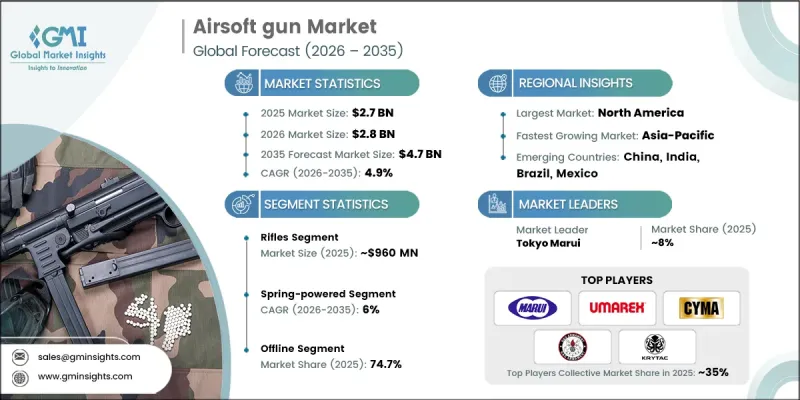
全球氣槍市場預計到 2025 年將價值 27 億美元,預計到 2035 年將達到 47 億美元,年複合成長率為 4.9%。
休閒射擊活動和戰術模擬體驗參與度的不斷提高,正推動著全球需求的穩定成長。隨著各機構擴大採用更安全、更經濟的替代方案來取代傳統槍械進行技能培訓,休閒應用也日益受到關注。氣槍產品旨在模擬真實槍械的操作和使用,同時使用非致命彈藥,使其適用於系統訓練和休閒娛樂。人們對身臨其境型、團隊協作活動和模擬環境的興趣日益濃厚,進一步推動了市場擴張。此外,體育和互動娛樂產業的蓬勃發展也增加了對具有不同運行機制的各類產品的需求。消費者尋求兼具逼真度、性能穩定和適應各種使用情境的設備,這進一步鞏固了市場的上升趨勢。
| 市場範圍 | |
|---|---|
| 開始年份 | 2025 |
| 預測期 | 2026-2035 |
| 初始市場規模 | 27億美元 |
| 預測金額 | 47億美元 |
| 複合年成長率 | 4.9% |
預計到2025年,步槍市場規模將達到9.6億美元,並在2035年之前以6%的複合年成長率成長。推動這一市場成長的主要因素是射程更遠、精度更高以及在遊戲和訓練環境中更強的適應性。步槍平台的設計旨在模仿戰術裝備,具有逼真的尺寸和功能特性。其持續的性能表現以及可自訂組件的特性,使其對廣大用戶群更具吸引力。
預計到2025年,彈簧式空調的市佔率將達到45%,並在2026年至2035年間以6%的複合年成長率成長。該類別之所以保持主導地位,是因為其設計簡單、經濟高效且維護需求極低。這些系統無需外部電源,性能可靠,因此非常適合新手用戶和日常使用環境。
美國氣槍市場預計到2025年將達到7.888億美元,並在2035年之前以5.8%的複合年成長率成長。市場成長的主要驅動力是蓬勃發展的休閒射擊文化、競技活動的日益普及以及模擬訓練的廣泛應用。此外,有組織的活動和體驗式娛樂形式的日益流行,以及對高性能裝備和客製化解決方案的需求,也進一步推動了市場需求。
目錄
第1章:調查方法和範圍
第2章執行摘要
第3章業界考察
- 生態系分析
- 供應商情況
- 利潤率
- 每個階段增加的價值
- 影響價值鏈的因素
- 影響產業的因素
- 促進因素
- 射擊運動作為休閒運動越來越受歡迎
- 擴大戰術性訓練和模擬項目
- 對逼真槍械模型的需求日益成長
- 產業潛在風險與挑戰
- 監管限制和安全問題
- 來自其他休閒活動的競爭
- 機會
- 拓展線上零售與電子商務平台
- 新興市場的擴張和年輕人的加入
- 促進因素
- 成長潛力分析
- 未來市場趨勢
- 科技與創新趨勢
- 當前技術趨勢
- 新興技術
- 價格分析(基於初步調查)
- 對過去價格趨勢的分析(基於初步研究)
- 根據業務類型分類的定價策略(高階/價值/成本加成)(基於初步調查)
- 監理情勢
- 標準和合規要求
- 區域法規結構
- 認證標準
- 波特五力分析
- PESTEL 分析
- 交易數據分析(基於初步調查)
- 進出口量和進出口額趨勢(基於初步調查)
- 主要貿易走廊及關稅影響(基於初步調查)
- HS編碼分類及貿易流量分析
- 人工智慧和生成式人工智慧對市場的影響
- 利用人工智慧改造現有經營模式
- 針對特定領域的生成式人工智慧應用案例和實施藍圖
- 風險、限制和監管考量
- 分銷基礎設施和通路滲透狀況(基於初步調查)
- 按地區與類型(現代貿易與傳統貿易)分類的通路滲透率(基於初步調查)
- 最後一公里基礎設施的不足和新分銷管道的變化(基於初步研究)
第4章 競爭情勢
- 介紹
- 企業市佔率分析
- 按地區
- 企業矩陣分析
- 主要市場公司的競爭分析
- 競爭定位矩陣
- 主要進展
- 併購
- 夥伴關係與合作
- 新產品發布
- 業務拓展計劃
第5章 市場估價與預測:依產品分類,2022-2035年
- 手槍
- 步槍
- 霰彈槍
- 前裝式
第6章 市場估計與預測:依機制分類,2022-2035年
- 彈簧型
- 電的
- 氣體類型
第7章 市場估計與預測:依價格區間分類,2022-2035年
- 價格低廉(100美元以下)
- 中價位(100-200美元)
- 高價位(超過300美元)
第8章 市場估算與預測:依通路分類,2022-2035年
- 線上
- 電子商務網站
- 企業網站
- 離線
- 大賣場/超級市場
- 百貨公司
- 其他
第9章 市場估計與預測:依地區分類,2022-2035年
- 北美洲
- 美國
- 加拿大
- 歐洲
- 德國
- 英國
- 法國
- 義大利
- 西班牙
- 亞太地區
- 中國
- 日本
- 印度
- 澳洲
- 韓國
- 拉丁美洲
- 巴西
- 墨西哥
- 阿根廷
- 中東和非洲
- 南非
- 沙烏地阿拉伯
- 阿拉伯聯合大公國
第10章:公司簡介
- Action Sport Games(ASG)
- ARES Airsoft
- Classic Army
- CYMA
- Echo 1 USA
- Elite Force
- G &G Armament
- ICS Airsoft
- JG Works(Jing Gong)
- King Arms
- Krytac
- KWA
- Lancer Tactical
- Tokyo Marui
- Umarex
- Vega Force Company(VFC)
The Global Airsoft Gun Market was valued at USD 2.7 billion in 2025 and is estimated to grow at a CAGR of 4.9% to reach USD 4.7 billion by 2035.
Rising participation in recreational shooting activities and tactical simulation experiences is driving steady demand worldwide. Training applications are also gaining traction, as organizations increasingly adopt safe and cost-efficient alternatives to traditional firearms for skill development. Airsoft products are designed to replicate the handling and operational feel of real weapons while using non-lethal projectiles, making them suitable for structured training and recreational use. Growing interest in immersive, team-based activities and simulation-based environments is further supporting market expansion. Additionally, the broader growth of sports and interactive entertainment industries is encouraging demand for varied product types with different operational mechanisms. Consumers are seeking equipment that delivers realism, performance consistency, and adaptability across different use cases, reinforcing the market's upward trajectory.
| Market Scope | |
|---|---|
| Start Year | 2025 |
| Forecast Year | 2026-2035 |
| Start Value | $2.7 Billion |
| Forecast Value | $4.7 Billion |
| CAGR | 4.9% |
The rifles segment generated USD 960 million in 2025 and is expected to grow at a CAGR of 6% through 2035. This segment leads the market due to its extended range, improved accuracy, and adaptability across gameplay and training environments. Rifle platforms are designed to mirror tactical equipment, offering realistic dimensions and functional features. Their ability to support sustained performance and accommodate customizable components enhances their appeal across user groups.
The spring-powered segment held a 45% share in 2025 and is projected to grow at a CAGR of 6% from 2026 to 2035. This category remains dominant due to its simple design, cost efficiency, and minimal maintenance needs. These systems operate without external power sources, providing reliable performance and making them suitable for entry-level users and consistent usage environments.
United States Airsoft Gun Market reached USD 788.8 million in 2025 and is expected to grow at a CAGR of 5.8% through 2035. Market growth is supported by a strong recreational shooting culture, expanding participation in competitive activities, and increasing adoption of simulation-based training. Demand is further reinforced by the need for performance-oriented equipment and customizable solutions, along with the growing popularity of organized events and experiential entertainment formats.
Key companies operating in the Global Airsoft Gun Market include Tokyo Marui, Umarex, G & G Armament, Krytac, Classic Army, ICS Airsoft, ARES Airsoft, CYMA, King Arms, Vega Force Company (VFC), Lancer Tactical, Echo 1 USA, Elite Force, Action Sport Games (ASG), and JG Works (Jing Gong). Companies in the airsoft gun market are strengthening their position by focusing on product innovation, including improved realism, enhanced durability, and advanced performance features. They are expanding product portfolios with customizable platforms and modular accessories to meet diverse user needs. Strategic partnerships with distributors and event organizers help increase brand visibility and market reach. Firms are also investing in manufacturing efficiency and quality control to maintain competitive pricing. Marketing initiatives, including digital campaigns and community engagement, play a key role in attracting enthusiasts. Additionally, companies are targeting emerging markets and enhancing after-sales support to build long-term customer loyalty and strengthen their global footprint.
Table of Contents
Chapter 1 Methodology and Scope
- 1.1 Market scope and definition
- 1.2 Research design
- 1.2.1 Research approach
- 1.2.2 Data collection methods
- 1.3 Data mining sources
- 1.3.1 Global
- 1.3.2 Regional/Country
- 1.4 Base estimates and calculations
- 1.4.1 Base year calculation
- 1.4.2 Key trends for market estimation
- 1.5 Primary research and validation
- 1.5.1 Primary sources
- 1.6 Forecast model
- 1.7 Research assumptions and limitations
Chapter 2 Executive Summary
- 2.1 Industry 360° synopsis
- 2.2 Key market trends
- 2.2.1 Regional
- 2.2.2 Product
- 2.2.3 Mechanism
- 2.2.4 Price Range
- 2.2.5 Distribution Channel
- 2.3 CXO perspectives: Strategic imperatives
- 2.3.1 Key decision points for industry executives
- 2.3.2 Critical success factors for market players
- 2.4 Future outlook and strategic recommendations
Chapter 3 Industry Insights
- 3.1 Industry ecosystem analysis
- 3.1.1 Supplier landscape
- 3.1.2 Profit margin
- 3.1.3 Value addition at each stage
- 3.1.4 Factor affecting the value chain
- 3.2 Industry impact forces
- 3.2.1 Growth drivers
- 3.2.1.1 Growing popularity of recreational shooting sports
- 3.2.1.2 Expansion of tactical training and simulation programs
- 3.2.1.3 Rising demand for realistic firearm replicas
- 3.2.2 Industry pitfalls & challenges
- 3.2.2.1 Regulatory restrictions and safety concerns
- 3.2.2.2 Competition from alternative recreational activities
- 3.2.3 Opportunities
- 3.2.3.1 Growing online retail and e-commerce platforms
- 3.2.3.2 Expansion in emerging markets and youth participation
- 3.2.1 Growth drivers
- 3.3 Growth potential analysis
- 3.4 Future market trends
- 3.5 Technology and innovation landscape
- 3.5.1 Current technological trends
- 3.5.2 Emerging technologies
- 3.6 Pricing Analysis (Driven by Primary Research)
- 3.6.1 Historical Price Trend Analysis (Driven by Primary Research)
- 3.6.2 Pricing Strategy by Player Type (Premium/Value/Cost-plus) (Driven by Primary Research)
- 3.7 Regulatory landscape
- 3.7.1 Standards and compliance requirements
- 3.7.2 Regional regulatory frameworks
- 3.7.3 Certification standards
- 3.8 Porter's analysis
- 3.9 PESTEL analysis
- 3.10 Trade Data Analysis (Driven by Primary Research)
- 3.10.1 Import/Export Volume & Value Trends (Driven by Primary Research)
- 3.10.2 Key Trade Corridors & Tariff Impact (Driven by Primary Research)
- 3.10.3 HS Code Classification & Trade Flow Analysis
- 3.11 Impact of AI & Generative AI on the Market
- 3.11.1 AI-Driven Disruption of Existing Business Models
- 3.11.2 GenAI Use Cases & Adoption Roadmap by Segment
- 3.11.3 Risks, Limitations & Regulatory Considerations
- 3.12 Distribution Infrastructure & Channel Penetration Landscape (Driven by Primary Research)
- 3.12.1 Channel Coverage by Region & Format (Modern vs. Traditional Trade) (Driven by Primary Research)
- 3.12.2 Last-Mile Infrastructure Gaps & Emerging Channel Shifts (Driven by Primary Research)
Chapter 4 Competitive Landscape, 2025
- 4.1 Introduction
- 4.2 Company market share analysis
- 4.2.1 By region
- 4.2.1.1 North America
- 4.2.1.2 Europe
- 4.2.1.3 Asia Pacific
- 4.2.1.4 Latin America
- 4.2.1.5 Middle East and Africa
- 4.2.1 By region
- 4.3 Company matrix analysis
- 4.4 Competitive analysis of major market players
- 4.5 Competitive positioning matrix
- 4.6 Key developments
- 4.6.1 Mergers & acquisitions
- 4.6.2 Partnerships & collaborations
- 4.6.3 New product launches
- 4.6.4 Expansion plans
Chapter 5 Market Estimates & Forecast, By Product, 2022 - 2035 (USD Billion) (Thousand Units)
- 5.1 Key trends
- 5.2 Hand guns
- 5.3 Rifles
- 5.4 Shotgun
- 5.5 Muzzle loading
Chapter 6 Market Estimates & Forecast, By Mechanism, 2022 - 2035 (USD Billion) (Thousand Units)
- 6.1 Key trends
- 6.2 Spring powered
- 6.3 Electric powered
- 6.4 Gas powered
Chapter 7 Market Estimates & Forecast, By Price Range, 2022 - 2035 (USD Billion) (Thousand Units)
- 7.1 Key trends
- 7.2 Low(utpo 100$)
- 7.3 Mid (100$-200$)
- 7.4 High (above 300$)
Chapter 8 Market Estimates & Forecast, By Distribution Channel Type, 2022 - 2035 (USD Billion) (Thousand Units)
- 8.1 Key trends
- 8.2 Online
- 8.2.1 E-commerce websites
- 8.2.2 Company websites
- 8.3 Offline
- 8.3.1 Hypermarket/supermarket
- 8.3.2 Departmental stores
- 8.3.3 Others
Chapter 9 Market Estimates and Forecast, By Region, 2022 - 2035 (USD Billion) (Thousand Units)
- 9.1 Key trends
- 9.2 North America
- 9.2.1 U.S.
- 9.2.2 Canada
- 9.3 Europe
- 9.3.1 Germany
- 9.3.2 UK
- 9.3.3 France
- 9.3.4 Italy
- 9.3.5 Spain
- 9.4 Asia Pacific
- 9.4.1 China
- 9.4.2 Japan
- 9.4.3 India
- 9.4.4 Australia
- 9.4.5 South Korea
- 9.5 Latin America
- 9.5.1 Brazil
- 9.5.2 Mexico
- 9.5.3 Argentina
- 9.6 Middle East and Africa
- 9.6.1 South Africa
- 9.6.2 Saudi Arabia
- 9.6.3 UAE
Chapter 10 Company Profiles
- 10.1 Action Sport Games (ASG)
- 10.2 ARES Airsoft
- 10.3 Classic Army
- 10.4 CYMA
- 10.5 Echo 1 USA
- 10.6 Elite Force
- 10.7 G & G Armament
- 10.8 ICS Airsoft
- 10.9 JG Works (Jing Gong)
- 10.10 King Arms
- 10.11 Krytac
- 10.12 KWA
- 10.13 Lancer Tactical
- 10.14 Tokyo Marui
- 10.15 Umarex
- 10.16 Vega Force Company (VFC)

 運動槍械市場:依產品類型、操作機制、應用及通路分類-2026-2032年全球市場預測氣槍市場:2026-2032年全球市場預測(依推進系統、槍型、射擊模式、價格範圍、應用和分銷管道分類)
 運動槍械市場分析及預測(至2035年):依類型、產品類型、技術、應用、最終用戶、材質、組件、部署類型及設備分類
 2026-2034年全球氣槍市場規模、佔有率、趨勢和成長分析報告
 氣槍市場 - 全球產業規模、佔有率、趨勢、機會及預測(按產品類型、銷售管道、地區及競爭格局分類,2021-2031年)運動槍械市場-全球產業規模、佔有率、趨勢、機會和預測:按產品類型、應用、分銷管道、地區和競爭格局分類,2021-2031年槍械清潔產品市場按產品類型、包裝形式、分銷管道和最終用戶分類 - 全球預測 2026-2032
 氣槍市場規模、佔有率和成長分析(按產品類型、機制、價格分佈、分銷管道和地區)- 2025-2032 年行業預測
 安全氣槍和空氣噴嘴的全球市場全球氣槍市場