


 |
市場調查報告書
商品編碼
2019185
生物模擬市場機會、成長要素、產業趨勢分析及2026-2035年預測Biosimulation Market Opportunity, Growth Drivers, Industry Trend Analysis, and Forecast 2026 - 2035 |
||||||

2025年全球生物模擬市場價值49億美元,預計2035年將以17.9%的複合年成長率成長至251億美元。
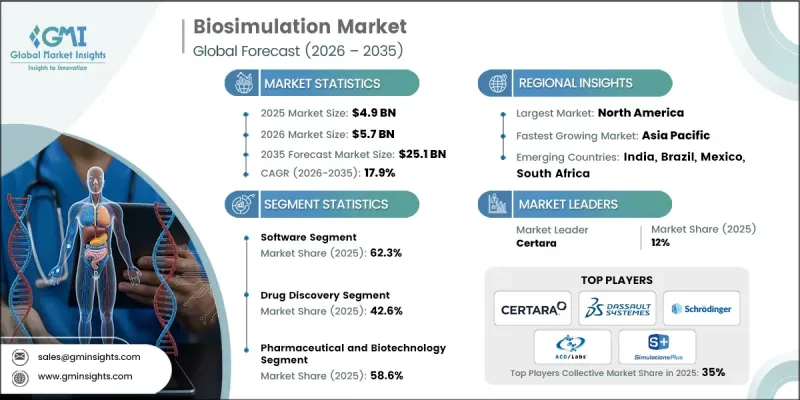
由於慢性疾病負擔日益加重、計算建模技術不斷進步以及人工智慧 (AI) 和機器學習的日益融合,生物模擬行業正經歷強勁的發展勢頭。此外,精準醫療的興起也加速了生物模擬技術的應用,因為它能夠開發更具針對性和高效性的治療方法。個人化醫療的需求,尤其是依賴先進的數位建模來預測患者個別化治療結果並最佳化治療策略的需求,是推動市場擴張的主要動力。這些解決方案支援對藥物動力學、動態和疾病進展進行精細模擬,並可根據個體生物學特徵進行客製化。因此,生物模擬工具在製藥、生技以及研發領域正變得不可或缺。它們能夠提高臨床成功率、最佳化給藥方案並縮短研發週期,從而顯著降低成本並提高監管效率。因此,生物模擬市場正在發展成為現代藥物研發的關鍵要素,加速創新並改善患者療效。
| 市場範圍 | |
|---|---|
| 開始年份 | 2025 |
| 預測期 | 2026-2035 |
| 上市時的市場規模 | 49億美元 |
| 預測金額 | 251億美元 |
| 複合年成長率 | 17.9% |
生物模擬是指利用計算技術對生物系統、過程和交互作用進行建模,並評估其在各種條件下的行為。它結合數學框架、數據驅動演算法和實驗數據,重現生理、生化和分子層面的功能,從而支持藥物發現、臨床試驗設計以及個人化治療方法的發展。
預計到2025年,軟體產業規模將達到30億美元,佔62.3%的市場。先進的模擬軟體利用複雜的演算法和機器學習技術,能夠精確地模擬複雜的生物過程。這項技術使研究人員能夠在藥物研發的早期階段評估其安全性和有效性,從而改善決策並提高整體效率。透過最大限度地減少對傳統實驗室測試的依賴,這些工具有助於加快研發週期並提高資源利用效率。
預計到2025年,訂閱模式將佔55.3%的市場。這種模式降低了初始投資負擔,使包括小規模機構和研究機構在內的更多用戶能夠使用先進的生物模擬平台。靈活的定價模式讓使用者可以根據專案需求調整使用量,而培訓和技術支援等配套服務則進一步提升了便利性。由於機構無需內部專業知識即可最大限度地利用平台價值,因此該模式更易於被廣泛採用。
預計到2025年,美國生物模擬市場規模將達到18億美元。慢性病發病率的上升和對先進醫療解決方案需求的成長是推動市場擴張的主要因素。此外,對創新研究工具和連續監測技術的需求不斷成長,也進一步促進了市場發展。美國擁有完善的醫療基礎設施、強大的研發投入以及良好的法規環境,這些優勢共同鞏固了其在全球生物模擬市場的主導地位。
目錄
第1章:調查方法和範圍
第2章執行摘要
第3章業界考察
- 生態系分析
- 影響產業的因素
- 促進因素
- 慢性病盛行率增加
- 計算建模的技術進步
- 對個人化醫療的需求日益成長
- 人工智慧和機器學習的日益普及
- 產業潛在風險與挑戰
- 產品高成本
- 熟練專業人員短缺
- 市場機遇
- 新興市場醫療基礎設施的擴張
- 促進因素
- 成長潛力分析
- 監理情勢
- 北美洲
- 歐洲
- 亞太地區
- 技術進步(基於初步調查)
- 當前技術趨勢
- In Silico模擬和模型主導藥物發現(MIDD)的迅速普及
- 人工智慧與機器學習的融合
- 雲端運算高效能運算(HPC)的擴展
- 新興技術
- 先進的多尺度定量系統藥理學(QSP)平台
- 雲端運算、人工智慧和進階分析平台等技術的融合。
- 當前技術趨勢
- 未來市場趨勢(基於初步研究)
- 價格分析
- 波特五力分析
- PESTEL 分析
第4章 競爭情勢
- 介紹
- 企業市佔率分析
- 北美洲
- 歐洲
- 亞太地區
- 企業矩陣分析
- 主要市場公司的競爭分析
- 競爭定位矩陣
- 主要進展
- 併購
- 合作夥伴關係和合資企業
- 新產品發布
- 業務拓展計劃
第5章 市場估算與預測:依產品類型分類,2022-2035年
- 軟體
- 整合軟體套件/平台
- 分子建模和模擬軟體
- 臨床試驗設計軟體
- PK/PD建模與模擬軟體
- PBPK建模與模擬軟體
- 毒性預測軟體
- 其他整合軟體套件/平台
- 獨立模組
- 整合軟體套件/平台
- 服務
第6章 市場估計與預測:依應用領域分類,2022-2035年
- 藥物發現
- 藥物研發
- 疾病建模
- 其他用途
第7章 市場估計與預測:依治療領域分類,2022-2035年
- 腫瘤學
- 心血管疾病
- 神經系統疾病
- 感染疾病
- 其他治療領域
第8章 市場估算與預測:以交付方式分類,2022-2035年
- 訂閱模式
- 自有車型
- 基於許可的模式
- 計量收費模式
- 基於服務的模式
第9章 市場估算與預測:依部署模式分類,2022-2035年
- 本地部署
- 基於雲端的模型
第10章 市場估價與預測:依最終用途分類,2022-2035年
- 製藥和生物技術公司
- 合約研究組織(CRO)
- 學術研究機構
第11章 市場估價與預測:按地區分類,2022-2035年
- 北美洲
- 美國
- 加拿大
- 歐洲
- 德國
- 英國
- 法國
- 西班牙
- 義大利
- 荷蘭
- 亞太地區
- 中國
- 印度
- 日本
- 澳洲
- 韓國
- 拉丁美洲
- 巴西
- 墨西哥
- 阿根廷
- 中東和非洲
- 沙烏地阿拉伯
- 南非
- 阿拉伯聯合大公國
第12章:公司簡介
- Allucent
- Advanced Chemistry Development(ACD/Labs)
- Certara
- Cellworks
- Chemical Computing Group
- Dassault Systemes
- Genedata
- In Silico Biosciences
- Immunetrics
- OpenEye
- Physiomics
- Simulations Plus
- Schrodinger
- Thermo Fisher Scientific
- VeriSIM Life
The Global Biosimulation Market was valued at USD 4.9 billion in 2025 and is estimated to grow at a CAGR of 17.9% to reach USD 25.1 billion by 2035.
The biosimulation industry is witnessing strong momentum due to the rising burden of chronic diseases, continuous advancements in computational modeling technologies, and the increasing integration of artificial intelligence and machine learning. Growing interest in precision-driven healthcare is also accelerating adoption, as biosimulation enables more targeted and efficient therapeutic development. The demand for personalized medicine is a major contributor to market expansion, as it relies heavily on advanced digital modeling to predict patient-specific outcomes and refine treatment strategies. These solutions support detailed simulation of pharmacokinetics, pharmacodynamics, and disease progression tailored to individual biological profiles. As a result, biosimulation tools are becoming essential across pharmaceutical, biotechnology, and research environments. Their ability to improve clinical success rates, optimize dosing approaches, and reduce development timelines is significantly lowering costs while enhancing regulatory efficiency. The biosimulation market is therefore evolving into a critical component of modern drug development, enabling faster innovation and improved patient outcomes.
| Market Scope | |
|---|---|
| Start Year | 2025 |
| Forecast Year | 2026-2035 |
| Start Value | $4.9 Billion |
| Forecast Value | $25.1 Billion |
| CAGR | 17.9% |
Biosimulation refers to the use of computational techniques to model biological systems, processes, and interactions to evaluate their behavior under different conditions. It combines mathematical frameworks, data-driven algorithms, and experimental inputs to replicate physiological, biochemical, and molecular functions, supporting drug discovery, clinical trial design, and the advancement of personalized treatment approaches.
The software segment reached USD 3 billion in 2025, representing 62.3% share. Advanced biosimulation software leverages sophisticated algorithms and machine learning to replicate complex biological processes with high precision. This capability enables researchers to assess drug safety and effectiveness earlier in development, improving decision-making and overall productivity. By minimizing dependence on traditional laboratory testing, these tools help accelerate development cycles and improve resource efficiency.
The subscription-based model segment held a 55.3% share in 2025. This approach lowers initial investment requirements, making advanced biosimulation platforms more accessible to a wider range of users, including smaller organizations and research institutions. Flexible pricing structures allow users to adjust their usage based on project needs, while bundled services such as training and technical support enhance usability. This model enables organizations to maximize value without requiring extensive in-house expertise, thereby supporting broader adoption.
U.S. Biosimulation Market captured USD 1.8 billion in 2025. Market expansion is driven by the growing prevalence of chronic health conditions and the increasing need for advanced healthcare solutions. Rising demand for innovative research tools and continuous monitoring technologies is further supporting adoption. The country benefits from a well-established healthcare infrastructure, strong investment in research and development, and a supportive regulatory environment, which collectively reinforce its leading position in the global biosimulation market.
Key companies operating in the Global Biosimulation Market include Certara, Dassault Systemes, Thermo Fisher Scientific, Schrodinger, Simulations Plus, Genedata, Advanced Chemistry Development (ACD/Labs), Chemical Computing Group, OpenEye, Allucent, Physiomics, Cellworks, Immunetrics, VeriSIM Life, and In Silico Biosciences. Companies in the biosimulation market are strengthening their competitive position through continuous innovation and strategic expansion. They are investing in advanced computational technologies, including AI-driven modeling and machine learning integration, to enhance simulation accuracy and efficiency. Strategic partnerships with pharmaceutical and biotechnology firms are enabling broader application of biosimulation tools in drug development. Firms are also focusing on expanding cloud-based platforms and subscription models to improve accessibility and scalability. Additionally, companies are enhancing user experience through training, support services, and integrated solutions.
Table of Contents
Chapter 1 Methodology and Scope
- 1.1 Research approach
- 1.2 Quality commitments
- 1.2.1 GMI AI policy & data integrity commitment
- 1.2.1.1 Source consistency protocol
- 1.2.1 GMI AI policy & data integrity commitment
- 1.3 Research trail & confidence scoring
- 1.3.1 Research trail components
- 1.3.2 Scoring components
- 1.4 Data collection
- 1.4.1 Partial list of primary sources
- 1.5 Data mining sources
- 1.5.1 Paid sources
- 1.5.1.1 Sources, by region
- 1.5.1 Paid sources
- 1.6 Base estimates and calculations
- 1.6.1 Base year calculation for any one approach
- 1.7 Forecast model
- 1.7.1 Quantified market impact analysis
- 1.7.1.1 Mathematical impact of growth parameters on forecast
- 1.7.1 Quantified market impact analysis
- 1.8 Research transparency addendum
- 1.8.1 Source attribution framework
- 1.8.2 Quality assurance metrics
- 1.8.3 Our commitment to trust
Chapter 2 Executive Summary
- 2.1 Industry 360° synopsis
- 2.2 Key market trends
- 2.2.1 Regional trends
- 2.2.2 Offering trends
- 2.2.3 Application trends
- 2.2.4 Therapeutic area trends
- 2.2.5 Delivery model trends
- 2.2.6 Deployment model trends
- 2.2.7 End use trends
- 2.3 CXO perspectives: Strategic imperatives
Chapter 3 Industry Insights
- 3.1 Industry ecosystem analysis
- 3.2 Industry impact forces
- 3.2.1 Growth drivers
- 3.2.1.1 Rising prevalence of chronic diseases
- 3.2.1.2 Technological advancements in computational modeling
- 3.2.1.3 Rising demand for personalized medicine
- 3.2.1.4 Increasing use of AI and machine Learning
- 3.2.2 Industry pitfalls and challenges
- 3.2.2.1 High costs of products
- 3.2.2.2 Lack of skilled professionals
- 3.2.3 Market opportunities
- 3.2.3.1 Rising healthcare infrastructure in emerging markets
- 3.2.1 Growth drivers
- 3.3 Growth potential analysis
- 3.4 Regulatory landscape
- 3.4.1 North America
- 3.4.2 Europe
- 3.4.3 Asia Pacific
- 3.5 Technological advancements (Driven by primary research)
- 3.5.1 Current technological trends
- 3.5.1.1 Rapid adoption of in silico modeling and model-informed drug development (MIDD)
- 3.5.1.2 Integration of artificial intelligence and machine learning
- 3.5.1.3 Expansion of cloud-based high-performance computing (HPC)
- 3.5.2 Emerging technologies
- 3.5.2.1 Advanced multi-scale quantitative systems pharmacology (QSP) platforms
- 3.5.2.2 Technological convergence in cloud, AI, and advanced analytics platforms
- 3.5.1 Current technological trends
- 3.6 Future market trends (Driven by primary research)
- 3.7 Pricing analysis
- 3.8 Porter's analysis
- 3.9 PESTEL analysis
Chapter 4 Competitive Landscape, 2025
- 4.1 Introduction
- 4.2 Company market share analysis
- 4.2.1 North America
- 4.2.2 Europe
- 4.2.3 Asia Pacific
- 4.3 Company matrix analysis
- 4.4 Competitive analysis of major market players
- 4.5 Competitive positioning matrix
- 4.6 Key developments
- 4.6.1 Mergers and acquisitions
- 4.6.2 Partnerships and collaborations
- 4.6.3 New product launches
- 4.6.4 Expansion plans
Chapter 5 Market Estimates and Forecast, By Offering, 2022 - 2035 ($ Mn)
- 5.1 Key trends
- 5.2 Software
- 5.2.1 Integrated software suites/platform
- 5.2.1.1 Molecular modeling and simulation software
- 5.2.1.2 Clinical trial design software
- 5.2.1.3 PK/PD modeling and simulation software
- 5.2.1.4 Pbpk modeling and simulation software
- 5.2.1.5 Toxicity prediction software
- 5.2.1.6 Other integrated software suites/platforms
- 5.2.2 Standalone modules
- 5.2.1 Integrated software suites/platform
- 5.3 Service
Chapter 6 Market Estimates and Forecast, By Application, 2022 - 2035 ($ Mn)
- 6.1 Key trends
- 6.2 Drug discovery
- 6.3 Drug development
- 6.4 Disease modeling
- 6.5 Other applications
Chapter 7 Market Estimates and Forecast, By Therapeutic Area, 2022 - 2035 ($ Mn)
- 7.1 Key trends
- 7.2 Oncology
- 7.3 Cardiovascular disease
- 7.4 Neurological disorder
- 7.5 Infectious diseases
- 7.6 Other therapeutic areas
Chapter 8 Market Estimates and Forecast, By Delivery Mode, 2022 - 2035 ($ Mn)
- 8.1 Key trends
- 8.2 Subscription models
- 8.3 Ownership models
- 8.3.1 License-based model
- 8.3.2 Pay-per-use model
- 8.4 Service-based models
Chapter 9 Market Estimates and Forecast, By Deployment Model, 2022 - 2035 ($ Mn)
- 9.1 Key trends
- 9.2 On-premises model
- 9.3 Cloud-based model
Chapter 10 Market Estimates and Forecast, By End Use, 2022 - 2035 ($ Mn)
- 10.1 Key trends
- 10.2 Pharmaceutical and biotechnology companies
- 10.3 Contract research organizations (CROs)
- 10.4 Academic research institutions
Chapter 11 Market Estimates and Forecast, By Region, 2022 - 2035 ($ Mn)
- 11.1 Key trends
- 11.2 North America
- 11.2.1 U.S.
- 11.2.2 Canada
- 11.3 Europe
- 11.3.1 Germany
- 11.3.2 UK
- 11.3.3 France
- 11.3.4 Spain
- 11.3.5 Italy
- 11.3.6 Netherlands
- 11.4 Asia Pacific
- 11.4.1 China
- 11.4.2 India
- 11.4.3 Japan
- 11.4.4 Australia
- 11.4.5 South Korea
- 11.5 Latin America
- 11.5.1 Brazil
- 11.5.2 Mexico
- 11.5.3 Argentina
- 11.6 Middle East and Africa
- 11.6.1 Saudi Arabia
- 11.6.2 South Africa
- 11.6.3 UAE
Chapter 12 Company Profiles
- 12.1 Allucent
- 12.2 Advanced Chemistry Development (ACD/Labs)
- 12.3 Certara
- 12.4 Cellworks
- 12.5 Chemical Computing Group
- 12.6 Dassault Systemes
- 12.7 Genedata
- 12.8 In Silico Biosciences
- 12.9 Immunetrics
- 12.10 OpenEye
- 12.11 Physiomics
- 12.12 Simulations Plus
- 12.13 Schrodinger
- 12.14 Thermo Fisher Scientific
- 12.15 VeriSIM Life


