


 |
市場調查報告書
商品編碼
2019178
工業排放氣體控制系統市場:市場機會、成長要素、產業趨勢分析及2026-2035年預測Industrial Emission Control System Market Opportunity, Growth Drivers, Industry Trend Analysis, and Forecast 2026 - 2035 |
||||||

全球工業排放氣體控制系統市場預計到 2025 年將價值 448 億美元,預計到 2035 年將以 5.5% 的複合年成長率成長至 772 億美元。
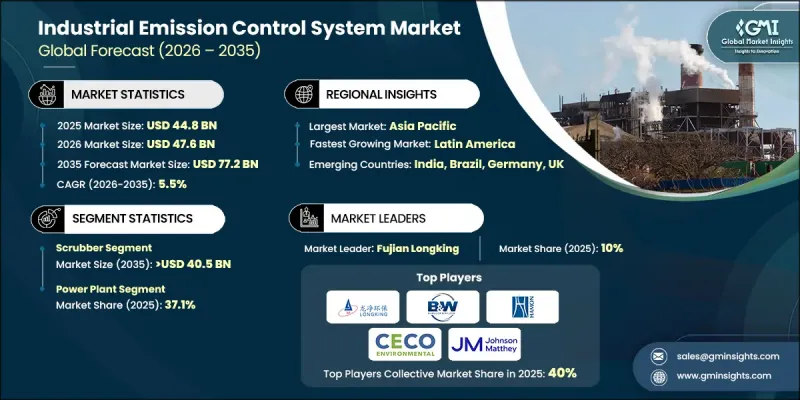
市場成長主要受能源密集產業(例如發電、製造和化學)日益嚴格的環境法規和排放限制的推動。世界各國政府和環保機構正在實施嚴格的標準,以減少硫氧化物、氮氧化物、粒狀物、揮發性有機化合物和碳排放等污染物。隨著環保意識的增強,企業擴大採用先進的排放氣體控制解決方案,包括選擇性催化還原 (SCR) 系統、靜電除塵設備(ESP) 和碳捕獲技術。清潔能源生產的努力以及對永續基礎設施的大量投資,進一步加速了市場需求。各產業將排放氣體控制系統整合到營運中,不僅是為了遵守法規,也是為了提高營運效率、減少環境影響並實現企業永續性目標。在企業平衡經濟和環境優先事項的過程中,對可靠、高效能排放氣體控制解決方案的需求比以往任何時候都更加迫切。
| 市場範圍 | |
|---|---|
| 開始年份 | 2025 |
| 預測期 | 2026-2035 |
| 初始市場規模 | 448億美元 |
| 預測金額 | 772億美元 |
| 複合年成長率 | 5.5% |
預計到2035年,洗滌器市場規模將達到405億美元,這主要得益於除塵系統的進步和油霧控制技術的日益普及。這些系統對於減少工業應用中的粒狀物排放和提高運作安全性至關重要。
預計到2025年,發電業將佔37.1%的市場佔有率,到2035年將以5.4%的複合年成長率成長。這一成長得益於全球能源基礎設施的擴張和排放法規執行的加強。透過將對清潔技術的投資與現有設施的維修相結合,電廠在確保合規性的同時,最佳化了營運效率。隨著該行業採用最先進的排放氣體控制設備,它也受益於環境處罰的減少、能源效率的提高和職場安全性的增強,從而進一步加速了市場接受度。
預計到2025年,美國工業排放氣體控制系統市場將佔據67%的市場佔有率,市場規模將達到48億美元。這一強勁的市場地位得益於快速的工業成長、日益嚴格的環境法規以及人們對空氣品質日益成長的關注。美國各產業正積極採用排放氣體控制解決方案,以符合聯邦和州級環境法規的要求。技術創新進一步推動了市場發展,企業紛紛投資於整合監測、預測性維護和即時排放報告功能的智慧系統。在美國和加拿大,隨著清潔生產和永續能源實踐的重要性日益凸顯,行業相關人員持續將合規性、效率和環境管理置於業務運營的優先位置,從而為市場擴張創造了更多機會。
目錄
第1章:調查方法和範圍
第2章執行摘要
第3章業界考察
- 生態系分析
- 監理情勢
- 影響產業的因素
- 促進因素
- 政府制定了嚴格的框架和行業標準,以排放法規。
- 政府加強監管,以減少碳足跡
- 產業潛在風險與挑戰
- 高昂的實施和維修成本以及性能挑戰
- 促進因素
- 成長潛力分析
- 波特五力分析
- PESTEL 分析
- 新機會和趨勢
- 數位化和物聯網整合
- 進入新興市場
第4章 競爭情勢
- 介紹
- 企業市佔率分析
- 北美洲
- 歐洲
- 亞太地區
- 中東和非洲
- 拉丁美洲
- 策略舉措
- 競爭性標竿分析
- 戰略儀錶板
- 創新與科技趨勢
第5章 市場規模及預測:依系統分類,2022-2035年
- 靜電集塵器
- 催化轉換器系統
- 吸收裝置
- 洗滌器
- 其他
第6章 市場規模及預測:依產業分類,2022-2035年
- 發電廠
- 化工/石油化工
- 水泥
- 金屬
- 製造業
- 其他
第7章 市場規模及預測:依地區分類,2022-2035年
- 北美洲
- 美國
- 加拿大
- 墨西哥
- 歐洲
- 德國
- 法國
- 西班牙
- 英國
- 義大利
- 荷蘭
- 亞太地區
- 中國
- 印度
- 日本
- 印尼
- 澳洲
- 韓國
- 中東和非洲
- 沙烏地阿拉伯
- 阿拉伯聯合大公國
- 南非
- 拉丁美洲
- 巴西
- 阿根廷
- 智利
第8章:公司簡介
- ACS Industries
- ACT Dust Collectors
- Air Quality Engineering
- Anguil Environmental Systems
- APC Technologies
- Airnord
- Aquest Corporation
- Babcock & Wilcox
- CECO Environmental
- Ducon Technologies
- Durr Group
- Fuel Tech
- Fujian Longking
- KC Cottrell
- General Electric
- Hamon
- Honeywell International
- Johnson Matthey
- Mitsubishi Heavy Industries
- Thermax
The Global Industrial Emission Control System Market was valued at USD 44.8 billion in 2025 and is estimated to grow at a CAGR of 5.5% to reach USD 77.2 billion by 2035.
The market growth is driven by stricter environmental regulations and emission limits across energy-intensive industries, including power generation, manufacturing, and chemical processing. Governments and environmental agencies worldwide are implementing rigorous standards to reduce pollutants such as sulfur oxides, nitrogen oxides, particulate matter, volatile organic compounds, and carbon emissions. As environmental awareness rises, companies are increasingly adopting advanced emission control solutions, including selective catalytic reduction (SCR) systems, electrostatic precipitators (ESPs), and carbon capture technologies. The push toward cleaner energy production, coupled with substantial investments in sustainable infrastructure, is further accelerating demand. Industries are integrating emission control systems into their operations not only to comply with regulations but also to achieve operational efficiency, reduce environmental impact, and align with corporate sustainability goals. The need for reliable, high-performance emission control solutions is more critical than ever as companies balance economic and ecological priorities.
| Market Scope | |
|---|---|
| Start Year | 2025 |
| Forecast Year | 2026-2035 |
| Start Value | $44.8 Billion |
| Forecast Value | $77.2 Billion |
| CAGR | 5.5% |
The scrubber segment is projected to reach USD 40.5 billion by 2035, with growth fueled by advancements in dust collection systems and increasing adoption of oil mist control technologies. These systems are essential for mitigating particulate emissions and improving operational safety in industrial applications.
The power generation sector captured 37.1% share in 2025 and is anticipated to grow at a CAGR of 5.4% by 2035. The growth is supported by expanding energy infrastructure worldwide and stricter enforcement of emission control standards. Investments in cleaner technologies, coupled with retrofitting existing facilities, are enabling plants to maintain regulatory compliance while optimizing operational efficiency. As industries adopt modern emission control equipment, they also benefit from reduced environmental penalties, enhanced energy efficiency, improved workplace safety, and further drive market adoption.
U.S. Industrial Emission Control System Market held a 67% share in 2025, generating USD 4.8 billion. The strong market position is supported by rapid industrial growth, stringent environmental legislation, and increasing focus on air quality. U.S. industries are actively deploying emission control solutions to comply with federal and state-level environmental mandates. The market is further bolstered by technological innovation, with companies investing in intelligent systems that integrate monitoring, predictive maintenance, and real-time emission reporting. The emphasis on cleaner production and sustainable energy practices in both the U.S. and Canada continues to create opportunities for market expansion, as industrial players prioritize compliance, efficiency, and environmental stewardship in their operations.
Key players in the Global Industrial Emission Control System Market include ACS Industries, A.C.T. Dust Collectors, Air Quality Engineering, Anguil Environmental Systems, APC Technologies, Airnord, Aquest Corporation, Babcock & Wilcox, CECO Environmental, Ducon Technologies, Durr Group, Fuel Tech, Fujian Longking, KC Cottrell, General Electric, Hamon, Honeywell International, Johnson Matthey, Mitsubishi Heavy Industries, Thermax. Companies operating in the Global Industrial Emission Control System Market employ several strategies to strengthen their market presence and competitive edge. Key approaches include heavy investment in research and development to advance emission reduction technologies, enhancing product efficiency, and ensuring compliance with evolving environmental standards. Strategic partnerships and collaborations with energy, manufacturing, and industrial firms allow companies to expand their installation networks and project portfolios. Firms are also focusing on geographic expansion into emerging markets with growing industrial bases and stricter environmental regulations. Mergers and acquisitions help consolidate capabilities, while sustainability-driven product innovation supports long-term growth. Providing digital monitoring solutions, predictive maintenance services, and integrated emission management platforms increases customer retention and accelerates adoption across sectors.
Table of Contents
Chapter 1 Methodology & Scope
- 1.1 Research approach
- 1.2 Quality commitment
- 1.2.1 GMI AI policy & data integrity commitment
- 1.2.1.1 Source consistency protocol
- 1.2.1 GMI AI policy & data integrity commitment
- 1.3 Research Trail & Confidence Scoring
- 1.3.1 Research Trail Components
- 1.3.2 Scoring Components
- 1.4 Data Collection
- 1.4.1 Partial list of primary sources
- 1.5 Data mining sources
- 1.5.1 Paid sources
- 1.5.1.1 Sources, by region
- 1.5.1 Paid sources
- 1.6 Base estimates and calculations
- 1.6.1 Base year calculation for any one approach
- 1.7 Forecast model
- 1.8 Research transparency addendum
- 1.8.1 Source attribution framework
- 1.8.2 Quality assurance metrics
- 1.8.3 Our commitment to trust
- 1.9 Market definitions
Chapter 2 Executive Summary
- 2.1 Industry synopsis, 2022 - 2035
- 2.1.1 Business trends
- 2.1.2 System trends
- 2.1.3 Industry trends
- 2.1.4 Regional trends
Chapter 3 Industry Insights
- 3.1 Industry ecosystem analysis
- 3.2 Regulatory landscape
- 3.3 Industry impact forces
- 3.3.1 Growth drivers
- 3.3.1.1 Stringent government framework and industry standards for emission control
- 3.3.1.2 Stricter government mandates toward reducing carbon footprint
- 3.3.2 Industry pitfalls & challenges
- 3.3.2.1 High installation & retrofitting cost and performance issues
- 3.3.1 Growth drivers
- 3.4 Growth potential analysis
- 3.5 Porter's analysis
- 3.5.1 Bargaining power of suppliers
- 3.5.2 Bargaining power of buyers
- 3.5.3 Threat of new entrants
- 3.5.4 Threat of substitutes
- 3.6 PESTEL analysis
- 3.6.1 Political factors
- 3.6.2 Economic factors
- 3.6.3 Social factors
- 3.6.4 Technology factors
- 3.6.5 environmental factors
- 3.6.6 Legal factors
- 3.7 Emerging opportunities & trends
- 3.7.1 Digitalization and IoT integration
- 3.7.2 Emerging market penetration
Chapter 4 Competitive landscape, 2026
- 4.1 Introduction
- 4.2 Company market share analysis, 2025
- 4.2.1 North America
- 4.2.2 Europe
- 4.2.3 Asia Pacific
- 4.2.4 Middle East & Africa
- 4.2.5 Latin America
- 4.3 Strategic initiatives
- 4.4 Competitive benchmarking
- 4.5 Strategic dashboard
- 4.6 Innovation & technology landscape
Chapter 5 Market Size and Forecast, By System, 2022 - 2035 (USD Million)
- 5.1 Key trends
- 5.2 Electrostatic precipitators
- 5.3 Catalytic systems
- 5.4 Absorbers
- 5.5 Scrubbers
- 5.6 Others
Chapter 6 Market Size and Forecast, By Industry, 2022 - 2035 (USD Million)
- 6.1 Key trends
- 6.2 Power Plants
- 6.3 Chemical & Petrochemical
- 6.4 Cement
- 6.5 Metal
- 6.6 Manufacturing
- 6.7 Others
Chapter 7 Market Size and Forecast, By Region, 2022 - 2035 (USD Million)
- 7.1 Key trends
- 7.2 North America
- 7.2.1 U.S.
- 7.2.2 Canada
- 7.2.3 Mexico
- 7.3 Europe
- 7.3.1 Germany
- 7.3.2 France
- 7.3.3 Spain
- 7.3.4 UK
- 7.3.5 Italy
- 7.3.6 Netherlands
- 7.4 Asia Pacific
- 7.4.1 China
- 7.4.2 India
- 7.4.3 Japan
- 7.4.4 Indonesia
- 7.4.5 Australia
- 7.4.6 South Korea
- 7.5 Middle East & Africa
- 7.5.1 Saudi Arabia
- 7.5.2 UAE
- 7.5.3 South Africa
- 7.6 Latin America
- 7.6.1 Brazil
- 7.6.2 Argentina
- 7.6.3 Chile
Chapter 8 Company Profiles
- 8.1 ACS Industries
- 8.2 A.C.T. Dust Collectors
- 8.3 Air Quality Engineering
- 8.4 Anguil Environmental Systems
- 8.5 APC Technologies
- 8.6 Airnord
- 8.7 Aquest Corporation
- 8.8 Babcock & Wilcox
- 8.9 CECO Environmental
- 8.10 Ducon Technologies
- 8.11 Durr Group
- 8.12 Fuel Tech
- 8.13 Fujian Longking
- 8.14 KC Cottrell
- 8.15 General Electric
- 8.16 Hamon
- 8.17 Honeywell International
- 8.18 Johnson Matthey
- 8.19 Mitsubishi Heavy Industries
- 8.20 Thermax

 2026年全球現場醫療垃圾焚化發電系統市場報告
 工業排放氣體控制系統市場:依技術、污染物類型、燃料類型、部署模式、最終用戶產業和銷售管道分類-2026-2032年全球市場預測2026年全球排放設備市場報告2026年全球工業排放控制系統市場報告
 工業排放氣體處理系統市場規模、佔有率、趨勢和預測:按設備類型、排放源和地區分類,2026-2034年
 垃圾焚化發電(WtE)系統帶來的成長機會
 排放控制技術市場-全球產業規模、佔有率、趨勢、機會及預測(依技術、燃料類型、終端用戶產業、地區及競爭格局分類,2021-2031年)工業排放氣體控制系統市場-2026-2031年預測排放控制技術市場(按技術、組件、燃料類型和最終用戶分類)—2025 年至 2030 年全球預測工業廢棄物能源工廠市場-全球產業規模、佔有率、趨勢、機會和預測(按技術類型、應用、地區和競爭細分,2020-2030 年)