

 |
市場調查報告書
商品編碼
2019177
壓電微型幫浦市場機會、成長要素、產業趨勢分析及2026-2035年預測Piezoelectric Micro Pump Market Opportunity, Growth Drivers, Industry Trend Analysis, and Forecast 2026 - 2035 |
||||||

全球壓電微型幫浦市場預計到 2025 年將價值 15 億美元,預計到 2035 年將以 8.1% 的複合年成長率成長至 32 億美元。
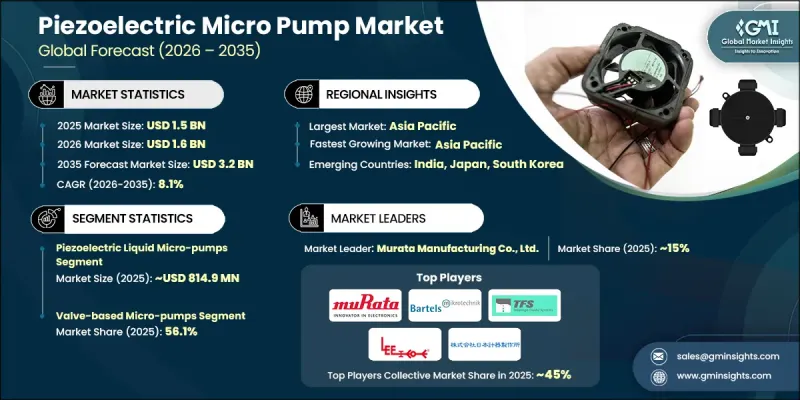
壓電微泵產業的成長主要得益於醫療保健領域對精確控制流體處理日益成長的需求。流體輸送精度仍然是設備選擇的關鍵因素,因為可靠性和穩定性對於患者安全和治療效果至關重要。隨著慢性病患者人數的不斷增加,對先進流體控制技術的需求持續加速成長,尤其是在居家照護領域。壓電居家照護技術的日益關注也推動了對小型化解決方案的需求。這些泵浦能夠無縫整合到可攜式系統中,同時保持高精度。消費者對便利醫療保健解決方案的日益偏好也促進了緊湊型流體管理系統的創新,從而推動了壓電微泵市場的整體擴張。
| 市場範圍 | |
|---|---|
| 開始年份 | 2025 |
| 預測期 | 2026-2035 |
| 上市時的市場規模 | 15億美元 |
| 預測金額 | 32億美元 |
| 複合年成長率 | 8.1% |
預計到2025年,壓電液體微型幫浦市場規模將達到8.149億美元,並在2026年至2035年間以5.1%的複合年成長率成長。壓電液體微型幫浦市場的成長與對精度和小型化日益成長的需求密切相關。這些泵浦採用壓電驅動機制,能夠在最大限度降低機械複雜性的同時控制流體運動,使其適用於先進的流體管理應用。其緊湊的設計和高效的運作支持了現代醫療技術的進步。穿戴式系統日益成長的需求也進一步推動了其應用,因為這些泵浦在性能和能源效率之間實現了必要的平衡。低噪音水平和更高的便攜性也促進了其在各種應用場景中的廣泛應用。
預計到2025年,閥式微型幫浦市場佔有率將達到56.1%,並在2026年至2035年間以7.7%的複合年成長率成長。由於閥式微型幫浦能夠精確控制流體方向,其市場需求持續成長。這些系統採用機械閥來調節流量並最大限度地降低迴流風險,從而確保高運作可靠性。它們對各種不同特性流體的適應性增強了其在複雜環境中的應用。需要精確控制流體輸送的產業越來越依賴這些解決方案,因為它們兼具高性能和運作安全性。
預計到2025年,中國壓電微型幫浦市場規模將達到2.118億美元,並在2035年之前以9.1%的複合年成長率成長。該地區市場受益於醫療技術、電子製造以及需要高精度控制的工業應用領域日益成長的需求。對高效流體控制的緊湊型設備的日益普及也推動了市場成長。中國強大的製造業生態系統能夠實現微型泵浦技術的大規模生產及其在先進系統中的整合。在中國營運的企業正致力於提高產品的效率、可靠性和成本效益,以滿足各行各業不斷成長的需求。
目錄
第1章:調查方法和範圍
第2章執行摘要
第3章業界考察
- 生態系分析
- 供應商情況
- 利潤率
- 每個階段增加的價值
- 影響價值鏈的因素
- 影響產業的因素
- 促進因素
- 醫療和保健設備對精密流體控制的需求日益成長。
- 電子和生物醫學醫療設備小型化趨勢
- 壓電技術的高效率和低功耗
- 陷阱與挑戰
- 精密零件的製造成本和材料成本高成本
- 與傳統泵浦相比,其流量和壓力範圍有限。
- 機會
- 擴大在穿戴式醫療設備和即時診斷的應用。
- 多功能混合微流體系統的開發
- 促進因素
- 成長潛力分析
- 未來市場趨勢
- 科技與創新趨勢
- 當前技術趨勢
- 新興技術
- 監理情勢
- 標準和合規要求
- 區域法規結構
- 認證標準
- 波特五力分析
- PESTEL 分析
- 價格分析(基於初步調查)
- 對過去價格趨勢的分析(基於初步研究)
- 根據業務類型分類的定價策略(高階/價值/成本加成)(基於初步調查)
- 以最終用途分類的價格敏感度(基於初步調查)
- 貿易數據分析(基於付費資料庫)
- 進出口量和進口額趨勢(基於付費資料庫)
- 主要貿易走廊及關稅影響(基於付費資料庫)
- 按地區分類的貿易流量趨勢(基於付費資料庫)
- 人工智慧和生成式人工智慧對市場的影響
- 利用人工智慧改造現有經營模式
- 針對特定領域的生成式人工智慧應用案例和實施藍圖
- 風險、限制和監管考量
第4章 競爭情勢
- 介紹
- 企業市佔率分析
- 按地區
- 企業矩陣分析
- 主要市場公司的競爭分析
- 競爭定位矩陣
- 主要進展
- 併購
- 夥伴關係與合作
- 新產品發布
- 業務拓展計劃
第5章 市場估算與預測:依設備類型分類,2022-2035年
- 壓電液體微型泵
- 用於空氣和氣體的壓電微型泵
第6章 市場估價與預測:依設計類型分類,2022-2035年
- 無閥微型泵
- 閥式微型泵
第7章 市場估計與預測:依應用領域分類,2022-2035年
- 公司
- 個人
第8章 市場估算與預測:依最終用途產業分類,2022-2035年
- 醫學與生命科學
- 家用電子電器
- 工業應用
- 汽車和交通運輸
- 家用電器
- 其他
第9章 市場估價與預測:依通路分類,2022-2035年
- 直銷
- 間接銷售
第10章 市場估價與預測:依地區分類,2022-2035年
- 北美洲
- 美國
- 加拿大
- 歐洲
- 德國
- 英國
- 法國
- 義大利
- 西班牙
- 亞太地區
- 中國
- 印度
- 日本
- 韓國
- 澳洲
- 拉丁美洲
- 巴西
- 墨西哥
- 阿根廷
- 中東和非洲(MEA)
- 沙烏地阿拉伯
- 阿拉伯聯合大公國
- 南非
第11章:公司簡介
- Audiowell Electronics(Guangdong)Co., Ltd.
- Bartels Mikrotechnik GmbH
- Debiotech SA
- HeYi Precision Pump
- HOERBIGER Motion Control GmbH
- Koge Micro Tech Co., Ltd.
- Maxclever Electric Co., Ltd.
- MicroJet Technology Co., Ltd.
- Murata Manufacturing Co., Ltd.
- Nippon Keiki Works, Ltd.
- NITTO KOHKI CO., LTD.
- PiezoData Inc.
- Takasago Electric, Inc
- The Lee Company
- TTP Ventus Ltd.
The Global Piezoelectric Micro Pump Market was valued at USD 1.5 billion in 2025 and is estimated to grow at a CAGR of 8.1% to reach USD 3.2 billion by 2035.
Growth in the piezoelectric micro pump industry is being driven by the increasing need for accurate and controlled fluid handling across healthcare and medical applications. Precision in fluid delivery remains a critical factor influencing device selection, as reliability and consistency are essential for patient safety and treatment outcomes. The growing population affected by chronic conditions continues to accelerate demand for advanced fluid control technologies, particularly in home-based care environments. Manufacturers across the piezoelectric micro pump market are prioritizing improvements in efficiency, response time, and durability to meet evolving performance expectations. Regulatory compliance and stringent quality benchmarks are further supporting wider adoption in sensitive applications. Additionally, the rising focus on compact and lightweight medical technologies is strengthening the demand for miniaturized solutions. These pumps enable seamless integration into portable systems while maintaining high accuracy. Increasing consumer preference for convenient healthcare solutions is also contributing to innovation in compact fluid management systems, reinforcing the overall expansion of the piezoelectric micro pump market.
| Market Scope | |
|---|---|
| Start Year | 2025 |
| Forecast Year | 2026-2035 |
| Start Value | $1.5 Billion |
| Forecast Value | $3.2 Billion |
| CAGR | 8.1% |
The piezoelectric liquid micro-pumps segment generated USD 814.9 million in 2025 and is forecast to grow at a CAGR of 5.1% between 2026 and 2035. Growth in the piezoelectric liquid micro-pumps segment is closely linked to the increasing emphasis on precision and miniaturization. These pumps rely on piezoelectric actuation mechanisms that allow controlled fluid movement with minimal mechanical complexity, making them suitable for advanced fluid management applications. Their compact design and efficient operation support the development of modern healthcare technologies. Rising interest in wearable systems is further supporting adoption, as these pumps offer the required balance of performance and energy efficiency. Low noise output and enhanced portability also contribute to their growing acceptance across various use cases.
The valve-based micro-pumps segment held a 56.1% share in 2025 and is anticipated to grow at a CAGR of 7.7% from 2026 to 2035. Demand for valve-based micro-pumps continues to increase due to their ability to provide precise directional control of fluids. These systems incorporate mechanical valves that regulate flow and minimize the risk of reverse movement, ensuring higher operational reliability. Their adaptability to handle fluids with varying properties strengthens their applicability across complex environments. Industries requiring accurate and controlled fluid transfer are increasingly relying on these solutions, as they deliver both performance and operational safety.
China Piezoelectric Micro Pump Market captured USD 211.8 million in 2025 and is projected to grow at a CAGR of 9.1% through 2035. The regional market is benefiting from rising demand across healthcare technologies, electronics manufacturing, and precision-driven industrial applications. Increasing adoption of compact devices that require efficient fluid control is supporting market growth. The country's strong manufacturing ecosystem enables large-scale production and integration of micro pump technologies into advanced systems. Companies operating in China are focusing on improving product efficiency, reliability, and cost-effectiveness to address expanding demand across multiple sectors.
Key companies participating in the Global Piezoelectric Micro Pump Market include Audiowell Electronics (Guangdong) Co., Ltd., Bartels Mikrotechnik GmbH, Debiotech SA, HeYi Precision Pump, HOERBIGER Motion Control GmbH, Koge Micro Tech Co., Ltd., Maxclever Electric Co., Ltd., MicroJet Technology Co., Ltd., Murata Manufacturing Co., Ltd., Nippon Keiki Works, Ltd., NITTO KOHKI CO., LTD., PiezoData Inc., Takasago Electric, Inc, The Lee Company, and TTP Ventus Ltd. Companies in the Piezoelectric Micro Pump Market are strengthening their market position by focusing on continuous product innovation, particularly in miniaturization and energy-efficient designs. Strategic collaborations and partnerships are being used to expand technological capabilities and enter new application areas. Many players are investing in research and development to enhance the precision, durability, and integration capabilities of their products. Geographic expansion, especially in high-growth regions, is another key approach to capture emerging demand. Firms are also prioritizing cost optimization and scalable manufacturing processes to remain competitive.
Table of Contents
Chapter 1 Methodology & Scope
- 1.1 Market scope and definition
- 1.2 Research design
- 1.2.1 Research approach
- 1.2.2 Data collection methods
- 1.3 Data mining sources
- 1.3.1 Global
- 1.3.2 Regional/Country
- 1.4 Base estimates and calculations
- 1.4.1 Base year calculation
- 1.4.2 Key trends for market estimation
- 1.5 Primary research and validation
- 1.5.1 Primary sources
- 1.6 Forecast model
- 1.7 Research assumptions and limitations
Chapter 2 Executive Summary
- 2.1 Industry 360° synopsis
- 2.2 Key market trends
- 2.2.1 Regional
- 2.2.2 Machine Type
- 2.2.3 Design Type
- 2.2.4 End Use Industry
- 2.2.5 Distribution channel
Chapter 3 Industry Insights
- 3.1 Industry ecosystem analysis
- 3.1.1 Supplier landscape
- 3.1.2 Profit margin
- 3.1.3 Value addition at each stage
- 3.1.4 Factor affecting the value chain
- 3.2 Industry impact forces
- 3.2.1 Growth drivers
- 3.2.1.1 Growing demand for precision fluid control in medical and healthcare devices
- 3.2.1.2 Miniaturization trend in electronics and biomedical devices
- 3.2.1.3 High efficiency and low power consumption of piezoelectric technology
- 3.2.2 Pitfalls & Challenges
- 3.2.2.1 High manufacturing and material costs for precision components
- 3.2.2.2 Limited flow rate and pressure range compared to conventional pumps
- 3.2.3 Opportunities
- 3.2.3.1 Rising use in wearable medical devices and point-of-care diagnostics
- 3.2.3.2 Development of multifunctional and hybrid microfluidic systems
- 3.2.1 Growth drivers
- 3.3 Growth potential analysis
- 3.4 Future market trends
- 3.5 Technology and innovation landscape
- 3.5.1 Current technological trends
- 3.5.2 Emerging technologies
- 3.6 Regulatory landscape
- 3.6.1 Standards and compliance requirements
- 3.6.2 Regional regulatory frameworks
- 3.6.3 Certification standards
- 3.7 Porter's analysis
- 3.8 PESTEL analysis
- 3.9 Pricing analysis (driven by primary research)
- 3.9.1 Historical price trend analysis (driven by primary research)
- 3.9.2 Pricing strategy by player type (premium / value / cost-plus) (driven by primary research)
- 3.9.3 Price sensitivity by end-use application (driven by primary research)
- 3.10 Trade data analysis (driven by paid database)
- 3.10.1 Import/export volume & value trends (driven by paid database)
- 3.10.2 Key trade corridors & tariff impact (driven by paid database)
- 3.10.3 Regional trade flow dynamics (driven by paid database)
- 3.11 Impact of AI & generative AI on the market
- 3.11.1 AI-driven disruption of existing business models
- 3.11.2 GenAI use cases & adoption roadmap by segment
- 3.11.3 Risks, limitations & regulatory considerations
Chapter 4 Competitive Landscape, 2025
- 4.1 Introduction
- 4.2 Company market share analysis
- 4.2.1 By Region
- 4.2.1.1 North America
- 4.2.1.2 Europe
- 4.2.1.3 Asia Pacific
- 4.2.1.4 Latin America
- 4.2.1.5 Middle East & Africa
- 4.2.1 By Region
- 4.3 Company matrix analysis
- 4.4 Competitive analysis of major market players
- 4.5 Competitive positioning matrix
- 4.6 Key developments
- 4.6.1 Mergers & acquisitions
- 4.6.2 Partnerships & collaborations
- 4.6.3 New product launches
- 4.6.4 Expansion plans
Chapter 5 Market Estimates & Forecast, By Machine Type, 2022 - 2035, (USD Billion) (Thousand Units)
- 5.1 Key trends
- 5.2 Piezoelectric liquid micro-pumps
- 5.3 Piezoelectric air/gas micro-pumps
Chapter 6 Market Estimates & Forecast, By Design Type, 2022 - 2035, (USD Billion) (Thousand Units)
- 6.1 Key trends
- 6.2 Valveless micro-pumps
- 6.3 Valve-based micro-pumps
Chapter 7 Market Estimates & Forecast, By Application, 2022 - 2035, (USD Billion) (Thousand Units)
- 7.1 Key trends
- 7.2 Professional
- 7.3 Individual
Chapter 8 Market Estimates & Forecast, By End Use Industry, 2022 - 2035, (USD Billion) (Thousand Units)
- 8.1 Key trends
- 8.2 Medical & life sciences
- 8.3 Consumer electronics
- 8.4 Industrial applications
- 8.5 Automotive & transportation
- 8.6 Household appliances
- 8.7 Others
Chapter 9 Market Estimates & Forecast, By Distribution Channel, 2022 - 2035, (USD Billion) (Thousand Units)
- 9.1 Key trends
- 9.2 Direct sales
- 9.3 Indirect sales
Chapter 10 Market Estimates & Forecast, By Region, 2022 - 2035, (USD Billion) (Thousand Units)
- 10.1 Key trends
- 10.2 North America
- 10.2.1 U.S.
- 10.2.2 Canada
- 10.3 Europe
- 10.3.1 Germany
- 10.3.2 UK
- 10.3.3 France
- 10.3.4 Italy
- 10.3.5 Spain
- 10.4 Asia Pacific
- 10.4.1 China
- 10.4.2 India
- 10.4.3 Japan
- 10.4.4 South Korea
- 10.4.5 Australia
- 10.5 Latin America
- 10.5.1 Brazil
- 10.5.2 Mexico
- 10.5.3 Argentina
- 10.6 MEA
- 10.6.1 Saudi Arabia
- 10.6.2 UAE
- 10.6.3 South Africa
Chapter 11 Company Profiles
- 11.1 Audiowell Electronics (Guangdong) Co., Ltd.
- 11.2 Bartels Mikrotechnik GmbH
- 11.3 Debiotech SA
- 11.4 HeYi Precision Pump
- 11.5 HOERBIGER Motion Control GmbH
- 11.6 Koge Micro Tech Co., Ltd.
- 11.7 Maxclever Electric Co., Ltd.
- 11.8 MicroJet Technology Co., Ltd.
- 11.9 Murata Manufacturing Co., Ltd.
- 11.10 Nippon Keiki Works, Ltd.
- 11.11 NITTO KOHKI CO., LTD.
- 11.12 PiezoData Inc.
- 11.13 Takasago Electric, Inc
- 11.14 The Lee Company
- 11.15 TTP Ventus Ltd.

 壓電材料市場預測至2034年-按材料類型、產品形式、裝置類型、技術、頻寬、最終用戶和地區分類的全球分析
 無鉛多層壓電陶瓷市場報告:趨勢、預測及競爭分析(至2035年)
 先進壓電裝置市場分析及預測(至2035年):按類型、產品類型、技術、應用、材料類型、最終用戶、功能、安裝類型、裝置、解決方案分類壓電材料市場分析及預測(至2035年):依類型、產品、應用、材料類型、技術、組件、裝置、最終用戶及功能分類
 全球壓電材料市場規模、佔有率、趨勢和成長分析報告(2026-2034年)
 壓電材料市場規模、佔有率及成長分析(依產品、材料、元件、工作模式、應用及地區分類)-2026-2033年產業預測
 KNN無鉛壓電陶瓷:全球市佔率及排名、總收入及需求預測(2025-2031年)壓電微型幫浦:全球市場佔有率和排名、總收入和需求預測(2025-2031年)壓電陶瓷技術:全球市佔率及排名、總收入及需求預測(2025-2031年)
 壓電材料的全球市場 (~2035年):材料·用途·終端用戶·各地區