


 |
市場調查報告書
商品編碼
2019160
膜氧合設備市場:商業機會、成長要素、產業趨勢分析及2026-2035年預測。Membrane Oxygenators Market Opportunity, Growth Drivers, Industry Trend Analysis, and Forecast 2026 - 2035 |
||||||

全球膜氧合市場預計到 2025 年將價值 1.338 億美元,預計到 2035 年將以 2.4% 的複合年成長率成長至 1.675 億美元。
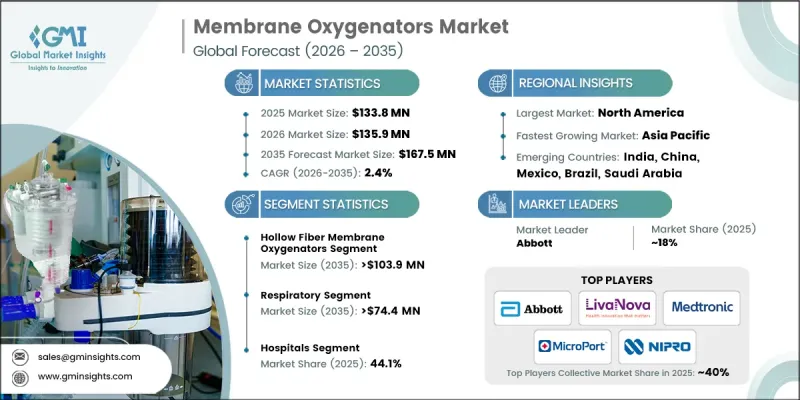
由於呼吸系統和心臟疾病(包括急性呼吸窘迫症候群(ARDS)、心源性休克和心肌炎)發病率的上升,該市場正在擴張。膜式氧合器在體外生命維持中發揮著至關重要的作用,它透過清除二氧化碳和向血液輸送氧氣來促進氣體交換。採用中空纖維膜和板式膜的先進設計對於治療呼吸衰竭和心臟衰竭至關重要,尤其是在體外膜氧合 (ECMO) 治療過程中。醫療成本的上升和發展中地區基礎設施的改善推動了 ECMO 在重症監護中的應用,從而刺激了市場需求。政府旨在改善 ECMO 培訓機會的舉措,以及攜帶式和易用型設備的開發,正在擴大膜式氧合器的應用範圍,尤其是在新生兒和兒童領域。效率、安全性和適應性的提升是全球市場成長的關鍵促進因素。
| 市場範圍 | |
|---|---|
| 開始年份 | 2025 |
| 預測期 | 2026-2035 |
| 上市時的市場規模 | 1.338億美元 |
| 預測金額 | 1.675億美元 |
| 複合年成長率 | 2.4% |
預計2035年,中空纖維膜氧合市場將以2.7%的複合年成長率成長,達到1.039億美元。中空纖維系統因其結構緊湊、氣體交換效率高以及與包括心肺體外迴圈和體外膜氧合(ECMO)在內的重症監護程序相容而備受青睞。技術進步提高了生物相容性並減少了血液負荷,進一步擴大了其應用範圍,尤其是在新生兒和兒童領域,因為這些領域的患者體型和安全性至關重要。
截至2025年,醫院將佔據44.1%的市場。由於體外膜氧合(ECMO)設備在治療急性呼吸窘迫症候群(ARDS)、心源性休克和心血管手術術後護理等嚴重方面發揮著至關重要的作用,醫院仍然是ECMO設備的主要使用者。心血管和呼吸系統疾病病例的不斷增加,以及專業基礎設施和訓練有素的醫護人員的配備,正在推動ECMO治療需求的成長。在加護病房(ICU)部署先進的ECMO系統,正在改善病患預後,並進一步鞏固醫院在市場擴張中的重要角色。
美國體外膜氧合(ECMO)市場預計到2025年將達到4,440萬美元。呼吸系統和心血管疾病的日益普遍、人口老化以及慢性病的增加,推動了依賴膜肺氧合的ECMO治療技術的應用。完善的醫療基礎設施、ECMO中心的增加以及攜帶式高效氧合器技術的進步,都支撐著市場需求,尤其是在新生兒和兒童醫療領域。
目錄
第1章:調查方法
- 研究途徑
- 品質改進計劃
- GMI人工智慧政策和資料完整性計劃
- 資訊來源一致性協議
- GMI人工智慧政策和資料完整性計劃
- 調查過程和可靠性評分
- 調查過程的組成部分
- 評分組成部分
- 數據收集
- 主要來源部分列表
- 資料探勘資訊來源
- 付費資訊來源
- 區域資訊來源
- 付費資訊來源
- 基本估算和計算方法
- 每種方法中基準年的計算
- 預測模型
- 量化市場影響分析
- 生長參數對預測的數學影響
- 量化市場影響分析
- 關於調查透明度的補充信息
- 資訊來源歸屬框架
- 品質保證指標
- 對信任的承諾
第2章執行摘要
第3章業界考察
- 生態系分析
- 影響產業的因素
- 促進因素
- 心血管疾病盛行率增加
- 體外膜氧合(ECMO)需求不斷成長
- 急性呼吸窘迫症候群(ARDS)發生率高
- 器官移植手術數量增加
- 兒童和新生兒醫學領域的應用迅速成長
- 產業潛在風險與挑戰
- 嚴格的監管要求
- 先進氧合設備高成本
- 市場機遇
- 高分子科學創新
- 促進因素
- 成長潛力分析
- 監理情勢
- 北美洲
- 歐洲
- 亞太地區
- 科技趨勢
- 當前技術趨勢
- 新興技術
- 未來市場趨勢(基於初步研究)
- 人工智慧和生成式人工智慧對市場的影響
- 客戶洞察(基於初步研究)
- 2025年價格分析
- 波特五力分析
- PESTEL 分析
- 差距分析
第4章 競爭情勢
- 介紹
- 企業矩陣分析
- 企業市佔率分析
- 世界
- 北美洲
- 歐洲
- 亞太地區
- 競爭定位矩陣
- 主要市場公司的競爭分析
- 主要進展
- 併購
- 夥伴關係與合作
- 新產品類型發布
- 業務拓展計劃
第5章 市場估計與預測:依類型分類,2022-2035年
- 中空纖維膜式氧合裝置
- 平板式膜氧合裝置
第6章 市場估計與預測:依應用領域分類,2022-2035年
- 呼吸系統
- 呼吸衰竭
- 肺動脈栓塞
- 急性呼吸窘迫症候群
- 肺炎
- 心
- 補償心肌病
- 急性心肌梗塞
- 心源性休克
- 移植後併發症
- 心肌炎
- 體外心肺復甦術(CPR)
第7章 市場估計與預測:依年齡層別分類,2022-2035年
- 成人
- 新生
- 兒童
第8章 市場估算與預測:依最終用途分類,2022-2035年
- 醫院
- 門診手術中心
- 其他最終用戶
第9章 市場估計與預測:依地區分類,2022-2035年
- 北美洲
- 美國
- 加拿大
- 歐洲
- 德國
- 英國
- 法國
- 西班牙
- 義大利
- 荷蘭
- 亞太地區
- 中國
- 日本
- 印度
- 澳洲
- 韓國
- 拉丁美洲
- 巴西
- 墨西哥
- 阿根廷
- 中東和非洲
- 南非
- 沙烏地阿拉伯
- 阿拉伯聯合大公國
第10章:公司簡介
- Abbott
- BRAILE
- chalice
- CytoSorbents
- EUROSETS
- Fresenius
- GETINGE
- LivaNova
- Medtronic
- MicroPort
- NIPRO
- PrecisionMedical
- RECTUS MEDICAL
- TERUMO
- XENIOS
The Global Membrane Oxygenators Market was valued at USD 133.8 million in 2025 and is estimated to grow at a CAGR of 2.4% to reach USD 167.5 million by 2035.
The market is expanding due to the rising incidence of respiratory and cardiac disorders, including conditions such as ARDS, cardiogenic shock, and myocarditis. Membrane oxygenators serve a critical role in extracorporeal life support, facilitating gas exchange by removing carbon dioxide and delivering oxygen to the blood. Advanced designs utilizing hollow fiber and flat sheet membranes are essential in managing respiratory and cardiac failure, particularly during ECMO procedures. Increasing adoption of ECMO in critical care, supported by growing healthcare spending and enhanced infrastructure in developing regions, is driving demand. Government initiatives to improve access to ECMO training, alongside the development of portable and user-friendly devices, are broadening the application of membrane oxygenators, particularly in neonatal and pediatric care. Enhanced efficiency, safety, and adaptability are key drivers shaping market growth globally.
| Market Scope | |
|---|---|
| Start Year | 2025 |
| Forecast Year | 2026-2035 |
| Start Value | $133.8 Million |
| Forecast Value | $167.5 Million |
| CAGR | 2.4% |
The hollow fiber membrane oxygenators segment is expected to grow at a CAGR of 2.7% to reach USD 103.9 million by 2035. Hollow fiber systems are preferred for their compact design, superior gas exchange efficiency, and compatibility with critical care procedures, including cardiopulmonary bypass and ECMO. Technological advancements enhancing biocompatibility and reducing blood trauma further strengthen their adoption, particularly in neonatal and pediatric applications, where patient size and safety are critical.
The hospitals segment held a 44.1% share in 2025. Hospitals remain primary users of membrane oxygenators due to their role in managing critical conditions such as ARDS, cardiogenic shock, and post-cardiac surgery care. The increasing number of cardiovascular and respiratory cases, combined with specialized infrastructure and trained staff, supports the rising demand for ECMO procedures. Integration of advanced ECMO systems in ICUs improves patient outcomes, reinforcing the critical role of hospitals in market expansion.
U.S. Membrane Oxygenators Market was valued at USD 44.4 million in 2025. A rising prevalence of respiratory and cardiovascular diseases, an aging population, and increasing chronic health conditions are driving the adoption of ECMO procedures that rely on membrane oxygenators. A strong healthcare infrastructure, the proliferation of ECMO centers, and technological improvements in portable and efficient oxygenators support demand, especially in neonatal and pediatric care applications.
Prominent players in the Global Membrane Oxygenators Market include Abbott, BRAILE, Chalice, CytoSorbents, EUROSETS, Fresenius, GETINGE, LivaNova, Medtronic, MicroPort, NIPRO, PrecisionMedical, RECTUS MEDICAL, TERUMO, and XENIOS. Companies in the Global Membrane Oxygenators Market adopt strategies such as investing in R&D to improve membrane biocompatibility and gas exchange efficiency, expanding product lines to include portable and neonatal-friendly oxygenators, and forming strategic partnerships with hospitals and ECMO centers to strengthen distribution channels. They also focus on regulatory compliance and clinical validation to enhance credibility and market trust. Targeted marketing campaigns, training programs for healthcare professionals, and participation in global medical expos help boost brand recognition. In addition, companies pursue mergers and acquisitions to consolidate technological capabilities, reduce competition, and expand their regional footprint across North America, Europe, and Asia-Pacific, ensuring long-term market presence and sustained growth.
Table of Contents
Chapter 1 Research Methodology
- 1.1 Research approach
- 1.2 Quality commitments
- 1.2.1 GMI AI policy & data integrity commitment
- 1.2.1.1 Source consistency protocol
- 1.2.1 GMI AI policy & data integrity commitment
- 1.3 Research trail & confidence scoring
- 1.3.1 Research trail components
- 1.3.2 Scoring components
- 1.4 Data collection
- 1.4.1 Partial list of primary sources
- 1.5 Data mining sources
- 1.5.1 Paid sources
- 1.5.1.1 Sources, by region
- 1.5.1 Paid sources
- 1.6 Base estimates and calculations
- 1.6.1 Base year calculation for any one approach
- 1.7 Forecast model
- 1.7.1 Quantified market impact analysis
- 1.7.1.1 Mathematical impact of growth parameters on forecast
- 1.7.1 Quantified market impact analysis
- 1.8 Research transparency addendum
- 1.8.1 Source attribution framework
- 1.8.2 Quality assurance metrics
- 1.8.3 Our commitment to trust
Chapter 2 Executive Summary
- 2.1 Industry 360° synopsis
- 2.2 Key market trends
- 2.2.1 Regional trends
- 2.2.2 Type trends
- 2.2.3 Application trends
- 2.2.4 Age group trends
- 2.2.5 End use trends
- 2.3 CXO perspectives: Strategic imperatives
Chapter 3 Industry Insights
- 3.1 Industry ecosystem analysis
- 3.2 Industry impact forces
- 3.2.1 Growth drivers
- 3.2.1.1 Rising cardiovascular disease prevalence
- 3.2.1.2 Growing demand for extracorporeal membrane oxygenation (ECMO)
- 3.2.1.3 High incidence of acute respiratory distress syndrome (ARDS)
- 3.2.1.4 Rise in organ transplant procedures
- 3.2.1.5 Surging applications in pediatric and neonatal care
- 3.2.2 Industry pitfalls and challenges
- 3.2.2.1 Strict regulatory requirements
- 3.2.2.2 High costs of advanced oxygenators
- 3.2.3 Market opportunities
- 3.2.3.1 Innovation in polymer science
- 3.2.1 Growth drivers
- 3.3 Growth potential analysis
- 3.4 Regulatory landscape
- 3.4.1 North America
- 3.4.2 Europe
- 3.4.3 Asia Pacific
- 3.5 Technology landscape
- 3.5.1 Current technological trends
- 3.5.2 Emerging technologies
- 3.6 Future market trends (Driven by Primary Research)
- 3.7 Impact of AI and generative AI on the market
- 3.8 Customer insights (Driven by Primary Research)
- 3.9 Pricing analysis, 2025
- 3.10 Porter's analysis
- 3.11 PESTEL analysis
- 3.12 Gap analysis
Chapter 4 Competitive Landscape, 2025
- 4.1 Introduction
- 4.2 Company matrix analysis
- 4.3 Company market share analysis
- 4.3.1 Global
- 4.3.2 North America
- 4.3.3 Europe
- 4.3.4 Asia Pacific
- 4.4 Competitive positioning matrix
- 4.5 Competitive analysis of major market players
- 4.6 Key developments
- 4.6.1 Mergers & acquisitions
- 4.6.2 Partnerships & collaborations
- 4.6.3 New product type launches
- 4.6.4 Expansion plans
Chapter 5 Market Estimates and Forecast, By Type, 2022 - 2035 ($ Mn)
- 5.1 Key trends
- 5.2 Hollow fiber membrane oxygenators
- 5.3 Flat sheet membrane oxygenators
Chapter 6 Market Estimates and Forecast, By Application, 2022 - 2035 ($ Mn)
- 6.1 Key trends
- 6.2 Respiratory
- 6.2.1 Respiratory failure
- 6.2.2 Pulmonary embolism
- 6.2.3 Acute respiratory distress syndrome
- 6.2.4 Pneumonia
- 6.3 Cardiac
- 6.3.1 Decompensated cardiomyopathy
- 6.3.2 Acute myocardial infarction
- 6.3.3 Cardiogenic shock
- 6.3.4 Post-transplant complications
- 6.3.5 Myocarditis
- 6.4 Extra corporeal cardiopulmonary resuscitation
Chapter 7 Market Estimates and Forecast, By Age Group, 2022 - 2035 ($ Mn)
- 7.1 Key trends
- 7.2 Adults
- 7.3 Neonates
- 7.4 Pediatrics
Chapter 8 Market Estimates and Forecast, By End Use, 2022 - 2035 ($ Mn)
- 8.1 Key trends
- 8.2 Hospitals
- 8.3 Ambulatory surgical centers
- 8.4 Other end users
Chapter 9 Market Estimates and Forecast, By Region, 2022 - 2035 ($ Mn)
- 9.1 Key trends
- 9.2 North America
- 9.2.1 U.S.
- 9.2.2 Canada
- 9.3 Europe
- 9.3.1 Germany
- 9.3.2 UK
- 9.3.3 France
- 9.3.4 Spain
- 9.3.5 Italy
- 9.3.6 Netherlands
- 9.4 Asia Pacific
- 9.4.1 China
- 9.4.2 Japan
- 9.4.3 India
- 9.4.4 Australia
- 9.4.5 South Korea
- 9.5 Latin America
- 9.5.1 Brazil
- 9.5.2 Mexico
- 9.5.3 Argentina
- 9.6 Middle East and Africa
- 9.6.1 South Africa
- 9.6.2 Saudi Arabia
- 9.6.3 UAE
Chapter 10 Company Profiles
- 10.1 Abbott
- 10.2 BRAILE
- 10.3 chalice
- 10.4 CytoSorbents
- 10.5 EUROSETS
- 10.6 Fresenius
- 10.7 GETINGE
- 10.8 LivaNova
- 10.9 Medtronic
- 10.10 MicroPort
- 10.11 NIPRO
- 10.12 PrecisionMedical
- 10.13 RECTUS MEDICAL
- 10.14 TERUMO
- 10.15 XENIOS

 膜氧合市場-2026-2032年全球市場預測
 托盤回收系統市場規模、佔有率和成長分析:按系統機制、裝載配置、托盤材料、使用環境、銷售管道和地區分類-2026-2033年產業預測體外膜氧合(ECMO)市場:2026-2032年全球市場預測(按模式、組件、系統類型、技術、插管方法、適應症嚴重程度和最終用戶分類)
 體外膜氧合(ECMO)系統市場:依方法、應用、年齡層和地區分類。
 全球體外膜氧合(ECMO)市場規模、佔有率、趨勢和成長分析報告(2026-2034)
 膜式氧合系統市場規模、佔有率和成長分析:按材料類型、應用模式、患者組件尺寸、最終用戶和地區分類-2026-2033年產業預測
 體外膜氧合(ECMO)系統市場-全球產業規模、佔有率、趨勢、機會、預測:依方法、應用、最終用戶、地區和競爭格局分類,2021-2031年人工肺市場:2026-2032年全球市場預測(依產品類型、技術、材料類型、最終用戶、應用及分銷通路分類)
 2026年全球游泳池循環系統市場報告體外循環系統市場:全球市場按產品類型、組件、技術、應用和最終用戶分類的預測——2026-2032年