


 |
市場調查報告書
商品編碼
2019154
自修復聚合物市場商機、成長要素、產業趨勢分析及2026-2035年預測。Self-repairing Polymers Market Opportunity, Growth Drivers, Industry Trend Analysis, and Forecast 2026 - 2035 |
||||||

全球自修復聚合物市場預計到 2025 年價值 32 億美元,預計到 2035 年將達到 269 億美元,複合年成長率為 23.8%。
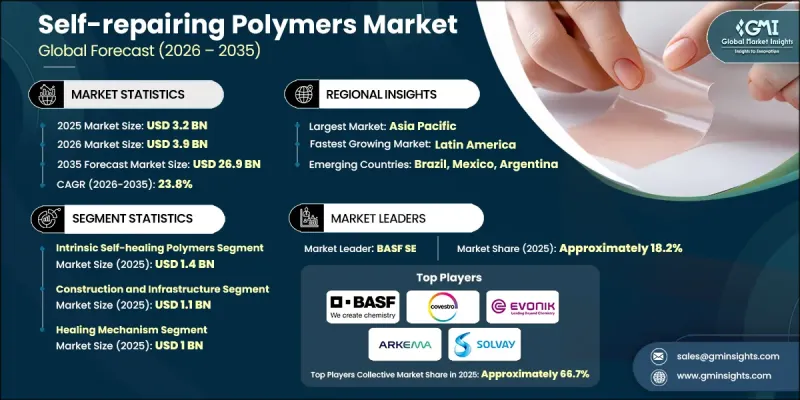
隨著材料科學領域對耐久性、延長產品壽命和持續性能的要求日益提高,自修復聚合物市場呈現強勁的成長動能。這些先進聚合物旨在損傷後恢復其機械、化學和功能特性,從而減少維修和材料更換的頻率。此領域的研究主要集中在「內在體系」(依賴聚合物結構內部的可逆鍵結)和「外在體系」(包含修復劑)兩方面。聚合物化學、奈米技術和仿生材料設計的不斷進步,正在拓展這些材料的應用範圍,使其能夠應用於要求更高的領域。在材料失效可能導致高成本和安全風險的領域,自修復聚合物的應用日益廣泛,這推動了市場成長。自修復聚合物有助於延長各行業的產品壽命並提高可靠性。持續的創新旨在提高修復速度、一致性和結構完整性。人們對永續材料解決方案的日益關注以及對循環經濟原則的日益重視,進一步推動了對自修復聚合物的需求,這有助於減少廢棄物並提高資源利用效率。
| 市場範圍 | |
|---|---|
| 開始年份 | 2025 |
| 預測期 | 2026-2035 |
| 上市時的市場規模 | 32億美元 |
| 預測金額 | 269億美元 |
| 複合年成長率 | 23.8% |
預計到2025年,本徵自修復聚合物市場規模將達14億美元,並在2026年至2035年間以23%的複合年成長率成長。該市場佔據重要地位,原因在於其能夠透過嵌入聚合物基體內部的可逆鍵結機制來修復損傷。這些材料無需外部試劑即可進行多次修復循環,從而保持結構完整性和長期性能。它們能夠從微損傷中恢復,使其成為即使在反覆應力條件下也需要保持穩定功能的應用的理想選擇。這種可靠性,加上低維護成本和輕量化結構等特性,持續吸引業界的濃厚興趣。
預計到2025年,修復機制市場規模將達到10億美元,佔市場佔有率的30.7%,並將在2035年之前以22.4%的複合年成長率成長。修復機制的類型在決定材料從損傷中恢復的有效性、修復過程的頻率以及材料長期穩定性方面起著至關重要的作用。雖然修復效率、恢復速度和環境耐受性等因素會影響整體性能,但背後的修復機制仍然是決定材料在各種使用條件和應用中性能的關鍵因素。
預計到2025年,北美自修復聚合物市場規模將達到8.685億美元。該地區受益於完善的研究生態系統、先進材料的早期應用以及在高科技產業的廣泛應用。美國憑藉著強大的研究機構網路、專業製造商和創新主導產業,正引領區域發展。加拿大則透過持續推動以永續材料和基礎設施為重點的研究舉措,為區域發展做出貢獻,從而支持整體市場擴張。
目錄
第1章:調查方法
第2章執行摘要
第3章業界考察
- 生態系分析
- 供應商情況
- 利潤率
- 每個階段增加的價值
- 影響價值鏈的因素
- 中斷
- 影響產業的因素
- 促進因素
- 產業潛在風險與挑戰
- 市場機遇
- 成長潛力分析
- 監理情勢
- 北美洲
- 歐洲
- 亞太地區
- 拉丁美洲
- 中東和非洲
- 波特五力分析
- PESTEL 分析
- 價格趨勢
- 按地區
- 依產品
- 未來市場趨勢
- 科技與創新趨勢
- 當前技術趨勢
- 新興技術
- 專利趨勢
- 貿易統計
- 主要進口國
- 主要出口國
- 永續性和環境方面
- 永續計劃
- 減少廢棄物策略
- 生產中的能源效率
- 環保意識的舉措
- 關於碳足跡的考量
第4章 競爭情勢
- 介紹
- 企業市佔率分析
- 按地區
- 北美洲
- 歐洲
- 亞太地區
- 拉丁美洲
- 中東和非洲
- 按地區
- 企業矩陣分析
- 主要市場公司的競爭分析
- 競爭定位矩陣
- 主要進展
- 併購
- 夥伴關係與合作
- 新產品發布
- 業務拓展計劃
第5章 市場估計與預測:依類型分類,2022-2035年
- 本徵自修復聚合物
- 基於可逆共用價鍵
- 基於超分子交互作用
- 形狀記憶聚合物
- 其他
- 外源性自修復聚合物
- 微膠囊系統
- 血管網路系統
- 超細纖維增強
- 其他
- 混合式自癒系統
- 內在系統與外在系統的結合
- 多機制系統
- 其他
第6章 市場估計與預測:依應用領域分類,2022-2035年
- 建築和基礎設施
- 自癒混凝土
- 保護塗層
- 密封劑和黏合劑
- 其他
- 汽車和航太
- 結構部件
- 塗料和油漆
- 室內使用
- 其他
- 電子與能源
- 電池零件
- 軟性電子產品
- 太陽能板
- 其他
- 生醫醫療保健
- 組織工程
- 藥物輸送系統
- 醫療設備
- 其他
- 消費品
- 包裝
- 保護膜
- 纖維
- 其他
- 其他
第7章 市場估計與預測:依性能特徵分類,2022-2035年
- 修復機制
- 熱啟用
- 光激活
- pH響應性
- 機械激活
- 其他
- 維修效率
- 高效率(>80%)
- 中等效率(50-80%)
- 效率低(<50%)
- 療癒時間
- 快速癒合(不到1小時)
- 中等癒合速度(1-24小時)
- 癒合速度慢(超過24小時)
- 環境穩定性
- 耐熱性
- 化學耐受性
- 抗紫外線
- 其他
第8章 市場估計與預測:依地區分類,2022-2035年
- 北美洲
- 美國
- 加拿大
- 歐洲
- 德國
- 英國
- 法國
- 義大利
- 西班牙
- 其他歐洲地區
- 亞太地區
- 中國
- 印度
- 日本
- 澳洲
- 韓國
- 亞太其他地區
- 拉丁美洲
- 巴西
- 墨西哥
- 阿根廷
- 其他拉丁美洲地區
- 中東和非洲
- 沙烏地阿拉伯
- 南非
- 阿拉伯聯合大公國
- 其他中東和非洲地區
第9章:公司簡介
- BASF SE
- Arkema
- Covestro AG
- Evonik Industries AG
- The Dow Chemical Company
- Sika AG
- Solvay SA
- Toray Industries, Inc.
- NEI Corporation
The Global Self-Repairing Polymers Market was valued at USD 3.2 billion in 2025 and is estimated to grow at a CAGR of 23.8% to reach USD 26.9 billion by 2035.
The self-repairing polymers market is gaining strong momentum as material science increasingly emphasizes durability, extended product life, and sustained performance. These advanced polymers are engineered to restore their mechanical, chemical, and functional properties after damage, reducing the frequency of repairs and material replacement. Research in this field is focused on both intrinsic systems, which rely on reversible bonding within the polymer structure, and extrinsic systems that incorporate embedded healing agents. Continuous advancements in polymer chemistry, nanotechnology, and bio-inspired material design are expanding the scope of these materials across demanding applications. Market growth is being driven by rising adoption in sectors where material failure can result in high costs or safety risks. Self-repairing polymers contribute to longer product lifecycles and improved reliability across various industries. Ongoing innovation is aimed at enhancing healing speed, consistency, and structural integrity. Increasing awareness of sustainable material solutions and the growing focus on circular economy principles are further supporting the demand for self-repairing polymers, as they help reduce waste and improve resource efficiency.
| Market Scope | |
|---|---|
| Start Year | 2025 |
| Forecast Year | 2026-2035 |
| Start Value | $3.2 Billion |
| Forecast Value | $26.9 Billion |
| CAGR | 23.8% |
The intrinsic self-healing polymers segment accounted for USD 1.4 billion in 2025 and is projected to grow at a CAGR of 23% from 2026 to 2035. This segment holds a prominent position due to its ability to repair damage through reversible bonding mechanisms embedded within the polymer matrix. These materials can undergo multiple healing cycles without requiring external agents, preserving their structural integrity and long-term performance. Their capability to recover from micro-level damage makes them highly suitable for applications requiring consistent functionality under repeated stress conditions. This reliability, combined with reduced maintenance needs and lightweight characteristics, continues to drive strong interest from industrial sectors.
The healing mechanism segment reached USD 1 billion in 2025, accounting for 30.7% share, and is anticipated to grow at a CAGR of 22.4% through 2035. The type of healing mechanism plays a critical role in determining how effectively a material can recover from damage, how frequently the healing process can occur, and how stable the material remains over time. Factors such as healing efficiency, recovery speed, and environmental resistance influence overall performance; however, the underlying healing mechanism remains the key factor shaping material behavior across different operating conditions and applications.
North America Self-Repairing Polymers Market was valued at USD 868.5 million in 2025. The region benefits from a well-established research ecosystem, early adoption of advanced materials, and broad application across high-technology industries. The United States leads regional development, supported by a strong network of research institutions, specialized manufacturers, and innovation-driven industries. Canada contributes to regional progress through continued advancements in sustainable materials and infrastructure-focused research initiatives, supporting the overall expansion of the market.
Key companies operating in the Global Self-Repairing Polymers Market include Covestro AG, Arkema, BASF SE, Evonik Industries AG, The Dow Chemical Company, Solvay S.A., Sika AG, Toray Industries, Inc., and NEI Corporation. Companies in the self-repairing polymers market are strengthening their competitive position through continuous innovation, strategic collaborations, and expansion into high-growth application areas. They are investing heavily in research and development to improve the healing efficiency, durability, and environmental performance of advanced polymer systems. Partnerships with end-use industries are enabling the development of customized solutions tailored to specific performance requirements. Manufacturers are also focusing on scaling production capabilities and optimizing supply chains to meet increasing demand efficiently. In addition, companies are exploring sustainable material innovations and integrating advanced technologies such as nanomaterials to enhance product functionality, while expanding their presence in emerging markets to capture new growth opportunities.
Table of Contents
Chapter 1 Methodology
- 1.1 Market scope and definition
- 1.2 Research design
- 1.2.1 Research approach
- 1.2.2 Data collection methods
- 1.3 Data mining sources
- 1.3.1 Global
- 1.3.2 Regional/Country
- 1.4 Base estimates and calculations
- 1.4.1 Base year calculation
- 1.4.2 Key trends for market estimation
- 1.5 Primary research and validation
- 1.5.1 Primary sources
- 1.6 Forecast model
- 1.7 Research assumptions and limitations
Chapter 2 Executive Summary
- 2.1 Industry 360° synopsis
- 2.2 Key market trends
- 2.2.1 Regional
- 2.2.2 Type
- 2.2.3 Application
- 2.2.4 Performance Characteristics
- 2.3 TAM Analysis, 2026-2035
- 2.4 CXO perspectives: Strategic imperatives
Chapter 3 Industry Insights
- 3.1 Industry ecosystem analysis
- 3.1.1 Supplier Landscape
- 3.1.2 Profit Margin
- 3.1.3 Value addition at each stage
- 3.1.4 Factor affecting the value chain
- 3.1.5 Disruptions
- 3.2 Industry impact forces
- 3.2.1 Growth drivers
- 3.2.2 Industry pitfalls and challenges
- 3.2.3 Market opportunities
- 3.3 Growth potential analysis
- 3.4 Regulatory landscape
- 3.4.1 North America
- 3.4.2 Europe
- 3.4.3 Asia Pacific
- 3.4.4 Latin America
- 3.4.5 Middle East & Africa
- 3.5 Porter's analysis
- 3.6 PESTEL analysis
- 3.7 Price trends
- 3.7.1 By region
- 3.7.2 By product
- 3.8 Future market trends
- 3.9 Technology and Innovation landscape
- 3.9.1 Current technological trends
- 3.9.2 Emerging technologies
- 3.10 Patent Landscape
- 3.11 Trade statistics
- 3.11.1 Major importing countries
- 3.11.2 Major exporting countries
- 3.12 Sustainability and Environmental Aspects
- 3.12.1 Sustainable Practices
- 3.12.2 Waste Reduction Strategies
- 3.12.3 Energy Efficiency in Production
- 3.12.4 Eco-friendly Initiatives
- 3.13 Carbon Footprint Considerations
Chapter 4 Competitive Landscape, 2025
- 4.1 Introduction
- 4.2 Company market share analysis
- 4.2.1 By region
- 4.2.1.1 North America
- 4.2.1.2 Europe
- 4.2.1.3 Asia Pacific
- 4.2.1.4 LATAM
- 4.2.1.5 MEA
- 4.2.1 By region
- 4.3 Company matrix analysis
- 4.4 Competitive analysis of major market players
- 4.5 Competitive positioning matrix
- 4.6 Key developments
- 4.6.1 Mergers & acquisitions
- 4.6.2 Partnerships & collaborations
- 4.6.3 New Product Launches
- 4.6.4 Expansion Plans
Chapter 5 Market Estimates and Forecast, By Type, 2022- 2035 (USD Billion, Kilo Tons)
- 5.1 Key trends
- 5.2 Intrinsic Self-healing Polymers
- 5.2.1 Reversible Covalent Bond-based
- 5.2.2 Supramolecular Interaction-based
- 5.2.3 Shape Memory Polymers
- 5.2.4 Others
- 5.3 Extrinsic Self-healing Polymers
- 5.3.1 Microcapsule-based Systems
- 5.3.2 Vascular Network Systems
- 5.3.3 Microfiber Reinforcement
- 5.3.4 Others
- 5.4 Hybrid Self-healing Systems
- 5.4.1 Combined Intrinsic-Extrinsic Systems
- 5.4.2 Multi-mechanism Systems
- 5.4.3 Others
Chapter 6 Market Estimates and Forecast, By Application, 2022 - 2035 (USD Billion, Kilo Tons)
- 6.1 Key trends
- 6.2 Construction and Infrastructure
- 6.2.1 Self-healing Concrete
- 6.2.2 Protective Coatings
- 6.2.3 Sealants and Adhesives
- 6.2.4 Others
- 6.3 Automotive and Aerospace
- 6.3.1 Structural Components
- 6.3.2 Coatings and Paints
- 6.3.3 Interior Applications
- 6.3.4 Others
- 6.4 Electronics and Energy
- 6.4.1 Battery Components
- 6.4.2 Flexible Electronics
- 6.4.3 Solar Panels
- 6.4.4 Others
- 6.5 Biomedical and Healthcare
- 6.5.1 Tissue Engineering
- 6.5.2 Drug Delivery Systems
- 6.5.3 Medical Devices
- 6.5.4 Others
- 6.6 Consumer Products
- 6.6.1 Packaging
- 6.6.2 Protective Films
- 6.6.3 Textiles
- 6.6.4 Others
- 6.7 Others
Chapter 7 Market Estimates and Forecast, By Performance Characteristics, 2022 - 2035 (USD Billion, Kilo Tons)
- 7.1 Key trends
- 7.2 Healing Mechanism
- 7.2.1 Thermally Activated
- 7.2.2 Light-activated
- 7.2.3 pH-responsive
- 7.2.4 Mechanically Activated
- 7.2.5 Others
- 7.3 Healing Efficiency
- 7.3.1 High Efficiency (>80%)
- 7.3.2 Medium Efficiency (50-80%)
- 7.3.3 Low Efficiency (<50%)
- 7.4 Healing Time
- 7.4.1 Rapid Healing (<1 hour)
- 7.4.2 Moderate Healing (1-24 hours)
- 7.4.3 Slow Healing (>24 hours)
- 7.5 Environmental Stability
- 7.5.1 Temperature Resistant
- 7.5.2 Chemical Resistant
- 7.5.3 UV Resistant
- 7.5.4 Others
Chapter 8 Market Estimates and Forecast, By Region, 2022 - 2035 (USD Billion, Kilo Tons)
- 8.1 Key trends
- 8.2 North America
- 8.2.1 U.S.
- 8.2.2 Canada
- 8.3 Europe
- 8.3.1 Germany
- 8.3.2 UK
- 8.3.3 France
- 8.3.4 Italy
- 8.3.5 Spain
- 8.3.6 Rest of Europe
- 8.4 Asia Pacific
- 8.4.1 China
- 8.4.2 India
- 8.4.3 Japan
- 8.4.4 Australia
- 8.4.5 South Korea
- 8.4.6 Rest of Asia Pacific
- 8.5 Latin America
- 8.5.1 Brazil
- 8.5.2 Mexico
- 8.5.3 Argentina
- 8.5.4 Rest of Latin America
- 8.6 Middle East & Africa
- 8.6.1 Saudi Arabia
- 8.6.2 South Africa
- 8.6.3 UAE
- 8.6.4 Rest of Middle East & Africa
Chapter 9 Company Profiles
- 9.1 BASF SE
- 9.2 Arkema
- 9.3 Covestro AG
- 9.4 Evonik Industries AG
- 9.5 The Dow Chemical Company
- 9.6 Sika AG
- 9.7 Solvay S.A.
- 9.8 Toray Industries, Inc.
- 9.9 NEI Corporation
