


 |
市場調查報告書
商品編碼
2019149
動物用藥品市場商機、成長要素、產業趨勢分析及2026-2035年預測。Animal Drugs Market Opportunity, Growth Drivers, Industry Trend Analysis, and Forecast 2026 - 2035 |
||||||

預計到 2025 年,全球動物用藥品市場價值將達到 463 億美元,並有望以 5.8% 的複合年成長率成長,到 2035 年達到 825 億美元。
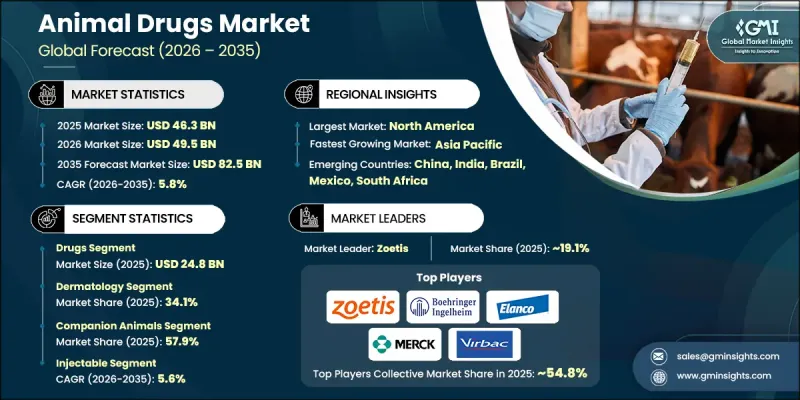
動物疾病的增加、人們對畜牧業生產力的日益關注以及全球寵物數量的成長推動了市場成長。隨著寵物越來越“擬人化”,寵物飼主對類似於人類醫療的先進醫療保健解決方案的需求不斷成長,市場呈現出強勁的發展勢頭。這一趨勢顯著增加了對伴侶動物專用治療藥物、預防保健產品和慢性病管理藥物的需求。此外,獸醫基礎設施的不斷改進和動物福利意識的提高也進一步加速了市場成長。政府和監管機構在支持動物健康措施和確保有效安全藥物的供應方面也發揮著至關重要的作用。
| 市場範圍 | |
|---|---|
| 開始年份 | 2025 |
| 預測期 | 2026-2035 |
| 上市時的市場規模 | 463億美元 |
| 預測金額 | 825億美元 |
| 複合年成長率 | 5.8% |
先進動物用藥品(包括生物製藥和疫苗)的日益普及正在改變產業格局。生物製藥因其提供更安全、更具針對性的治療方案而備受關注,尤其是在牲畜疾病預防和伴侶動物疫苗接種方面。此外,人工智慧驅動的藥物研發、遠端醫療平台和數位診斷等技術進步正在提高獸醫服務的可及性和效率。線上獸藥商店和零售分銷管道的快速擴張進一步提高了產品的供應量,尤其是在新興市場。然而,高昂的研發成本、嚴格的監管要求以及某些藥物潛在的副作用等挑戰仍然影響著市場動態。儘管存在這些挑戰,但預計未來幾年對研發和創新的持續投入將創造新的成長機會。
按產品細分,預計2025年,藥品市場規模將達248億美元。此細分市場涵蓋了用於治療和預防伴侶動物和牲畜疾病的各種必需藥品,例如感染疾病、驅蟲藥、抗發炎藥和循環系統藥物。動物細菌感染疾病、寄生蟲疾病和慢性病發病率的不斷上升,顯著推動了對這些藥物的需求。此外,先進製劑和標靶治療的研發提高了治療效果和用藥依從性。人們對合理使用抗菌藥物(AMS)和負責任用藥的日益關注,也推動了該領域的創新,促進了更安全、更永續的治療方案的開發。
預計到2025年,注射劑藥物市場將佔據主導地位,並在預測期內以5.6%的複合年成長率穩定成長。此細分市場包括肌肉注射、皮下注射和靜脈注射的藥物。注射藥物因其起效迅速、給藥精準、療效可靠而備受青睞,尤其適用於急診和急性疾病的治療。腸外給藥廣泛應用於疫苗、抗生素、止痛藥和其他需要即時生物利用度和持續療效的重要藥物。此外,注射劑也適用於緩釋製劑、生物製藥和無法有效口服的高活性藥物,進一步加速了其在醫院、診所和急診醫療機構的應用。
預計到2025年,北美動物用藥品市場規模將達到192億美元。這主要得益於大規模的牲畜存欄量、較高的寵物飼養率以及先進的獸醫醫療基礎設施。該地區受益於強力的監管支持、不斷成長的動物保健支出以及獸藥領域的持續創新。美國憑藉其龐大的牛數量以及對肉類和乳製品的高需求(這些需求需要有效的疾病管理解決方案),在該市場中扮演著重要角色。此外,獸醫服務支出的增加以及預防性醫療保健措施的日益普及也推動了該地區市場的持續成長。
目錄
第1章:調查方法和範圍
第2章執行摘要
第3章業界考察
- 生態系分析
- 影響產業的因素
- 促進因素
- 動物疾病發生率增加
- 人們對畜牧業生產力越來越感興趣。
- 寵物保險的需求正在飆升。
- 擴大政府對動物福利的措施和支持
- 研發活動的活性化正在推動獸醫學的進步。
- 拓展線上動物用藥品業務
- 產業潛在風險與挑戰
- 副作用和藥品召回
- 動物用藥品研發高成本
- 市場機遇
- 新興市場獸醫保健基礎設施的擴張
- 預防性獸醫學的廣泛應用
- 促進因素
- 成長潛力分析
- 監理情勢(基於初步調查)
- 北美洲
- 美國
- 加拿大
- 歐洲
- 亞太地區
- 北美洲
- 政策環境
- 產品平臺分析(基於初步調查)
- 投資者概覽
- 消費者行為趨勢(基於初步調查)
- 人工智慧對市場的影響
- 波特五力分析
- PESTEL 分析
第4章 競爭情勢
- 介紹
- 企業市佔率分析
- 北美洲
- 歐洲
- 亞太地區
- 企業矩陣分析
- 主要市場公司的競爭分析
- 競爭定位矩陣
- 主要進展
- 併購
- 夥伴關係與合作
- 新產品發布
- 業務拓展計劃
第5章 市場估價與預測:依產品分類,2022-2035年
- 製藥
- 驅蟲
- 抗發炎藥
- 抗感染藥物
- 皮質類固醇
- 鎮靜劑
- 循環系統藥物
- 消化器官系統藥物
- 其他藥物
- 疫苗
- 活病毒疫苗(MLV)
- 去活化疫苗
- 重組疫苗
- 藥用飼料添加劑
- 抗生素
- 維他命
- 胺基酸
- 酵素
- 抗氧化劑
- 益生元和益生菌
- 礦物
- 其他藥用飼料添加劑
第6章 市場估計與預測:依動物種類分類,2022-2035年
- 伴侶動物
- 狗
- 貓
- 馬
- 其他伴侶動物
- 家畜
- 家禽
- 豬
- 牛
- 魚
- 其他牲畜
第7章 市場估計與預測:依應用領域分類,2022-2035年
- 皮膚科
- 循環系統疾病
- 消化系統疾病
- 呼吸系統疾病
- 其他跡象
第8章 市場估計與預測:依給藥途徑分類,2022-2035年
- 口服
- 注射藥物
- 外用
- 其他給藥途徑
第9章 市場估價與預測:依通路分類,2022-2035年
- 獸藥
- 電子商務
- 零售藥房
第10章 市場估價與預測:依地區分類,2022-2035年
- 北美洲
- 美國
- 加拿大
- 歐洲
- 德國
- 英國
- 法國
- 西班牙
- 義大利
- 波蘭
- 荷蘭
- 亞太地區
- 中國
- 日本
- 印度
- 澳洲
- 韓國
- 台灣
- 拉丁美洲
- 巴西
- 墨西哥
- 阿根廷
- 中東和非洲
- 南非
- 海灣合作理事會國家
- 以色列
第11章:公司簡介
- Agrolabo SpA
- Boehringer Ingelheim International
- Ceva Sante Animale
- Chanelle Pharma
- Dechra Pharmaceuticals
- Durvet Animal Health Products
- Elanco Animal Health
- Endovac Animal Health
- HIPRA
- Indian Immunologicals
- Merck &Co., Inc.
- Neogen Corporation
- Norbrook
- Vetoquinol
- Virbac
- Zagro
- Zoetis
The Global Animal Drugs Market was valued at USD 46.3 billion in 2025 and is estimated to grow at a CAGR of 5.8% to reach USD 82.5 billion by 2035.
Market growth is driven by the rising prevalence of animal diseases, increasing focus on livestock productivity, and growing pet ownership worldwide. The market is witnessing strong momentum due to the humanization of pets, where owners increasingly demand advanced healthcare solutions like human medicine. This trend has significantly boosted the demand for specialized therapeutics, preventive care products, and chronic disease management drugs for companion animals. Additionally, the expansion of veterinary healthcare infrastructure and increasing awareness about animal welfare are further accelerating market growth. Governments and regulatory bodies are also playing a crucial role by supporting animal health initiatives and ensuring the availability of effective and safe pharmaceutical products.
| Market Scope | |
|---|---|
| Start Year | 2025 |
| Forecast Year | 2026-2035 |
| Start Value | $46.3 Billion |
| Forecast Value | $82.5 Billion |
| CAGR | 5.8% |
The increasing adoption of advanced veterinary medicines, including biologics and vaccines, is reshaping the industry landscape. Biologics are gaining traction as they offer safer and more targeted treatment options, particularly for disease prevention in livestock and immunization in companion animals. Moreover, technological advancements such as AI-driven drug discovery, telemedicine platforms, and digital diagnostics are improving accessibility and efficiency in veterinary care. The rapid expansion of online veterinary pharmacies and retail distribution channels is further enhancing product availability, especially in emerging markets. However, challenges such as high development costs, stringent regulatory requirements, and potential adverse effects associated with certain drugs continue to impact market dynamics. Despite these challenges, continuous R&D investments and innovation are expected to create new growth opportunities in the coming years.
Based on product, the drugs segment generated USD 24.8 billion in 2025. This segment includes a wide range of pharmaceuticals such as anti-infectives, antiparasitic drugs, anti-inflammatory agents, and cardiovascular medications that are essential for treating and preventing diseases in both companion and livestock animals. The increasing incidence of bacterial infections, parasitic infestations, and chronic conditions in animals has significantly boosted demand for these drugs. Additionally, the development of advanced formulations and targeted therapies is enhancing treatment effectiveness and compliance. The growing emphasis on antimicrobial stewardship and responsible drug usage is also driving innovation within this segment, encouraging the development of safer and more sustainable treatment options.
The injectable segment held a leading position in the market in 2025 and is projected to experience robust growth at a CAGR of 5.6% during the forecast period. This segment includes medications delivered through intramuscular, subcutaneous, and intravenous administration methods. The injectable route is preferred because it allows for rapid onset of action, accurate dosing, and reliable therapeutic effects, making it particularly suitable for urgent care and acute medical conditions. Parenteral administration is widely utilized for vaccines, antibiotics, analgesics, and other critical medications that demand immediate bioavailability and consistent efficacy. Additionally, the injectable format supports controlled release formulations, biologics, and high-potency drugs that cannot be effectively delivered orally, further driving its adoption across hospitals, clinics, and emergency care settings.
North America Animal Drugs Market reached USD 19.2 billion in 2025, driven by a large livestock population, high pet ownership rates, and advanced veterinary healthcare infrastructure. The region benefits from strong regulatory support, increasing spending on animal healthcare, and continuous innovation in veterinary pharmaceuticals. The U.S. plays a key role due to its large cattle population and significant demand for meat and dairy products, which necessitate effective disease management solutions. Furthermore, rising expenditure on veterinary services and the growing adoption of preventive healthcare measures are contributing to sustained market growth in the region.
Key players operating in the Global Animal Drugs Market include Boehringer Ingelheim, Ceva Sante Animale, Dechra Pharmaceuticals, Elanco Animal Health, Merck & Co., Inc. (MSD Animal Health), Vetoquinol, Virbac, Zoetis, Phibro Animal Health, HIPRA, Norbrook, and Indian Immunologicals. These companies are actively expanding their product portfolios, strengthening their distribution networks, and investing in research and development to maintain their competitive edge. Companies in the Global Animal Drugs Market are adopting several strategic initiatives to strengthen their market position. A key approach is mergers and acquisitions, enabling firms to expand their product portfolios and geographic presence. Companies are also heavily investing in R&D to develop innovative drugs, biologics, and targeted therapies that address evolving animal health needs. Strategic collaborations and partnerships with research institutions and distributors are helping enhance market reach and technological capabilities. Additionally, firms are focusing on digital transformation, including AI-based drug discovery and e-commerce platforms, to improve accessibility and customer engagement. Expansion into emerging markets and strengthening supply chain networks are further supporting long-term growth and competitiveness in the industry.
Table of Contents
Chapter 1 Methodology and Scope
- 1.1 Market scope and definition
- 1.2 Research approach
- 1.3 Quality commitments
- 1.3.1 GMI AI policy and data integrity commitment
- 1.3.1.1 Source consistency protocol
- 1.3.1 GMI AI policy and data integrity commitment
- 1.4 Research trail and confidence scoring
- 1.4.1 Research trail components
- 1.4.2 Scoring components
- 1.5 Data collection
- 1.5.1 Partial list of primary sources
- 1.6 Data mining sources
- 1.6.1 Paid sources
- 1.6.1.1 Sources, by region
- 1.6.1 Paid sources
- 1.7 Base estimates and calculations
- 1.7.1 Revenue share analysis
- 1.7.2 Base year calculation
- 1.8 Forecast model
- 1.9 Research transparency addendum
- 1.9.1 Source attribution framework
- 1.9.2 Quality assurance metrics
- 1.9.3 Our commitment to trust
Chapter 2 Executive Summary
- 2.1 Industry 360° synopsis
- 2.2 Key market trends
- 2.2.1 Regional trends
- 2.2.2 Product trends
- 2.2.3 Indication trends
- 2.2.4 Animal type trends
- 2.2.5 Route of administration trends
- 2.2.6 Distribution channel trends
- 2.3 CXO perspectives: Strategic imperatives
Chapter 3 Industry Insights
- 3.1 Industry ecosystem analysis
- 3.2 Industry impact forces
- 3.2.1 Growth drivers
- 3.2.1.1 Rising prevalence of animal diseases
- 3.2.1.2 Growing focus on livestock productivity
- 3.2.1.3 Surging demand for pet insurance policies
- 3.2.1.4 Growing government initiatives and support towards animal welfare
- 3.2.1.5 Intensified R&D activities driving advancements in veterinary medicine
- 3.2.1.6 Expanding online veterinary pharmacies
- 3.2.2 Industry pitfalls and challenges
- 3.2.2.1 Adverse side effects and drug recalls
- 3.2.2.2 High cost associated with animal drugs development
- 3.2.3 Market opportunities
- 3.2.3.1 Expansion of veterinary healthcare infrastructure in emerging markets
- 3.2.3.2 Increasing adoption of preventive veterinary care
- 3.2.1 Growth drivers
- 3.3 Growth potential analysis
- 3.4 Regulatory landscape (Driven by Primary Research)
- 3.4.1 North America
- 3.4.1.1 U.S.
- 3.4.1.2 Canada
- 3.4.2 Europe
- 3.4.3 Asia Pacific
- 3.4.1 North America
- 3.5 Policy landscape
- 3.6 Product pipeline analysis (Driven by Primary Research)
- 3.7 Investor overview
- 3.8 Consumer behaviour trends (Driven by Primary Research)
- 3.9 Impact of AI on the market
- 3.10 Porter's analysis
- 3.11 PESTEL analysis
Chapter 4 Competitive Landscape, 2025
- 4.1 Introduction
- 4.2 Company market share analysis
- 4.2.1 North America
- 4.2.2 Europe
- 4.2.3 Asia Pacific
- 4.3 Company matrix analysis
- 4.4 Competitive analysis of major market players
- 4.5 Competitive positioning matrix
- 4.6 Key developments
- 4.6.1 Merger and acquisition
- 4.6.2 Partnership and collaboration
- 4.6.3 New product launches
- 4.6.4 Expansion plans
Chapter 5 Market Estimates and Forecast, By Product, 2022 - 2035 ($ Mn)
- 5.1 Key trends
- 5.2 Drugs
- 5.2.1 Antiparasitic
- 5.2.2 Anti-inflammatory
- 5.2.3 Anti-infectives
- 5.2.4 Corticosteroids
- 5.2.5 Tranquilizers
- 5.2.6 Cardiovascular drugs
- 5.2.7 Gastrointestinal drugs
- 5.2.8 Other drugs
- 5.3 Vaccines
- 5.3.1 Modified live vaccines (MLV)
- 5.3.2 Killed inactivated vaccines
- 5.3.3 Recombinant vaccines
- 5.4 Medicated feed additives
- 5.4.1 Antibiotics
- 5.4.2 Vitamins
- 5.4.3 Amino acids
- 5.4.4 Enzymes
- 5.4.5 Antioxidants
- 5.4.6 Prebiotics and probiotics
- 5.4.7 Minerals
- 5.4.8 Other medicated feed additives
Chapter 6 Market Estimates and Forecast, By Animal Type, 2022 - 2035 ($ Mn)
- 6.1 Key trends
- 6.2 Companion animals
- 6.2.1 Dogs
- 6.2.2 Cats
- 6.2.3 Horses
- 6.2.4 Other companion animals
- 6.3 Livestock animals
- 6.3.1 Poultry
- 6.3.2 Swine
- 6.3.3 Cattle
- 6.3.4 Fish
- 6.3.5 Other livestock animals
Chapter 7 Market Estimates and Forecast, By Indication, 2022 - 2035 ($ Mn)
- 7.1 Key trends
- 7.2 Dermatology
- 7.3 Cardiovascular diseases
- 7.4 Gastrointestinal diseases
- 7.5 Respiratory diseases
- 7.6 Other indications
Chapter 8 Market Estimates and Forecast, By Route of Administration, 2022 - 2035 ($ Mn)
- 8.1 Key trends
- 8.2 Oral
- 8.3 Injectable
- 8.4 Topical
- 8.5 Other routes of administration
Chapter 9 Market Estimates and Forecast, By Distribution Channel, 2022 - 2035 ($ Mn)
- 9.1 Key trends
- 9.2 Veterinary hospital pharmacies
- 9.3 E-commerce
- 9.4 Retail pharmacies
Chapter 10 Market Estimates and Forecast, By Region, 2022 - 2035 ($ Mn)
- 10.1 Key trends
- 10.2 North America
- 10.2.1 U.S.
- 10.2.2 Canada
- 10.3 Europe
- 10.3.1 Germany
- 10.3.2 UK
- 10.3.3 France
- 10.3.4 Spain
- 10.3.5 Italy
- 10.3.6 Poland
- 10.3.7 Netherlands
- 10.4 Asia Pacific
- 10.4.1 China
- 10.4.2 Japan
- 10.4.3 India
- 10.4.4 Australia
- 10.4.5 South Korea
- 10.4.6 Taiwan
- 10.5 Latin America
- 10.5.1 Brazil
- 10.5.2 Mexico
- 10.5.3 Argentina
- 10.6 Middle East and Africa
- 10.6.1 South Africa
- 10.6.2 GCC Countries
- 10.6.3 Israel
Chapter 11 Company Profiles
- 11.1 Agrolabo S.p.A
- 11.2 Boehringer Ingelheim International
- 11.3 Ceva Sante Animale
- 11.4 Chanelle Pharma
- 11.5 Dechra Pharmaceuticals
- 11.6 Durvet Animal Health Products
- 11.7 Elanco Animal Health
- 11.8 Endovac Animal Health
- 11.9 HIPRA
- 11.10 Indian Immunologicals
- 11.11 Merck & Co., Inc.
- 11.12 Neogen Corporation
- 11.13 Norbrook
- 11.14 Vetoquinol
- 11.15 Virbac
- 11.16 Zagro
- 11.17 Zoetis

 寵物藥品市場預測至2034年-按產品類型、目標動物、給藥途徑、通路、應用和地區分類的全球分析
 伴侶動物術後疼痛管理治療市場:依產品種類、動物種類、給藥途徑及最終使用者分類-2026年至2032年全球市場預測動物用藥品市場:2026-2032年全球市場預測(依產品類型、給藥途徑、目標動物、適應症、通路及最終用戶分類)動物醫藥市場:2026-2032年全球市場預測(依產品類型、目標動物、治療領域、給藥途徑及通路分類)動物用藥品市場:2026-2032年全球市場預測(產品類型、給藥途徑、目標動物及通路分類)馬用藥品和補充劑市場:按產品類型、治療領域、給藥途徑、劑型、動物年齡層、最終用戶和分銷管道分類 - 全球市場預測(2026-2032 年)動物用藥品市場:2026-2032年全球市場預測(依產品類型、目標動物、給藥途徑、疾病類型、最終用戶和分銷管道分類)獸藥市場:2026-2032年全球市場預測(依產品類型、疾病類型、目標動物、劑型、給藥途徑及最終用戶分類)寵物咀嚼片市場:依產品類型、動物類型、成分類型、最終用戶和通路分類-2026-2032年全球市場預測
 實驗動物藥物市場規模、佔有率和趨勢分析報告:按產品、動物模型、應用、客戶類型、地區和細分市場預測(2026-2033 年)