


 |
市場調查報告書
商品編碼
2019140
巴巴蘇油市場機會、成長要素、產業趨勢分析及2026-2035年預測Babassu Oil Market Opportunity, Growth Drivers, Industry Trend Analysis, and Forecast 2026 - 2035 |
||||||

2025 年全球巴巴蘇油市場價值估計為 2.375 億美元,預計到 2035 年將以 4.4% 的複合年成長率成長至 3.624 億美元。
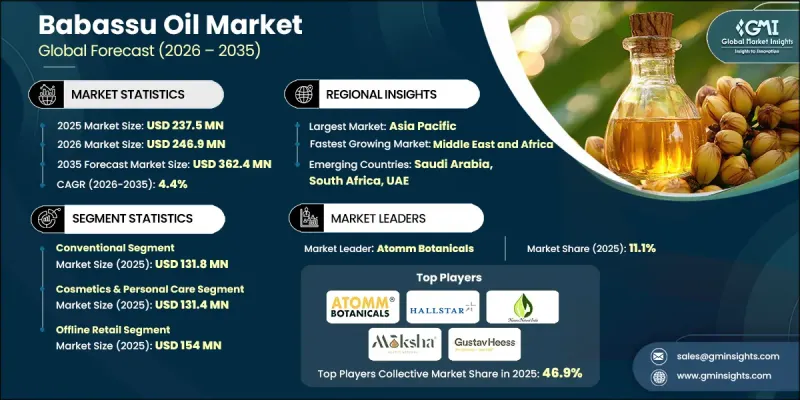
巴巴蘇油提取自原產於南美洲的巴巴蘇棕櫚樹的種子,因其質地輕盈、月桂酸含量高、香氣淡雅而備受推崇,成為個人護理、食品和工業領域用途廣泛的原料。其天然成分使其成為熱帶植物油的永續替代品,同時滿足各項性能要求。市場成長的驅動力在於人們對植物來源產品的認知不斷提高,以及各種應用領域對天然成分的需求日益成長。巴巴蘇油的生產集中在巴巴蘇棕櫚樹的生長區域,需要特定的種植方法。傳統的萃取方法,例如機械提取和冷壓,已經發展成為先進的加工技術。現代技術提高了出油率,保留了必需脂肪酸,延長了保存期限,並確保了產品品質的穩定性。技術進步和小規模機械化生產減少了廢棄物,同時保持了高品質標準,從而滿足了全球對天然功能性油脂日益成長的需求。
| 市場範圍 | |
|---|---|
| 開始年份 | 2025 |
| 預測期 | 2026-2035 |
| 上市時的市場規模 | 2.375億美元 |
| 預測金額 | 3.624億美元 |
| 複合年成長率 | 4.4% |
傳統巴巴蘇油市場預計到2025年將達到1.318億美元,憑藉其廣泛的應用、成本效益和穩定的供應,仍將是最大的細分市場。其加工方法成熟,適用於無需特殊認證的大規模生產應用。在對性能和擴充性要求極高的眾多行業中,該細分市場持續提供切實可行的優勢。
預計到2025年,化妝品和個人護理用品市場規模將達到1.314億美元。巴巴蘇油質地輕盈,保濕效果極佳,因此在乳霜、乳液、香皂和護髮產品中備受青睞。其用途廣泛,產品開發人員可以輕鬆地將其添加到產品中,以滿足不同的功能需求。在食品和飲料應用領域,巴巴蘇油的需求受地理接受度、加工規範和產品開發目標的影響,因此該油已應用於多個品類。
預計北美巴巴蘇油市場規模將從2025年的5,280萬美元成長到2035年的8,190萬美元。這一區域成長主要得益於消費者對天然成分日益成長的偏好以及個人保健產品中潔淨標示配方的普及。在美國,市場需求具有選擇性,配方開發人員在評估巴巴蘇油在化妝品應用中的適用性及其提升產品性能的潛力的同時,會充分利用現有的國內分銷網路。
目錄
第1章:調查方法和範圍
第2章執行摘要
第3章業界考察
- 生態系分析
- 供應商情況
- 利潤率
- 每個階段增加的價值
- 影響價值鏈的因素
- 中斷
- 影響產業的因素
- 促進因素
- 全球各行各業對植物來源成分的需求都在不斷成長。
- 在化妝品和個人保健產品領域不斷拓展應用。
- 人們對永續和可再生原料的興趣日益濃厚。
- 陷阱與挑戰
- 由於不同地區的收穫時間和氣候差異,供應量會出現波動。
- 影響整體一致性和擴充性結果的處理限制
- 機會
- 融入全球新興天然產物開發平臺
- 技術進步使得更有效率的萃取和加工方法得以引入。
- 促進因素
- 成長潛力分析
- 監理情勢
- 波特五力分析
- PESTEL 分析
- 科技與創新趨勢
- 當前技術趨勢
- 新興技術
- 價格趨勢
- 按地區
- 自然
- 未來市場趨勢
- 科技與創新趨勢
- 當前技術趨勢
- 新興技術
- 專利趨勢
- 貿易統計(HS編碼)
- 主要進口國
- 主要出口國
- 永續性和環境方面
- 永續計劃
- 減少廢棄物策略
- 生產中的能源效率
- 環保意識的舉措
- 考慮碳足跡
第4章 競爭情勢
- 介紹
- 企業市佔率分析
- 按地區
- 北美洲
- 歐洲
- 亞太地區
- 拉丁美洲
- 中東和非洲
- 按地區
- 企業矩陣分析
- 主要市場公司的競爭分析
- 競爭定位矩陣
- 主要進展
- 併購
- 夥伴關係與合作
- 新產品發布
- 業務拓展計劃
第5章 市場估計與預測:依類型分類,2022-2035年
- 有機的
- 傳統的
第6章 市場估計與預測:依應用領域分類,2022-2035年
- 化妝品和個人護理
- 飲食
- 製藥
- 其他
第7章 市場估價與預測:依通路分類,2022-2035年
- 線上零售
- 實體零售
第8章 市場估計與預測:依地區分類,2022-2035年
- 北美洲
- 美國
- 加拿大
- 歐洲
- 德國
- 英國
- 法國
- 西班牙
- 義大利
- 其他歐洲地區
- 亞太地區
- 中國
- 印度
- 日本
- 澳洲
- 韓國
- 亞太其他地區
- 拉丁美洲
- 巴西
- 墨西哥
- 阿根廷
- 其他拉丁美洲地區
- 中東和非洲
- 沙烏地阿拉伯
- 南非
- 阿拉伯聯合大公國
- 其他中東和非洲地區
第9章:公司簡介
- Atomm Botanicals
- Natures Natural India
- Moksha Lifestyle Products
- Pioma Chemicals
- Hallstar
- Citroleo
- Raasa Oils
- Aromaaz International
- Gustav Heess
- Kush Aroma Exports
The Global Babassu Oil Market was valued at USD 237.5 million in 2025 and is estimated to grow at a CAGR of 4.4% to reach USD 362.4 million by 2035.
Babassu oil, derived from the kernels of the babassu palm native to South America, is prized for its light texture, high lauric acid content, and subtle aroma, making it a versatile ingredient across personal care, food, and industrial sectors. Its natural composition allows it to function as a sustainable alternative to tropical oils while fulfilling performance requirements. Market growth is driven by rising awareness of plant-based products and increasing demand for natural ingredients in multiple applications. Production is concentrated in regions where babassu palms grow, requiring specific cultivation practices. Traditional extraction using mechanical and cold-press methods has largely evolved into advanced processing technologies. Modern techniques enhance oil yield, preserve essential fatty acids, extend shelf life, and ensure product consistency. Technological upgrades and small-scale mechanization reduce waste while maintaining high-quality standards, supporting the growing preference for natural, functional oils globally.
| Market Scope | |
|---|---|
| Start Year | 2025 |
| Forecast Year | 2026-2035 |
| Start Value | $237.5 Million |
| Forecast Value | $362.4 Million |
| CAGR | 4.4% |
The conventional babassu oil segment accounted for USD 131.8 million in 2025, remaining the largest segment due to its widespread adoption, cost efficiency, and steady availability. Its processing methods are well-established, making it suitable for high-volume applications that do not require specialized certifications. The segment continues to benefit from practical usability across various industries where performance and scalability are critical.
The cosmetics and personal care segment captured USD 131.4 million in 2025. Babassu oil's lightweight texture and moisturizing properties make it highly desirable for creams, lotions, soaps, and hair care formulations. Its versatility allows formulators to integrate it easily into products to meet functional requirements. In food and beverage applications, demand is influenced by regional acceptance, processing specifications, and product development objectives, ensuring the oil's adoption across multiple categories.
North American Babassu Oil Market is forecasted to grow from USD 52.8 million in 2025 to USD 81.9 million by 2035. Growth in this region is fueled by rising consumer preference for natural ingredients and the integration of clean-label formulations in personal care products. In the United States, demand is selective, with formulators assessing the oil's suitability for cosmetic products and its potential to enhance product performance while leveraging existing distribution networks across the country.
Key players operating in the Babassu Oil Market include Atomm Botanicals, Nature's Natural India, Moksha Lifestyle Products, Pioma Chemicals, Hallstar, Citroleo, Raasa Oils, Aromaaz International, Gustav Heess, and Kush Aroma Exports. Companies in the Babassu Oil Market are adopting several strategies to strengthen their position and expand their reach. They are investing in research and development to improve extraction methods, enhance product quality, and create formulations tailored for specific applications. Strategic partnerships with distributors and cosmetic formulators help expand market access and awareness. Emphasis on sustainability, including ethically sourced raw materials and eco-friendly processing, is increasing consumer trust and market appeal. Firms are also diversifying product portfolios to cater to personal care, food, and industrial applications. Investment in advanced processing equipment and mechanization ensures consistent yields, reduces waste, and supports scaling operations efficiently while maintaining high-quality standards.
Table of Contents
Chapter 1 Methodology & Scope
- 1.1 Market scope and definition
- 1.2 Research design
- 1.2.1 Research approach
- 1.2.2 Data collection methods
- 1.3 Data mining sources
- 1.3.1 Global
- 1.3.2 Regional/Country
- 1.4 Base estimates and calculations
- 1.4.1 Base year calculation
- 1.4.2 Key trends for market estimation
- 1.5 Primary research and validation
- 1.5.1 Primary sources
- 1.6 Forecast model
- 1.7 Research assumptions and limitations
Chapter 2 Executive Summary
- 2.1 Industry 360° synopsis
- 2.2 Key market trends
- 2.2.1 Nature
- 2.2.2 Application
- 2.2.3 Distribution Channel
- 2.2.4 Regional
- 2.3 TAM Analysis, 2026-2035
- 2.4 CXO perspectives: Strategic imperatives
- 2.5 Future outlook and strategic recommendations
Chapter 3 Industry Insights
- 3.1 Industry ecosystem analysis
- 3.1.1 Supplier landscape
- 3.1.2 Profit margin
- 3.1.3 Value addition at each stage
- 3.1.4 Factor affecting the value chain
- 3.1.5 Disruptions
- 3.2 Industry impact forces
- 3.2.1 Growth drivers
- 3.2.1.1 Rising preference for plant-based ingredients across industries globally
- 3.2.1.2 Expanded applications within cosmetics personal care formulations segments
- 3.2.1.3 Increasing focus on sustainable and renewable raw materials
- 3.2.2 Pitfalls/challenge
- 3.2.2.1 Supply variability due to regional harvesting and climate
- 3.2.2.2 Processing limitations affecting consistency and scalability outcomes overall
- 3.2.3 Opportunities
- 3.2.3.1 Integration into emerging natural product development pipelines worldwide
- 3.2.3.2 Advancements enabling higher efficiency extraction processing methods adoption
- 3.2.1 Growth drivers
- 3.3 Growth potential analysis
- 3.4 Regulatory landscape
- 3.4.1 North America
- 3.4.2 Europe
- 3.4.3 Asia Pacific
- 3.4.4 Latin America
- 3.4.5 Middle East & Africa
- 3.5 Porter's analysis
- 3.6 PESTEL analysis
- 3.7 Technology and innovation landscape
- 3.7.1 Current technological trends
- 3.7.2 Emerging technologies
- 3.8 Price trends
- 3.8.1 By region
- 3.8.2 By nature
- 3.9 Future market trends
- 3.10 Technology and innovation landscape
- 3.10.1 Current technological trends
- 3.10.2 Emerging technologies
- 3.11 Patent landscape
- 3.12 Trade statistics (HS code)
- 3.12.1 Major importing countries
- 3.12.2 Major exporting countries
- 3.13 Sustainability and environmental aspects
- 3.13.1 Sustainable practices
- 3.13.2 Waste reduction strategies
- 3.13.3 Energy efficiency in production
- 3.13.4 Eco-friendly initiatives
- 3.14 Carbon footprint consideration
Chapter 4 Competitive Landscape, 2025
- 4.1 Introduction
- 4.2 Company market share analysis
- 4.2.1 By region
- 4.2.1.1 North America
- 4.2.1.2 Europe
- 4.2.1.3 Asia Pacific
- 4.2.1.4 LATAM
- 4.2.1.5 MEA
- 4.2.1 By region
- 4.3 Company matrix analysis
- 4.4 Competitive analysis of major market players
- 4.5 Competitive positioning matrix
- 4.6 Key developments
- 4.6.1 Mergers & acquisitions
- 4.6.2 Partnerships & collaborations
- 4.6.3 New product launches
- 4.6.4 Expansion plans
Chapter 5 Market Estimates and Forecast, By Nature, 2022-2035 (USD Million) (Kilo Tons)
- 5.1 Key trends
- 5.2 Organic
- 5.3 Conventional
Chapter 6 Market Estimates and Forecast, By Application, 2022-2035 (USD Million) (Kilo Tons)
- 6.1 Key trends
- 6.2 Cosmetics & personal care
- 6.3 Food & beverage
- 6.4 Pharmaceutical
- 6.5 Others
Chapter 7 Market Estimates and Forecast, By Distribution Channel, 2022-2035 (USD Million) (Kilo Tons)
- 7.1 Key trends
- 7.2 Online retail
- 7.3 Offline retail
Chapter 8 Market Estimates and Forecast, By Region, 2022-2035 (USD Million) (Kilo Tons)
- 8.1 Key trends
- 8.2 North America
- 8.2.1 U.S.
- 8.2.2 Canada
- 8.3 Europe
- 8.3.1 Germany
- 8.3.2 UK
- 8.3.3 France
- 8.3.4 Spain
- 8.3.5 Italy
- 8.3.6 Rest of Europe
- 8.4 Asia Pacific
- 8.4.1 China
- 8.4.2 India
- 8.4.3 Japan
- 8.4.4 Australia
- 8.4.5 South Korea
- 8.4.6 Rest of Asia Pacific
- 8.5 Latin America
- 8.5.1 Brazil
- 8.5.2 Mexico
- 8.5.3 Argentina
- 8.5.4 Rest of Latin America
- 8.6 Middle East and Africa
- 8.6.1 Saudi Arabia
- 8.6.2 South Africa
- 8.6.3 UAE
- 8.6.4 Rest of Middle East and Africa
Chapter 9 Company Profiles
- 9.1 Atomm Botanicals
- 9.2 Natures Natural India
- 9.3 Moksha Lifestyle Products
- 9.4 Pioma Chemicals
- 9.5 Hallstar
- 9.6 Citroleo
- 9.7 Raasa Oils
- 9.8 Aromaaz International
- 9.9 Gustav Heess
- 9.10 Kush Aroma Exports

