


 |
市場調查報告書
商品編碼
2019123
獸用X光市場:商機、成長要素、產業趨勢分析及2026-2035年預測Veterinary X-ray Market Opportunity, Growth Drivers, Industry Trend Analysis, and Forecast 2026 - 2035 |
||||||

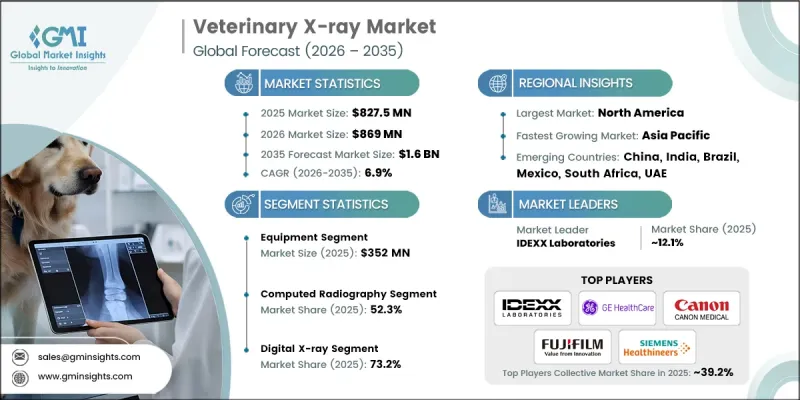
預計到 2025 年,全球獸醫 X光市場價值將達到 8.275 億美元,並以 6.9% 的複合年成長率成長,到 2035 年將達到 16 億美元。
全球伴侶動物數量的增加、寵物飼養率的上升、獸醫診斷服務需求的成長以及新興經濟體可支配收入的提高,共同推動了這個市場的成長。先進獸醫設施的擴建、尖端診斷設備的普及、動物醫院和診所數量的增加以及寵物保險滲透率的提高,都促進了市場的發展。此外,肥胖、骨關節炎、呼吸系統疾病、牙科疾病和消化系統疾病等慢性動物健康問題的日益普遍,也推動了對影像診斷解決方案的需求,進一步促進了行業的穩步成長,並促使診所採用先進的X光技術,以提供準確快速的診斷。
| 市場範圍 | |
|---|---|
| 開始年份 | 2025 |
| 預測期 | 2026-2035 |
| 上市時的市場規模 | 8.275億美元 |
| 預測金額 | 16億美元 |
| 複合年成長率 | 6.9% |
獸用X光系統是不可或缺的診斷工具,它利用電磁波產生動物骨骼、器官和軟組織的詳細影像。這些系統使獸醫能夠有效率且無痛地檢測骨折、腫瘤、外來物、牙科疾病和其他異常情況,從而支持對多種動物進行準確的醫療評估和治療方案。
受獸醫學領域對先進診斷影像解決方案需求不斷成長的推動,預計到 2025 年,該設備市場規模將達到 3.52 億美元。寵物數量的成長和動物健康支出的增加進一步推動了對高品質診斷設備的需求。
到2025年,電腦斷層掃描(CR)系統將佔據52.3%的市場。與直接X光(DR)系統相比,CR系統因其價格實惠、安裝簡單、維護成本低等優點,在獸醫實踐中更受歡迎。尤其是小規模動物醫院,更傾向於選擇CR系統,因為它們可以經濟高效地升級傳統的膠片X光設備,並在無需過多投資的情況下提供可靠的診斷成像解決方案。
到2025年,北美獸用X光市佔率將達到38.7%。寵物擁有率高,加上先進獸醫服務的普及,正在推動X光系統的廣泛應用。該地區動物醫療保健支出的增加、完善的獸醫基礎設施以及寵物保險的普及,進一步促進了市場成長,並支持了診斷影像技術的廣泛應用。
目錄
第1章:調查方法和範圍
第2章執行摘要
第3章業界考察
- 生態系分析
- 影響產業的因素
- 促進因素
- 寵物保險需求不斷成長,動物醫療保健支出也在增加
- 寵物數量增加
- 獸醫診斷影像技術的進步
- 擴大X光影像技術在獸醫整形外科、牙科和創傷學的應用。
- 產業潛在風險與挑戰
- 獸用X光設備高成本
- 輻射暴露
- 市場機遇
- 攜帶式和手持式獸醫成像系統的廣泛應用
- 將人工智慧應用於獸醫影像診斷
- 促進因素
- 成長潛力分析
- 監理情勢(基於初步調查)
- 北美洲
- 美國
- 加拿大
- 歐洲
- 亞太地區
- 北美洲
- 科技與創新趨勢
- 當前技術趨勢
- 新興技術(基於初步調查)
- 價格分析(基於初步調查)
- 未來市場趨勢(基於初步研究)
- 人工智慧/生成式人工智慧對市場的影響
- 波特五力分析
- PESTEL 分析
第4章 競爭情勢
- 介紹
- 企業市佔率分析
- 北美洲
- 歐洲
- 亞太地區
- 企業矩陣分析
- 主要市場公司的競爭分析
- 競爭定位矩陣
- 主要進展
- 併購
- 夥伴關係與合作
- 新產品發布
- 業務拓展計劃
第5章 市場估價與預測:依產品分類,2022-2035年
- 裝置
- 配件/耗材
- 軟體
第6章 市場估計與預測:依技術分類,2022-2035年
- 電腦放射成像系統
- 直接成像系統
- 基於膠片的X光成像系統
第7章 市場估計與預測:依類型分類,2022-2035年
- 數位X光系統
- 模擬X光系統
第8章 市場估計與預測:依性別分類的出行狀況,2022-2035年
- 固定式X光系統
- 攜帶式X光系統
第9章 市場估計與預測:依動物種類分類,2022-2035年
- 小型伴侶動物
- 狗
- 貓
- 其他小型伴侶動物
- 大型動物
- 馬
- 牛
- 其他大型動物
- 其他動物
第10章 市場估價與預測:依應用領域分類,2022-2035年
- 整形外科/創傷科
- 呼吸系統
- 牙科用途
- 其他用途
第11章 市場估計與預測:依最終用途分類,2022-2035年
- 獸醫醫院和診所
- 診斷影像中心
- 其他最終用戶
第12章 市場估計與預測:依地區分類,2022-2035年
- 北美洲
- 美國
- 加拿大
- 歐洲
- 德國
- 英國
- 法國
- 義大利
- 西班牙
- 荷蘭
- 亞太地區
- 中國
- 日本
- 印度
- 澳洲
- 韓國
- 拉丁美洲
- 巴西
- 墨西哥
- 阿根廷
- 中東和非洲
- 南非
- 沙烏地阿拉伯
- 阿拉伯聯合大公國
第13章:公司簡介
- Avante Animal Health
- Agfa-Gevaert Group
- Carestream Health
- Canon Medical Systems
- Examion
- Fujifilm Holdings Corporation
- GE Healthcare
- Heska Corporation
- IDEXX Laboratories
- Konica Minolta
- MinXray
- Onex Corporation
- Sedecal
- Sound
- Siemens Healthineers
- SignalPET
The Global Veterinary X-ray Market was valued at USD 827.5 million in 2025 and is estimated to grow at a CAGR of 6.9% to reach USD 1.6 billion by 2035.
The market growth is fueled by the rising global population of companion animals, increasing adoption of pets, growing demand for veterinary diagnostic services, and higher disposable incomes in emerging economies. Expansion of advanced veterinary medical facilities, the availability of cutting-edge diagnostic equipment, growth in the number of veterinary hospitals and clinics, and increasing uptake of pet insurance have all contributed to market development. Additionally, the growing prevalence of chronic animal health issues, including obesity, osteoarthritis, respiratory disorders, dental problems, and gastrointestinal conditions, is driving demand for diagnostic imaging solutions, further supporting the industry's steady growth and prompting clinics to adopt sophisticated X-ray technologies to deliver accurate and timely diagnoses.
| Market Scope | |
|---|---|
| Start Year | 2025 |
| Forecast Year | 2026-2035 |
| Start Value | $827.5 Million |
| Forecast Value | $1.6 Billion |
| CAGR | 6.9% |
Veterinary X-ray systems are essential diagnostic tools that employ electromagnetic radiation to generate detailed images of animals' bones, organs, and soft tissues. These systems help veterinarians detect fractures, tumors, foreign bodies, dental issues, and other abnormalities efficiently and painlessly, facilitating precise medical assessments and treatment planning across multiple species.
The equipment segment reached USD 352 million in 2025, due to the increasing need for advanced imaging solutions in veterinary healthcare. The rise in pet ownership and heightened spending on animal health has further propelled demand for high-quality diagnostic devices.
The computed radiography (CR) systems held a 52.3% share in 2025. CR systems are widely preferred in veterinary practices due to their affordability, ease of integration, and low maintenance costs compared with direct radiography (DR) systems. Smaller veterinary clinics particularly favor CR systems for their longer lifespan and cost-efficient upgrade from traditional film-based X-ray machines, providing dependable imaging solutions without excessive investment.
North America Veterinary X-ray Market held a 38.7% share in 2025. Strong pet ownership rates, coupled with the presence of advanced veterinary care services, drive high adoption of X-ray systems. The region's growing expenditure on animal healthcare, extensive veterinary infrastructure, and high adoption of pet insurance further reinforce market growth and support widespread utilization of diagnostic imaging technologies.
Key players in the Global Veterinary X-ray Market include Canon Medical Systems, Carestream Health, Fujifilm Holdings Corporation, GE Healthcare, Heska Corporation, IDEXX Laboratories, MinXray, Avante Animal Health, Agfa-Gevaert Group, Konica Minolta, Onex Corporation, Sedecal, Examion, Sound, SignalPET, Siemens Healthineers. Key strategies adopted by companies in the Global Veterinary X-ray Market include investing in research and development to design innovative, high-resolution imaging systems tailored for veterinary use. Firms are focusing on cost-effective solutions that cater to both large and small clinics while ensuring accuracy and reliability. Partnerships with veterinary hospitals and clinics expand market access and product adoption, while marketing initiatives highlight the diagnostic precision and efficiency of their systems. Companies also pursue geographic expansion, offering after-sales support, maintenance services, and training programs for veterinary staff. Adoption of digital imaging technologies and portable X-ray units helps strengthen market presence and enhance customer loyalty.
Table of Contents
Chapter 1 Methodology and Scope
- 1.1 Market scope and definition
- 1.2 Research approach
- 1.3 Quality commitments
- 1.3.1 GMI AI policy and data integrity commitment
- 1.3.1.1 Source consistency protocol
- 1.3.1 GMI AI policy and data integrity commitment
- 1.4 Research trail and confidence scoring
- 1.4.1 Research trail components
- 1.4.2 Scoring components
- 1.5 Data collection
- 1.5.1 Partial list of primary sources
- 1.6 Data mining sources
- 1.6.1 Paid sources
- 1.6.1.1 Sources, by region
- 1.6.1 Paid sources
- 1.7 Base estimates and calculations
- 1.7.1 Revenue share analysis
- 1.7.2 Base year calculation
- 1.8 Forecast model
- 1.9 Research transparency addendum
- 1.9.1 Source attribution framework
- 1.9.2 Quality assurance metrics
- 1.9.3 Our commitment to trust
Chapter 2 Executive Summary
- 2.1 Industry 360° synopsis
- 2.2 Key market trends
- 2.2.1 Business trends
- 2.2.2 Regional trends
- 2.2.3 Product trends
- 2.2.4 Technology trends
- 2.2.5 Type trends
- 2.2.6 Mobility trends
- 2.2.7 Animal type trends
- 2.2.8 Application trends
- 2.2.9 End use trends
- 2.3 CXO perspectives: Strategic imperatives
Chapter 3 Industry Insights
- 3.1 Industry ecosystem analysis
- 3.2 Industry impact forces
- 3.2.1 Growth drivers
- 3.2.1.1 Increasing demand for pet insurance and increasing spending on animal healthcare
- 3.2.1.2 Rise in companion animal ownership
- 3.2.1.3 Technological developments in veterinary diagnostic imaging
- 3.2.1.4 Increasing use of radiography in veterinary orthopedics, dentistry, and traumatology
- 3.2.2 Industry pitfalls and challenges
- 3.2.2.1 High cost of veterinary X-ray equipment
- 3.2.2.2 Exposure to radiation
- 3.2.3 Market opportunities
- 3.2.3.1 Rising adoption of portable and handheld veterinary imaging systems
- 3.2.3.2 Integration of artificial intelligence in veterinary imaging analysis
- 3.2.1 Growth drivers
- 3.3 Growth potential analysis
- 3.4 Regulatory landscape (Driven by Primary Research)
- 3.4.1 North America
- 3.4.1.1 U.S.
- 3.4.1.2 Canada
- 3.4.2 Europe
- 3.4.3 Asia Pacific
- 3.4.1 North America
- 3.5 Technology and innovation landscape
- 3.5.1 Current technological trends
- 3.5.2 Emerging technologies (Driven by Primary Research)
- 3.6 Pricing analysis (Driven by Primary Research)
- 3.7 Future market trends (Driven by Primary Research)
- 3.8 Impact of AI/Gen AI on the market
- 3.9 Porter's analysis
- 3.10 PESTEL analysis
Chapter 4 Competitive Landscape, 2025
- 4.1 Introduction
- 4.2 Company market share analysis
- 4.2.1 North America
- 4.2.2 Europe
- 4.2.3 Asia Pacific
- 4.3 Company matrix analysis
- 4.4 Competitive analysis of major market players
- 4.5 Competitive positioning matrix
- 4.6 Key developments
- 4.6.1 Merger and acquisition
- 4.6.2 Partnership and collaboration
- 4.6.3 New product launches
- 4.6.4 Expansion plans
Chapter 5 Market Estimates and Forecast, By Product, 2022 - 2035 ($ Mn)
- 5.1 Key trends
- 5.2 Equipment
- 5.3 Accessories/consumables
- 5.4 Software
Chapter 6 Market Estimates and Forecast, By Technology, 2022 - 2035 ($ Mn)
- 6.1 Key trends
- 6.2 Computed radiography systems
- 6.3 Direct radiography systems
- 6.4 Film-based radiography systems
Chapter 7 Market Estimates and Forecast, By Type, 2022 - 2035 ($ Mn)
- 7.1 Key trends
- 7.2 Digital X-ray systems
- 7.3 Analog X-ray systems
Chapter 8 Market Estimates and Forecast, By Mobility, 2022 - 2035 ($ Mn)
- 8.1 Key trends
- 8.2 Stationary X-ray systems
- 8.3 Portable X-ray systems
Chapter 9 Market Estimates and Forecast, By Animal Type, 2022 - 2035 ($ Mn)
- 9.1 Key trends
- 9.2 Small companion animals
- 9.2.1 Dogs
- 9.2.2 Cats
- 9.2.3 Other small companion animals
- 9.3 Large animals
- 9.3.1 Horse
- 9.3.2 Cattle
- 9.3.3 Other large animals
- 9.4 Other animals
Chapter 10 Market Estimates and Forecast, By Application, 2022 - 2035 ($ Mn)
- 10.1 Key trends
- 10.2 Orthopedics/traumatology
- 10.3 Respiratory
- 10.4 Dental application
- 10.5 Other applications
Chapter 11 Market Estimates and Forecast, By End Use, 2022 - 2035 ($ Mn)
- 11.1 Key trends
- 11.2 Veterinary hospitals and clinics
- 11.3 Diagnostic imaging centers
- 11.4 Other end users
Chapter 12 Market Estimates and Forecast, By Region, 2022 - 2035 ($ Mn)
- 12.1 Key trends
- 12.2 North America
- 12.2.1 U.S.
- 12.2.2 Canada
- 12.3 Europe
- 12.3.1 Germany
- 12.3.2 UK
- 12.3.3 France
- 12.3.4 Italy
- 12.3.5 Spain
- 12.3.6 Netherlands
- 12.4 Asia Pacific
- 12.4.1 China
- 12.4.2 Japan
- 12.4.3 India
- 12.4.4 Australia
- 12.4.5 South Korea
- 12.5 Latin America
- 12.5.1 Brazil
- 12.5.2 Mexico
- 12.5.3 Argentina
- 12.6 Middle East and Africa
- 12.6.1 South Africa
- 12.6.2 Saudi Arabia
- 12.6.3 UAE
Chapter 13 Company Profiles
- 13.1 Avante Animal Health
- 13.2 Agfa-Gevaert Group
- 13.3 Carestream Health
- 13.4 Canon Medical Systems
- 13.5 Examion
- 13.6 Fujifilm Holdings Corporation
- 13.7 GE Healthcare
- 13.8 Heska Corporation
- 13.9 IDEXX Laboratories
- 13.10 Konica Minolta
- 13.11 MinXray
- 13.12 Onex Corporation
- 13.13 Sedecal
- 13.14 Sound
- 13.15 Siemens Healthineers
- 13.16 SignalPET

 獸用放射成像系統市場:依系統類型、便攜性、目標動物、最終用戶和通路分類-2026-2032年全球市場預測
 獸醫用X光市場報告:趨勢、預測與競爭分析(至2035年)獸用X光市場:按技術、產品、動物類型、應用和最終用戶分類,全球預測,2026-2032年
 獸用X光市場-全球產業規模、佔有率、趨勢、機會和預測:按動物類型、解決方案、技術、行動裝置類型、應用、最終用途、地區和競爭格局分類,2021-2031年
 獸用X光市場規模、佔有率和趨勢分析報告:按解決方案、動物、技術、類型、便攜性、應用、最終用途、地區和細分市場預測(2025-2033年)
 全球獸醫X光市場評估:依解決方案、依動物類型、依技術、依類型、依移動性、依性別、依應用、依最終用戶、依地區、依機會、依預測(2018-2032)伴侶動物診斷市場規模、佔有率、趨勢分析報告:按產品、動物類型、類型、應用、方式、最終用途、地區、細分市場預測,2025-2033美國伴侶動物影像市場規模、佔有率、趨勢分析報告:按產品、動物類型、類型、應用、方式、最終用途、國家、細分市場預測,2025 年至 2033 年
 全球動物 X 光市場 - 2024 年至 2029 年預測