


 |
市場調查報告書
商品編碼
2019116
二氧化鈦奈米材料市場:商業機會、成長要素、產業趨勢分析及2026-2035年預測。Titanium Dioxide Nanomaterials Market Opportunity, Growth Drivers, Industry Trend Analysis, and Forecast 2026 - 2035 |
||||||

全球二氧化鈦奈米材料市場預計到 2025 年將達到 232 億美元,年複合成長率為 5.6%,到 2035 年將達到 400 億美元。
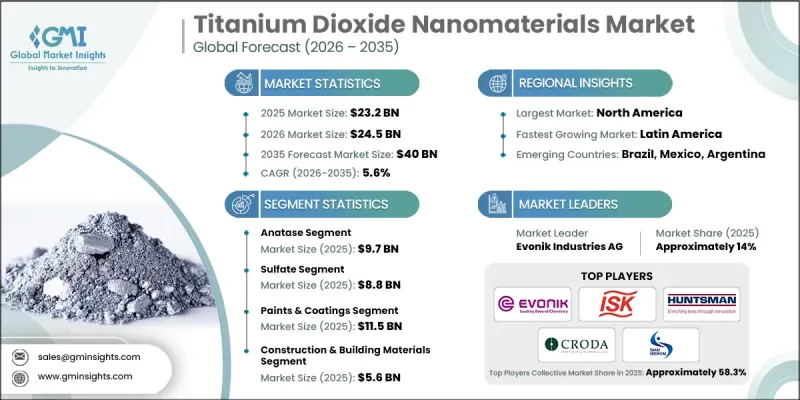
二氧化鈦奈米材料市場的成長主要受先進技術產業對高性能材料日益成長的需求所驅動。奈米級二氧化鈦的獨特性質,例如高表面反應活性和更高的光催化效率,正推動其在許多應用領域中廣泛應用。這些材料在提高裝置效率和支撐高科技製造環境創新方面發揮著至關重要的作用。此外,人們對永續材料和節能技術的日益關注也促進了市場需求。研發投入的增加以及奈米技術在各行各業日益重要的地位,進一步推動了市場成長。隨著各行業對兼具高性能、高耐久性和環境友善性的材料的需求不斷成長,預計二氧化鈦奈米材料市場將在預測期內保持強勁穩定的成長動能。
| 市場範圍 | |
|---|---|
| 開始年份 | 2025 |
| 預測期 | 2026-2035 |
| 上市時的市場規模 | 232億美元 |
| 預測金額 | 400億美元 |
| 複合年成長率 | 5.6% |
二氧化鈦奈米材料市場也受益於其在醫學和先進材料科學領域應用範圍的不斷擴大。這些奈米材料因其穩定性、與生物系統的相容性以及對高精度環境的適應性而廣受認可。將其應用於創新解決方案中,能夠促進對材料性能可靠性和高效性有更高要求的先進技術的發展。此外,隨著工業領域對支持污染防治和永續性目標的材料的採用,環境因素在需求形成過程中發揮著至關重要的作用。這些奈米材料在各種應用中增強功能性能的能力,也促使它們在工業生產過程中得到更廣泛的應用。
預計到2025年,銳鈦礦型二氧化鈦市場規模將達到97億美元,反映了其在二氧化鈦奈米材料市場的強勢地位。該細分市場憑藉其卓越的功能特性,尤其是在需要高催化效率的應用領域,持續保持成長動能。其在實現先進材料性能方面的有效性,使其在各種工業製程中廣泛應用。同時,金紅石型二氧化鈦市場也保持穩定,這得益於其在需要長期穩定性和抗環境因素的應用領域中展現出的耐久性和性能優勢。晶體結構的差異將持續影響基於特定應用需求的產品選擇。
預計到2025年,塗料市場規模將達到115億美元,凸顯其在二氧化鈦奈米材料市場的主導地位。該領域受益於二氧化鈦奈米材料增強產品耐久性、改善表面保護以及即使在惡劣環境下也能確保性能穩定的特性。奈米材料的加入能夠提升產品品質並圖使用壽命,整體在工業應用領域創造顯著價值。塑膠產業也正經歷穩定成長,這主要得益於市場對能夠提升產品強度、穩定性和整體性能的材料需求不斷成長。
預計到2025年,北美二氧化鈦奈米材料市場規模將達到82億美元,並持續維持在二氧化鈦奈米材料市場的領先地位。該地區的成長得益於強大的技術實力、先進的製造基礎設施以及材料科學領域的持續創新。高性能材料在工業應用中的日益普及也推動了市場需求的持續成長。完善的生產設施和持續的研發投入進一步鞏固了區域市場。工業應用的拓展以及對永續材料解決方案日益成長的興趣預計將在整個預測期內保持市場成長勢頭。
目錄
第1章:調查方法和範圍
第2章執行摘要
第3章業界考察
- 生態系分析
- 供應商情況
- 利潤率
- 每個階段增加的價值
- 影響價值鏈的因素
- 中斷
- 影響產業的因素
- 促進因素
- 電子和光電子產業的需求不斷成長
- 在醫療和生物技術領域不斷擴展的應用
- 環境永續性和嚴格的法規
- 產業潛在風險與挑戰
- 奈米顆粒暴露引發的健康與環境問題
- 生產成本高且難以擴大規模
- 市場機遇
- 在光催化和環境領域不斷拓展的應用
- 儲能和太陽光電技術的廣泛應用
- 促進因素
- 成長潛力分析
- 監理情勢
- 波特五力分析
- PESTEL 分析
- 價格趨勢
- 按地區
- 產品類型
- 未來市場趨勢
- 科技與創新趨勢
- 當前技術趨勢
- 新興技術
- 專利趨勢
- 貿易統計資料(HS編碼)(註:貿易統計僅提供主要國家的資料)
- 主要進口國
- 主要出口國
- 永續性和環境方面
- 永續計劃
- 減少廢棄物策略
- 生產中的能源效率
- 環保意識的舉措
第4章 競爭情勢
- 介紹
- 企業市佔率分析
- 按地區
- 北美洲
- 歐洲
- 亞太地區
- 拉丁美洲
- 中東和非洲
- 按地區
- 企業矩陣分析
- 主要市場公司的競爭分析
- 競爭定位矩陣
- 主要進展
- 併購
- 夥伴關係與合作
- 新產品發布
- 業務拓展計劃
第5章 市場估算與預測:依等級分類,2022-2035年
- 金紅石
- 銳鈦礦
- 混合相
第6章 市場估計與預測:依應用領域分類,2022-2035年
- 氯化物
- 硫酸鹽
- 溶膠-凝膠法
- 水熱法
第7章 市場估計與預測:依應用領域分類,2022-2035年
- 油漆和塗料
- 塑膠
- 紙漿和紙漿
- 印刷油墨
- 其他
第8章 市場估算與預測:依最終用途產業分類,2022-2035年
- 建材
- 住宅
- 商業和基礎設施
- 汽車和交通運輸
- 搭乘用車
- 商用車輛
- 醫療保健和製藥
- 醫療設備
- 藥物製劑
- 抗菌應用
- 消費品
- 個人保健產品
- 家居用品
- 電子與電機工程
- 家用電子電器
- 工業電子設備
- 能源與公共產業
- 太陽能
- 儲能
- 其他
- 農業
- 航太
- 防禦
第9章 市場估計與預測:依地區分類,2022-2035年
- 北美洲
- 美國
- 加拿大
- 歐洲
- 德國
- 英國
- 法國
- 西班牙
- 義大利
- 其他歐洲地區
- 亞太地區
- 中國
- 印度
- 日本
- 澳洲
- 韓國
- 亞太其他地區
- 拉丁美洲
- 巴西
- 墨西哥
- 其他拉丁美洲地區
- 中東和非洲
- 沙烏地阿拉伯
- 南非
- 阿拉伯聯合大公國
- 其他中東和非洲地區
第10章:公司簡介
- Evonik Industries AG
- Sigma-Aldrich
- ISHIHARA SANGYO KAISHA, LTD
- Huntsman International LLC
- Croda International Plc
- American Elements
- Sakai Chemical Industry Co., Ltd
- Titan Kogyo, Ltd
- Cinkarna Celje dd
- ACS Material
- Techinstro
The Global Titanium Dioxide Nanomaterials Market was valued at USD 23.2 billion in 2025 and is estimated to grow at a CAGR of 5.6% to reach USD 40 billion by 2035.
Growth in the titanium dioxide nanomaterials market is primarily supported by increasing demand from advanced technology industries that rely on high-performance materials. The unique properties of nano-scale titanium dioxide, including high surface reactivity and enhanced photocatalytic efficiency, are driving its adoption across a wide range of applications. These materials play a critical role in improving device efficiency, supporting innovation in high-tech manufacturing environments. In addition, rising interest in sustainable materials and energy-efficient technologies is reinforcing demand. Expanding investments in research and development, along with the growing importance of nanotechnology across multiple industries, are further strengthening market growth. As industries continue to seek materials that combine performance, durability, and environmental compatibility, the titanium dioxide nanomaterials market is expected to maintain a strong and consistent growth trajectory over the forecast period.
| Market Scope | |
|---|---|
| Start Year | 2025 |
| Forecast Year | 2026-2035 |
| Start Value | $23.2 Billion |
| Forecast Value | $40 Billion |
| CAGR | 5.6% |
The titanium dioxide nanomaterials market is also benefiting from its increasing utilization across healthcare and advanced material science applications. These nanomaterials are widely recognized for their stability, compatibility with biological systems, and suitability for high-precision environments. Their integration into innovative solutions is enabling the development of advanced technologies that require reliable and efficient material performance. Additionally, environmental considerations are playing a significant role in shaping demand, as industries adopt materials that support pollution control and sustainability objectives. The ability of these nanomaterials to enhance functional performance across diverse applications is contributing to their growing acceptance in industrial processes.
The anatase segment accounted for USD 9.7 billion in 2025, reflecting its strong position within the titanium dioxide nanomaterials market. This segment continues to gain traction due to its superior functional characteristics, particularly in applications requiring high catalytic efficiency. Its effectiveness in enabling advanced material performance supports its widespread adoption across various industrial processes. Meanwhile, the rutile segment maintains a stable presence due to its durability and performance advantages in applications that require long-term stability and resistance to environmental factors. The differentiation between crystalline structures continues to influence product selection based on application-specific requirements.
The paints and coatings segment generated USD 11.5 billion in 2025, highlighting its dominant role in the titanium dioxide nanomaterials market. This segment benefits from the material's ability to enhance product durability, improve surface protection, and deliver consistent performance in demanding environments. The incorporation of nano-scale materials supports improved product quality and extended lifespan, making them highly valuable across industrial applications. The plastics segment also continues to demonstrate steady growth, supported by increasing demand for materials that enhance product strength, stability, and overall performance.
North America Titanium Dioxide Nanomaterials Market accounted for USD 8.2 billion in 2025 and remains a key region within the titanium dioxide nanomaterials market. The region's growth is supported by strong technological capabilities, advanced manufacturing infrastructure, and ongoing innovation in material science. Increasing adoption of high-performance materials across industrial applications is contributing to sustained demand. The presence of well-established production facilities and continued investment in research activities are further strengthening the regional market. Expanding industrial applications and the growing emphasis on sustainable material solutions are expected to maintain growth momentum over the forecast period.
Key players involved in the Global Titanium Dioxide Nanomaterials Market include Evonik Industries AG, Sigma-Aldrich, ISHIHARA SANGYO KAISHA LTD, Huntsman International LLC, Croda International Plc, American Elements, Sakai Chemical Industry Co. Ltd, Titan Kogyo Ltd, Cinkarna Celje d.d., ACS Material, and Techinstro. Companies operating in the Global Titanium Dioxide Nanomaterials Market are focusing on enhancing their market position through continuous innovation, strategic collaborations, and expansion of production capabilities. Manufacturers are investing in research and development to improve material properties and develop advanced formulations that meet evolving industry requirements. Strengthening supply chain networks and expanding global distribution channels are key strategies to increase market reach. Firms are also emphasizing sustainability by developing environmentally friendly products and improving production processes. Partnerships with research institutions and technology providers are enabling the development of high-performance applications. Additionally, companies are prioritizing product quality, consistency, and cost efficiency to maintain competitiveness and address the growing demand for advanced nanomaterials across multiple industries.
Table of Contents
Chapter 1 Methodology & Scope
- 1.1 Market scope and definition
- 1.2 Research design
- 1.2.1 Research approach
- 1.2.2 Data collection methods
- 1.3 Data mining sources
- 1.3.1 Global
- 1.3.2 Regional/Country
- 1.4 Base estimates and calculations
- 1.4.1 Base year calculation
- 1.4.2 Key trends for market estimation
- 1.5 Primary research and validation
- 1.5.1 Primary sources
- 1.6 Forecast model
- 1.7 Research assumptions and limitations
Chapter 2 Executive Summary
- 2.1 Industry 360° synopsis
- 2.2 Key market trends
- 2.2.1 Regional
- 2.2.2 Grade
- 2.2.3 Process
- 2.2.4 Application
- 2.2.5 End Use Industry
- 2.3 TAM Analysis, 2026-2035
- 2.4 CXO perspectives: Strategic imperatives
- 2.4.1 Executive decision points
- 2.4.2 Critical success factors
- 2.5 Future Outlook and Strategic Recommendations
Chapter 3 Industry Insights
- 3.1 Industry ecosystem analysis
- 3.1.1 Supplier Landscape
- 3.1.2 Profit Margin
- 3.1.3 Value addition at each stage
- 3.1.4 Factor affecting the value chain
- 3.1.5 Disruptions
- 3.2 Industry impact forces
- 3.2.1 Growth drivers
- 3.2.1.1 Increasing demand in electronics and optoelectronics.
- 3.2.1.2 Growing applications in healthcare and biotechnology.
- 3.2.1.3 Environmental sustainability and stringent regulations.
- 3.2.2 Industry pitfalls and challenges
- 3.2.2.1 Health and environmental concerns regarding nanoparticle exposure.
- 3.2.2.2 High Production Costs and Scale-Up Challenges.
- 3.2.3 Market opportunities
- 3.2.3.1 Expanding Photocatalytic and Environmental Applications
- 3.2.3.2 Rising Penetration in Energy Storage and Solar Technologies
- 3.2.1 Growth drivers
- 3.3 Growth potential analysis
- 3.4 Regulatory landscape
- 3.4.1 North America
- 3.4.2 Europe
- 3.4.3 Asia Pacific
- 3.4.4 Latin America
- 3.4.5 Middle East & Africa
- 3.5 Porter's analysis
- 3.6 PESTEL analysis
- 3.7 Price trends
- 3.7.1 By region
- 3.7.2 Product type
- 3.8 Future market trends
- 3.9 Technology and Innovation Landscape
- 3.9.1 Current technological trends
- 3.9.2 Emerging technologies
- 3.10 Patent Landscape
- 3.11 Trade statistics (HS code) (Note: the trade statistics will be provided for key countries only)
- 3.11.1 Major importing countries
- 3.11.2 Major exporting countries
- 3.12 Sustainability and environmental aspects
- 3.12.1 Sustainable practices
- 3.12.2 Waste reduction strategies
- 3.12.3 Energy efficiency in production
- 3.12.4 Eco-friendly initiatives
Chapter 4 Competitive Landscape, 2025
- 4.1 Introduction
- 4.2 Company market share analysis
- 4.2.1 By region
- 4.2.1.1 North America
- 4.2.1.2 Europe
- 4.2.1.3 Asia Pacific
- 4.2.1.4 LATAM
- 4.2.1.5 MEA
- 4.2.1 By region
- 4.3 Company matrix analysis
- 4.4 Competitive analysis of major market players
- 4.5 Competitive positioning matrix
- 4.6 Key developments
- 4.6.1 Mergers & acquisitions
- 4.6.2 Partnerships & collaborations
- 4.6.3 New product launches
- 4.6.4 Expansion plans
Chapter 5 Market Estimates and Forecast, By Grade, 2022 - 2035 (USD billion) (Kilo Tons)
- 5.1 Key trends
- 5.2 Rutile
- 5.3 Anatase
- 5.4 Mixed Phase
Chapter 6 Market Estimates and Forecast, By Application, 2022 - 2035 (USD billion) (Kilo Tons)
- 6.1 Key trends
- 6.2 Chloride
- 6.3 Sulfate
- 6.4 Sol-Gel Process
- 6.5 Hydrothermal Process
Chapter 7 Market Estimates and Forecast, By Application, 2022 - 2035 (USD billion) (Kilo Tons)
- 7.1 Key trends
- 7.2 Paints & Coatings
- 7.3 Plastic
- 7.4 Paper and Pulp
- 7.5 Printing Inks
- 7.6 Other
Chapter 8 Market Estimates and Forecast, By End Use Industry, 2022 - 2035 (USD billion) (Kilo Tons)
- 8.1 Key trends
- 8.2 Construction & Building Materials
- 8.2.1 Residential Construction
- 8.2.2 Commercial & Infrastructure
- 8.3 Automotive & Transportation
- 8.3.1 Passenger Vehicles
- 8.3.2 Commercial Vehicles
- 8.4 Healthcare & Pharmaceuticals
- 8.4.1 Medical Devices
- 8.4.2 Pharmaceutical Formulations
- 8.4.3 Antimicrobial Applications
- 8.5 Consumer Goods
- 8.5.1 Personal Care Products
- 8.5.2 Household Products
- 8.6 Electronics & Electrical
- 8.6.1 Consumer Electronics
- 8.6.2 Industrial Electronics
- 8.7 Energy & Utilities
- 8.7.1 Solar Energy
- 8.7.2 Energy Storage
- 8.8 Others
- 8.8.1 Agriculture
- 8.8.2 Aerospace
- 8.9 Defense
Chapter 9 Market Estimates and Forecast, By Region, 2022 - 2035 (USD billion) (Kilo Tons)
- 9.1 Key trends
- 9.2 North America
- 9.2.1 U.S.
- 9.2.2 Canada
- 9.3 Europe
- 9.3.1 Germany
- 9.3.2 UK
- 9.3.3 France
- 9.3.4 Spain
- 9.3.5 Italy
- 9.3.6 Rest of Europe
- 9.4 Asia Pacific
- 9.4.1 China
- 9.4.2 India
- 9.4.3 Japan
- 9.4.4 Australia
- 9.4.5 South Korea
- 9.4.6 Rest of Asia Pacific
- 9.5 Latin America
- 9.5.1 Brazil
- 9.5.2 Mexico
- 9.5.3 Rest of Latin America
- 9.6 Middle East and Africa
- 9.6.1 Saudi Arabia
- 9.6.2 South Africa
- 9.6.3 UAE
- 9.6.4 Rest of Middle East and Africa
Chapter 10 Company Profiles
- 10.1 Evonik Industries AG
- 10.2 Sigma-Aldrich
- 10.3 ISHIHARA SANGYO KAISHA, LTD
- 10.4 Huntsman International LLC
- 10.5 Croda International Plc
- 10.6 American Elements
- 10.7 Sakai Chemical Industry Co., Ltd
- 10.8 Titan Kogyo, Ltd
- 10.9 Cinkarna Celje d.d.
- 10.10 ACS Material
- 10.11 Techinstro

 奈米材料市場:按類型、合成技術、形狀、應用和最終用途產業分類-全球市場預測(2026-2032 年)奈米多孔材料市場:按材料類型、孔徑、製造方法、形狀、應用和最終用途產業分類-2026-2032年全球市場預測奈米薄膜市場:按類型、材料、厚度、形成技術和應用分類-2026-2032年全球市場預測奈米銀市場:2026-2032年全球市場預測(依產品類型、合成方法、應用及通路分類)
 2026年全球智慧奈米建築材料市場報告
 奈米材料的全球市場(2025年)- 終端用戶,用途,競爭企業:2024年~2030年的分析與預測
 二氧化鈦奈米材料市場報告:按類型、應用和地區分類(2026-2034年)
 奈米薄膜市場規模、佔有率和成長分析:按材料、應用和地區分類-2026-2033年產業預測2034 年前智慧奈米材料的全球市場機會與策略
 奈米材料市場分析與預測(至2035年):按類型、產品類型、應用、技術、材料類型、最終用戶、形態、組件和解決方案分類