


 |
市場調查報告書
商品編碼
2019110
動物消毒劑市場商機、成長要素、產業趨勢分析及2026-2035年預測。Animal Disinfectants Market Opportunity, Growth Drivers, Industry Trend Analysis, and Forecast 2026 - 2035 |
||||||

全球動物消毒劑市場預計到 2025 年將達到 40.5 億美元,年複合成長率為 8.5%,到 2035 年將達到 88.6 億美元。
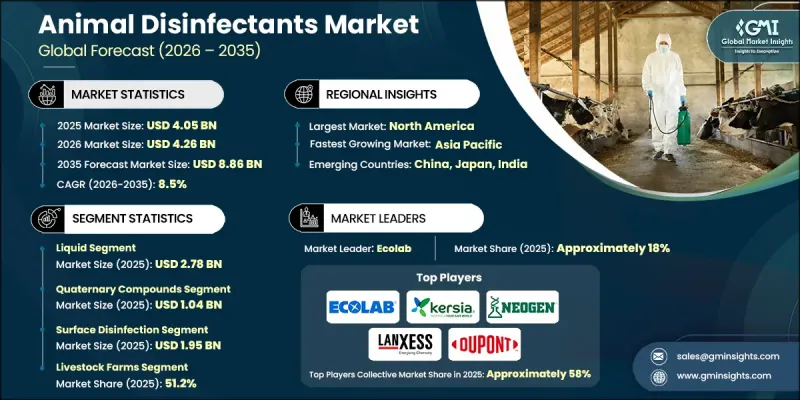
市場擴張的驅動力在於人們對整個動物飼養環境中的生物安全、疾病預防和衛生管理日益成長的關注。消毒劑在維持衛生、保障動物健康和最大限度降低感染傳播風險方面發揮著至關重要的作用。在各種產品類型中,季銨化合物因其廣譜抗菌性能、持久的殘留效果和易用性而被廣泛採用。這些化合物以其有效消毒表面並保持與材料的相容性和穩定性而聞名。人們對疾病爆發的日益關注和更嚴格的衛生規程推動了可靠消毒劑的使用,從而加速了產品創新和市場競爭。同時,基於過氧化氫的溶液也因其強大的抗菌性能和對各種應用的適應性而獲得發展動力。對配方改進和應用技術的持續投入正在提高產品的效率、安全性和易用性,從而支持動物消毒劑市場的整體發展。
| 市場範圍 | |
|---|---|
| 開始年份 | 2025 |
| 預測期 | 2026-2035 |
| 初始市場規模 | 40.5億美元 |
| 預測金額 | 88.6億美元 |
| 複合年成長率 | 8.5% |
預計到2025年,液體消毒劑市場規模將達到27.8億美元,並在2026年至2035年間以8.6%的複合年成長率成長。其強大的市場地位得益於其易用性、高效稀釋和均勻的表面覆蓋能力。這些配方與常用的供應系統相容,並可實現有效的大規模消毒。相較之下,粉狀消毒劑在注重儲存便利性、運輸效率和成本的環境中仍扮演著重要角色。儘管液體消毒劑由於其操作優勢預計將以更快的速度成長,但粉狀消毒劑仍繼續支援特定的應用場景,從而導致不同產品形式之間的需求保持平衡。
預計到2025年,季銨化合物市場規模將達到10.4億美元,並在2035年之前以8.5%的複合年成長率成長。其市場主導地位源自於其對微生物的廣譜殺菌功效、與多種表面相容性以及對日常衛生習慣的適應性。其他消毒劑類別,包括碘基、氯基、過氧化氫、有機酸和氯己定製劑,則根據環境條件、目標病原體和安全考慮,滿足特定需求。人們對製劑安全性、殘留控制和針對性應用的日益關注,推動了對傳統和新興消毒劑解決方案的穩定需求。
到2025年,北美動物消毒劑市場規模將達到13.2億美元。該地區消毒劑產品應用日益普及,這得益於完善的動物護理體系和先進的獸醫基礎設施。美國在區域需求中佔據主導地位,這主要得益於其大規模畜牧系統對衛生管理和疾病控制措施的高度重視。加拿大也透過持續實施規範的動物健康管理措施和在商業設施中嚴格遵守生物安全標準,為市場成長做出了貢獻。
目錄
第1章:調查方法
第2章執行摘要
第3章業界考察
- 生態系分析
- 供應商情況
- 利潤率
- 每個階段增加的價值
- 影響價值鏈的因素
- 中斷
- 影響產業的因素
- 促進因素
- 產業潛在風險與挑戰
- 市場機遇
- 成長潛力分析
- 監理情勢
- 北美洲
- 歐洲
- 亞太地區
- 拉丁美洲
- 中東和非洲
- 波特五力分析
- PESTEL 分析
- 價格趨勢
- 按地區
- 依產品
- 未來市場趨勢
- 科技與創新趨勢
- 當前技術趨勢
- 新興技術
- 專利趨勢
- 貿易統計
- 主要進口國
- 主要出口國
- 永續性和環境方面
- 永續計劃
- 減少廢棄物策略
- 生產中的能源效率
- 環保意識的舉措
- 關於碳足跡的考量
第4章 競爭情勢
- 介紹
- 企業市佔率分析
- 按地區
- 北美洲
- 歐洲
- 亞太地區
- 拉丁美洲
- 中東和非洲
- 按地區
- 企業矩陣分析
- 主要市場公司的競爭分析
- 競爭定位矩陣
- 主要進展
- 併購
- 夥伴關係與合作
- 新產品發布
- 業務拓展計劃
第5章 市場估計與預測:依類型分類,2022-2035年
- 液體
- 粉末
第6章 市場估計與預測:依類型分類,2022-2035年
- 季銨化合物
- 碘
- 過氧化氫
- 酚酸
- 氯
- 二氧化氯
- 乳酸
- 氯己定
- 乙醇酸
- 其他
第7章 市場估計與預測:依應用方法分類,2022-2035年
- 表面消毒
- 空中噴灑/噴灑消毒
- 水處理
- 設備消毒
第8章 市場估算與預測:依最終用途分類,2022-2035年
- 畜牧場
- 動物醫院
- 研究機構
- 其他
第9章 市場估計與預測:依地區分類,2022-2035年
- 北美洲
- 美國
- 加拿大
- 歐洲
- 德國
- 英國
- 法國
- 義大利
- 西班牙
- 其他歐洲地區
- 亞太地區
- 中國
- 印度
- 日本
- 澳洲
- 韓國
- 亞太其他地區
- 拉丁美洲
- 巴西
- 墨西哥
- 阿根廷
- 其他拉丁美洲地區
- 中東和非洲
- 沙烏地阿拉伯
- 南非
- 阿拉伯聯合大公國
- 其他中東和非洲地區
第10章:公司簡介
- Kersia Group
- Antec International
- Virox Technologies
- Ecolab(includes CID LINES)
- Christeyns
- Evonik Industries AG
- Lanxess AG
- Solvay Group
- STOCKMEIER Group
- DuPont Animal Health
- Neogen Corporation
- Kemin Industries
The Global Animal Disinfectants Market was valued at USD 4.05 billion in 2025 and is estimated to grow at a CAGR of 8.5% to reach USD 8.86 billion by 2035.
Market expansion is driven by the increasing focus on biosecurity, disease prevention, and hygiene management across animal care environments. Disinfectant solutions play a critical role in maintaining sanitary conditions, supporting animal health, and minimizing the risk of infection spread. Among the various product types, quaternary compounds are widely adopted due to their broad-spectrum antimicrobial performance, long-lasting residual effect, and operational convenience. These compounds are recognized for their ability to provide effective surface disinfection while maintaining material compatibility and stability. Growing concerns around disease outbreaks and stricter hygiene protocols are encouraging the use of reliable disinfectants, which is accelerating product innovation and competition in the market. In parallel, hydrogen peroxide-based solutions are gaining momentum due to their strong antimicrobial properties and adaptability across different applications. Continuous investment in formulation improvements and application technologies is enhancing product efficiency, safety, and ease of use, supporting the overall advancement of the animal disinfectants market.
| Market Scope | |
|---|---|
| Start Year | 2025 |
| Forecast Year | 2026-2035 |
| Start Value | $4.05 Billion |
| Forecast Value | $8.86 Billion |
| CAGR | 8.5% |
The liquid segment generated USD 2.78 billion in 2025 and is expected to grow at a CAGR of 8.6% from 2026 to 2035. Its strong market position is supported by ease of application, efficient dilution, and the ability to achieve consistent surface coverage. These formulations are compatible with commonly used delivery systems, enabling effective large-scale sanitation. In contrast, powder disinfectants remain relevant in environments where storage convenience, transport efficiency, and cost considerations are critical. While liquid formats are projected to grow at a faster pace due to operational advantages, powder-based solutions continue to support specific use cases, ensuring a balanced demand across different product forms.
The quaternary compounds segment reached USD 1.04 billion in 2025 and is anticipated to grow at a CAGR of 8.5% through 2035. Its dominance is attributed to its effectiveness across a wide range of microorganisms, compatibility with various surfaces, and suitability for routine sanitation practices. Other disinfectant categories, including iodine-based, chlorine-based, hydrogen peroxide, organic acids, and chlorhexidine formulations, address specific requirements based on environmental conditions, targeted pathogens, and safety considerations. Increasing attention to formulation safety, residue management, and targeted application is supporting steady demand across both conventional and emerging disinfectant solutions.
North America Animal Disinfectants Market accounted for USD 1.32 billion in 2025. The region demonstrates a well-established adoption of disinfectant products, supported by organized animal care systems and advanced veterinary infrastructure. The United States plays a leading role in regional demand, driven by large-scale animal production systems that prioritize hygiene and disease control measures. Canada contributes to market growth through consistent implementation of regulated animal health practices and adherence to biosecurity standards across commercial operations.
Key companies operating in the Global Animal Disinfectants Market include Lanxess AG, Evonik Industries AG, Solvay Group, Kersia Group, Ecolab (including CID LINES), Neogen Corporation, Kemin Industries, DuPont Animal Health, Christeyns, Antec International, Virox Technologies, and STOCKMEIER Group. Companies in the Animal Disinfectants Market are focusing on innovation, strategic alliances, and geographic expansion to strengthen their competitive position. They are investing in research and development to create advanced formulations with improved efficacy, safety, and environmental compatibility. Collaborations with distributors and animal health organizations are helping expand market reach and enhance product adoption. Manufacturers are also optimizing production processes and supply chains to ensure cost efficiency and consistent product availability. In addition, companies are emphasizing regulatory compliance and quality assurance to build trust and credibility.
Table of Contents
Chapter 1 Methodology
- 1.1 Market scope and definition
- 1.2 Research design
- 1.2.1 Research approach
- 1.2.2 Data collection methods
- 1.3 Data mining sources
- 1.3.1 Global
- 1.3.2 Regional/Country
- 1.4 Base estimates and calculations
- 1.4.1 Base year calculation
- 1.4.2 Key trends for market estimation
- 1.5 Primary research and validation
- 1.5.1 Primary sources
- 1.6 Forecast model
- 1.7 Research assumptions and limitations
Chapter 2 Executive Summary
- 2.1 Industry 360° synopsis
- 2.2 Key market trends
- 2.2.1 Regional
- 2.2.2 Form
- 2.2.3 Type
- 2.2.4 Application Method
- 2.2.5 End Use
- 2.3 TAM Analysis, 2026-2035
- 2.4 CXO perspectives: Strategic imperatives
Chapter 3 Industry Insights
- 3.1 Industry ecosystem analysis
- 3.1.1 Supplier Landscape
- 3.1.2 Profit Margin
- 3.1.3 Value addition at each stage
- 3.1.4 Factor affecting the value chain
- 3.1.5 Disruptions
- 3.2 Industry impact forces
- 3.2.1 Growth drivers
- 3.2.2 Industry pitfalls and challenges
- 3.2.3 Market opportunities
- 3.3 Growth potential analysis
- 3.4 Regulatory landscape
- 3.4.1 North America
- 3.4.2 Europe
- 3.4.3 Asia Pacific
- 3.4.4 Latin America
- 3.4.5 Middle East & Africa
- 3.5 Porter's analysis
- 3.6 PESTEL analysis
- 3.7 Price trends
- 3.7.1 By region
- 3.7.2 By product
- 3.8 Future market trends
- 3.9 Technology and Innovation landscape
- 3.9.1 Current technological trends
- 3.9.2 Emerging technologies
- 3.10 Patent Landscape
- 3.11 Trade statistics
- 3.11.1 Major importing countries
- 3.11.2 Major exporting countries
- 3.12 Sustainability and Environmental Aspects
- 3.12.1 Sustainable Practices
- 3.12.2 Waste Reduction Strategies
- 3.12.3 Energy Efficiency in Production
- 3.12.4 Eco-friendly Initiatives
- 3.13 Carbon Footprint Considerations
Chapter 4 Competitive Landscape, 2025
- 4.1 Introduction
- 4.2 Company market share analysis
- 4.2.1 By region
- 4.2.1.1 North America
- 4.2.1.2 Europe
- 4.2.1.3 Asia Pacific
- 4.2.1.4 LATAM
- 4.2.1.5 MEA
- 4.2.1 By region
- 4.3 Company matrix analysis
- 4.4 Competitive analysis of major market players
- 4.5 Competitive positioning matrix
- 4.6 Key developments
- 4.6.1 Mergers & acquisitions
- 4.6.2 Partnerships & collaborations
- 4.6.3 New Product Launches
- 4.6.4 Expansion Plans
Chapter 5 Market Estimates and Forecast, By Form, 2022- 2035 (USD Billion, Kilo Tons)
- 5.1 Key trends
- 5.2 Liquid
- 5.3 Powder
Chapter 6 Market Estimates and Forecast, By Type, 2022- 2035 (USD Billion, Kilo Tons)
- 6.1 Key trends
- 6.2 Quaternary Compounds
- 6.3 Iodine
- 6.4 Hydrogen Peroxide
- 6.5 Phenolic Acids
- 6.6 Chlorine
- 6.7 Chlorine Dioxide
- 6.8 Lactic Acid
- 6.9 Chlorhexidine
- 6.10 Glycolic Acid
- 6.11 Others
Chapter 7 Market Estimates and Forecast, By Application Method, 2022 - 2035 (USD Billion, Kilo Tons)
- 7.1 Key trends
- 7.2 Surface Disinfection
- 7.3 Aerial/Fogging Disinfection
- 7.4 Water Treatment
- 7.5 Equipment Sanitization
Chapter 8 Market Estimates and Forecast, By End Use, 2022 - 2035 (USD Billion, Kilo Tons)
- 8.1 Key trends
- 8.2 Livestock Farms
- 8.3 Veterinary Clinics
- 8.4 Research Laboratories
- 8.5 Others
Chapter 9 Market Estimates and Forecast, By Region, 2022 - 2035 (USD Billion, Kilo Tons)
- 9.1 Key trends
- 9.2 North America
- 9.2.1 U.S.
- 9.2.2 Canada
- 9.3 Europe
- 9.3.1 Germany
- 9.3.2 UK
- 9.3.3 France
- 9.3.4 Italy
- 9.3.5 Spain
- 9.3.6 Rest of Europe
- 9.4 Asia Pacific
- 9.4.1 China
- 9.4.2 India
- 9.4.3 Japan
- 9.4.4 Australia
- 9.4.5 South Korea
- 9.4.6 Rest of Asia Pacific
- 9.5 Latin America
- 9.5.1 Brazil
- 9.5.2 Mexico
- 9.5.3 Argentina
- 9.5.4 Rest of Latin America
- 9.6 Middle East & Africa
- 9.6.1 Saudi Arabia
- 9.6.2 South Africa
- 9.6.3 UAE
- 9.6.4 Rest of Middle East & Africa
Chapter 10 Company Profiles
- 10.1 Kersia Group
- 10.2 Antec International
- 10.3 Virox Technologies
- 10.4 Ecolab (includes CID LINES)
- 10.5 Christeyns
- 10.6 Evonik Industries AG
- 10.7 Lanxess AG
- 10.8 Solvay Group
- 10.9 STOCKMEIER Group
- 10.10 DuPont Animal Health
- 10.11 Neogen Corporation
- 10.12 Kemin Industries

 全球動物消毒劑市場:按類型、應用、動物種類、劑型、最終用戶和地區分類-預測至2031年
 動物消毒劑市場:2026-2032年全球市場預測(按產品類型、配方、活性成分、目標動物、應用、最終用戶和分銷管道分類)
 動物消毒劑市場:按類型、劑型、應用和地區分類。
 全球動物消毒劑市場規模、佔有率、趨勢和成長分析報告(2026-2034年)
 2026年全球家禽消毒劑市場報告全球畜牧消毒劑市場(按產品類型、劑型、應用、最終用戶和分銷管道分類)預測(2026-2032年)
 動物消毒劑市場規模、佔有率和成長分析(按劑型、類型、應用、動物類型、最終用戶和地區分類)—產業預測(2026-2033 年)
 動物消毒劑市場-全球產業規模、佔有率、趨勢、機會及預測,依類型、應用、劑型、地區及競爭格局分類,2020-2030年預測
 2025-2029年全球動物消毒劑市場
 到 2030 年動物消毒劑市場預測:按類型、動物類型、形式、分銷管道、應用、最終用戶和地區進行分析