

 |
市場調查報告書
商品編碼
2019031
臥室家具市場機會、成長要素、產業趨勢分析及2026-2035年預測。Bedroom Furniture Market Opportunity, Growth Drivers, Industry Trend Analysis, and Forecast 2026 - 2035 |
||||||

預計到 2025 年,全球臥室家具市場價值將達到 412 億美元,並以 3.7% 的複合年成長率成長,到 2035 年將達到 592 億美元。
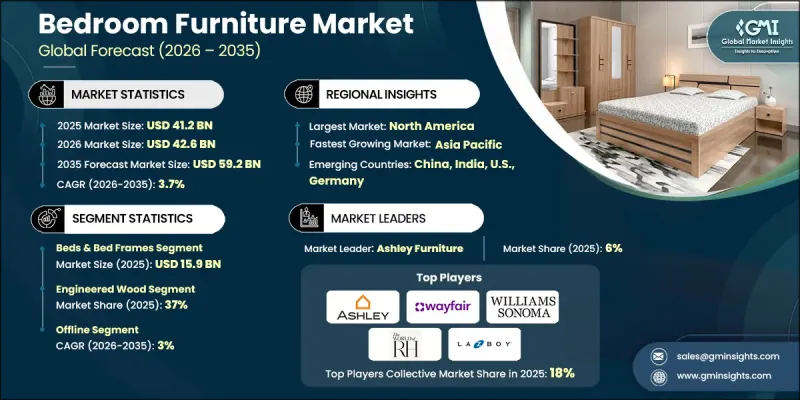
臥室家具產業的成長受到都市區增加、收入水準提高以及消費者偏好向現代、節省空間和多功能家具解決方案轉變的顯著影響。消費者對家居美學和室內升級的日益關注進一步推動了市場需求,尤其是在高階和豪華家具領域。生產技術的進步使得永續和環保材料的使用成為可能,滿足了消費者對環保責任日益成長的期望。同時,電子商務平台的快速發展使臥室家具更容易被更廣泛的客戶群所接受,提高了購買的便利性和產品供應。全球房地產開發的成長和飯店基礎設施的擴張也為市場參與企業創造了新的機遇,因為對設計精良、高品質家具的需求持續成長。儘管面臨一些營運和經濟方面的挑戰,但預計在整個預測期內,市場將保持持續穩定的成長。
| 市場範圍 | |
|---|---|
| 開始年份 | 2025 |
| 預測期 | 2026-2035 |
| 上市時的市場規模 | 412億美元 |
| 預測金額 | 592億美元 |
| 複合年成長率 | 3.7% |
預計到2025年,床及床架市場規模將達到159億美元,並在2026年至2035年間以4.1%的複合年成長率成長。推動這項市場需求的因素是消費者越來越偏好選擇兼具功能性和空間利用率的家具。消費者日益追求既能提升舒適度又能有效利用生活空間的多功能設計,這也促進了該市場的持續成長。
預計到2025年,膠合板家具市佔率將達到37%,並在2026年至2035年間以3.6%的複合年成長率成長。膠合板家具之所以廣受歡迎,是因為它經濟實惠、經久耐用且設計柔軟性。消費者被其兼具價格優勢和美觀性的特徵所吸引,使其成為各種住宅的理想選擇。
預計到2025年,美國臥室家具市場將佔據全球76%的佔有率,市場規模將達到115億美元。推動美國市場成長的主要因素包括消費者生活方式的改變、可支配收入的增加以及住宅維修支出的增加。此外,住宅開發和翻新活動的增加,以及人口成長和城市擴張,也進一步刺激了全部區域對臥室家具的需求。
目錄
第1章:調查方法和範圍
第2章執行摘要
第3章業界考察
- 生態系分析
- 供應商情況
- 利潤率
- 每個階段增加的價值
- 影響價值鏈的因素
- 中斷
- 影響產業的因素
- 促進因素
- 產業潛在風險與挑戰
- 機會
- 成長潛力分析
- 未來市場趨勢
- 科技與創新趨勢
- 當前技術趨勢
- 新興技術
- 價格分析(基於初步調查)
- 對過去價格趨勢的分析(基於初步研究)
- 根據業務類型分類的定價策略(高階/價值/成本加成)(基於初步調查)
- 法律規範
- 標準和認證
- 環境法規
- 出口和進口限制
- 交易數據分析(基於初步調查)
- 進出口數量和價值趨勢(基於初步調查)
- 主要貿易走廊和關稅的影響(基於初步調查)
- 人工智慧和生成式人工智慧對市場的影響
- 利用人工智慧改造現有經營模式
- GenAI 各細分市場的應用案例與部署藍圖
- 風險、限制和監管考量
- 分銷基礎設施和通路滲透狀況(基於初步調查)
- 按地區和業態(現代零售與傳統零售)分類的通路覆蓋率(基於初步調查)
- 最後一公里基礎設施的差異和新管道的變化(基於初步研究)
- 波特五力分析
- PESTEL 分析
- 消費行為分析
- 購買模式
- 偏好分析
- 不同地區的消費行為差異
- 電子商務對購買決策的影響
第4章 競爭情勢
- 介紹
- 企業市佔率分析
- 企業矩陣分析
- 主要市場公司的競爭分析
- 競爭定位矩陣
- 主要進展
- 併購
- 夥伴關係與合作
- 新產品發布
- 業務拓展計劃
第5章 市場估算與預測:依產品類型分類,2022-2035年
- 床和床架
- 平台床
- 板床
- 座艙罩床
- 奴隸床
- 其他(雙層床、閣樓床等)
- 衣櫃/衣櫥
- 盔甲
- 拉門衣櫃
- 鉸鏈門衣櫃
- 其他(例如,步入式衣帽間系統)
- 梳妝台和衣櫃
- 水平梳妝台
- 垂直胸部
- 其他物品(例如女用貼身內衣箱)
- 床頭櫃和床邊桌
- 傳統床頭櫃
- 附開放式層架的床頭櫃
- 其他(壁掛式床頭櫃等)
- 臥室椅
- 臥室椅
- 臥室長凳
- 其他物品(腳凳、蒲團等)
- 其他物品(梳妝台、梳妝台等)
第6章 市場估計與預測:依材料分類,2022-2035年
- 木頭
- 金屬
- 複合板
- 軟墊
- 其他(玻璃等)
第7章 市場估計與預測:依價格分類,2022-2035年
- 低於 999 美元
- 1,000 美元 – 1,999 美元
- 超過 2,000 美元
第8章 市場估算與預測:依最終使用者分類,2022-2035年
- 住宅
- 商業的
- 飯店和度假村
- 服務式公寓
- 醫療設施
- 其他(學生宿舍、學生住宅等)
第9章 市場估價與預測:依通路分類,2022-2035年
- 線上
- 電子商務
- 企業網站
- 離線
- 超級市場/大賣場
- 專業零售店
- 其他(例如獨立經營零售商店)
第10章 市場估價與預測:依地區分類,2022-2035年
- 北美洲
- 美國
- 加拿大
- 歐洲
- 德國
- 英國
- 法國
- 西班牙
- 義大利
- 荷蘭
- 亞太地區
- 中國
- 日本
- 印度
- 澳洲
- 韓國
- 拉丁美洲
- 巴西
- 墨西哥
- 阿根廷
- 中東和非洲(MEA)
- 南非
- 沙烏地阿拉伯
- 阿拉伯聯合大公國
第11章:公司簡介
- Ashley Furniture
- B&B Italia
- BoConcept
- Burrow
- Durian Industries
- Godrej & Boyce
- Herman Miller
- Knoll
- La-Z-Boy
- Natuzzi
- RH
- Rooms To Go
- Skyline Furniture
- Wayfair
- Williams-Sonoma
The Global Bedroom Furniture Market was valued at USD 41.2 billion in 2025 and is estimated to grow at a CAGR of 3.7% to reach USD 59.2 billion by 2035.
Growth in the bedroom furniture industry is shaped by rising urban populations, improving income levels, and a clear shift in consumer preferences toward modern, space-efficient, and multifunctional furniture solutions. Increasing consumer interest in home aesthetics and interior upgrades is further strengthening demand, particularly within premium and luxury categories. Advancements in production technologies are enabling the use of sustainable and eco-conscious materials, aligning with changing consumer expectations around environmental responsibility. At the same time, the rapid expansion of e-commerce platforms is making bedroom furniture more accessible to a wider customer base, improving convenience and product availability. Growth in global real estate development and the expansion of hospitality infrastructure are also creating new opportunities for market participants, as demand for well-designed and high-quality furniture continues to rise. Despite certain operational and economic challenges, the market is expected to maintain consistent and stable growth over the forecast period.
| Market Scope | |
|---|---|
| Start Year | 2025 |
| Forecast Year | 2026-2035 |
| Start Value | $41.2 Billion |
| Forecast Value | $59.2 Billion |
| CAGR | 3.7% |
The beds and bed frames segment accounted for USD 15.9 billion in 2025 and is estimated to grow at a CAGR of 4.1% during 2026-2035. Demand for these products is being driven by the increasing preference for furniture that combines functionality with space optimization. Consumers are increasingly seeking versatile designs that enhance comfort while efficiently utilizing available living space, contributing to the continued growth of this segment.
The engineered wood segment held a 37% share in 2025 and is anticipated to grow at a CAGR of 3.6% from 2026 to 2035. The popularity of engineered wood furniture is supported by its cost efficiency, durability, and design flexibility. Consumers are drawn to its ability to deliver both affordability and aesthetic appeal, making it a preferred choice across a wide range of residential applications.
United States Bedroom Furniture Market held a 76% share, generating USD 11.5 billion in 2025. Market growth in the country is being driven by evolving consumer lifestyles, higher disposable income levels, and increasing spending on home improvement. Rising residential development and renovation activities, combined with population growth and urban expansion, are further supporting demand for bedroom furniture across the region.
Key players operating in the Global Bedroom Furniture Market include Ashley Furniture, B&B Italia, BoConcept, Burrow, Durian Industries, Godrej & Boyce, Herman Miller, Knoll, La-Z-Boy, Natuzzi, RH, Rooms To Go, Skyline Furniture, Wayfair, and Williams-Sonoma. Companies in the Global Bedroom Furniture Market are focusing on expanding their product portfolios with innovative, multifunctional, and space-saving designs to meet evolving consumer needs. They are investing in sustainable materials and advanced manufacturing technologies to improve product quality and align with environmental preferences. Strengthening online presence and enhancing digital retail capabilities are key priorities to reach a broader customer base. Strategic collaborations, new product launches, and geographic expansion are helping companies increase market penetration. Businesses are also emphasizing customization options and competitive pricing strategies to attract diverse consumer segments while maintaining brand differentiation and long-term customer loyalty.
Table of Contents
Chapter 1 Methodology and scope
- 1.1 Research approach
- 1.2 Quality Commitments
- 1.2.1 GMI AI policy & data integrity commitment
- 1.2.1.1 Source consistency protocol
- 1.2.1 GMI AI policy & data integrity commitment
- 1.3 Research Trail & Confidence Scoring
- 1.3.1 Research Trail Components
- 1.3.2 Scoring Components
- 1.4 Data Collection
- 1.4.1 Partial list of primary sources
- 1.5 Data mining sources
- 1.5.1 Paid sources
- 1.5.1.1 Sources, by region
- 1.5.1 Paid sources
- 1.6 Base estimates and calculations
- 1.6.1 Base year calculation for any one approach
- 1.7 Forecast model
- 1.7.1 Quantified market impact analysis
- 1.7.1.1 Mathematical impact of growth parameters on forecast
- 1.7.1 Quantified market impact analysis
- 1.8 Research transparency addendum
- 1.8.1 Source attribution framework
- 1.8.2 Quality assurance metrics
- 1.8.3 Our commitment to trust
Chapter 2 Executive summary
- 2.1 Industry 360° synopsis
- 2.2 Key market trends
- 2.2.1 Regional
- 2.2.2 By product type
- 2.2.3 By material type
- 2.2.4 By price
- 2.2.5 By end users
- 2.2.6 By distribution channel
Chapter 3 Industry insights
- 3.1 Industry ecosystem analysis
- 3.1.1 Supplier landscape
- 3.1.2 Profit margin
- 3.1.3 Value addition at each stage
- 3.1.4 Factor affecting the value chain
- 3.1.5 Disruptions
- 3.2 Industry impact forces
- 3.2.1 Growth drivers
- 3.2.2 Industry pitfalls & challenges
- 3.2.3 Opportunities
- 3.3 Growth potential analysis
- 3.4 Future market trends
- 3.5 Technology and innovation landscape
- 3.5.1 Current technological trends
- 3.5.2 Emerging technologies
- 3.6 Pricing analysis (Driven by Primary Research)
- 3.6.1 Historical price trend analysis (Driven by Primary Research)
- 3.6.2 Pricing strategy by player type (Premium / Value / Cost-plus) (Driven by Primary Research)
- 3.7 Regulatory framework
- 3.7.1 Standards and certifications
- 3.7.2 Environmental regulations
- 3.7.3 Import export regulations
- 3.8 Trade data analysis (Driven by Primary Research)
- 3.8.1 Import/export volume & value trends (Driven by Primary Research)
- 3.8.2 Key trade corridors & tariff impact (Driven by Primary Research)
- 3.9 Impact of AI & generative AI on the market
- 3.9.1 AI-driven disruption of existing business models
- 3.9.2 GenAI use cases & adoption roadmap by segment
- 3.9.3 Risks, limitations & regulatory considerations
- 3.10 Distribution infrastructure & channel penetration landscape (Driven by Primary Research)
- 3.10.1 Channel coverage by region & format (Modern vs. Traditional Trade) (Driven by Primary Research)
- 3.10.2 Last-mile infrastructure gaps & emerging channel shifts (Driven by Primary Research)
- 3.11 Porter's five forces analysis
- 3.12 PESTEL analysis
- 3.13 Consumer behavior analysis
- 3.13.1 Purchasing patterns
- 3.13.2 Preference analysis
- 3.13.3 Regional variations in consumer behavior
- 3.13.4 Impact of e-commerce on buying decisions
Chapter 4 Competitive landscape, 2025
- 4.1 Introduction
- 4.2 Company market share analysis
- 4.2.1 North America
- 4.2.2 Europe
- 4.2.3 Asia Pacific
- 4.2.4 Latin America
- 4.2.5 MEA
- 4.3 Company matrix analysis
- 4.4 Competitive analysis of major market players
- 4.5 Competitive positioning matrix
- 4.6 Key developments
- 4.6.1 Mergers & acquisitions
- 4.6.2 Partnerships & collaborations
- 4.6.3 New product launches
- 4.6.4 Expansion plans
Chapter 5 Market Estimates & Forecast, By Product Type, 2022 - 2035 ($Billion, Thousand Units)
- 5.1 Key trends
- 5.2 Beds & bed frames
- 5.2.1 Platform beds
- 5.2.2 Panel beds
- 5.2.3 Canopy beds
- 5.2.4 Sleigh beds
- 5.2.5 Others (bunk beds & loft beds etc.)
- 5.3 Wardrobes & closets
- 5.3.1 Armoires
- 5.3.2 Sliding door wardrobes
- 5.3.3 Hinged door wardrobes
- 5.3.4 Others (walk-in closet systems etc.)
- 5.4 Dressers & chests
- 5.4.1 Horizontal dressers
- 5.4.2 Vertical chests
- 5.4.3 Others (lingerie chests etc.)
- 5.5 Nightstands & bedside tables
- 5.5.1 Traditional nightstands
- 5.5.2 Open shelf nightstands
- 5.5.3 Others (wall-mounted nightstands etc.)
- 5.6 Bedroom seating
- 5.6.1 Bedroom chairs
- 5.6.2 Bedroom benches
- 5.6.3 Others (ottomans & poufs etc.)
- 5.7 Others (vanities & dressing tables etc.)
Chapter 6 Market Estimates & Forecast, By Material Type, 2022 - 2035 ($Billion, Thousand Units)
- 6.1 Key trends
- 6.2 Wood
- 6.3 Metal
- 6.4 Engineered Wood
- 6.5 Upholstered
- 6.6 Others (glass etc.)
Chapter 7 Market Estimates & Forecast, By Price, 2022 - 2035 ($Billion, Thousand Units)
- 7.1 Key trends
- 7.2 Up to $999
- 7.3 $1,000 to 1,999
- 7.4 $2,000 and above
Chapter 8 Market Estimates & Forecast, By End User, 2022 - 2035 ($Billion, Thousand Units)
- 8.1 Key trends
- 8.2 Residential
- 8.3 Commercial
- 8.3.1 Hotels & resorts
- 8.3.2 Serviced apartments
- 8.3.3 Healthcare facilities
- 8.3.4 Others (dormitories & student housing etc.)
Chapter 9 Market Estimates & Forecast, By Distribution Channel, 2022 - 2035 ($Billion, Thousand Units)
- 9.1 Key trends
- 9.2 Online
- 9.2.1 E-commerce
- 9.2.2 Company websites
- 9.3 Offline
- 9.3.1 Supermarkets/hypermarket
- 9.3.2 Specialty retail stores
- 9.3.3 Others (independent retailer etc.)
Chapter 10 Market Estimates & Forecast, By Region, 2022 - 2035 ($Billion, Thousand Units)
- 10.1 Key trends
- 10.2 North America
- 10.2.1 U.S.
- 10.2.2 Canada
- 10.3 Europe
- 10.3.1 Germany
- 10.3.2 UK
- 10.3.3 France
- 10.3.4 Spain
- 10.3.5 Italy
- 10.3.6 Netherlands
- 10.4 Asia Pacific
- 10.4.1 China
- 10.4.2 Japan
- 10.4.3 India
- 10.4.4 Australia
- 10.4.5 South Korea
- 10.5 Latin America
- 10.5.1 Brazil
- 10.5.2 Mexico
- 10.5.3 Argentina
- 10.6 MEA
- 10.6.1 South Africa
- 10.6.2 Saudi Arabia
- 10.6.3 UAE
Chapter 11 Company Profiles
- 11.1 Ashley Furniture
- 11.2 B&B Italia
- 11.3 BoConcept
- 11.4 Burrow
- 11.5 Durian Industries
- 11.6 Godrej & Boyce
- 11.7 Herman Miller
- 11.8 Knoll
- 11.9 La-Z-Boy
- 11.10 Natuzzi
- 11.11 RH
- 11.12 Rooms To Go
- 11.13 Skyline Furniture
- 11.14 Wayfair
- 11.15 Williams-Sonoma


