

 |
市場調查報告書
商品編碼
2019028
2026 年至 2035 年化妝品和個人保健產品市場的商業機會、成長要素、產業趨勢和預測。Cosmetics and Personal Care Products Market Opportunity, Growth Drivers, Industry Trend Analysis, and Forecast 2026 - 2035 |
||||||

2025年全球化妝品和個人保健產品市場價值為4,981億美元,預計到2035年將以4.9%的複合年成長率成長至7,988億美元。
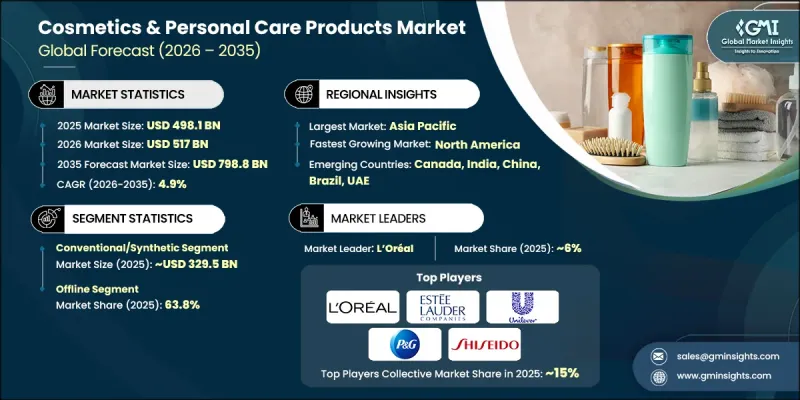
消費者對長期健康影響和環境負擔的日益關注,正促使他們轉向更清潔的替代方案。隨著消費者尋求更安全、更溫和的日常用品,對含有天然成分和永續配方的產品的需求不斷成長。這種轉變正在影響各個細分市場的購買行為,並促使產品開發策略進行調整。製造商正透過審查產品配方以滿足「潔淨標示」的要求、強調原料採購的透明度以及採用環保包裝來應對這一變化。此外,對道德採購和可再生成分日益重視,正在提升品牌價值和消費者信任度。這些因素,加上持續的創新和對健康美容解決方案日益成長的興趣,共同推動了全球化妝品和個人保健產品市場的長期成長。
| 市場範圍 | |
|---|---|
| 開始年份 | 2025 |
| 預測期 | 2026-2035 |
| 初始市場規模 | 4981億美元 |
| 預測金額 | 7988億美元 |
| 複合年成長率 | 4.9% |
預計到2025年,傳統和合成原料市場規模將達到3,295億美元,並在2026年至2035年間以4.6%的複合年成長率成長。由於合成原料具有諸多功能優勢,有助於提高產品的均勻性、穩定性和性能,因此該市場仍然至關重要。這些原料在各種應用中都能顯著提升產品的質地、耐久性和整體功效。其擴充性和可靠性使其成為大規模生產流程的理想選擇。化妝品科學的不斷進步正在進一步提升這些原料的性能和安全性,從而推動其在大眾市場和高級產品類別中的持續應用。
預計到2025年,實體銷售管道將佔據63.8%的市場佔有率,並在2026年至2035年間以4.7%的複合年成長率成長。實體店憑藉其身臨其境型的購物體驗,持續發揮主導作用,從而引導消費者做出明智的購買決策。透過店內體驗,消費者可以利用專家建議和個人化提案,更有效地探索產品。零售基礎設施的擴張,包括現代化的門市模式和品牌形象的提升,進一步促進了客流量的增加和消費者信任度的提高,從而鞏固了線下通路的市場地位。
美國化妝品和個人保健產品市場預計到2025年將達到820億美元,並在2026年至2035年間以5%的複合年成長率成長,這主要得益於消費者對自我護理、健康和高效美容解決方案日益成長的興趣。安全有效配方的需求不斷成長,促使品牌更加重視創新、透明度和永續發展。美國先進的數位生態系統也在塑造消費者的購買行為方面發揮著至關重要的作用,線上平台的發展勢頭強勁。數位互動、個人化推薦和直接面對消費者(D2C)策略正在改變消費者與品牌互動以及做出購買決策的方式。
目錄
第1章:調查方法和範圍
第2章執行摘要
第3章業界考察
- 生態系分析
- 供應商情況
- 利潤率
- 每個階段增加的價值
- 影響價值鏈的因素
- 影響產業的因素
- 促進因素
- 對天然和有機產品的需求日益成長
- 人們越來越重視衛生和自我護理
- 產品配方創新
- 產業潛在風險與挑戰
- 消費者日益成長的懷疑態度與價值意識
- 與供應鏈和原料相關的挑戰
- 促進因素
- 成長潛力分析
- 未來市場趨勢
- 科技與創新趨勢
- 當前技術趨勢
- 新興技術
- 價格趨勢
- 按地區
- 依產品類型
- 監理情勢
- 標準和合規要求
- 區域法規結構
- 認證標準
- 貿易統計
- 主要進口國
- 主要出口國
- 波特五力分析
- PESTEL 分析
- 消費行為分析
- 購買模式
- 偏好分析
- 不同地區的消費行為差異
- 電子商務對購買決策的影響
第4章 競爭情勢
- 介紹
- 企業市佔率分析
- 按地區
- 北美洲
- 歐洲
- 亞太地區
- 拉丁美洲
- 中東和非洲
- 按地區
- 企業矩陣分析
- 主要市場公司的競爭分析
- 競爭定位矩陣
- 主要進展
- 併購
- 夥伴關係與合作
- 新產品發布
- 業務拓展計劃
第5章 市場估算與預測:依產品類型分類,2022-2035年
- 個人護理
- 護膚
- 身體保養
- 防曬油
- 護髮
- 浴缸和淋浴設備
- 口腔護理
- 除臭劑和止汗劑
- 男士理容
- 香水及香氛
- 女性用衛生用品
- 化妝品和彩妝
- 臉部化妝品
- 眼部彩妝產品
- 唇部化妝品
- 美甲化妝品
- 服務
- 水療和健康服務
- 美容院
- 美甲沙龍
- 美容診所及美容治療
- 化妝服務
第6章 市場估計與預測:依原料類型分類,2022-2035年
- 天然/有機
- 常規/合成
第7章 市場估計與預測:依消費群組分類,2022-2035年
- 女士
- 男性
- 適合兒童
第8章 市場估計與預測:依價格分類,2022-2035年
- 低價位
- 中號
- 高的
第9章 市場估價與預測:依通路分類,2022-2035年
- 線上
- 電子商務
- 企業網站
- 離線
- 專賣店
- 藥局
- 沙龍
- 其他(百貨公司等)
第10章 市場估價與預測:依地區分類,2022-2035年
- 北美洲
- 美國
- 加拿大
- 歐洲
- 德國
- 英國
- 法國
- 義大利
- 西班牙
- 亞太地區
- 中國
- 印度
- 日本
- 韓國
- 澳洲
- 印尼
- 馬來西亞
- 拉丁美洲
- 巴西
- 墨西哥
- 阿根廷
- 中東和非洲(MEA)
- 沙烏地阿拉伯
- 阿拉伯聯合大公國
- 南非
第11章:公司簡介
- Amorepacific
- Avon
- Beiersdorf
- Chanel
- Coty Inc.
- 雅詩蘭黛公司
- Fenty Beauty
- Johnson &Johnson
- Kao Corporation
- L'Oreal
- LVMH(Beauty Division)
- Procter &Gamble(P&G)
- Revlon
- Shiseido
- Unilever
The Global Cosmetics & Personal Care Products Market was valued at USD 498.1 billion in 2025 and is estimated to grow at a CAGR of 4.9% to reach USD 798.8 billion by 2035.
Increasing awareness regarding long-term health effects and environmental impact is encouraging consumers to shift toward cleaner product alternatives. Demand for naturally derived and sustainably formulated products is rising as consumers seek safer, skin-friendly solutions for everyday use. This shift is influencing purchasing behavior across multiple demographics and is reshaping product development strategies. Manufacturers are adapting by reformulating their offerings to meet clean-label expectations, emphasizing transparency in ingredient sourcing, and introducing environmentally responsible packaging. Additionally, the growing importance of ethical sourcing and renewable inputs is reinforcing brand value and consumer trust. Continuous innovation, combined with rising interest in wellness-oriented beauty solutions, is supporting the long-term expansion of the global cosmetics & personal care products market.
| Market Scope | |
|---|---|
| Start Year | 2025 |
| Forecast Year | 2026-2035 |
| Start Value | $498.1 Billion |
| Forecast Value | $798.8 Billion |
| CAGR | 4.9% |
The conventional and synthetic segment generated USD 329.5 billion in 2025 and is expected to grow at a CAGR of 4.6% from 2026 to 2035. This segment remains essential due to the functional benefits provided by synthetic components, which contribute to product consistency, stability, and performance. These ingredients play a key role in enhancing texture, durability, and overall product effectiveness across a wide range of applications. Their scalability and reliability make them highly suitable for large-scale manufacturing processes. Ongoing advancements in cosmetic science are further improving the performance and safety of these materials, supporting their continued adoption across both mass-market and premium product categories.
The offline distribution channel held 63.8% share in 2025 and is anticipated to grow at a CAGR of 4.7% between 2026 and 2035. Physical retail environments continue to play a dominant role by offering immersive shopping experiences that support informed purchasing decisions. In-store engagement allows consumers to explore products more effectively, benefiting from expert guidance and personalized recommendations. The expansion of retail infrastructure, including modern store formats and enhanced brand presence, is further contributing to increased consumer footfall and trust, strengthening the position of offline channels in the market.
United States Cosmetics & Personal Care Products Market was valued at USD 82 billion in 2025 and is expected to grow at a CAGR of 5% from 2026 to 2035, driven by rising consumer interest in self-care, wellness, and high-performance beauty solutions. Increasing demand for safe and effective formulations is encouraging brands to focus on innovation, transparency, and sustainable practices. The country's advanced digital ecosystem is also playing a key role in shaping purchasing behavior, with online platforms gaining significant traction. Digital engagement, personalized recommendations, and direct-to-consumer strategies are transforming how consumers interact with brands and make purchasing decisions.
Key companies operating in the Global Cosmetics & Personal Care Products Market include L'Oreal, Estee Lauder Companies, Procter & Gamble (P&G), Unilever, Chanel, Coty Inc., Shiseido, Beiersdorf, Kao Corporation, LVMH (Beauty Division), Amorepacific, Johnson & Johnson, Avon, Revlon, and Fenty Beauty. Companies in the Cosmetics & Personal Care Products Market are strengthening their competitive position through innovation, sustainability, and digital transformation. They are investing in research and development to create high-performance formulations that align with evolving consumer preferences for safety and efficacy. Expanding product portfolios with clean-label, vegan, and eco-friendly options is a key focus area. Brands are also enhancing their digital presence through e-commerce platforms and direct-to-consumer channels to improve accessibility and customer engagement. Strategic partnerships and acquisitions are being leveraged to expand market reach and capabilities. Additionally, companies are adopting advanced marketing strategies, including personalized campaigns and data-driven insights, to build brand loyalty and maintain long-term growth.
Table of Contents
Chapter 1 Methodology & Scope
- 1.1 Market scope and definition
- 1.2 Research design
- 1.2.1 Research approach
- 1.2.2 Data collection methods
- 1.3 Data mining sources
- 1.3.1 Global
- 1.3.2 Regional/Country
- 1.4 Base estimates and calculations
- 1.4.1 Base year calculation
- 1.4.2 Key trends for market estimation
- 1.5 Primary research and validation
- 1.5.1 Primary sources
- 1.6 Forecast model
- 1.7 Research assumptions and limitations
Chapter 2 Executive Summary
- 2.1 Industry 360° synopsis
- 2.2 Key market trends
- 2.2.1 Regional
- 2.2.2 Product type
- 2.2.3 Ingredient type
- 2.2.4 Consumer group
- 2.2.5 Price
- 2.2.6 Distribution channel
Chapter 3 Industry Insights
- 3.1 Industry ecosystem analysis
- 3.1.1 Supplier landscape
- 3.1.2 Profit margin
- 3.1.3 Value addition at each stage
- 3.1.4 Factor affecting the value chain
- 3.2 Industry impact forces
- 3.2.1 Growth drivers
- 3.2.1.1 Rising demand for natural & organic products
- 3.2.1.2 Growing hygiene & self-care awareness
- 3.2.1.3 Innovation in product formulations
- 3.2.2 Industry pitfalls & challenges
- 3.2.2.1 Increasing consumer skepticism & value consciousness
- 3.2.2.2 Supply chain & raw material challenges
- 3.2.1 Growth drivers
- 3.3 Growth potential analysis
- 3.4 Future market trends
- 3.5 Technology and innovation landscape
- 3.5.1 Current technological trends
- 3.5.2 Emerging technologies
- 3.6 Price trends
- 3.6.1 By region
- 3.6.2 By product type
- 3.7 Regulatory landscape
- 3.7.1 Standards and compliance requirements
- 3.7.2 Regional regulatory frameworks
- 3.7.3 Certification standards
- 3.8 Trade statistics
- 3.8.1 Major importing countries
- 3.8.2 Major exporting countries
- 3.9 Porter's analysis
- 3.10 PESTEL analysis
- 3.11 Consumer behavior analysis
- 3.11.1 Purchasing patterns
- 3.11.2 Preference analysis
- 3.11.3 Regional variations in consumer behavior
- 3.11.4 Impact of e-commerce on buying decisions
Chapter 4 Competitive Landscape, 2025
- 4.1 Introduction
- 4.2 Company market share analysis
- 4.2.1 By Region
- 4.2.1.1 North America
- 4.2.1.2 Europe
- 4.2.1.3 Asia Pacific
- 4.2.1.4 Latin America
- 4.2.1.5 Middle East & Africa
- 4.2.1 By Region
- 4.3 Company matrix analysis
- 4.4 Competitive analysis of major market players
- 4.5 Competitive positioning matrix
- 4.6 Key developments
- 4.6.1 Mergers & acquisitions
- 4.6.2 Partnerships & collaborations
- 4.6.3 New product launches
- 4.6.4 Expansion plans
Chapter 5 Market Estimates & Forecast, By Product type, 2022 - 2035, (USD Billion) (Million Units)
- 5.1 Key trends
- 5.2 Personal care
- 5.2.1 Skincare
- 5.2.2 Body care
- 5.2.3 Sun care
- 5.2.4 Haircare
- 5.2.5 Bath & shower
- 5.2.6 Oral care
- 5.2.7 Deodorants & antiperspirants
- 5.2.8 Men's grooming
- 5.2.9 Fragrances & perfumes
- 5.2.10 Feminine hygiene
- 5.3 Makeup & color cosmetics
- 5.3.1 Facial cosmetics
- 5.3.2 Eye cosmetics
- 5.3.3 Lip cosmetics
- 5.3.4 Nail cosmetics
- 5.4 Services
- 5.4.1 Spa & wellness services
- 5.4.2 Hair salons
- 5.4.3 Nail salons
- 5.4.4 Beauty clinics & aesthetic treatments
- 5.4.5 Makeup services
Chapter 6 Market Estimates & Forecast, By Ingredient Type, 2022 - 2035, (USD Billion) (Million Units)
- 6.1 Key trends
- 6.2 Natural & organic
- 6.3 Conventional/synthetic
Chapter 7 Market Estimates & Forecast, By Consumer group, 2022 - 2035, (USD Billion) (Million Units)
- 7.1 Key trends
- 7.2 Female
- 7.3 Male
- 7.4 Kids
Chapter 8 Market Estimates & Forecast, By Price, 2022 - 2035, (USD Billion) (Million Units)
- 8.1 Key trends
- 8.2 Low
- 8.3 Medium
- 8.4 High
Chapter 9 Market Estimates & Forecast, By Distribution Channel, 2022 - 2035, (USD Billion) (Million Units)
- 9.1 Key trends
- 9.2 Online
- 9.2.1 E-commerce
- 9.2.2 Company website
- 9.3 Offline
- 9.3.1 Specialty stores
- 9.3.2 Pharmacies
- 9.3.3 Salons
- 9.3.4 Others (departmental stores, etc.)
Chapter 10 Market Estimates & Forecast, By Region, 2022 - 2035, (USD Billion) (Million Units)
- 10.1 Key trends
- 10.2 North America
- 10.2.1 U.S.
- 10.2.2 Canada
- 10.3 Europe
- 10.3.1 Germany
- 10.3.2 UK
- 10.3.3 France
- 10.3.4 Italy
- 10.3.5 Spain
- 10.4 Asia Pacific
- 10.4.1 China
- 10.4.2 India
- 10.4.3 Japan
- 10.4.4 South Korea
- 10.4.5 Australia
- 10.4.6 Indonesia
- 10.4.7 Malaysia
- 10.5 Latin America
- 10.5.1 Brazil
- 10.5.2 Mexico
- 10.5.3 Argentina
- 10.6 MEA
- 10.6.1 Saudi Arabia
- 10.6.2 UAE
- 10.6.3 South Africa
Chapter 11 Company Profiles
- 11.1 Amorepacific
- 11.2 Avon
- 11.3 Beiersdorf
- 11.4 Chanel
- 11.5 Coty Inc.
- 11.6 Estee Lauder Companies
- 11.7 Fenty Beauty
- 11.8 Johnson & Johnson
- 11.9 Kao Corporation
- 11.10 L’Oreal
- 11.11 LVMH (Beauty Division)
- 11.12 Procter & Gamble (P&G)
- 11.13 Revlon
- 11.14 Shiseido
- 11.15 Unilever

 化妝品市場:2026-2032年全球市場預測(依產品類型、成分類型、性別、年齡層、膚質及銷售管道)奢華化妝品及美容產品市場:2026-2032年全球市場預測(依產品類型、價格範圍、性別、年齡層、包裝、分銷管道及最終用戶分類)
 2026-2030年全球化妝品市場
 兒童化妝品市場-全球產業規模、佔有率、趨勢、機會與預測:按產品類型、通路、地區和競爭格局分類,2021-2031年含金化妝品市場-全球產業規模、佔有率、趨勢、機會和預測:按產品類型、膚質、最終用戶、分銷管道、地區和競爭格局分類,2021-2031年女性用化妝品市場-全球產業規模、佔有率、趨勢、機會和預測:按產品類型、天然成分、膚質、分銷管道、地區和競爭格局分類,2021-2031年
 2034年可生物分解貓砂市場預測-全球產品類型、原料、形態、應用、價格範圍、通路與區域分析零浪費化妝品市場預測至2034年-按產品類型、包裝類型、成分類型、應用、分銷管道、最終用戶和地區分類的全球分析
 聚山梨醇酯市場規模及預測(2021-2034年),全球及區域佔有率、趨勢和成長機會分析報告:按形態、類型、功能、應用和地區分類沙龍化妝品市場:按產品類型、價格範圍、最終用戶和分銷管道分類的全球市場預測,2026-2032年