

 |
市場調查報告書
商品編碼
2019027
2026 年至 2035 年模塑纖維餐具的市場機會、成長要素、產業趨勢分析與預測。Molded Fiber Tableware Market Opportunity, Growth Drivers, Industry Trend Analysis, and Forecast 2026 - 2035 |
||||||

全球模塑纖維餐具市場預計到 2025 年將價值 45 億美元,預計到 2035 年將以 5.3% 的複合年成長率成長至 75 億美元。
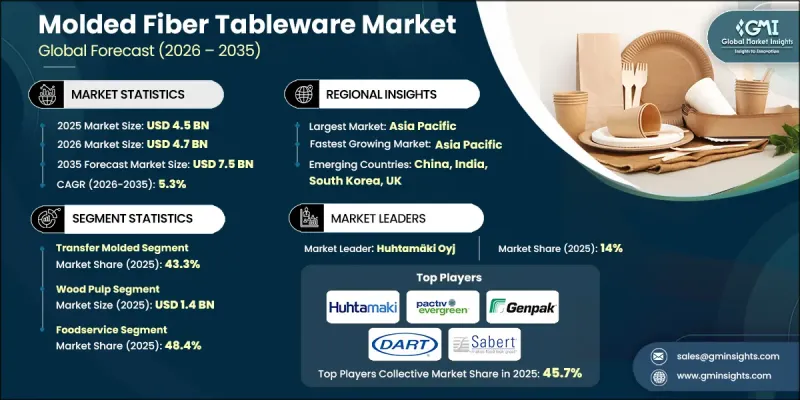
模塑纖維模塑纖維餐具市場的成長主要得益於更嚴格的法規結構限制了傳統一次性材料的使用,並增加了對環保替代品的需求。此外,可堆肥包裝解決方案的普及以及生產中可再生原料使用量的增加也推動了市場的發展。大規模餐飲服務業不斷擴大的永續發展措施也促進了向纖維基一次性產品的轉型。對永續製造流程和材料創新投入的增加也為模塑纖維餐具市場提供了支持。隨著人們對環境影響的認知不斷提高以及政策支持的加強,預計模塑纖維餐具市場在已開發市場和新興市場都將保持穩步成長。
| 市場範圍 | |
|---|---|
| 開始年份 | 2025 |
| 預測期 | 2026-2035 |
| 上市時的市場規模 | 45億美元 |
| 預測金額 | 75億美元 |
| 複合年成長率 | 5.3% |
模塑纖維餐具市場正受到公共部門對環保餐飲解決方案日益成長的需求的推動,因為機構採購持續影響大規模消費模式。此外,外帶和外帶等非現場食品消費的擴張也帶動了模塑纖維餐具市場的發展,進而推動了全球對一次性包裝的需求。快速的都市化和數位化食品生態系統的發展正在加速消費者行為的這些變化。模塑纖維餐具市場的另一個顯著趨勢是,消費者越來越偏好甘蔗渣衍生產品,因為製造商正擴大採用農產品作為永續原料。自2020年以來,隨著生產商尋求既能支持循環經濟實踐又能減少對傳統材料依賴的替代方案,這一轉變的勢頭顯著增強。
受市場對具有更高強度、更佳表面光潔度和更強防護性能的高品質產品需求不斷成長的推動,模塑纖維市場預計將在2026年至2035年間以5.9%的複合年成長率成長。這種製造方法能夠生產輕巧、精密設計的餐具,從而促進其在先進食品包裝領域的應用。其優異的性能和可堆肥性正推動著專注於永續產品創新的企業更廣泛地採用這種材料。
預計2026年至2035年間,甘蔗渣市場將以7.4%的複合年成長率成長,主要得益於農業廢棄物在環保包裝解決方案中應用日益廣泛。甘蔗渣因其耐熱性和可生物分解性,成為一次性餐具的理想材料。在全球市場,隨著原料供應量的增加和對可堆肥包裝需求的成長,甘蔗渣衍生模塑纖維產品的應用正在加速普及。
預計到2025年,北美模塑纖維餐具市場佔有率將達到23.7%,這主要得益於旨在減少一次性包裝對環境影響的更嚴格法規。隨著各組織機構為滿足合規要求和環境目標而轉向永續替代方案,該地區市場正在不斷擴張。持續的政策發展和永續性措施正在推動模塑纖維餐具解決方案的更廣泛應用,從而增強了該地區市場的前景。
目錄
第1章:調查方法和範圍
第2章執行摘要
第3章業界考察
- 生態系分析
- 供應商情況
- 利潤率
- 成本結構
- 每個階段增加的價值
- 影響價值鏈的因素
- 中斷
- 影響產業的因素
- 促進因素
- 全球禁止使用一次性塑膠食品服務
- 政府採購環保餐飲產品
- 食品配送和外帶服務的快速擴張
- 速食店的企業永續發展舉措
- 改良模塑紙漿的成型技術和阻隔塗層技術
- 產業潛在風險與挑戰
- 與塑膠和發泡材的替代品相比,成本更高。
- 如果沒有塗層,其防水防油性能將受到限制。
- 市場機遇
- 適用於飛機餐飲的高級模壓紙漿餐具。
- 高速模塑紙漿製造機械的自動化
- 促進因素
- 成長潛力分析
- 監理情勢
- 波特五力分析
- PESTEL 分析
- 科技與創新趨勢
- 當前技術趨勢
- 新興技術
- 價格趨勢
- 按地區
- 依產品
- 定價策略
- 新興經營模式
- 合規要求
- 專利和智慧財產權分析
第4章 競爭情勢
- 介紹
- 企業市佔率分析
- 按地區
- 市場集中度分析
- 主要企業的競爭標竿分析
- 財務績效比較
- 銷售量
- 利潤率
- 研究與發展(R&D)
- 產品系列比較
- 產品線寬度
- 科技
- 創新
- 區域擴張比較
- 全球擴張分析
- 服務網路覆蓋
- 按地區分類的市場滲透率
- 競爭定位矩陣
- 領導者
- 挑戰者
- 追蹤者
- 小眾玩家
- 戰略展望矩陣
- 財務績效比較
- 主要進展
- 併購
- 夥伴關係與合作
- 技術進步
- 業務拓展與投資策略
- 數位轉型計劃
- 新興/Start-Ups競爭對手的發展趨勢
第5章 市場估算與預測:依產品類型分類,2022-2035年
- 盤子
- 碗
- 托盤
- 翻蓋式容器
- 杯子
- 蓋
- 其他
第6章 市場估算與預測:依成型技術分類,2022-2035年
- 厚壁模壓
- 轉注成型
- 熱成型模塑纖維
第7章 市場估價與預測:依紡織原料分類,2022-2035年
- 渣
- 竹纖維
- 木漿
- 小麥秸稈
- 再生紙纖維
- 其他
第8章 市場估計與預測:依應用領域分類,2022-2035年
- 食品服務業
- 院內餐飲服務
- 家庭和零售
第9章 市場估計與預測:依地區分類,2022-2035年
- 北美洲
- 美國
- 加拿大
- 歐洲
- 德國
- 英國
- 法國
- 西班牙
- 義大利
- 亞太地區
- 中國
- 印度
- 日本
- 澳洲
- 韓國
- 拉丁美洲
- 巴西
- 墨西哥
- 阿根廷
- 中東和非洲
- 南非
- 沙烏地阿拉伯
- 阿拉伯聯合大公國
第10章:公司簡介
- 主要企業
- Huhtamaki Oyj
- Pactiv Evergreen Inc.
- Genpak LLC
- Dart Container Corporation
- Sabert Corporation
- 按地區分類的主要企業
- 北美洲
- Eco-Products Inc.
- Fabri-Kal Corporation
- Greenwave Products Inc.
- World Centric
- 亞太地區
- Biopac India Corporation Ltd.
- Ningbo Homelink Eco-iTech Co., Ltd.
- 歐洲
- Duni AB
- Vegware Ltd.
- 北美洲
- 特殊玩家/干擾者
- Bonitopak
- Natur-Tec Inc.
The Global Molded Fiber Tableware Market was valued at USD 4.5 billion in 2025 and is estimated to grow at a CAGR of 5.3% to reach USD 7.5 billion by 2035.
Growth in the molded fiber tableware market is driven by stricter regulatory frameworks that limit the use of conventional disposable materials and increase demand for environmentally responsible alternatives. The molded fiber tableware market is also benefiting from the growing shift toward compostable packaging solutions and the rising use of renewable raw materials in production. In addition, expanding sustainability initiatives across large-scale foodservice operations is encouraging the transition to fiber-based disposable products. The molded fiber tableware market is further supported by increasing investments in sustainable manufacturing processes and material innovation. As awareness around environmental impact continues to grow and policy support strengthens, the molded fiber tableware market is positioned for consistent growth across developed and emerging economies.
| Market Scope | |
|---|---|
| Start Year | 2025 |
| Forecast Year | 2026-2035 |
| Start Value | $4.5 Billion |
| Forecast Value | $7.5 Billion |
| CAGR | 5.3% |
The molded fiber tableware market is propelled by rising public-sector demand for environmentally responsible catering solutions, as institutional purchasing continues to influence large-scale consumption patterns. The molded fiber tableware market is also gaining traction due to the expansion of off-premise food consumption, which is increasing the global demand for disposable packaging formats. Rapid urban growth and the evolution of digital food ecosystems are accelerating this shift in consumption behavior. Another notable trend in the molded fiber tableware market is the growing preference for bagasse-derived products, as manufacturers increasingly adopt agricultural byproducts as sustainable raw materials. This transition has gained significant momentum since 2020, as producers seek alternatives that reduce reliance on traditional materials while supporting circular economy practices.
The thermoformed fiber segment is projected to grow at a CAGR of 5.9% during 2026-2035, driven by rising demand for high-quality products with improved strength, surface finish, and protective characteristics. This manufacturing approach enables the production of lightweight and precision-designed tableware, supporting its increasing use in advanced food packaging applications. The ability to combine performance efficiency with compostability is encouraging wider adoption among companies focused on sustainable product innovation.
The bagasse segment is expected to grow at a CAGR of 7.4% during 2026-2035, supported by the growing utilization of agricultural residues in eco-friendly packaging solutions. Bagasse offers strong thermal resistance and biodegradability, making it a preferred material for manufacturing disposable tableware. Increasing availability of raw materials, along with rising demand for compostable packaging, is accelerating the adoption of bagasse-based molded fiber products across global markets.
North America Molded Fiber Tableware Market held 23.7% share in 2025, driven by heightened regulatory measures aimed at reducing environmental impact from disposable packaging. The molded fiber tableware market in the region is expanding as organizations transition toward sustainable alternatives to meet compliance requirements and environmental targets. Ongoing policy developments and sustainability commitments are encouraging broader adoption of fiber-based tableware solutions, strengthening the regional market outlook.
Key companies operating in the Global Molded Fiber Tableware Market include Huhtamaki Oyj, Dart Container Corporation, Pactiv Evergreen Inc., Genpak LLC, Duni AB, Eco-Products Inc., Sabert Corporation, Vegware Ltd., World Centric, Fabri-Kal Corporation, Greenwave Products Inc., Natur-Tec Inc., Bonitopak, Ningbo Homelink Eco iTech Co., Ltd., and Biopac India Corporation Ltd. Companies in the Global Molded Fiber Tableware Market are strengthening their market position through strategic investments in sustainable material innovation and production efficiency. Many players are focusing on developing advanced manufacturing technologies to enhance product quality and reduce costs. Partnerships and collaborations across the supply chain are enabling faster adoption and broader distribution of eco-friendly solutions. Firms are also expanding their production capacities to meet increasing global demand while improving operational scalability. Additionally, companies are leveraging branding and certification strategies to align with sustainability standards and consumer expectations. Geographic expansion into emerging markets and continuous product portfolio diversification are further supporting long-term growth and competitive advantage in the molded fiber tableware market.
Table of Contents
Chapter 1 Methodology and Scope
- 1.1 Market scope and definition
- 1.2 Research design
- 1.2.1 Research approach
- 1.2.2 Data collection methods
- 1.3 Data mining sources
- 1.3.1 Global
- 1.3.2 Regional/Country
- 1.4 Base estimates and calculations
- 1.4.1 Base year calculation
- 1.4.2 Key trends for market estimation
- 1.5 Primary research and validation
- 1.5.1 Primary sources
- 1.6 Forecast model
- 1.7 Research assumptions and limitations
Chapter 2 Executive Summary
- 2.1 Industry 360° synopsis, 2022 - 2035
- 2.2 Key market trends
- 2.2.1 Product type trends
- 2.2.2 Molding technology trends
- 2.2.3 Fiber source trends
- 2.2.4 End-use trends
- 2.2.5 Regional trends
- 2.3 TAM Analysis, 2026-2035
- 2.4 CXO perspectives: Strategic imperatives
Chapter 3 Industry Insights
- 3.1 Industry ecosystem analysis
- 3.1.1 Supplier Landscape
- 3.1.2 Profit Margin
- 3.1.3 Cost structure
- 3.1.4 Value addition at each stage
- 3.1.5 Factor affecting the value chain
- 3.1.6 Disruptions
- 3.2 Industry impact forces
- 3.2.1 Growth drivers
- 3.2.1.1 Global bans on single-use plastic foodservice products
- 3.2.1.2 Government procurement of eco-friendly catering products
- 3.2.1.3 Rapid expansion of food delivery and takeaway services
- 3.2.1.4 Corporate sustainability commitments in quick-service restaurants
- 3.2.1.5 Improved molded pulp forming and barrier-coating technologies
- 3.2.2 Industry pitfalls and challenges
- 3.2.2.1 Higher cost compared to plastic and foam alternatives
- 3.2.2.2 Limited water and grease resistance without coatings
- 3.2.3 Market opportunities
- 3.2.3.1 Premium molded fiber tableware for airline catering
- 3.2.3.2 Automation in high-speed molded pulp manufacturing machines
- 3.2.1 Growth drivers
- 3.3 Growth potential analysis
- 3.4 Regulatory landscape
- 3.4.1 North America
- 3.4.2 Europe
- 3.4.3 Asia Pacific
- 3.4.4 Latin America
- 3.4.5 Middle East & Africa
- 3.5 Porter's analysis
- 3.6 PESTEL analysis
- 3.7 Technology and Innovation landscape
- 3.7.1 Current technological trends
- 3.7.2 Emerging technologies
- 3.8 Price trends
- 3.8.1 By region
- 3.8.2 By product
- 3.9 Pricing Strategies
- 3.10 Emerging Business Models
- 3.11 Compliance Requirements
- 3.12 Patent and IP analysis
Chapter 4 Competitive Landscape, 2025
- 4.1 Introduction
- 4.2 Company market share analysis
- 4.2.1 By region
- 4.2.1.1 North America
- 4.2.1.2 Europe
- 4.2.1.3 Asia Pacific
- 4.2.1.4 Latin America
- 4.2.1.5 Middle East & Africa
- 4.2.2 Market concentration analysis
- 4.2.1 By region
- 4.3 Competitive benchmarking of key players
- 4.3.1 Financial performance comparison
- 4.3.1.1 Revenue
- 4.3.1.2 Profit margin
- 4.3.1.3 R&D
- 4.3.2 Product portfolio comparison
- 4.3.2.1 Product range breadth
- 4.3.2.2 Technology
- 4.3.2.3 Innovation
- 4.3.3 Geographic presence comparison
- 4.3.3.1 Global footprint analysis
- 4.3.3.2 Service network coverage
- 4.3.3.3 Market penetration by region
- 4.3.4 Competitive positioning matrix
- 4.3.4.1 Leaders
- 4.3.4.2 Challengers
- 4.3.4.3 Followers
- 4.3.4.4 Niche players
- 4.3.5 Strategic outlook matrix
- 4.3.1 Financial performance comparison
- 4.4 Key developments
- 4.4.1 Mergers and acquisitions
- 4.4.2 Partnerships and collaborations
- 4.4.3 Technological advancements
- 4.4.4 Expansion and investment strategies
- 4.4.5 Digital transformation initiatives
- 4.5 Emerging/ startup competitors landscape
Chapter 5 Market Estimates and Forecast, By Product Type, 2022 - 2035 (USD Million)
- 5.1 Key trends
- 5.2 Plates
- 5.3 Bowls
- 5.4 Trays
- 5.5 Clamshell containers
- 5.6 Cups
- 5.7 Lids
- 5.8 Others
Chapter 6 Market Estimates and Forecast, By Molding Technology, 2022 - 2035 (USD Million)
- 6.1 Key trends
- 6.2 Thick wall molded
- 6.3 Transfer molded
- 6.4 Thermoformed fiber
Chapter 7 Market Estimates and Forecast, By Fiber Source, 2022 - 2035 (USD Million)
- 7.1 Key trends
- 7.2 Bagasse
- 7.3 Bamboo fiber
- 7.4 Wood pulp
- 7.5 Wheat straw
- 7.6 Recycled paper fiber
- 7.7 Others
Chapter 8 Market Estimates and Forecast, By End-Use, 2022 - 2035 (USD Million)
- 8.1 Key trends
- 8.2 Foodservice
- 8.3 Institutional dining
- 8.4 Household/retail
Chapter 9 Market Estimates and Forecast, By Region, 2022 - 2035 (USD Million)
- 9.1 Key trends
- 9.2 North America
- 9.2.1 U.S.
- 9.2.2 Canada
- 9.3 Europe
- 9.3.1 Germany
- 9.3.2 UK
- 9.3.3 France
- 9.3.4 Spain
- 9.3.5 Italy
- 9.4 Asia Pacific
- 9.4.1 China
- 9.4.2 India
- 9.4.3 Japan
- 9.4.4 Australia
- 9.4.5 South Korea
- 9.5 Latin America
- 9.5.1 Brazil
- 9.5.2 Mexico
- 9.5.3 Argentina
- 9.6 Middle East and Africa
- 9.6.1 South Africa
- 9.6.2 Saudi Arabia
- 9.6.3 UAE
Chapter 10 Company Profiles
- 10.1 Global Key Players
- 10.1.1 Huhtamaki Oyj
- 10.1.2 Pactiv Evergreen Inc.
- 10.1.3 Genpak LLC
- 10.1.4 Dart Container Corporation
- 10.1.5 Sabert Corporation
- 10.2 Regional key players
- 10.2.1 North America
- 10.2.1.1 Eco-Products Inc.
- 10.2.1.2 Fabri-Kal Corporation
- 10.2.1.3 Greenwave Products Inc.
- 10.2.1.4 World Centric
- 10.2.2 Asia Pacific
- 10.2.2.1 Biopac India Corporation Ltd.
- 10.2.2.2 Ningbo Homelink Eco-iTech Co., Ltd.
- 10.2.3 Europe
- 10.2.3.1 Duni AB
- 10.2.3.2 Vegware Ltd.
- 10.2.1 North America
- 10.3 Niche Players/Disruptors
- 10.3.1 Bonitopak
- 10.3.2 Natur-Tec Inc.

 模製餐具產品市場:全球市場預測,2026-2032年餐具市場:全球市場預測,2026-2032年商用餐具及服務市場:全球市場預測(2026-2032 年)
 調理食品餐盒市場規模、佔有率和成長分析:按材料、產品類型、應用、最終用戶、封裝方法、分銷管道和地區分類-2026-2033年產業預測
 瓷器餐具市場規模、佔有率和成長分析:按產品類型、應用、分銷管道和地區分類-2026-2033年產業預測
 餐具市場規模、佔有率和成長分析:按產品類型、材料、應用、銷售管道和地區分類-2026-2033年產業預測食品托盤市場:按類型、材料、可重複使用性、形狀、製造流程、應用、最終用戶和分銷管道分類-2026-2032年全球市場預測
 全球有機餐具市場規模、佔有率、趨勢和成長分析報告(2026-2034年)
 不鏽鋼茶壺市場 - 全球產業規模、佔有率、趨勢、機會、預測:按類型、銷售管道、地區和競爭格局分類,2021-2031年廚房用品市場-全球產業規模、佔有率、趨勢、機會、預測:按類型、應用、地區和競爭格局分類,2021-2031年