

 |
市場調查報告書
商品編碼
2019017
照片印表機市場機會、成長要素、產業趨勢分析及2026-2035年預測。Photo Printer Market Opportunity, Growth Drivers, Industry Trend Analysis, and Forecast 2026 - 2035 |
||||||

預計到 2025 年,全球相片印表機市場價值將達到 298 億美元,並以 5.2% 的複合年成長率成長,到 2035 年將達到 488 億美元。
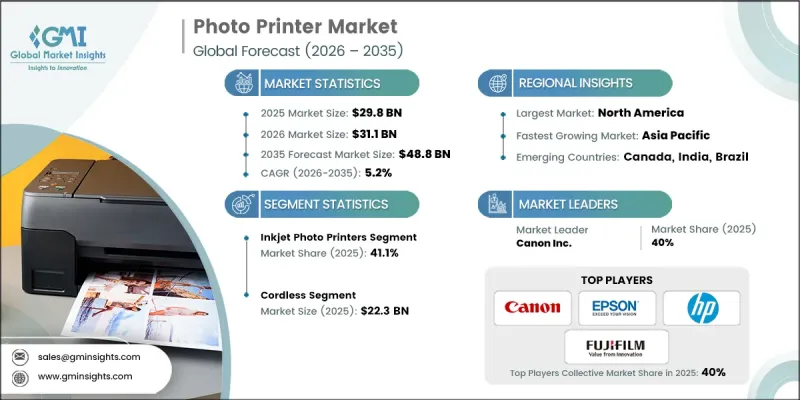
照片印表機市場的成長得益於成像技術、行動連線和即時列印功能的不斷進步,這些進步正在重塑消費者和專業人士與印刷媒體的互動方式。行業整合也透過提高營運效率和增強競爭力,促進了市場擴張。從傳統照片列印方式到行動裝置按需解決方案的轉變,顯著改變了使用者的期望,帶來了更大的便利性和更快的輸出速度。先進的列印技術能夠增強個人化和創意性,並實現即時輸出,使其對各類用戶極具吸引力。無縫多裝置連接、智慧影像處理和整合式雲端工作流程等創新技術,正在提升列印品質和整體使用者體驗。此外,採用先進的影像最佳化工具和自動校正技術,可即時最佳化照片輸出,從而增強現代照片列印解決方案的價值提案。
| 市場範圍 | |
|---|---|
| 開始年份 | 2025 |
| 預測期 | 2026-2035 |
| 初始市場規模 | 298億美元 |
| 預測金額 | 488億美元 |
| 複合年成長率 | 5.2% |
預計到2025年,噴墨照片印表機市佔率將達到41.1%,市場規模將達到122億美元。該細分市場之所以能夠持續領先,是因為其適應性強、色彩還原能力廣,並且無論在個人還是商用方面都具有很高的性價比。
預計到2035年,無線照片印表機市場將以5.3%的複合年成長率成長。這一成長主要得益於消費者對行動列印解決方案日益成長的需求,他們越來越傾向於選擇能夠與智慧型手機無縫整合的靈活便攜設備。無線功能、緊湊機殼和易用性等特性正在推動無線照片印表機的普及。消費者對即時列印和實體照片輸出的便利性偏好的需求,進一步促進了該市場的擴張,尤其是在那些尋求快速便捷列印解決方案的數位化使用者群體中。
預計到2025年,北美照片印表機市場規模將達到92.4億美元,並在2035年之前以5.1%的複合年成長率成長。該地區受益於對攜帶式、先進照片列印設備的強勁需求,這得益於娛樂、零售和個人文件管理等應用領域的廣泛採用。成熟的消費性電子生態系統和主要製造商的存在正在加速智慧影像處理和雲端列印解決方案等先進技術的普及。
目錄
第1章:調查方法和範圍
第2章執行摘要
第3章業界考察
- 生態系分析
- 供應商情況
- 利潤率
- 每個階段增加的價值
- 影響價值鏈的因素
- 影響產業的因素
- 促進因素
- 社群媒體與“即時滿足感”
- 人工智慧驅動的個人化
- 擴增實境(AR)整合
- 產業潛在風險與挑戰
- 耗材成本高
- 數位化進程
- 機會
- 列印即服務 (PaaS) 的成長與擴張
- 電子產品和智慧包裝的成長
- 促進因素
- 成長潛力分析
- 未來市場趨勢
- 科技與創新趨勢
- 當前技術趨勢
- 新興技術
- 價格分析(基於初步調查)
- 對過去價格趨勢的分析(基於初步研究)
- 根據業務類型分類的定價策略(高階/價值/成本加成)(基於初步調查)
- 監理情勢
- 標準和合規要求
- 區域法規結構
- 認證標準
- 波特五力分析
- PESTEL 分析
- 貿易數據分析(基於初步調查)
- 進出口數量和價值趨勢(基於初步調查)
- 主要貿易走廊及關稅影響(基於初步調查)
- 人工智慧和生成式人工智慧對市場的影響
- 人工智慧驅動的列印管理和預測性維護
- 針對特定領域的生成式人工智慧應用案例和實施藍圖
- 風險、限制和監管考量
- 基礎設施和實施情況(基於初步調查)
- 按地區和購買者群體分類的採用率和滲透率(基於初步調查)
- 基礎設施投資的可擴展性限制和趨勢(基於初步調查)
第4章 競爭情勢
- 介紹
- 企業市佔率分析
- 按地區
- 企業矩陣分析
- 主要市場公司的競爭分析
- 競爭定位矩陣
- 主要進展
- 併購
- 夥伴關係與合作
- 新產品發布
- 業務拓展計劃
第5章 市場估計與預測:依類型分類,2022-2035年
- 噴墨照片印表機
- 熱昇華印表機
- 熱傳遞
- 轉印印表機
- 其他(壓電式噴墨印表機、雷射相片印表機等)
第6章 市場估算與預測:以連結方式分類,2022-2035年
- 有線
- 無線
第7章 市場估計與預測:依價格分類,2022-2035年
- 低的
- 中等的
- 高的
第8章 市場估算與預測:依最終使用者分類,2022-2035年
- 專業攝影師
- 普通用戶
- 攝影工作室
- 活動企劃
- 其他(教育機構、小規模企業主等)
第9章 市場估價與預測:依銷售管道分類,2022-2035年
- 線上
- 電子商務
- 企業網站
- 離線
- 量販店
- 專業照片處理
- 其他
第10章 市場估價與預測:依地區分類,2022-2035年
- 北美洲
- 美國
- 加拿大
- 歐洲
- 德國
- 英國
- 法國
- 義大利
- 西班牙
- 亞太地區
- 中國
- 日本
- 印度
- 澳洲
- 韓國
- 拉丁美洲
- 巴西
- 墨西哥
- 阿根廷
- 中東和非洲
- 南非
- 沙烏地阿拉伯
- 阿拉伯聯合大公國
第11章:公司簡介
- Brother Industries
- Canon Inc.
- Citizen Systems
- DNP(Dai Nippon Printing)
- Epson Corporation
- Fujifilm Holdings
- HiTi Digital, Inc.
- HP Inc.
- Kodak Alaris
- Lifeprint
- Mitsubishi Electric
- Polaroid
- Prinics(Kodak Brand)
- Ricoh Company
- Sinfonia Technology
The Global Photo Printer Market was valued at USD 29.8 billion in 2025 and is estimated to grow at a CAGR of 5.2% to reach USD 48.8 billion by 2035.
The growth of the photo printer market is driven by continuous advancements across imaging technologies, mobile integration, and instant printing capabilities, which are reshaping how consumers and professionals interact with printed media. Increasing industry consolidation is also contributing to market expansion by enhancing operational efficiencies and strengthening competitive positioning. The transition from traditional photo printing methods to modern, mobile-enabled, and on-demand solutions has significantly transformed user expectations, enabling greater convenience and faster output. Advanced printing technologies now support enhanced personalization, creativity, and immediate results, making them highly appealing across various user groups. Innovations such as seamless multi-device connectivity, intelligent image processing, and integrated cloud-based workflows are improving both print quality and overall user experience. In addition, the adoption of advanced image optimization tools and automated enhancement technologies is enabling real-time improvements in photo output, reinforcing the value proposition of modern photo printing solutions.
| Market Scope | |
|---|---|
| Start Year | 2025 |
| Forecast Year | 2026-2035 |
| Start Value | $29.8 Billion |
| Forecast Value | $48.8 Billion |
| CAGR | 5.2% |
The inkjet photo printers segment held 41.1% share in 2025 and generated USD 12.2 billion. This segment continues to lead due to its adaptability, wide color reproduction capabilities, and cost efficiency across both personal and professional use cases.
The cordless photo printer segment is expected to grow at a CAGR of 5.3% through 2035. The rising demand for mobile-centric printing solutions is driving this growth, as consumers increasingly prefer flexible and portable devices that integrate seamlessly with smartphones. Features such as wireless functionality, compact form factors, and ease of use are enhancing adoption. The growing preference for instant printing and convenient access to physical photo outputs is further supporting segment expansion, particularly among digitally engaged users seeking quick and accessible printing solutions.
North America Photo Printer Market reached USD 9.24 billion in 2025 and is projected to grow at a CAGR of 5.1% through 2035. The region benefits from strong demand for portable and advanced photo printing devices, supported by widespread adoption across entertainment, retail, and personal documentation applications. A well-established consumer electronics ecosystem and the presence of leading manufacturers are enabling faster adoption of advanced technologies, including intelligent image processing and cloud-enabled printing solutions.
Key companies operating in the Global Photo Printer Market include Brother Industries, Canon Inc., Citizen Systems, DNP (Dai Nippon Printing), Epson Corporation, Fujifilm Holdings, HiTi Digital, Inc., HP Inc., Kodak Alaris, Lifeprint, Mitsubishi Electric, Polaroid, Prinics (Kodak Brand), Ricoh Company, and Sinfonia Technology. Companies in the Global Photo Printer Market are reinforcing their competitive position through continuous innovation and strategic expansion initiatives. They are investing in advanced printing technologies to improve image quality, speed, and device efficiency. Businesses are also focusing on developing compact, wireless-enabled products that align with evolving consumer preferences for mobility and convenience. Strategic collaborations and partnerships are being leveraged to enhance product portfolios and expand market reach. In addition, firms are integrating smart features such as cloud connectivity and intelligent image processing to deliver enhanced user experiences. Companies are also strengthening distribution networks and optimizing supply chains to improve accessibility, while aligning their offerings with changing consumer behavior to maintain a strong foothold in the market.
Table of Contents
Chapter 1 Methodology and Scope
- 1.1 Market scope and definition
- 1.2 Research design
- 1.2.1 Research approach
- 1.2.2 Data collection methods
- 1.3 Data mining sources
- 1.3.1 Global
- 1.3.2 Regional/Country
- 1.4 Base estimates and calculations
- 1.4.1 Base year calculation
- 1.4.2 Key trends for market estimation
- 1.5 Primary research and validation
- 1.5.1 Primary sources
- 1.6 Forecast model
- 1.7 Research assumptions and limitations
Chapter 2 Executive Summary
- 2.1 Industry 360° synopsis
- 2.2 Key market trends
- 2.2.1 Regional
- 2.2.2 Type
- 2.2.3 Connectivity
- 2.2.4 Price
- 2.2.5 End User
- 2.2.6 Distribution Channel
- 2.3 CXO perspectives: Strategic imperatives
- 2.3.1 Key decision points for industry executives
- 2.3.2 Critical success factors for market players
- 2.4 Future outlook and strategic recommendations
Chapter 3 Industry Insights
- 3.1 Industry ecosystem analysis
- 3.1.1 Supplier landscape
- 3.1.2 Profit margin
- 3.1.3 Value addition at each stage
- 3.1.4 Factor affecting the value chain
- 3.2 Industry impact forces
- 3.2.1 Growth drivers
- 3.2.1.1 Social Media & "Instant Gratification"
- 3.2.1.2 AI-Assisted Personalization
- 3.2.1.3 AR (Augmented Reality) Integration
- 3.2.2 Industry pitfalls & challenges
- 3.2.2.1 High Consumable Cost Burn
- 3.2.2.2 Increasing Digital Dominance
- 3.2.3 Opportunities
- 3.2.3.1 Increasing growth of Printing-as-a-Service (PaaS)
- 3.2.3.2 Growth in Electronics & Smart Packaging
- 3.2.1 Growth drivers
- 3.3 Growth potential analysis
- 3.4 Future market trends
- 3.5 Technology and innovation landscape
- 3.5.1 Current technological trends
- 3.5.2 Emerging technologies
- 3.6 Pricing Analysis (Driven by Primary Research)
- 3.6.1 Historical Price Trend Analysis (Driven by Primary Research)
- 3.6.2 Pricing Strategy by Player Type (Premium / Value / Cost-Plus) (Driven by Primary Research)
- 3.7 Regulatory landscape
- 3.7.1 Standards and compliance requirements
- 3.7.2 Regional regulatory frameworks
- 3.7.3 Certification standards
- 3.8 Porter's analysis
- 3.9 PESTEL analysis
- 3.10 Trade Data Analysis (Driven by Primary Research)
- 3.10.1 Import/Export Volume & Value Trends (Driven by Primary Research)
- 3.10.2 Key Trade Corridors & Tariff Impact (Driven by Primary Research)
- 3.11 Impact of AI & Generative AI on the Market
- 3.11.1 AI-Driven Print Management & Predictive Maintenance
- 3.11.2 GenAI Use Cases & Adoption Roadmap by Segment
- 3.11.3 Risks, Limitations & Regulatory Considerations
- 3.12 Infrastructure & Deployment Landscape (Driven by Primary Research)
- 3.12.1 Deployment Penetration by Region & Buyer Segment (Driven by Primary Research)
- 3.12.2 Scalability Constraints & Infrastructure Investment Trends (Driven by Primary Research)
Chapter 4 Competitive Landscape, 2025
- 4.1 Introduction
- 4.2 Company market share analysis
- 4.2.1 By region
- 4.2.1.1 North America
- 4.2.1.2 Europe
- 4.2.1.3 Asia Pacific
- 4.2.1.4 Latin America
- 4.2.1.5 Middle East and Africa
- 4.2.1 By region
- 4.3 Company matrix analysis
- 4.4 Competitive analysis of major market players
- 4.5 Competitive positioning matrix
- 4.6 Key developments
- 4.6.1 Mergers & acquisitions
- 4.6.2 Partnerships & collaborations
- 4.6.3 New product launches
- 4.6.4 Expansion plans
Chapter 5 Market Estimates and Forecast, By Type, 2022 - 2035 (USD Billion) (Thousand units)
- 5.1 Key trends
- 5.2 Inkjet Photo Printers
- 5.3 Dye-Sublimation Printers
- 5.4 Thermal Dye
- 5.5 Transfer Printers
- 5.6 Others (Piezoelectric Inkjet Printers, Laser Photo Printers, etc.)
Chapter 6 Market Estimates and Forecast, By Connectivity, 2022 - 2035 (USD Billion) (Thousand units)
- 6.1 Key trends
- 6.2 Corded
- 6.3 Cordless
Chapter 7 Market Estimates and Forecast, By Price, 2022 - 2035 (USD Billion) (Thousand units)
- 7.1 Key trends
- 7.2 Low
- 7.3 Medium
- 7.4 High
Chapter 8 Market Estimates and Forecast, By End User, 2022 - 2035 (USD Billion) (Thousand units)
- 8.1 Key trends
- 8.2 Professional Photographers
- 8.3 Home Users
- 8.4 Photography Studios
- 8.5 Event Planners
- 8.6 Others (Educational Institutions, small business owners, etc.)
Chapter 9 Market Estimates & Forecast, By Distribution Channel, 2022 - 2035, (USD Billion) (Thousand units)
- 9.1 Key trends
- 9.2 Online
- 9.2.1 E-commerce
- 9.2.2 Company website
- 9.3 Offline
- 9.3.1 Consumer Electronics Stores
- 9.3.2 Specialty Photography Stores
- 9.3.3 Others
Chapter 10 Market Estimates and Forecast, By Region, 2022 - 2035 (USD Billion) (Thousand Units)
- 10.1 Key trends
- 10.2 North America
- 10.2.1 U.S.
- 10.2.2 Canada
- 10.3 Europe
- 10.3.1 Germany
- 10.3.2 UK
- 10.3.3 France
- 10.3.4 Italy
- 10.3.5 Spain
- 10.4 Asia Pacific
- 10.4.1 China
- 10.4.2 Japan
- 10.4.3 India
- 10.4.4 Australia
- 10.4.5 South Korea
- 10.5 Latin America
- 10.5.1 Brazil
- 10.5.2 Mexico
- 10.5.3 Argentina
- 10.6 Middle East and Africa
- 10.6.1 South Africa
- 10.6.2 Saudi Arabia
- 10.6.3 UAE
Chapter 11 Company Profiles
- 11.1 Brother Industries
- 11.2 Canon Inc.
- 11.3 Citizen Systems
- 11.4 DNP (Dai Nippon Printing)
- 11.5 Epson Corporation
- 11.6 Fujifilm Holdings
- 11.7 HiTi Digital, Inc.
- 11.8 HP Inc.
- 11.9 Kodak Alaris
- 11.10 Lifeprint
- 11.11 Mitsubishi Electric
- 11.12 Polaroid
- 11.13 Prinics (Kodak Brand)
- 11.14 Ricoh Company
- 11.15 Sinfonia Technology


