


 |
市場調查報告書
商品編碼
1998859
水質分析儀市場機會、成長要素、產業趨勢分析及2026-2035年預測Water Quality Analyzer Market Opportunity, Growth Drivers, Industry Trend Analysis, and Forecast 2026 - 2035 |
||||||

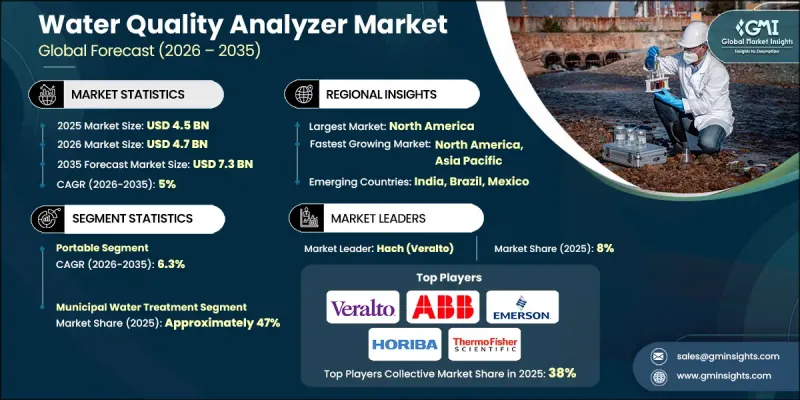
全球水質分析儀市場預計到 2025 年將達到 45 億美元,並預計以 5% 的複合年成長率成長,到 2035 年將達到 73 億美元。
對精準環境監測日益成長的需求以及全球水質安全標準日益嚴格,是推動先進水質分析技術需求的主要驅動力。水資源管理機構正在部署自動化監測系統,以提高營運效率並確保符合監管要求。同時,分析儀器製造商積極尋求夥伴關係與業務整合,旨在加強感測器技術並提升產品在工業和市政應用領域的功能。這些發展正在推動感測技術和材料工程的創新,並促進全球多個高度依賴精準水質監測系統的產業的市場擴張。傳統的依賴實驗室採樣和基礎化學試劑的手動檢測方法正逐漸被先進的數位化水質監測解決方案所取代。配備智慧感測器、自動校準和整合連接功能的現代分析儀器能夠即時分析關鍵水質參數。對營運效率的日益重視以及對日益嚴格的環境法規的遵守,仍然是推動全球水質分析儀市場擴張的關鍵因素。
| 市場範圍 | |
|---|---|
| 開始年份 | 2025 |
| 預測期 | 2026-2035 |
| 上市時的市場規模 | 45億美元 |
| 預測金額 | 73億美元 |
| 複合年成長率 | 5% |
可攜式水質分析儀市場預計在2025年達到20億美元,到2035年將達到36.8億美元,年複合成長率(CAGR)為6.3%。可攜式水質分析儀因其能夠在監測現場直接測量水質而備受青睞,無需實驗室檢測。這些緊湊型設備重量輕,無需固定電源即可獨立運行,因此適用於各種場所的現場環境評估和快速水質檢測。現場即時取得分析結果的便利性顯著減少了偵測延遲,加快了決策速度。其移動性和操作柔軟性持續推動著尋求高效、精準水質檢測解決方案的行業和監測機構的廣泛採用。
預計到2025年,城市水處理領域將佔據47%的市場。城市供水系統高度依賴先進的分析設備來維持安全的飲用水供應,並滿足嚴格的公共衛生要求。對供水管網的持續監測需要能夠處理大量水樣本的精確可靠的測量技術。該領域佔據如此大的市場佔有率,反映了城市水資源管理系統對關鍵水質指標持續監測的迫切需求。隨著城市擴張導致供水基礎設施日益複雜,市政營運中對可靠水質分析技術的需求也穩定成長。
預計2025年,美國水質分析儀市場規模將達11億美元。該國市場成長的主要驅動力來自成熟工業領域和依賴先進監測技術的供水事業系統的強勁需求。先進製造流程對高純度水的需求以及老舊水務基礎設施的現代化改造,都促進了市場的穩定擴張。此外,整合人工智慧和互聯感測器系統的數位化監測技術的投資不斷增加,也進一步強化了對先進水質分析解決方案的需求。監測精度和系統自動化的持續提升,也促使各機構投資先進的線上、直列式和可攜式分析儀,以增強其水資源管理能力。
目錄
第1章:調查方法和範圍
第2章執行摘要
第3章業界考察
- 生態系分析
- 供應商情況
- 利潤率
- 每個階段增加的價值
- 影響價值鏈的因素
- 影響產業的因素
- 促進因素
- 淡水需求不斷成長
- 快速的都市化和工業化
- 水污染加劇
- 產業潛在風險與挑戰
- 高整合複雜性
- 嚴格的監管標準
- 機會
- 技術進步
- 水資源短缺與永續性努力
- 促進因素
- 成長潛力分析
- 未來市場趨勢
- 科技與創新趨勢
- 當前技術趨勢
- 新興技術
- 價格趨勢
- 按地區
- 依產品類型
- 監理情勢
- 標準和合規要求
- 區域法規結構
- 認證標準
- 波特五力分析
- PESTEL 分析
- 貿易數據分析
- 進出口量及進口額趨勢
- 主要貿易路線及關稅的影響
- 人工智慧和生成式人工智慧對市場的影響
- 利用人工智慧改造現有經營模式
- 預測分析在產品開發的應用
第4章 競爭情勢
- 介紹
- 企業市佔率分析
- 按地區
- 企業矩陣分析
- 主要市場公司的競爭分析
- 競爭定位矩陣
- 主要進展
- 併購
- 夥伴關係與合作
- 新產品發布
- 業務拓展計劃
第5章 市場估算與預測:依產品類型分類,2022-2035年
- pH計
- 電導率儀
- 濁度計
- 溶氧分析儀
- 總有機碳分析儀
- 氧化還原電位感測器
- 氨/硝酸鹽/亞硝酸鹽感測器
- 多功能水質分析儀
- 比色計和光強度
- 其他
第6章 市場估計與預測:依類別分類,2022-2035年
- 可攜式的
- 桌面型
- 線上/內嵌
第7章 市場估計與預測:依參數類型分類,2022-2035年
- 單參數分析儀
- 多項目分析裝置
第8章 市場估計與預測:依應用領域分類,2022-2035年
- 市政水處理
- 工業和污水處理
- 海洋和海洋水系統
- 其他
第9章 市場估價與預測:依通路分類,2022-2035年
- 直銷
- 間接銷售
第10章 市場估價與預測:依地區分類,2022-2035年
- 北美洲
- 美國
- 加拿大
- 歐洲
- 德國
- 英國
- 法國
- 義大利
- 西班牙
- 亞太地區
- 中國
- 日本
- 印度
- 澳洲
- 韓國
- 拉丁美洲
- 巴西
- 墨西哥
- 阿根廷
- 中東和非洲
- 南非
- 沙烏地阿拉伯
- 阿拉伯聯合大公國
第11章:公司簡介
- ABB Ltd.
- AppliTek(Hach)
- Christian Burkert GmbH
- Emerson
- Endress+Hauser
- Hach(Veralto)
- Horiba Ltd.
- Martek Instruments
- Metrohm AG
- Mettler Toledo(Thornton)
- Shimadzu Corp.
- Thermo Fisher Scientific
- Veralto Corporation
- Xylem(Evoqua)
- Xylem(YSI)
The Global Water Quality Analyzer Market was valued at USD 4.5 billion in 2025 and is estimated to grow at a CAGR of 5% to reach USD 7.3 billion by 2035.
Increasing attention toward precise environmental monitoring and stricter global standards for water safety are major factors supporting the demand for advanced water analysis technologies. Organizations responsible for water management are adopting automated monitoring systems to improve operational efficiency and maintain consistent regulatory compliance. At the same time, manufacturers of analytical instruments are actively engaging in partnerships and consolidation activities aimed at strengthening sensor technologies and improving product capabilities for industrial and municipal applications. These developments are encouraging innovation in sensing technologies, materials engineering, and global market expansion across several industries that depend heavily on accurate water monitoring systems. Traditional manual testing methods that relied on laboratory sampling and basic chemical reagents are gradually being replaced by advanced digital water monitoring solutions. Modern analyzers equipped with intelligent sensors, automated calibration, and integrated connectivity capabilities enable real-time analysis of key water parameters. The growing emphasis on operational efficiency and compliance with increasingly strict environmental regulations continues to act as a significant catalyst for the expansion of the global water quality analyzer market.
| Market Scope | |
|---|---|
| Start Year | 2025 |
| Forecast Year | 2026-2035 |
| Start Value | $4.5 Billion |
| Forecast Value | $7.3 Billion |
| CAGR | 5% |
The portable segment generated USD 2 billion in 2025 and is expected to reach USD 3.68 billion by 2035, growing at a CAGR of 6.3%. Portable water analyzers are widely valued for their ability to measure water quality conditions directly at monitoring locations without the need for laboratory testing. These compact devices are designed to be lightweight and operate independently of fixed power sources, which makes them suitable for on-site environmental assessments and rapid water testing in various locations. The convenience of obtaining immediate analytical results directly in the field significantly reduces testing delays and improves decision-making speed. Their mobility and operational flexibility continue to support strong adoption across industries and monitoring authorities seeking efficient and accurate water testing solutions.
The municipal water treatment segment accounted for 47% share in 2025. Municipal water systems depend heavily on advanced analytical instruments to maintain safe drinking water supplies and meet strict public health requirements. Continuous monitoring of water distribution networks requires accurate and reliable measurement technologies capable of supporting high-volume operations. The large market share held by this segment reflects the ongoing requirement for consistent monitoring of essential water quality indicators within urban water management systems. As cities expand and water infrastructure becomes more complex, the demand for dependable water analysis technologies within municipal operations continues to grow steadily.
United States Water Quality Analyzer Market reached USD 1.1 billion in 2025. Market growth in the country is supported by strong demand from mature industrial sectors and water utility systems that rely on advanced monitoring technologies. The need for highly purified water in advanced manufacturing processes and modernization efforts across aging water infrastructure is contributing to the steady expansion of the market. In addition, increased investments in digital monitoring technologies that integrate artificial intelligence and connected sensor systems are strengthening the demand for advanced water quality analysis solutions. Continuous improvements in monitoring accuracy and system automation are further encouraging organizations to invest in sophisticated online, inline, and portable analyzers to enhance water management capabilities.
Major companies operating in the Global Water Quality Analyzer Market include ABB Ltd., AppliTek (Hach), Christian Burkert GmbH, Emerson, Endress+Hauser, Hach (Veralto), Horiba Ltd., Martek Instruments, Metrohm AG, Mettler Toledo (Thornton), Shimadzu Corp., Thermo Fisher Scientific, Veralto Corporation, Xylem (Evoqua), and Xylem (YSI). Companies participating in the Global Water Quality Analyzer Market are adopting several strategic initiatives to reinforce their competitive position and expand their global reach. Industry participants are investing heavily in research and development to create more advanced sensor technologies capable of delivering faster and more precise analytical results. Many organizations are also focusing on digital integration by incorporating smart monitoring systems, cloud connectivity, and automated calibration features into their product offerings. Strategic partnerships, acquisitions, and collaborations are being used to strengthen product portfolios and expand technological expertise. Additionally, companies are increasing their presence in emerging markets by expanding distribution networks and strengthening local service capabilities.
Table of Contents
Chapter 1 Methodology and Scope
- 1.1 Market scope and definition
- 1.2 Research design
- 1.2.1 Research approach
- 1.2.2 Data collection methods
- 1.3 Data mining sources
- 1.3.1 Global
- 1.3.2 Regional/Country
- 1.4 Base estimates and calculations
- 1.4.1 Base year calculation
- 1.4.2 Key trends for market estimation
- 1.5 Primary research and validation
- 1.5.1 Primary sources
- 1.6 Forecast model
- 1.7 Research assumptions and limitations
Chapter 2 Executive Summary
- 2.1 Industry 360° synopsis
- 2.2 Key market trends
- 2.2.1 Regional
- 2.2.2 Product Type
- 2.2.3 Category
- 2.2.4 Parameter Type
- 2.2.5 Application
- 2.2.6 Distribution Channel,
- 2.3 CXO perspectives: Strategic imperatives
- 2.3.1 Key decision points for industry executives
- 2.3.2 Critical success factors for market players
- 2.4 Future outlook and strategic recommendations
Chapter 3 Industry Insights
- 3.1 Industry ecosystem analysis
- 3.1.1 Supplier landscape
- 3.1.2 Profit margin
- 3.1.3 Value addition at each stage
- 3.1.4 Factor affecting the value chain
- 3.2 Industry impact forces
- 3.2.1 Growth drivers
- 3.2.1.1 Rising demand for fresh water
- 3.2.1.2 Rapid urbanization and industrialization
- 3.2.1.3 Increasing water pollution
- 3.2.2 Industry pitfalls & challenges
- 3.2.2.1 High integration complexity
- 3.2.2.2 Stringent regulatory standards
- 3.2.3 Opportunities
- 3.2.3.1 Technological advancements
- 3.2.3.2 Water scarcity and sustainability initiatives
- 3.2.1 Growth drivers
- 3.3 Growth potential analysis
- 3.4 Future market trends
- 3.5 Technology and innovation landscape
- 3.5.1 Current technological trends
- 3.5.2 Emerging technologies
- 3.6 Price trends
- 3.6.1 By region
- 3.6.2 By Product type
- 3.7 Regulatory landscape
- 3.7.1 Standards and compliance requirements
- 3.7.2 Regional regulatory frameworks
- 3.7.3 Certification standards
- 3.8 Porter's analysis
- 3.9 PESTEL analysis
- 3.10 Trade Data Analysis
- 3.10.1 Import & Export Volume & Value Trends
- 3.10.2 Key Trade Corridors & Tariff Impact
- 3.11 Impact of AI & Generative AI on the Market
- 3.11.1 AI-Driven Disruption of Existing Business Models
- 3.11.2 Predictive Analytics for Product Development
Chapter 4 Competitive Landscape, 2025
- 4.1 Introduction
- 4.2 Company market share analysis
- 4.2.1 By region
- 4.2.1.1 North America
- 4.2.1.2 Europe
- 4.2.1.3 Asia Pacific
- 4.2.1.4 Latin America
- 4.2.1.5 Middle East and Africa
- 4.2.1 By region
- 4.3 Company matrix analysis
- 4.4 Competitive analysis of major market players
- 4.5 Competitive positioning matrix
- 4.6 Key developments
- 4.6.1 Mergers & acquisitions
- 4.6.2 Partnerships & collaborations
- 4.6.3 New product launches
- 4.6.4 Expansion plans
Chapter 5 Market Estimates & Forecast, By Product Type, 2022 - 2035, (USD Billion) (Thousand Units)
- 5.1 Key trends
- 5.2 pH meters
- 5.3 Conductivity meters
- 5.4 Turbidity meters
- 5.5 Dissolved oxygen analyzers
- 5.6 Total organic carbon analyzers
- 5.7 Oxidation-reduction potential sensors
- 5.8 Ammonia/nitrate/nitrite sensors
- 5.9 Multi-parameter water quality analyzers
- 5.10 Colorimeters and spectrometers
- 5.11 Others
Chapter 6 Market Estimates & Forecast, By Category, 2022 - 2035, (USD Billion) (Million Units)
- 6.1 Key trends
- 6.2 Portable
- 6.3 Benchtop
- 6.4 Online/Inline
Chapter 7 Market Estimates & Forecast, By Parameter Type, 2022 - 2035, (USD Billion) (Thousand Units)
- 7.1 Key trends
- 7.2 Single parameter analyzers
- 7.3 Multi-parameter analyzers
Chapter 8 Market Estimates & Forecast, By Application, 2022 - 2035, (USD Billion) (Thousand Units)
- 8.1 Key trends
- 8.2 Municipal water treatment
- 8.3 Industrial and wastewater treatment
- 8.4 Marine & offshore water systems
- 8.5 Others
Chapter 9 Market Estimates & Forecast, By Distribution Channel, 2022 - 2035, (USD Billion) (Thousand Units)
- 9.1 Key trends
- 9.2 Direct
- 9.3 Indirect
Chapter 10 Market Estimates and Forecast, By Region, 2022 - 2035 (USD Billion) (Thousand Units)
- 10.1 Key trends
- 10.2 North America
- 10.2.1 U.S.
- 10.2.2 Canada
- 10.3 Europe
- 10.3.1 Germany
- 10.3.2 UK
- 10.3.3 France
- 10.3.4 Italy
- 10.3.5 Spain
- 10.4 Asia Pacific
- 10.4.1 China
- 10.4.2 Japan
- 10.4.3 India
- 10.4.4 Australia
- 10.4.5 South Korea
- 10.5 Latin America
- 10.5.1 Brazil
- 10.5.2 Mexico
- 10.5.3 Argentina
- 10.6 Middle East and Africa
- 10.6.1 South Africa
- 10.6.2 Saudi Arabia
- 10.6.3 UAE
Chapter 11 Company Profiles
- 11.1 ABB Ltd.
- 11.2 AppliTek (Hach)
- 11.3 Christian Burkert GmbH
- 11.4 Emerson
- 11.5 Endress+Hauser
- 11.6 Hach (Veralto)
- 11.7 Horiba Ltd.
- 11.8 Martek Instruments
- 11.9 Metrohm AG
- 11.10 Mettler Toledo (Thornton)
- 11.11 Shimadzu Corp.
- 11.12 Thermo Fisher Scientific
- 11.13 Veralto Corporation
- 11.14 Xylem (Evoqua)
- 11.15 Xylem (YSI)

 線上水硬度分析儀市場:全球市場預測,2026-2032年
 水質監測市場機會、成長促進因素、產業趨勢分析及2026-2035年預測
 水質監測市場預測至2034年:按產品類型、測量參數、採樣方法、應用、最終用戶和地區分類的全球分析水質感測器市場:2026-2032年全球市場預測(按感測器類型、產品類型、技術、連接方式、水類型、應用和最終用戶分類)
 水質分析儀市場規模、佔有率和成長分析:按產品組合、分析參數、終端用戶產業、分銷通路和地區分類-2026-2033年產業預測
 水質感測器市場:按類型、應用和地區分類(2026-2034 年)電導率感測器市場:按感測器類型、技術和終端用戶產業分類-2026-2032年全球市場預測水質線上分析儀市場:按組件、安裝類型、技術、測量項目、應用和最終用戶分類 - 全球預測 2026-2032重金屬水質自動線上監測市場:按組件、水源、連接方式、待測金屬類型、技術、應用和最終用戶分類-2026-2032年全球預測按產品類型、技術、參數和最終用戶分類的自動化線上水質分析儀市場—全球預測,2026-2032年