


 |
市場調查報告書
商品編碼
1998847
2026 年至 2035 年醫藥塑膠瓶的市場機會、成長要素、產業趨勢與預測。Pharmaceutical Plastic Bottles Market Opportunity, Growth Drivers, Industry Trend Analysis, and Forecast 2026 - 2035 |
||||||

預計到 2025 年,全球藥品用塑膠瓶市場價值將達到 98 億美元,並以 3.9% 的複合年成長率成長,到 2035 年將達到 144 億美元。
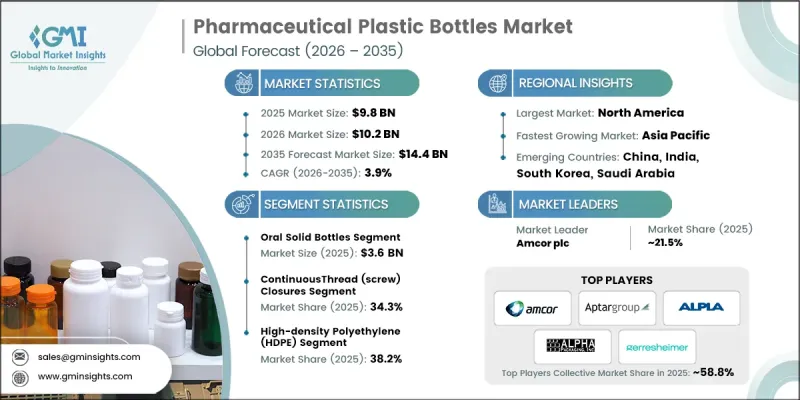
全球學名藥產量增加、口服固體製劑需求持續成長以及非處方藥(OTC)消費量擴大,是推動市場擴張的主要因素。此外,包裝材料從玻璃瓶轉向輕質高密度聚苯乙烯(HDPE),以及外包給契約製造組織(CMO)的趨勢,也促進了市場需求。兒童安全包裝和防篡改包裝的監管要求,以及推廣可回收和消費後回收(PCR)瓶的永續發展舉措,進一步推動了市場成長。在北美和亞太地區,受自我治療、藥房網路擴張以及機能性食品市場成長的推動,成藥的需求正在不斷成長。塑膠瓶具有安全性、防篡改性和輕巧設計等關鍵優勢,這些優勢持續支撐著全球零售和藥房通路的高周轉率和穩定需求。
| 市場範圍 | |
|---|---|
| 開始年份 | 2025 |
| 預測期 | 2026-2035 |
| 上市時的市場規模 | 98億美元 |
| 預測金額 | 144億美元 |
| 複合年成長率 | 3.9% |
預計到2025年,口服固態製劑瓶的市場規模將達到36億美元。鑑於片劑和膠囊是全球處方量最大的藥物之一,尤其是在治療慢性疾病方面,這些瓶子將繼續發揮至關重要的作用。它們具有防潮、適用於大宗包裝以及與兒童安全瓶蓋相容等優點,使其成為大規模藥品生產和分銷網路中不可或缺的包裝。
預計到2025年,高密度聚苯乙烯(HDPE)市佔率將達到38.2%。 HDPE因其優異的防潮性、耐化學性、耐久性和輕質特性而備受青睞,是片劑、膠囊和粉末包裝的理想材料。此外,HDPE運輸成本低,且符合藥品穩定性要求,使其成為北美、歐洲和亞洲等監管市場的理想包裝材料。
到2025年,北美醫藥塑膠瓶市佔率將達到39.7%。該地區的成長主要受處方藥消費量增加、藥品安全法規日益嚴格以及市場對輕便防碎包裝的需求所推動。美國食品藥物管理局(FDA)和加拿大衛生署 Canada)的法律規範,例如兒童安全標準和防篡改標準,也推動了對高密度聚乙烯(HDPE)和聚丙烯醫藥瓶的需求。
目錄
第1章:調查方法和範圍
第2章執行摘要
第3章業界考察
- 生態系分析
- 供應商情況
- 利潤率
- 成本結構
- 每個階段增加的價值
- 影響價值鏈的因素
- 中斷
- 影響產業的因素
- 促進因素
- 全球學名藥產量增加
- 口服固體製劑消耗量增加
- 全球對成藥的需求不斷成長
- 從玻璃瓶過渡到輕質高密度聚乙烯瓶
- 契約製造組織(CMO)的擴張
- 產業潛在風險與挑戰
- 樹脂(HDPE、PET、PP)價格波動
- 嚴格遵守有關萃取物和洗脫液的規定
- 市場機遇
- 生物基聚合物在藥品包裝上的應用
- 具有防偽功能的智慧包裝
- 促進因素
- 成長潛力分析
- 監理情勢
- 波特五力分析
- PESTEL 分析
- 科技與創新趨勢
- 當前技術趨勢
- 新興技術
- 價格趨勢
- 按地區
- 依產品
- 定價策略
- 新興經營模式
- 合規要求
- 專利和智慧財產權分析
- 地緣政治和貿易趨勢
第4章 競爭情勢
- 介紹
- 企業市佔率分析
- 按地區
- 市場集中度分析
- 主要企業的競爭標竿分析
- 財務績效比較
- 銷售量
- 利潤率
- 研究與發展(R&D)
- 產品系列比較
- 產品線寬度
- 科技
- 創新
- 區域擴張比較
- 全球擴張分析
- 服務網路覆蓋
- 按地區分類的市場滲透率
- 競爭定位矩陣
- 領導者
- 挑戰者
- 追蹤者
- 小眾玩家
- 戰略展望矩陣
- 財務績效比較
- 主要進展
- 併購
- 夥伴關係與合作
- 技術進步
- 業務拓展與投資策略
- 數位轉型計劃
- 新興/Start-Ups競爭對手的發展趨勢
第5章 市場估價與預測:以瓶型分類,2022-2035年
- 口服固態劑型用瓶
- 口服液體藥物瓶
- 眼藥水瓶
- 注射劑和注射管瓶
- 鼻噴霧瓶
- 外用/經皮瓶
第6章 市場估算與預測:依材料類型分類,2022-2035年
- 高密度聚苯乙烯(HDPE)
- 低密度聚乙烯(LDPE)
- 聚丙烯(PP)
- 聚對苯二甲酸乙二醇酯(PET)
- 聚對苯二甲酸乙二醇酯(PETG)
- 環烯烴聚合物(COP)和環烯烴共聚物(COC)
第7章 市場估價與預測:依瓶裝規格分類,2022-2035年
- 微型瓶(5毫升至20毫升)
- 小瓶裝(30毫升至100毫升)
- 中型瓶裝(120毫升-300毫升)
- 大容量瓶(500毫升至1000毫升)
- 特大瓶裝(超過1000毫升)
第8章 市場估計與預測:依市值類型分類,2022-2035年
- 連續螺帽
- 卡扣式帽
- 分配蓋
- 特製帽子
第9章 市場估價與預測:依最終用戶分類,2022-2035年
- 製藥公司(內部生產)
- 契約製造公司(CMO/CDMO)
- 營養補充品生產商
- 醫療機構
- 藥局
第10章 市場估價與預測:依地區分類,2022-2035年
- 北美洲
- 美國
- 加拿大
- 歐洲
- 德國
- 英國
- 法國
- 西班牙
- 義大利
- 俄羅斯
- 亞太地區
- 中國
- 印度
- 日本
- 澳洲
- 韓國
- 拉丁美洲
- 巴西
- 墨西哥
- 阿根廷
- 中東和非洲
- 南非
- 沙烏地阿拉伯
- 阿拉伯聯合大公國
第11章:公司簡介
- 主要企業
- Gerresheimer AG
- Amcor plc
- AptarGroup, Inc.
- ALPLA Group
- Silgan Holdings Inc.
- Plastipak Holdings, Inc.
- 按地區分類的主要企業
- 北美洲
- Alpha Packaging, Inc.
- COMAR LLC
- Drug Plastics & Glass Company, Inc.
- Pretium Packaging, LLC
- CL Smith Company
- O.Berk Company LLC
- United States Plastic Corporation
- 亞太地區
- Mykron Plus India Pvt. Ltd.
- Zhejiang BI Industrial Co., Ltd.
- Pro-Pac Packaging Ltd
- 歐洲
- Frapak Packaging BV
- Origin Pharma Packaging Ltd
- Weener Plastics Group BV
- Gil Plastic Products Ltd
- 北美洲
The Global Pharmaceutical Plastic Bottles Market was valued at USD 9.8 billion in 2025 and is estimated to grow at a CAGR of 3.9% to reach USD 14.4 billion in 2035.
The market is expanding due to rising global production of generic drugs, continuous growth of oral solid dosage forms, and increasing consumption of over-the-counter (OTC) medicines. The ongoing transition from glass to lightweight high-density polyethylene (HDPE) packaging, coupled with rising outsourcing to contract manufacturing organizations (CMOs), is also driving demand. Regulatory mandates for child-resistant and tamper-evident packaging, along with sustainability initiatives promoting recyclable and PCR-based bottles, are further stimulating growth. North America and Asia-Pacific are experiencing heightened OTC demand driven by self-medication trends, pharmacy network expansion, and growth in the nutraceutical segment. The use of plastic bottles provides key advantages, including safety, tamper evidence, and lightweight design, which continues to support high turnover and consistent demand in retail and pharmacy channels worldwide.
| Market Scope | |
|---|---|
| Start Year | 2025 |
| Forecast Year | 2026-2035 |
| Start Value | $9.8 Billion |
| Forecast Value | $14.4 Billion |
| CAGR | 3.9% |
The oral solid bottles segment reached USD 3.6 billion in 2025. These bottles remain critical as tablets and capsules account for the highest prescription volumes globally, particularly for chronic conditions. They offer moisture protection, bulk packaging efficiency, and compatibility with child-resistant closures, making them essential for large-scale pharmaceutical production and distribution networks.
The high-density polyethylene (HDPE) segment accounted for 38.2% share in 2025. HDPE is preferred for its excellent moisture barrier properties, chemical resistance, durability, and lightweight nature, making it highly suitable for packaging tablets, capsules, and powders. Its cost-effective transport and compliance with pharmaceutical stability requirements make it the material of choice in regulated markets across North America, Europe, and Asia.
North America Pharmaceutical Plastic Bottles Market held 39.7% share in 2025. Growth in this region is supported by rising prescription drug consumption, stricter drug safety regulations, and the shift to lightweight, shatter-resistant packaging. Regulatory oversight from the FDA and Health Canada requires adherence to child-resistant and tamper-evident standards, which drives demand for HDPE and polypropylene pharmaceutical bottles.
Prominent players in the Global Pharmaceutical Plastic Bottles Market include ALPLA Group, Amcor plc, Alpha Packaging, Inc., AptarGroup, Inc., COMAR LLC, Drug Plastics & Glass Company, Inc., C.L. Smith Company, Frapak Packaging B.V., Gerresheimer AG, Gil Plastic Products Ltd, Mykron Plus India Pvt. Ltd., O.Berk Company LLC, Origin Pharma Packaging Ltd, Plastipak Holdings, Inc., Pretium Packaging, LLC, Pro-Pac Packaging Ltd, Silgan Holdings Inc., United States Plastic Corporation, Weener Plastics Group BV, and Zhejiang B.I. Industrial Co., Ltd. Companies in the Global Pharmaceutical Plastic Bottles Market are employing multiple strategies to strengthen their foothold and expand their global presence. These include investing in R&D to develop child-resistant, tamper-evident, and PCR-based packaging solutions that align with sustainability trends. Firms are forming strategic alliances with CMOs and pharmaceutical companies to secure long-term contracts and increase production capacity. Expansion of regional manufacturing facilities ensures faster delivery and cost optimization. Companies are also implementing advanced quality control systems and regulatory compliance protocols to meet international standards, enhancing brand reliability.
Table of Contents
Chapter 1 Methodology and Scope
- 1.1 Market scope and definition
- 1.2 Research design
- 1.2.1 Research approach
- 1.2.2 Data collection methods
- 1.3 Data mining sources
- 1.3.1 Global
- 1.3.2 Regional/Country
- 1.4 Base estimates and calculations
- 1.4.1 Base year calculation
- 1.4.2 Key trends for market estimation
- 1.5 Primary research and validation
- 1.5.1 Primary sources
- 1.6 Forecast model
- 1.7 Research assumptions and limitations
Chapter 2 Executive Summary
- 2.1 Industry 360° synopsis, 2022 - 2035
- 2.2 Key market trends
- 2.2.1 Bottle type trends
- 2.2.2 Material type trends
- 2.2.3 Bottle capacity trends
- 2.2.4 Closure type trends
- 2.2.5 End-user trends
- 2.2.6 Regional trends
- 2.3 TAM Analysis, 2026-2035
- 2.4 CXO perspectives: Strategic imperatives
- 2.4.1 Executive decision points
- 2.4.2 critical success factors
- 2.5 Future outlook and strategic recommendations
Chapter 3 Industry Insights
- 3.1 Industry ecosystem analysis
- 3.1.1 Supplier Landscape
- 3.1.2 Profit Margin
- 3.1.3 Cost structure
- 3.1.4 Value addition at each stage
- 3.1.5 Factor affecting the value chain
- 3.1.6 Disruptions
- 3.2 Industry impact forces
- 3.2.1 Growth drivers
- 3.2.1.1 Rising global generic drug production volumes
- 3.2.1.2 Growth in oral solid dosage consumption
- 3.2.1.3 Increasing OTC medicine demand globally
- 3.2.1.4 Shift from glass to lightweight HDPE bottles
- 3.2.1.5 Expansion of contract manufacturing organizations (CMOs)
- 3.2.2 Industry pitfalls and challenges
- 3.2.2.1 Volatile resin prices (HDPE, PET, PP)
- 3.2.2.2 Stringent extractables and leachables compliance
- 3.2.3 Market opportunities
- 3.2.3.1 Bio-based polymer adoption in pharma packaging
- 3.2.3.2 Smart packaging with anti-counterfeit features
- 3.2.1 Growth drivers
- 3.3 Growth potential analysis
- 3.4 Regulatory landscape
- 3.4.1 North America
- 3.4.2 Europe
- 3.4.3 Asia Pacific
- 3.4.4 Latin America
- 3.4.5 Middle East & Africa
- 3.5 Porter's analysis
- 3.6 PESTEL analysis
- 3.7 Technology and Innovation landscape
- 3.7.1 Current technological trends
- 3.7.2 Emerging technologies
- 3.8 Price trends
- 3.8.1 By region
- 3.8.2 By product
- 3.9 Pricing Strategies
- 3.10 Emerging Business Models
- 3.11 Compliance Requirements
- 3.12 Patent and IP analysis
- 3.13 Geopolitical and trade dynamics
Chapter 4 Competitive Landscape, 2025
- 4.1 Introduction
- 4.2 Company market share analysis
- 4.2.1 By region
- 4.2.1.1 North America
- 4.2.1.2 Europe
- 4.2.1.3 Asia Pacific
- 4.2.1.4 Latin America
- 4.2.1.5 Middle East & Africa
- 4.2.2 Market concentration analysis
- 4.2.1 By region
- 4.3 Competitive benchmarking of key players
- 4.3.1 Financial performance comparison
- 4.3.1.1 Revenue
- 4.3.1.2 Profit margin
- 4.3.1.3 R&D
- 4.3.2 Product portfolio comparison
- 4.3.2.1 Product range breadth
- 4.3.2.2 Technology
- 4.3.2.3 Innovation
- 4.3.3 Geographic presence comparison
- 4.3.3.1 Global footprint analysis
- 4.3.3.2 Service network coverage
- 4.3.3.3 Market penetration by region
- 4.3.4 Competitive positioning matrix
- 4.3.4.1 Leaders
- 4.3.4.2 Challengers
- 4.3.4.3 Followers
- 4.3.4.4 Niche players
- 4.3.5 Strategic outlook matrix
- 4.3.1 Financial performance comparison
- 4.4 Key developments
- 4.4.1 Mergers and acquisitions
- 4.4.2 Partnerships and collaborations
- 4.4.3 Technological advancements
- 4.4.4 Expansion and investment strategies
- 4.4.5 Digital transformation initiatives
- 4.5 Emerging/ startup competitors landscape
Chapter 5 Market Estimates and Forecast, By Bottle Type, 2022 - 2035 (USD Million)
- 5.1 Key trends
- 5.2 Oral solid bottles
- 5.3 Oral liquid bottles
- 5.4 Ophthalmic bottles
- 5.5 Parenteral/injectable vials
- 5.6 Nasal spray bottles
- 5.7 Topical/dermal bottles
Chapter 6 Market Estimates and Forecast, By Material Type, 2022 - 2035 (USD Million)
- 6.1 Key trends
- 6.2 High-density polyethylene (HDPE)
- 6.3 Low-density polyethylene (LDPE)
- 6.4 Polypropylene (PP)
- 6.5 Polyethylene terephthalate (PET)
- 6.6 Polyethylene terephthalate glycol (PETG)
- 6.7 Cyclic olefin polymer (COP) & cyclic olefin copolymer (COC)
Chapter 7 Market Estimates and Forecast, By Bottle Capacity, 2022 - 2035 (USD Million)
- 7.1 Key trends
- 7.2 Micro bottles (5ml - 20ml)
- 7.3 Small bottles (30ml - 100ml)
- 7.4 Medium bottles (120ml - 300ml)
- 7.5 Large bottles (500ml - 1000ml)
- 7.6 Extra-large bottles (>1000ml)
Chapter 8 Market Estimates and Forecast, By Closure Type, 2022 - 2035 (USD Million)
- 8.1 Key trends
- 8.2 Continuous thread (screw) closures
- 8.3 Snap-on closures
- 8.4 Dispensing closures
- 8.5 Specialty closures
Chapter 9 Market Estimates and Forecast, By End-User, 2022 - 2035 (USD Million)
- 9.1 Key trends
- 9.2 Pharmaceutical manufacturers (in-house production)
- 9.3 Contract manufacturing organizations (CMO/CDMO)
- 9.4 Nutraceutical & dietary supplement manufacturers
- 9.5 Healthcare institutions
- 9.6 Compounding pharmacies
Chapter 10 Market Estimates and Forecast, By Region, 2022 - 2035 (USD Million)
- 10.1 Key trends
- 10.2 North America
- 10.2.1 U.S.
- 10.2.2 Canada
- 10.3 Europe
- 10.3.1 Germany
- 10.3.2 UK
- 10.3.3 France
- 10.3.4 Spain
- 10.3.5 Italy
- 10.3.6 Russia
- 10.4 Asia Pacific
- 10.4.1 China
- 10.4.2 India
- 10.4.3 Japan
- 10.4.4 Australia
- 10.4.5 South Korea
- 10.5 Latin America
- 10.5.1 Brazil
- 10.5.2 Mexico
- 10.5.3 Argentina
- 10.6 Middle East and Africa
- 10.6.1 South Africa
- 10.6.2 Saudi Arabia
- 10.6.3 UAE
Chapter 11 Company Profiles
- 11.1 Global Key Players
- 11.1.1 Gerresheimer AG
- 11.1.2 Amcor plc
- 11.1.3 AptarGroup, Inc.
- 11.1.4 ALPLA Group
- 11.1.5 Silgan Holdings Inc.
- 11.1.6 Plastipak Holdings, Inc.
- 11.2 Regional key players
- 11.2.1 North America
- 11.2.1.1 Alpha Packaging, Inc.
- 11.2.1.2 COMAR LLC
- 11.2.1.3 Drug Plastics & Glass Company, Inc.
- 11.2.1.4 Pretium Packaging, LLC
- 11.2.1.5 C.L. Smith Company
- 11.2.1.6 O.Berk Company LLC
- 11.2.1.7 United States Plastic Corporation
- 11.2.2 Asia Pacific
- 11.2.2.1 Mykron Plus India Pvt. Ltd.
- 11.2.2.2 Zhejiang B.I. Industrial Co., Ltd.
- 11.2.2.3 Pro-Pac Packaging Ltd
- 11.2.3 Europe
- 11.2.3.1 Frapak Packaging B.V.
- 11.2.3.2 Origin Pharma Packaging Ltd
- 11.2.3.3 Weener Plastics Group BV
- 11.2.3.4 Gil Plastic Products Ltd
- 11.2.1 North America


