


 |
市場調查報告書
商品編碼
1998842
陶瓷過濾器市場機會、成長要素、產業趨勢分析及2026-2035年預測。Ceramic Filters Market Opportunity, Growth Drivers, Industry Trend Analysis, and Forecast 2026 - 2035 |
||||||

全球陶瓷過濾器市場預計到 2025 年將價值 18.3 億美元,預計到 2035 年將以 10.9% 的複合年成長率成長至 52.7 億美元。
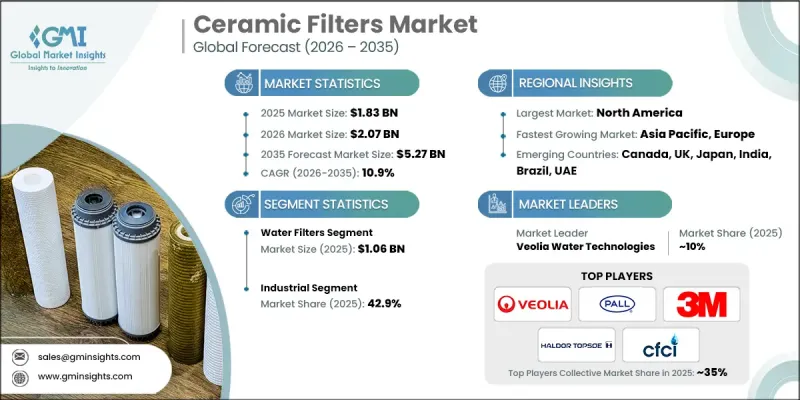
陶瓷過濾器市場的成長主要得益於全球對改善水質和空氣品質日益重視,而這又源於人們對環境問題的日益關注和監管標準的日益嚴格。各國政府、企業和社區都在優先考慮能夠有效去除污染物並確保更安全環境的技術。陶瓷過濾解決方案因其去除微生物、懸浮顆粒和其他污染物等雜質的能力而廣受認可,使其成為現代淨化系統的重要組成部分。此外,公眾健康和衛生意識的不斷提高,尤其是在發展中地區,正在推動住宅、商業和工業領域對陶瓷過濾技術的應用。陶瓷材料和過濾設計的持續創新提高了這些系統的耐用性、過濾性能和成本效益。這些改進使得陶瓷過濾器適用於各個領域的廣泛應用。此外,隨著各行業越來越重視環保技術,陶瓷過濾器因其可重複使用的結構、較長的使用壽命以及無需化學添加劑即可提供高效過濾的能力而備受關注。
| 市場範圍 | |
|---|---|
| 開始年份 | 2025 |
| 預測期 | 2026-2035 |
| 上市時的市場規模 | 18.3億美元 |
| 預測金額 | 52.7億美元 |
| 複合年成長率 | 10.9% |
預計到2025年,淨水器市場規模將達到10.6億美元,並在2026年至2035年間以11.2%的複合年成長率成長。在陶瓷過濾器市場中,陶瓷過濾系統憑藉其提供安全潔淨飲用水的卓越性能,保持著強勁的市場地位。其可靠性和易用性使其在先進水質淨化基礎設施有限的地區尤為重要。陶瓷過濾系統能夠有效去除有害微生物和懸浮顆粒,進而改善整體水質。其價格實惠、經久耐用且維護簡便,使其成為尋求可靠水質淨化方案的都市區和農村社區的理想選擇。
到2025年,工業領域將佔據42.9%的市場。該領域的成長主要歸功於陶瓷過濾的耐用性和熱穩定性,使其即使在嚴苛的工業環境中也能高效運作。這些過濾器廣泛應用於對耐熱性和使用壽命要求極高的製造和製作流程中。工業設施越來越依賴陶瓷過濾系統來維持產品品質、提高營運效率並確保符合環保標準。陶瓷過濾器能夠在惡劣條件下持續穩定地提供過濾性能,這持續推動其在工業應用中的廣泛應用。
預計到2025年,美國陶瓷過濾器市場規模將達到6.94億美元。在美國,嚴格的環境和公共衛生法規鼓勵採用先進的過濾技術,推動了市場的持續成長。對更清潔的水和更佳空氣品質日益成長的需求,以及工業活動中對可靠過濾解決方案的需求,共同支撐著全部區域的市場成長。陶瓷過濾器因其高效過濾和即使在惡劣條件下也能保持高耐久性而被廣泛應用於多個行業。其使用壽命長、性能穩定,使其成為需要可靠且永續過濾技術的產業不可或缺的解決方案。
全球陶瓷過濾器市場由眾多領先企業組成,包括3M、Aquacera、Ceramic Filters Company、Ceramicx、CeramTec、Doulton、Haldor Topsoe、Klean Kanteen、京瓷、LiqTech International、Metkem Silicon、Morgan Advanced Materials、Nanostone、Pall和威立雅務技術公司。這些企業正在實施各種策略性主要企業,以增強自身競爭力並擴大全球業務。主要企業優先投入研發,以提高陶瓷過濾系統的過濾效率、耐用性和成本績效。產品創新,特別是先進陶瓷材料和改進的過濾器設計,使它們能夠滿足不斷變化的工業和環境需求。與工業營運商和水處理供應商建立策略夥伴關係,有助於企業拓展應用領域並加強分銷網路。許多企業也積極拓展新興市場,這些市場對水質淨化技術的需求正在快速成長。
目錄
第1章:調查方法和範圍
第2章執行摘要
第3章業界考察
- 生態系分析
- 供應商情況
- 利潤率
- 每個階段增加的價值
- 影響價值鏈的因素
- 影響產業的因素
- 促進因素
- 日益成長的環境問題
- 對更清潔的水和空氣的需求日益成長
- 嚴格的規定
- 技術進步
- 產業潛在風險與挑戰
- 前期成本高
- 替代方案的可用性
- 促進因素
- 成長潛力分析
- 未來市場趨勢
- 科技與創新趨勢
- 當前技術趨勢
- 新興技術
- 價格趨勢
- 按地區
- 依產品類型
- 監理情勢
- 標準和合規要求
- 區域法規結構
- 認證標準
- 波特五力分析
- PESTEL 分析
第4章 競爭情勢
- 介紹
- 企業市佔率分析
- 按地區
- 企業矩陣分析
- 主要市場公司的競爭分析
- 競爭定位矩陣
- 主要進展
- 併購
- 夥伴關係與合作
- 新產品發布
- 業務拓展計劃
第5章 市場估算與預測:依產品類型分類,2022-2035年
- 空氣過濾器
- 水質淨化
第6章 市場估算與預測:陶瓷類型,2022-2035年
- 氧化鋁
- 氧化鋯
- 碳化矽
- 提泰妮婭
- 其他
第7章 市場估計與預測:依應用領域分類,2022-2035年
- 水處理
- 空氣過濾
- 食品和飲料過濾
- 汽車廢氣控制
- 工業製程過濾
- 其他
第8章 市場估算與預測:依最終使用者分類,2022-2035年
- 商業的
- 住宅
- 工業的
第9章 市場估價與預測:依通路分類,2022-2035年
- 直接地
- 間接
第10章 市場估價與預測:依地區分類,2022-2035年
- 北美洲
- 美國
- 加拿大
- 歐洲
- 德國
- 英國
- 法國
- 義大利
- 西班牙
- 亞太地區
- 中國
- 印度
- 日本
- 韓國
- 澳洲
- 印尼
- 馬來西亞
- 拉丁美洲
- 巴西
- 墨西哥
- 阿根廷
- 中東和非洲
- 沙烏地阿拉伯
- 阿拉伯聯合大公國
- 南非
第11章:公司簡介
- 3M
- Aquacera
- Ceramic Filters Company
- Ceramicx
- CeramTec
- Doulton
- Haldor Topsoe
- Klean Kanteen
- Kyocera
- LiqTech International
- Metkem Silicon
- Morgan Advanced Materials
- Nanostone Water
- Pall
- Veolia Water Technologies
The Global Ceramic Filters Market was valued at USD 1.83 billion in 2025 and is estimated to grow at a CAGR of 10.9% to reach USD 5.27 billion by 2035.
Growth in the ceramic filters market is supported by the increasing global emphasis on improving water and air quality amid rising environmental concerns and stricter regulatory standards. Governments, industries, and communities are placing greater priority on technologies that can effectively remove contaminants and ensure safer environmental conditions. Ceramic filtration solutions are widely recognized for their ability to eliminate impurities such as microorganisms, suspended particles, and other pollutants, making them a valuable component of modern purification systems. In addition, increasing awareness related to public health and sanitation, particularly in developing regions, is encouraging wider adoption of ceramic filtration technologies across residential, commercial, and industrial settings. Continuous innovation in ceramic materials and filtration design has enhanced the durability, filtration performance, and cost efficiency of these systems. These improvements make ceramic filters suitable for a broad range of applications across multiple sectors. Furthermore, industries are increasingly prioritizing environmentally responsible technologies, and ceramic filters are gaining attention due to their reusable structure, long service life, and ability to provide efficient filtration without reliance on chemical additives.
| Market Scope | |
|---|---|
| Start Year | 2025 |
| Forecast Year | 2026-2035 |
| Start Value | $1.83 Billion |
| Forecast Value | $5.27 Billion |
| CAGR | 10.9% |
The water filters segment generated USD 1.06 billion in 2025 and is expected to grow at a CAGR of 11.2% between 2026 and 2035. Within the ceramic filters market, ceramic water filtration systems maintain a strong position due to their proven ability to provide safe and clean drinking water. Their reliability and ease of use have made them particularly valuable in regions where advanced water purification infrastructure is limited. Ceramic filtration systems effectively capture harmful microorganisms and suspended particles, improving overall water quality. Their affordability, durability, and simple maintenance requirements make them an attractive option for both urban and rural communities seeking dependable water purification solutions.
The industrial segment held 42.9% share in 2025. Growth in this segment is largely attributed to the durability and thermal stability of ceramic filtration materials, which allow them to perform effectively in demanding industrial environments. These filters are widely utilized in manufacturing and processing operations where high-temperature resistance and long operational life are essential. Industrial facilities increasingly rely on ceramic filtration systems to maintain product quality, improve operational efficiency, and ensure compliance with environmental standards. Their ability to withstand harsh conditions while delivering consistent filtration performance continues to drive their widespread adoption across industrial applications.
United States Ceramic Filters Market generated USD 694 million in 2025. The U.S. ceramic filters market continues to expand due to the country's strict environmental and public health regulations, which encourage the use of advanced filtration technologies. Growing demand for cleaner water and improved air quality, combined with the need for reliable filtration solutions in industrial operations, is supporting market growth across the region. Ceramic filters are widely adopted in several sectors due to their ability to provide high-efficiency filtration while maintaining strong durability under demanding conditions. Their long service life and consistent performance make them an essential solution for industries that require dependable and sustainable filtration technologies.
Several key companies operate in the Global Ceramic Filters Market, including 3M, Aquacera, Ceramic Filters Company, Ceramicx, CeramTec, Doulton, Haldor Topsoe, Klean Kanteen, Kyocera, LiqTech International, Metkem Silicon, Morgan Advanced Materials, Nanostone Water, Pall, and Veolia Water Technologies. Companies in the Global Ceramic Filters Market are implementing various strategic initiatives to strengthen their competitive position and expand their global presence. Leading manufacturers are prioritizing research and development to improve filtration efficiency, durability, and cost performance of ceramic filtration systems. Product innovation focused on advanced ceramic materials and improved filter designs is enabling companies to address evolving industrial and environmental requirements. Strategic partnerships with industrial operators and water treatment providers are helping firms broaden their application areas and strengthen distribution networks. Many organizations are also expanding into emerging markets where demand for clean water technologies is rapidly increasing.
Table of Contents
Chapter 1 Methodology & Scope
- 1.1 Market scope and definition
- 1.2 Research design
- 1.2.1 Research approach
- 1.2.2 Data collection methods
- 1.3 Data mining sources
- 1.3.1 Global
- 1.3.2 Regional/Country
- 1.4 Base estimates and calculations
- 1.4.1 Base year calculation
- 1.4.2 Key trends for market estimation
- 1.5 Primary research and validation
- 1.5.1 Primary sources
- 1.6 Forecast model
- 1.7 Research assumptions and limitations
Chapter 2 Executive Summary
- 2.1 Industry 360° synopsis
- 2.2 Key market trends
- 2.2.1 Regional
- 2.2.2 Product Type
- 2.2.3 Ceramic Type
- 2.2.4 Application
- 2.2.5 End-user
- 2.2.6 Distribution channel
Chapter 3 Industry Insights
- 3.1 Industry ecosystem analysis
- 3.1.1 Supplier landscape
- 3.1.2 Profit margin
- 3.1.3 Value addition at each stage
- 3.1.4 Factor affecting the value chain
- 3.2 Industry impact forces
- 3.2.1 Growth drivers
- 3.2.1.1 Increasing environmental concerns
- 3.2.1.2 Increasing demand for cleaner water and air
- 3.2.1.3 Stringent regulations
- 3.2.1.4 Technological advancements
- 3.2.2 Industry pitfalls & challenges
- 3.2.2.1 High initial cost
- 3.2.2.2 Availability of alternatives
- 3.2.1 Growth drivers
- 3.3 Growth potential analysis
- 3.4 Future market trends
- 3.5 Technology and innovation landscape
- 3.5.1 Current technological trends
- 3.5.2 Emerging technologies
- 3.6 Price trends
- 3.6.1 By region
- 3.6.2 By product type
- 3.7 Regulatory landscape
- 3.7.1 Standards and compliance requirements
- 3.7.2 Regional regulatory frameworks
- 3.7.3 Certification standards
- 3.8 Porter's analysis
- 3.9 PESTEL analysis
Chapter 4 Competitive Landscape, 2025
- 4.1 Introduction
- 4.2 Company market share analysis
- 4.2.1 By Region
- 4.2.1.1 North America
- 4.2.1.2 Europe
- 4.2.1.3 Asia Pacific
- 4.2.1.4 Latin America
- 4.2.1.5 Middle East & Africa
- 4.2.1 By Region
- 4.3 Company matrix analysis
- 4.4 Competitive analysis of major market players
- 4.5 Competitive positioning matrix
- 4.6 Key developments
- 4.6.1 Mergers & acquisitions
- 4.6.2 Partnerships & collaborations
- 4.6.3 New product launches
- 4.6.4 Expansion plans
Chapter 5 Market Estimates & Forecast, By Product Type, 2022 - 2035, (USD Million) (Thousand Units)
- 5.1 Key trends
- 5.2 Air filters
- 5.3 Water filters
Chapter 6 Market Estimates & Forecast, By Ceramic Type, 2022 - 2035, (USD Million) (Thousand Units)
- 6.1 Key trends
- 6.2 Alumina
- 6.3 Zirconia
- 6.4 Silicon carbide
- 6.5 Titania
- 6.6 Others
Chapter 7 Market Estimates & Forecast, By Application, 2022 - 2035, (USD Million) (Thousand Units)
- 7.1 Key trends
- 7.2 Water treatment
- 7.3 Air filtration
- 7.4 Food and beverage filtration
- 7.5 Automotive emission control
- 7.6 Industrial process filtration
- 7.7 Others
Chapter 8 Market Estimates & Forecast, By End-user, 2022 - 2035, (USD Million) (Thousand Units)
- 8.1 Key trends
- 8.2 Commercial
- 8.3 Residential
- 8.4 Industrial
Chapter 9 Market Estimates & Forecast, By Distribution Channel, 2022 - 2035, (USD Million) (Thousand Units)
- 9.1 Key trends
- 9.2 Direct
- 9.3 Indirect
Chapter 10 Market Estimates & Forecast, By Region, 2022 - 2035, (USD Million) (Thousand Units)
- 10.1 Key trends
- 10.2 North America
- 10.2.1 U.S.
- 10.2.2 Canada
- 10.3 Europe
- 10.3.1 Germany
- 10.3.2 UK
- 10.3.3 France
- 10.3.4 Italy
- 10.3.5 Spain
- 10.4 Asia Pacific
- 10.4.1 China
- 10.4.2 India
- 10.4.3 Japan
- 10.4.4 South Korea
- 10.4.5 Australia
- 10.4.6 Indonesia
- 10.4.7 Malaysia
- 10.5 Latin America
- 10.5.1 Brazil
- 10.5.2 Mexico
- 10.5.3 Argentina
- 10.6 MEA
- 10.6.1 Saudi Arabia
- 10.6.2 UAE
- 10.6.3 South Africa
Chapter 11 Company Profiles
- 11.1 3M
- 11.2 Aquacera
- 11.3 Ceramic Filters Company
- 11.4 Ceramicx
- 11.5 CeramTec
- 11.6 Doulton
- 11.7 Haldor Topsoe
- 11.8 Klean Kanteen
- 11.9 Kyocera
- 11.10 LiqTech International
- 11.11 Metkem Silicon
- 11.12 Morgan Advanced Materials
- 11.13 Nanostone Water
- 11.14 Pall
- 11.15 Veolia Water Technologies

 陶瓷過濾器市場:按過濾器類型、材料、應用、最終用戶和銷售管道分類-2026-2032年全球市場預測真空陶瓷盤式過濾器市場:按盤片結構、運作模式、過濾容量類別、材料等級、應用和最終用途產業分類-全球預測,2026-2032年陶瓷過濾設備市場:按類型、孔徑、材料、過濾機制、應用、最終用戶分類,全球預測(2026-2032)
 陶瓷過濾器市場報告:按產品類型、應用和地區分類(2026-2034 年)陶瓷盤式過濾器市場(按過濾器類型、材料、過濾方式、孔徑、應用、終端用戶行業和銷售管道),全球預測,2026-2032年
 全球陶瓷過濾器市場規模、佔有率、趨勢和成長分析報告(2026-2034年)
 陶瓷過濾器市場 - 全球產業規模、佔有率、趨勢、機會及預測(按應用、產品、地區和競爭格局分類,2021-2031年)
 催化陶瓷過濾管:全球市佔率及排名、總收入及需求預測(2025-2031年)
 全球再生陶瓷過濾器市場:2032 年預測 - 按產品類型、材料來源、應用、最終用戶和地區進行分析
 氧化鋁泡沫陶瓷過濾器市場報告:趨勢、預測和競爭分析(至 2031 年)