


 |
市場調查報告書
商品編碼
1998828
2026 年至 2035 年汽車碰撞測試碰撞測試人偶的市場機會、成長要素、產業趨勢分析與預測。Automotive Crash Test Dummies Market Opportunity, Growth Drivers, Industry Trend Analysis, and Forecast 2026 - 2035 |
||||||

全球汽車碰撞測試碰撞測試人偶市場預計到 2025 年將價值 1.291 億美元,預計到 2035 年將以 2.8% 的複合年成長率成長至 1.696 億美元。
汽車碰撞測試碰撞測試人偶市場的成長與全球汽車產量的持續擴張密切相關,這導致所有新車型對安全檢驗和一致性測試的需求不斷成長。隨著汽車製造商推出改進的車輛設計並整合新的安全技術,對詳細碰撞模擬和安全性能評估的需求持續上升。此外,隨著多個地區的監管機構收緊車輛安全標準,製造商被敦促進行廣泛的碰撞測試,以確保符合不斷變化的指導方針。隨著對乘員保護和汽車安全技術創新的日益重視,碰撞測試碰撞測試人偶在汽車研發專案中的重要性進一步提升。此外,動態力學建模和測量能力的進步使工程師能夠獲得更準確的碰撞場景中人員受傷風險數據。這些進步持續支撐著對先進碰撞測試工具的長期需求,汽車碰撞測試碰撞測試人偶市場正在成為更廣泛的汽車安全生態系統中不可或缺的重要組成部分。
| 市場範圍 | |
|---|---|
| 開始年份 | 2025 |
| 預測期 | 2026-2035 |
| 上市時的市場規模 | 1.291億美元 |
| 預測金額 | 1.696億美元 |
| 複合年成長率 | 2.8% |
在汽車產業,人們越來越重視提升對不同體型乘員的保護,這導致對能夠模擬各種人體結構的專用碰撞測試碰撞測試人偶的需求日益成長。現代碰撞測試人偶系統變得更加精密和複雜,更高的生物逼真度使工程師能夠在模擬碰撞過程中收集到關於潛在損傷的極其精確的數據。先進感測器技術的整合使碰撞測試碰撞測試人偶能夠在測試過程中記錄更廣泛的力、運動和衝擊響應測量數據。隨著碰撞模擬變得越來越複雜,這些先進的碰撞測試人偶正在幫助工程師更深入地了解車輛的安全性能,並據此改進安全設計。
成人碰撞測試碰撞測試人偶市場佔據63%的市場佔有率,預計2026年至2035年將以1.6%的複合年成長率成長。成人碰撞測試人偶廣泛應用於車輛碰撞模擬,以評估乘員在多種碰撞場景(包括正面碰撞、側面碰撞和追撞)中的安全性。這些碰撞測試人偶旨在複製典型成年人的體型結構,並配備測量系統,用於追蹤身體多個關鍵部位的潛在損傷。從這些模擬中收集的數據對於制定全球車輛安全標準和指南改進型安全系統的開發至關重要。由於成年人的體型結構代表了實際車輛乘員的絕大多數,因此這些碰撞測試人偶仍然是全球汽車安全測試計畫中不可或缺的一部分。
預計到2025年,標準碰撞測試人偶市佔率將達到54.5%,並在2026年至2035年間以1.7%的複合年成長率成長。標準碰撞測試碰撞測試人偶是通用模型,主要用於法規遵循測試和車輛安全性的基準評估。這些模型通常採用簡化的機械結構,模擬碰撞過程中人體的移動。雖然與更先進的模型相比,它們的電子元件較少,但由於其易於獲取且經濟高效,因此在許多測試項目中仍然發揮著重要作用。汽車製造商經常在常規安全檢驗程序和實驗室測試活動中使用標準碰撞測試人偶,尤其是在不需要收集高度詳細資料的情況下。
受嚴格的車輛安全法規和汽車測試標準的不斷進步的推動,美國汽車碰撞測試碰撞測試人偶市場預計在2025年將達到3870萬美元。聯邦安全指南要求製造商在車輛認證過程中進行全面的碰撞評估,這持續推動對標準化碰撞測試設備的需求。美國汽車製造商和獨立測試實驗室定期進行詳細的碰撞模擬,以確保車輛符合既定的安全標準。隨著安全評估項目的不斷發展和測試通訊協定的日益完善,研究機構正在逐步升級其設施,以適應新的碰撞測試碰撞測試人偶技術。
目錄
第1章:調查方法
第2章執行摘要
第3章業界考察
- 生態系分析
- 供應商情況
- 利潤率
- 成本結構
- 每個階段增加的價值
- 影響價值鏈的因素
- 中斷
- 影響產業的因素
- 促進因素
- 嚴格的汽車安全法規
- 全球汽車產量增加
- 人們越來越關注兒童和行人的安全問題
- 擴大高級碰撞測試人偶的使用範圍
- 產業潛在風險與挑戰
- 先進碰撞測試碰撞測試人偶高成本
- 漫長的更新和調整週期
- 市場機遇
- 新興市場安全法規的擴展
- 建立代表女性和老年人的碰撞測試人偶變量
- 電動車和自動駕駛汽車測試的成長
- 智慧數據採集系統的進展
- 促進因素
- 成長潛力分析
- 監理情勢
- 北美洲
- 美國國家公路交通安全管理局(NHTSA)
- 美國公路安全保險協會(IIHS)
- 歐洲
- 歐洲新車安全評鑑協會(Euro NCAP)
- 聯合國歐洲經濟委員會規章(R94、R95、R129)
- 亞太地區
- 日本汽車研究所(JARI)/JIS標準
- 中國汽車技術研究中心(CATARC)/中國新車安全評估協會(C-NCAP)
- 拉丁美洲
- 拉丁美洲 NCAP
- ABNT NBR/國家汽車安全指南
- 中東和非洲
- ESMA車輛安全標準(阿拉伯聯合大公國)
- 南非汽車安全標準 (SABS)
- 北美洲
- 波特五力分析
- PESTEL 分析
- 科技與創新趨勢
- 當前技術趨勢
- 新興技術
- 價格分析(基於初步調查)
- 對過去價格趨勢的分析
- 按業務類型分類的定價策略(溢價/價值/成本加成)
- 成本細分分析
- 專利分析(基於初步研究)
- 永續性和環境方面
- 永續計劃
- 減少廢棄物策略
- 生產中的能源效率
- 環保意識的舉措
- 關於碳足跡的考量
- 人工智慧和生成式人工智慧對市場的影響
- 利用人工智慧改造現有經營模式
- 按細分市場分類的生成式人工智慧用例和部署藍圖
- 風險、局限性和監管考量
- 生產能力和生產趨勢(基於初步調查)
- 按地區和主要生產商分類的設備產能
- 運轉率和擴張計劃
- 貿易數據分析(基於付費資料庫)
- 進出口量及進口額趨勢
- 主要貿易走廊及關稅的影響
- 預測假設和情境分析(基於初步研究)
- 基本案例-驅動複合年成長率的關鍵宏觀經濟與產業變量
- 樂觀情境-宏觀經濟與產業的順風
- 悲觀情景-宏觀經濟放緩或產業逆風
第4章 競爭情勢
- 介紹
- 企業市佔率分析
- 北美洲
- 歐洲
- 亞太地區
- 拉丁美洲
- 中東和非洲(MEA)
- 主要市場公司的競爭分析
- 競爭定位矩陣
- 主要進展
- 併購
- 夥伴關係與合作
- 新產品發布
- 業務拓展計劃及資金籌措
- 企業級分層基準測試
- 層級分類標準與選擇標準
- 按收入、地區和創新能力分類的層級定位矩陣。
第5章 市場估算與預測:Dummy Inc.,2022-2035年
- 成人碰撞測試人偶
- 成年男性碰撞測試人偶
- 成年女性用碰撞測試人偶
- 嬰兒和幼兒安撫奶嘴
- 適用於一歲以下嬰兒的安撫奶嘴
- 6歲兒童碰撞測試人偶
- 3歲兒童碰撞測試人偶
- 嬰兒安撫奶嘴
- 適用於8個月大嬰兒的安撫奶嘴
- 適用於2個月大嬰兒的安撫奶嘴
- 新生兒安撫奶嘴
第6章 市場估計與預測:依技術分類,2022-2035年
- 標準假人
- 配備高級功能/感測器的碰撞測試人偶
- 混合型碰撞測試人偶
第7章 市場估價與預測:依車輛類型分類,2022-2035年
- 搭乘用車
- 掀背車
- 轎車
- SUV
- 商用車輛
- LCV
- MCV
- 重型車輛(HCV)
第8章 市場估算與預測:依最終用途分類,2022-2035年
- OEM(目的地設備製造商)
- 汽車零件供應商和測試實驗室
- 政府和監管機構
- 獨立安全組織/研究機構
第9章 市場估計與預測:依地區分類,2022-2035年
- 北美洲
- 美國
- 加拿大
- 歐洲
- 德國
- 英國
- 法國
- 義大利
- 西班牙
- 北歐國家
- 俄羅斯
- 波蘭
- 羅馬尼亞
- 亞太地區
- 中國
- 印度
- 日本
- 韓國
- ANZ
- 越南
- 印尼
- 菲律賓
- 拉丁美洲
- 巴西
- 墨西哥
- 阿根廷
- 中東和非洲(MEA)
- 南非
- 沙烏地阿拉伯
- 阿拉伯聯合大公國
第10章:公司簡介
- 世界公司
- 4activeSystems
- Autoliv
- Cellbond
- CTS
- HORIBA MIRA
- Humanetics Innovative Solutions
- JASTI
- Kistler
- MGA Research
- TASS International
- 當地公司
- Calspan
- Crashtest-Service.com
- DEKRA
- Denton
- Diversified Technical Systems(DTS)
- Dynamic Research
- Transportation Research Center(TRC)
- 新興企業
- AB Dynamics
- FUTEK Advanced Sensor Technology
- Hunan Safe Automobile Technology
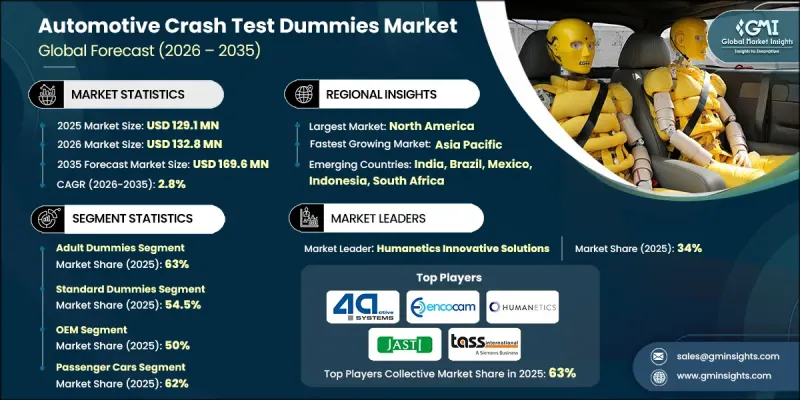
The Global Automotive Crash Test Dummies Market was valued at USD 129.1 million in 2025 and is estimated to grow at a CAGR of 2.8% to reach USD 169.6 million by 2035.
Growth in the automotive crash test dummies market is closely linked to the continued expansion of global vehicle manufacturing, which increases the need for safety validation and compliance testing across new vehicle models. As automakers introduce updated vehicle designs and integrate new safety technologies, the requirement for detailed crash simulations and safety performance assessments continues to rise. Regulatory bodies across several regions have also strengthened vehicle safety standards, encouraging manufacturers to perform extensive crash testing to ensure compliance with evolving guidelines. The increasing emphasis on occupant protection and vehicle safety innovation is reinforcing the importance of crash test dummies in automotive research and development programs. In addition, improvements in biomechanical modeling and measurement capabilities are enabling engineers to capture more accurate data related to human injury risk during crash scenarios. These developments continue to support the long-term demand for advanced crash testing tools, positioning the automotive crash test dummies market as a critical component within the broader automotive safety ecosystem.
| Market Scope | |
|---|---|
| Start Year | 2025 |
| Forecast Year | 2026-2035 |
| Start Value | $129.1 Million |
| Forecast Value | $169.6 Million |
| CAGR | 2.8% |
The automotive industry has placed greater attention on improving protection for occupants with varying physical characteristics, which has increased demand for specialized crash test dummies designed to represent different body structures. Modern dummy systems are becoming significantly more advanced, offering improved bio-fidelity that enables engineers to collect highly precise data regarding potential injuries during simulated collisions. The integration of enhanced sensor technologies has allowed crash test dummies to record a wider range of measurements related to force, motion, and impact response during testing procedures. As crash simulations become more complex, these advanced dummies help engineers better understand vehicle safety performance and refine safety designs accordingly.
The adult crash test dummies segment held 63% share and is expected to grow at a CAGR of 1.6% between 2026 and 2035. Adult dummies are widely used in vehicle crash simulations to evaluate occupant safety across multiple collision scenarios involving the front, side, and rear of a vehicle. These dummies are designed to replicate the physical characteristics of typical adult body structures and are equipped with measurement systems that track potential injuries across several critical areas of the body. Data collected from these simulations plays an essential role in establishing global vehicle safety benchmarks and guiding the development of improved safety systems. Because adult body structures represent a significant portion of real-world vehicle occupants, these dummies remain fundamental to automotive safety testing programs worldwide.
The standard dummies segment accounted for 54.5% share in 2025 and is anticipated to grow at a CAGR of 1.7% from 2026 to 2035. Standard crash test dummies are designed as general-purpose models used primarily in regulatory compliance testing and baseline vehicle safety evaluations. These models typically feature simplified mechanical structures that replicate human body movement during collision events. Although they incorporate limited electronic instrumentation compared to advanced models, they continue to play a crucial role in many testing programs due to their accessibility and cost efficiency. Automotive manufacturers frequently utilize standard dummies for routine safety validation procedures and laboratory testing activities where extremely detailed data collection is not required.
United States Automotive Crash Test Dummies Market reached USD 38.7 million in 2025, supported by strict vehicle safety regulations and ongoing advancements in automotive testing standards. Federal safety guidelines require manufacturers to conduct comprehensive crash evaluations as part of vehicle certification processes, which continues to drive demand for standardized crash test equipment. Automotive manufacturers and independent testing organizations in the United States regularly perform detailed crash simulations to ensure that vehicles meet established safety benchmarks. As safety evaluation programs evolve and testing protocols become more sophisticated, research laboratories are gradually upgrading their facilities to accommodate newer crash test dummy technologies.
Key companies operating in the Global Automotive Crash Test Dummies Market include Humanetics Innovative Solutions, Kistler, Cellbond (Encocam), MGA Research, Dynamic Research, CTS, 4activeSystems, JASTI, and TASS (Siemens). Companies active in the Global Automotive Crash Test Dummies Market are focusing on multiple strategic initiatives to strengthen their competitive position and expand their technological capabilities. Significant investments are being directed toward research and development to improve dummy biofidelity and enhance the accuracy of injury measurement systems. Manufacturers are also incorporating advanced sensor technologies and data acquisition systems to provide more detailed insights into crash dynamics. Strategic collaborations with automotive manufacturers, safety laboratories, and regulatory institutions are helping companies develop testing solutions aligned with evolving safety standards. Expanding product portfolios to include next-generation dummy platforms designed for complex crash simulations is another key strategy.
Table of Contents
Chapter 1 Methodology
- 1.1 Research approach
- 1.2 Quality commitments
- 1.3 GMI AI policy & data integrity commitment
- 1.4 Research trail & confidence scoring
- 1.4.1 Research trail components
- 1.4.2 Scoring components
- 1.5 Data collection
- 1.5.1 Partial list of primary sources
- 1.6 Data mining sources
- 1.6.1 Paid sources
- 1.7 Base estimates and calculations
- 1.7.1 Base year calculation
- 1.8 Forecast model
- 1.9 Research transparency addendum
Chapter 2 Executive Summary
- 2.1 Industry 360° synopsis
- 2.2 Key market trends
- 2.2.1 Regional
- 2.2.2 Dummy
- 2.2.3 Technology
- 2.2.4 Vehicle
- 2.2.5 End use
- 2.3 TAM analysis, 2026-2035
- 2.4 CXO perspectives: Strategic imperatives
Chapter 3 Industry Insights
- 3.1 Industry ecosystem analysis
- 3.1.1 Supplier landscape
- 3.1.2 Profit margin
- 3.1.3 Cost structure
- 3.1.4 Value addition at each stage
- 3.1.5 Factor affecting the value chain
- 3.1.6 Disruptions
- 3.2 Industry impact forces
- 3.2.1 Growth drivers
- 3.2.1.1 Stringent vehicle safety regulations
- 3.2.1.2 Rising vehicle production globally
- 3.2.1.3 Increasing focus on child & pedestrian safety
- 3.2.1.4 Growing adoption of advanced dummies
- 3.2.2 Industry pitfalls and challenges
- 3.2.2.1 High cost of advanced crash test dummies
- 3.2.2.2 Long replacement & calibration cycles
- 3.2.3 Market opportunities
- 3.2.3.1 Emerging market safety regulation expansion
- 3.2.3.2 Development of female and elderly representative dummies
- 3.2.3.3 Growth in electric & autonomous vehicle testing
- 3.2.3.4 Advancements in smart data acquisition systems
- 3.2.1 Growth drivers
- 3.3 Growth potential analysis
- 3.4 Regulatory landscape
- 3.4.1 North America
- 3.4.1.1 National Highway Traffic Safety Administration (NHTSA)
- 3.4.1.2 Insurance Institute for Highway Safety (IIHS)
- 3.4.2 Europe
- 3.4.2.1 Euro NCAP (European New Car Assessment Programme)
- 3.4.2.2 UNECE Regulations (R94, R95, R129)
- 3.4.3 Asia Pacific
- 3.4.3.1 Japan Automobile Research Institute (JARI) / JIS Standards
- 3.4.3.2 China Automotive Technology & Research Center (CATARC) / Chinese NCAP (C-NCAP)
- 3.4.4 Latin America
- 3.4.4.1 Latin NCAP
- 3.4.4.2 ABNT NBR / National Automotive Safety Guidelines
- 3.4.5 Middle East & Africa
- 3.4.5.1 ESMA Vehicle Safety Standards (UAE)
- 3.4.5.2 SABS Automotive Safety Standards (South Africa)
- 3.4.1 North America
- 3.5 Porter's analysis
- 3.6 PESTEL analysis
- 3.7 Technology and innovation landscape
- 3.7.1 Current technological trends
- 3.7.2 Emerging technologies
- 3.8 Pricing analysis (Driven by primary research)
- 3.8.1 Historical price trend analysis
- 3.8.2 Pricing strategy by player type (premium / value / cost-plus)
- 3.9 Cost breakdown analysis
- 3.10 Patent analysis (Driven by primary research)
- 3.11 Sustainability and environmental aspects
- 3.11.1 Sustainable practices
- 3.11.2 Waste reduction strategies
- 3.11.3 Energy efficiency in production
- 3.11.4 Eco-friendly initiatives
- 3.11.5 Carbon footprint considerations
- 3.12 Impact of AI & Generative AI on the Market
- 3.12.1 AI-driven disruption of existing business models
- 3.12.2 Gen AI use cases & adoption roadmap by segment
- 3.12.3 Risks, limitations & regulatory considerations
- 3.13 Capacity & production landscape (Driven by primary research)
- 3.13.1 Installed capacity by region & key producer
- 3.13.2 Capacity utilization rates & expansion pipelines
- 3.14 Trade data analysis (Driven by paid database)
- 3.14.1 Import/export volume & value trends
- 3.14.2 Key trade corridors & tariff impact
- 3.15 Forecast assumptions & scenario analysis (Driven by primary research)
- 3.15.1 Base Case - key macro & industry variables driving CAGR
- 3.15.2 Optimistic Scenarios - Favorable macro and industry tailwinds
- 3.15.3 Pessimistic Scenario - Macroeconomic slowdown or industry headwinds
Chapter 4 Competitive Landscape, 2025
- 4.1 Introduction
- 4.2 Company market share analysis
- 4.2.1 North America
- 4.2.2 Europe
- 4.2.3 Asia Pacific
- 4.2.4 LATAM
- 4.2.5 MEA
- 4.3 Competitive analysis of major market players
- 4.4 Competitive positioning matrix
- 4.5 Key developments
- 4.5.1 Mergers & acquisitions
- 4.5.2 Partnerships & collaborations
- 4.5.3 New product launches
- 4.5.4 Expansion plans and funding
- 4.6 Company tier benchmarking
- 4.6.1 Tier classification criteria & qualifying thresholds
- 4.6.2 Tier positioning matrix by revenue, geography & innovation
Chapter 5 Market Estimates & Forecast, By Dummy, 2022 - 2035 ($Mn, Units)
- 5.1 Key trends
- 5.2 Adult dummies
- 5.2.1 Male adult dummies
- 5.2.2 Female adult dummies
- 5.3 Child dummies
- 5.3.1 0-year-old child dummies
- 5.3.2 6-year-old child dummies
- 5.3.3 3-year-old child dummies
- 5.4 Infant dummies
- 5.4.1 8-month infant dummies
- 5.4.2 2-month infant dummies
- 5.4.3 newborn dummies
Chapter 6 Market Estimates & Forecast, By Technology, 2022 - 2035 ($Mn, Units)
- 6.1 Key trends
- 6.2 Standard dummies
- 6.3 Advanced / sensor-equipped dummies
- 6.4 Hybrid dummies
Chapter 7 Market Estimates & Forecast, By Vehicle, 2022 - 2035 ($Mn)
- 7.1 Key trends
- 7.2 Passenger car
- 7.2.1 Hatchback
- 7.2.2 Sedan
- 7.2.3 SUV
- 7.3 Commercial vehicle
- 7.3.1 LCV
- 7.3.2 MCV
- 7.3.3 HCV
Chapter 8 Market Estimates & Forecast, By End use, 2022 - 2035 ($Mn, Units)
- 8.1 Key trends
- 8.2 Original Equipment Manufacturers (OEMs)
- 8.3 Automotive suppliers & testing labs
- 8.4 Government / regulatory bodies
- 8.5 Independent safety organizations / research institutions
Chapter 9 Market Estimates & Forecast, By Region, 2022 - 2035 ($Mn, Units)
- 9.1 Key trends
- 9.2 North America
- 9.2.1 US
- 9.2.2 Canada
- 9.3 Europe
- 9.3.1 Germany
- 9.3.2 UK
- 9.3.3 France
- 9.3.4 Italy
- 9.3.5 Spain
- 9.3.6 Nordics
- 9.3.7 Russia
- 9.3.8 Poland
- 9.3.9 Romania
- 9.4 Asia Pacific
- 9.4.1 China
- 9.4.2 India
- 9.4.3 Japan
- 9.4.4 South Korea
- 9.4.5 ANZ
- 9.4.6 Vietnam
- 9.4.7 Indonesia
- 9.4.8 Philippines
- 9.5 Latin America
- 9.5.1 Brazil
- 9.5.2 Mexico
- 9.5.3 Argentina
- 9.6 MEA
- 9.6.1 South Africa
- 9.6.2 Saudi Arabia
- 9.6.3 UAE
Chapter 10 Company Profiles
- 10.1 Global companies
- 10.1.1 4activeSystems
- 10.1.2 Autoliv
- 10.1.3 Cellbond
- 10.1.4 CTS
- 10.1.5 HORIBA MIRA
- 10.1.6 Humanetics Innovative Solutions
- 10.1.7 JASTI
- 10.1.8 Kistler
- 10.1.9 MGA Research
- 10.1.10 TASS International
- 10.2 Regional players
- 10.2.1 Calspan
- 10.2.2 Crashtest-Service.com
- 10.2.3 DEKRA
- 10.2.4 Denton
- 10.2.5 Diversified Technical Systems (DTS)
- 10.2.6 Dynamic Research
- 10.2.7 Transportation Research Center (TRC)
- 10.3 Emerging players
- 10.3.1 AB Dynamics
- 10.3.2 FUTEK Advanced Sensor Technology
- 10.3.3 Hunan Safe Automobile Technology


