


 |
市場調查報告書
商品編碼
1998823
消防飛機市場機會、成長要素、產業趨勢分析及2026-2035年預測。Firefighting Aircraft Market Opportunity, Growth Drivers, Industry Trend Analysis, and Forecast 2026 - 2035 |
||||||

全球消防飛機市場預計到 2025 年將價值 13 億美元,預計到 2035 年將以 5.3% 的複合年成長率成長至 22 億美元。
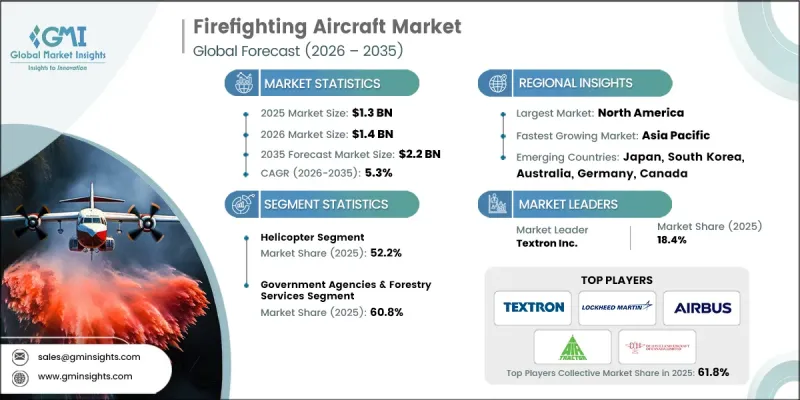
消防飛機市場的成長主要受易發嚴重野火地區對快速反應空中滅火能力的需求不斷成長所驅動。各國政府和緊急管理部門正在擴大空中滅火資源,以加強災害應變策略並減輕大規模火災造成的損失。此外,隨著老舊飛機逐漸接近使用壽命終點,空中滅火機隊的現代化已成為一項至關重要的優先事項。許多國家正在加大對能夠搭載更多消防人員並在複雜火災環境中作業的先進飛機平台的投資。此外,先進監控技術、任務協調工具和空中指揮系統的整合正在提高消防行動的效率和反應速度。這些技術進步使消防機構能夠更有效地監控火災並更精準地部署空中資源。所有這些因素共同推動了全球消防飛機市場的長期成長。
| 市場範圍 | |
|---|---|
| 開始年份 | 2025 |
| 預測期 | 2026-2035 |
| 上市時的市場規模 | 13億美元 |
| 預測金額 | 22億美元 |
| 複合年成長率 | 5.3% |
隨著全球多個地區野火發生頻率和規模的不斷擴大,消防飛機市場持續成長。火災強度的增加加重了消防機構的行動負擔,因此,對空中滅火能力的依賴性日益增強,以便迅速控制大規模火災。同時,許多現有的消防飛機機隊正在老化,迫使各國政府和營運商投資進行升級改造和現代化平台建設。隨著老舊飛機接近使用壽命終點,各機構正致力於引進新型飛機,以提高有效載荷能力、加強安全系統並提升作戰效率。此外,野火季的延長也增加了飛機的運轉率,而高峰響應時期對飛機運轉率的需求尤其迫切。
到2025年,直升機市場將佔據52.2%的佔有率。由於直升機即使在複雜環境下也能執行高度靈活的任務,因此在空中滅火行動中仍被廣泛應用。在其他空中平台因地形限制而無法有效作業的地區,直升機尤其重要。其機動性使其能夠在狹小空間內作業,並能高精度地向目標投放水和滅火劑。此外,直升機可以快速獲取附近的水源,從而在滅火任務中多次補給和重新部署。憑藉其作戰的多功能性和快速部署能力,直升機在許多火災頻繁地區的野火控制策略中繼續發揮核心作用。
預計2026年至2035年間,5000至10000升級飛機市場將以6.2%的複合年成長率成長,這反映出市場對中等容量空中消防平台的需求日益成長。在此負載容量範圍內的飛機在運作效率和任務柔軟性之間實現了良好的平衡。這些平台能夠投放大量滅火劑,同時維持從各種機場起飛的作戰能力。其多功能性使其能夠支援各種消防行動,例如應對局部野火和協同空中滅火任務。此外,與大型消防飛機相比,中型消防飛機的部署和運營成本通常更低,因此對於希望在不大幅增加資本支出的情況下擴大空中消防機隊規模的國家而言,它們是一個極具吸引力的選擇。
到2025年,北美消防飛機市佔率將達到33.8%。由於野火頻傳以及對高效能空中滅火能力的需求不斷成長,該地區市場持續擴張。北美地區的消防管理機構正投資先進的空中滅火資源,以增強其快速反應能力並減輕大規模火災的影響。政府機構和航空服務供應商也在擴大多年期飛機租賃合約和資源共用合作協議,以確保在火災高峰期擁有充足的消防能力。同時,對先進航空電子系統、改進的滅火劑應用技術以及即時任務協調平台的投資,也有助於提高北美各地營運商的營運效率和飛機運轉率。
目錄
第1章:調查方法和範圍
第2章執行摘要
第3章業界考察
- 生態系分析
- 供應商情況
- 利潤率
- 成本結構
- 每個階段增加的價值
- 影響價值鏈的因素
- 中斷
- 影響產業的因素
- 促進因素
- 北美和澳洲大規模野火發生頻率增加
- 世界各國老化的空中消防機隊亟需更新換代。
- 政府增加對撲滅野火的撥款
- 森林與城市邊界區域的擴大
- 氣候變遷正在延長全球火災季節。
- 產業潛在風險與挑戰
- 高昂的初始成本和生命週期維護成本
- 專用飛機生產能力的限制
- 市場機遇
- 下一代兩棲和水上飛機的研發
- 渦輪螺旋槳飛機改裝平台改裝計劃
- 促進因素
- 成長潛力分析
- 監理情勢
- 波特五力分析
- PESTEL 分析
- 科技與創新趨勢
- 當前技術趨勢
- 新興技術
- 價格趨勢
- 按地區
- 依產品
- 定價策略
- 新興經營模式
- 合規要求
- 專利和智慧財產權分析
第4章 競爭情勢
- 介紹
- 企業市佔率分析
- 按地區
- 市場集中度分析
- 主要企業的競爭標竿分析
- 財務績效比較
- 銷售量
- 利潤率
- 研究與發展(R&D)
- 產品系列比較
- 產品線寬度
- 科技
- 創新
- 區域擴張比較
- 全球擴張分析
- 服務網路覆蓋
- 按地區分類的市場滲透率
- 競爭定位矩陣
- 領導者
- 挑戰者
- 追蹤者
- 小眾玩家
- 戰略展望矩陣
- 財務績效比較
- 主要進展
- 併購
- 夥伴關係與合作
- 技術進步
- 業務拓展與投資策略
- 數位轉型計劃
- 新興/Start-Ups競爭對手的發展趨勢
第5章 市場估算與預測:依飛機類型分類,2022-2035年
- 直升機
- 1型
- 類型 2
- 3型
- 固定翼飛機
- 無人機
第6章 市場估算與預測:以水量計算,2022-2035年
- 不足5000升
- 5000至10000公升
- 超過10000公升
第7章 市場估計與預測:依最終用戶分類,2022-2035年
- 政府機構及林業部門
- 軍事商業
- 私人承包商
第8章 市場估計與預測:依地區分類,2022-2035年
- 北美洲
- 美國
- 加拿大
- 歐洲
- 德國
- 英國
- 法國
- 西班牙
- 義大利
- 荷蘭
- 亞太地區
- 中國
- 印度
- 日本
- 澳洲
- 韓國
- 拉丁美洲
- 巴西
- 墨西哥
- 阿根廷
- 中東和非洲
- 南非
- 沙烏地阿拉伯
- 阿拉伯聯合大公國
第9章:公司簡介
- 主要企業
- Airbus SE
- Lockheed Martin Corporation
- Textron Inc.
- Embraer SA
- United Aircraft Corporation
- 按地區分類的主要企業
- 北美洲
- Air Tractor, Inc.
- Erickson Incorporated
- Kaman Corporation
- Conair Group Inc.
- Coulson Aviation
- 亞太地區
- ShinMaywa Industries, Ltd.
- Russian Helicopters JSC
- 歐洲
- Saab AB
- De Havilland Aircraft of Canada Limited
- 北美洲
- 特殊玩家/干擾者
- Thrush Aircraft
The Global Firefighting Aircraft Market was valued at USD 1.3 billion in 2025 and is estimated to grow at a CAGR of 5.3% to reach USD 2.2 billion by 2035.
Growth in the firefighting aircraft market is supported by the increasing need for rapid-response aerial firefighting capabilities across regions that regularly experience severe wildfire activity. Governments and emergency management authorities are expanding aerial firefighting resources to strengthen disaster response strategies and reduce damage caused by large-scale fires. In addition, the modernization of aerial firefighting fleets is becoming a key priority as older aircraft gradually reach the end of their operational lifespan. Investment in advanced aircraft platforms capable of carrying larger suppressant loads and operating in complex fire environments is increasing across several countries. The integration of advanced surveillance technologies, mission coordination tools, and aerial command systems is also improving firefighting efficiency and response times. These technological improvements allow firefighting agencies to monitor fire behavior more effectively while deploying aerial resources with greater precision. Collectively, these factors are contributing to the long-term expansion of the global firefighting aircraft market.
| Market Scope | |
|---|---|
| Start Year | 2025 |
| Forecast Year | 2026-2035 |
| Start Value | $1.3 Billion |
| Forecast Value | $2.2 Billion |
| CAGR | 5.3% |
The firefighting aircraft market continues to gain momentum as wildfire events become more frequent and severe across several regions of the world. Rising fire intensity is placing greater operational pressure on firefighting agencies, which increasingly rely on aerial suppression capabilities to contain large fires quickly. At the same time, many existing firefighting aircraft fleets are aging, prompting governments and operators to invest in replacement programs and modernized platforms. As older aircraft approach retirement, agencies are focusing on acquiring newer models that offer improved payload capacity, enhanced safety systems, and greater operational efficiency. Additionally, wildfire seasons are extending in duration, which increases aircraft utilization rates and requires greater fleet availability during peak response periods.
The helicopter segment accounted for 52.2% share in 2025. Helicopters remain widely utilized in aerial firefighting operations due to their ability to perform highly flexible missions in complex environments. These aircraft are particularly valuable in areas where terrain conditions limit the effectiveness of other aerial platforms. Their maneuverability allows them to operate in confined spaces and deliver targeted water or retardant drops with high precision. Helicopters can also access nearby water sources quickly, allowing them to refill and redeploy multiple times during a firefighting mission. Because of their operational versatility and rapid deployment capability, helicopters continue to play a central role in wildfire suppression strategies across many regions affected by recurring fire activity.
The 5,000-10,000 liters segment is anticipated to grow at a CAGR of 6.2% during 2026-2035, reflecting increasing demand for mid-capacity aerial firefighting platforms. Aircraft within this payload range offer a balanced combination of operational efficiency and mission flexibility. These platforms can deliver substantial volumes of fire suppressant while maintaining the ability to operate from a broader range of airfields. Their versatility allows them to support various firefighting operations, including regional wildfire response and coordinated aerial suppression missions. In addition, mid-sized firefighting aircraft typically involve lower acquisition and operational costs compared with larger tanker aircraft, making them attractive options for countries seeking to expand their aerial firefighting fleets without significantly increasing capital expenditure.
North America Firefighting Aircraft Market accounted for 33.8% share in 2025. The market in this region continues to expand due to increasing wildfire activity and the growing need for effective aerial firefighting capabilities. Fire management agencies across the region are investing in advanced aerial suppression resources to strengthen rapid response capacity and reduce the impact of large-scale fires. Government organizations and aviation service providers are also expanding multi-year aircraft contracts and cooperative resource-sharing arrangements to ensure sufficient firefighting capacity during peak fire seasons. At the same time, investments in advanced avionics systems, improved retardant delivery technologies, and real-time mission coordination platforms are helping operators enhance operational performance and aircraft availability across North America.
Key companies operating in the Global Firefighting Aircraft Market include Airbus SE, Lockheed Martin Corporation, Textron Inc., Saab AB, Embraer S.A., United Aircraft Corporation, De Havilland Aircraft of Canada Limited, ShinMaywa Industries, Ltd., Air Tractor, Inc., Thrush Aircraft, Coulson Aviation, Conair Group Inc., Erickson Incorporated, Kaman Corporation, and Russian Helicopters JSC. Companies active in the Global Firefighting Aircraft Market are adopting several strategic initiatives to strengthen their competitive position and expand their operational capabilities. Many organizations are focusing on developing advanced aerial firefighting platforms with improved payload capacity, enhanced safety features, and greater operational efficiency. Investment in research and development is enabling manufacturers to integrate advanced avionics, mission management systems, and improved suppressant delivery technologies into modern aircraft designs. Strategic partnerships with government agencies and firefighting operators are also helping companies secure long-term contracts and strengthen their market presence. In addition, firms are expanding maintenance, repair, and support services to ensure reliable aircraft performance during demanding firefighting missions.
Table of Contents
Chapter 1 Methodology and Scope
- 1.1 Market scope and definition
- 1.2 Research design
- 1.2.1 Research approach
- 1.2.2 Data collection methods
- 1.3 Data mining sources
- 1.3.1 Global
- 1.3.2 Regional/Country
- 1.4 Base estimates and calculations
- 1.4.1 Base year calculation
- 1.4.2 Key trends for market estimation
- 1.5 Primary research and validation
- 1.5.1 Primary sources
- 1.6 Forecast model
- 1.7 Research assumptions and limitations
Chapter 2 Executive Summary
- 2.1 Industry 360° synopsis, 2022 - 2035
- 2.2 Key market trends
- 2.2.1 Aircraft trends
- 2.2.2 Water capacity trends
- 2.2.3 End-user trends
- 2.2.4 Regional trends
- 2.3 TAM Analysis, 2026-2035
- 2.4 CXO perspectives: Strategic imperatives
Chapter 3 Industry Insights
- 3.1 Industry ecosystem analysis
- 3.1.1 Supplier Landscape
- 3.1.2 Profit Margin
- 3.1.3 Cost structure
- 3.1.4 Value addition at each stage
- 3.1.5 Factor affecting the value chain
- 3.1.6 Disruptions
- 3.2 Industry impact forces
- 3.2.1 Growth drivers
- 3.2.1.1 Rising megafire frequency in North America and Australia
- 3.2.1.2 Aging global aerial firefighting fleets requiring replacement
- 3.2.1.3 Government funding increases for wildfire suppression
- 3.2.1.4 Expansion of wildland urban interface zones
- 3.2.1.5 Climate-driven longer fire seasons globally
- 3.2.2 Industry pitfalls and challenges
- 3.2.2.1 High acquisition and lifecycle maintenance costs
- 3.2.2.2 Limited production capacity for specialized aircraft
- 3.2.3 Market opportunities
- 3.2.3.1 Next-generation amphibious and scooper aircraft development
- 3.2.3.2 Retrofit programs for turboprop conversion platforms
- 3.2.1 Growth drivers
- 3.3 Growth potential analysis
- 3.4 Regulatory landscape
- 3.4.1 North America
- 3.4.2 Europe
- 3.4.3 Asia Pacific
- 3.4.4 Latin America
- 3.4.5 Middle East & Africa
- 3.5 Porter's analysis
- 3.6 PESTEL analysis
- 3.7 Technology and Innovation landscape
- 3.7.1 Current technological trends
- 3.7.2 Emerging technologies
- 3.8 Price trends
- 3.8.1 By region
- 3.8.2 By product
- 3.9 Pricing Strategies
- 3.10 Emerging Business Models
- 3.11 Compliance Requirements
- 3.12 Patent and IP analysis
Chapter 4 Competitive Landscape, 2025
- 4.1 Introduction
- 4.2 Company market share analysis
- 4.2.1 By region
- 4.2.1.1 North America
- 4.2.1.2 Europe
- 4.2.1.3 Asia Pacific
- 4.2.1.4 Latin America
- 4.2.1.5 Middle East & Africa
- 4.2.2 Market concentration analysis
- 4.2.1 By region
- 4.3 Competitive benchmarking of key players
- 4.3.1 Financial performance comparison
- 4.3.1.1 Revenue
- 4.3.1.2 Profit margin
- 4.3.1.3 R&D
- 4.3.2 Product portfolio comparison
- 4.3.2.1 Product range breadth
- 4.3.2.2 Technology
- 4.3.2.3 Innovation
- 4.3.3 Geographic presence comparison
- 4.3.3.1 Global footprint analysis
- 4.3.3.2 Service network coverage
- 4.3.3.3 Market penetration by region
- 4.3.4 Competitive positioning matrix
- 4.3.4.1 Leaders
- 4.3.4.2 Challengers
- 4.3.4.3 Followers
- 4.3.4.4 Niche players
- 4.3.5 Strategic outlook matrix
- 4.3.1 Financial performance comparison
- 4.4 Key developments
- 4.4.1 Mergers and acquisitions
- 4.4.2 Partnerships and collaborations
- 4.4.3 Technological advancements
- 4.4.4 Expansion and investment strategies
- 4.4.5 Digital transformation initiatives
- 4.5 Emerging/ startup competitors landscape
Chapter 5 Market Estimates and Forecast, By Aircraft, 2022 - 2035 (USD Million)
- 5.1 Key trends
- 5.2 Helicopter
- 5.2.1 Type 1
- 5.2.2 Type 2
- 5.2.3 Type 3
- 5.3 Fixed wing aircraft
- 5.4 Unmanned aerial vehicles
Chapter 6 Market Estimates and Forecast, By Water Capacity, 2022 - 2035 (USD Million)
- 6.1 Key trends
- 6.2 Less than 5,000 liters
- 6.3 5,000-10,000 liters
- 6.4 More than 10,000 liters
Chapter 7 Market Estimates and Forecast, By End-user, 2022 - 2035 (USD Million)
- 7.1 Key trends
- 7.2 Government agencies & forestry services
- 7.3 Military operators
- 7.4 Private contractors
Chapter 8 Market Estimates and Forecast, By Region, 2022 - 2035 (USD Million)
- 8.1 Key trends
- 8.2 North America
- 8.2.1 U.S.
- 8.2.2 Canada
- 8.3 Europe
- 8.3.1 Germany
- 8.3.2 UK
- 8.3.3 France
- 8.3.4 Spain
- 8.3.5 Italy
- 8.3.6 Netherlands
- 8.4 Asia Pacific
- 8.4.1 China
- 8.4.2 India
- 8.4.3 Japan
- 8.4.4 Australia
- 8.4.5 South Korea
- 8.5 Latin America
- 8.5.1 Brazil
- 8.5.2 Mexico
- 8.5.3 Argentina
- 8.6 Middle East and Africa
- 8.6.1 South Africa
- 8.6.2 Saudi Arabia
- 8.6.3 UAE
Chapter 9 Company Profiles
- 9.1 Global Key Players
- 9.1.1 Airbus SE
- 9.1.2 Lockheed Martin Corporation
- 9.1.3 Textron Inc.
- 9.1.4 Embraer S.A.
- 9.1.5 United Aircraft Corporation
- 9.2 Regional key players
- 9.2.1 North America
- 9.2.1.1 Air Tractor, Inc.
- 9.2.1.2 Erickson Incorporated
- 9.2.1.3 Kaman Corporation
- 9.2.1.4 Conair Group Inc.
- 9.2.1.5 Coulson Aviation
- 9.2.2 Asia Pacific
- 9.2.2.1 ShinMaywa Industries, Ltd.
- 9.2.2.2 Russian Helicopters JSC
- 9.2.3 Europe
- 9.2.3.1 Saab AB
- 9.2.3.2 De Havilland Aircraft of Canada Limited
- 9.2.1 North America
- 9.3 Niche Players/Disruptors
- 9.3.1 Thrush Aircraft

 自主消防無人機市場分析及預測(至2035年):類型、產品、服務、技術、組件、應用、部署、最終用戶、功能、解決方案
 消防無人機市場規模、佔有率和成長分析:按類型、應用、負載容量、最終用戶和地區分類-2026-2033年產業預測
 2026年全球消防飛機市場報告
 消防飛機市場:按類型、飛機類型、水箱容量、零件、應用和最終用戶分類-2026-2032年全球市場預測
 全球消防無人機市場規模、佔有率、趨勢和成長分析報告(2026-2034年)2026年全球消防無人機市場報告
 消防飛機市場-全球產業規模、佔有率、趨勢、機會、預測:按飛機類型、應用類型、最大起飛重量類型、地區和競爭格局分類,2021-2031年
 消防飛機市場規模、佔有率和趨勢分析報告:按飛機類型、航程、最大起飛重量、地區和細分市場預測(2025-2033 年)消防無人機市場規模、佔有率和趨勢分析報告:按類型、規模、有效載荷容量、應用、最終用途、地區和細分市場預測,2025-2033 年